display KIA OPTIMA PHEV 2018 Workshop Manual
[x] Cancel search | Manufacturer: KIA, Model Year: 2018, Model line: OPTIMA PHEV, Model: KIA OPTIMA PHEV 2018Pages: 547, PDF Size: 11.56 MB
Page 355 of 547
675
Driving your vehicle
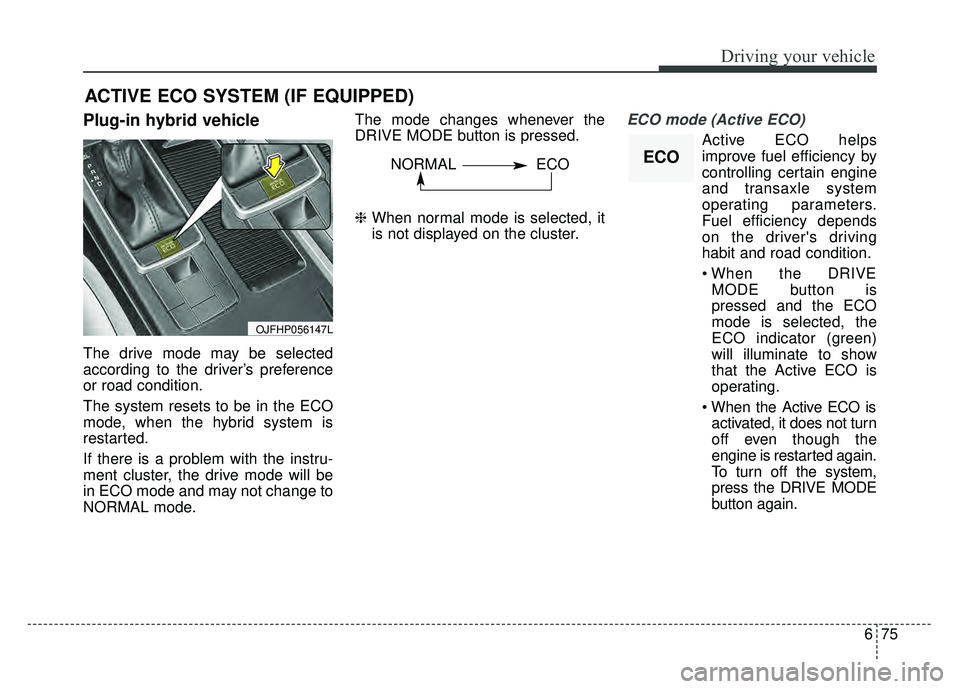
Plug-in hybrid vehicle
The drive mode may be selected
according to the driver’s preference
or road condition.
The system resets to be in the ECO
mode, when the hybrid system is
restarted.
If there is a problem with the instru-
ment cluster, the drive mode will be
in ECO mode and may not change to
NORMAL mode.The mode changes whenever the
DRIVE MODE button is pressed.
\b
When normal mode is selected, it
is not displayed on the cluster.
ECO mode (Active ECO)
Active ECO helps
improve fuel efficiency by
controlling certain engine
and transaxle system
operating parameters.
Fuel efficiency depends
on the driver's driving
habit and road condition.
MODE button is
pressed and the ECO
mode is selected, the
ECO indicator (green)
will illuminate to show
that the Active ECO is
operating.
activated, it does not turn
off even though the
engine is restarted again.
To turn off the system,
press the DRIVE MODE
button again.
ACTIVE ECO SYSTEM (IF EQUIPPED)
OJFHP056147L
ECONORMAL ECO
Page 359 of 547
679
Driving your vehicle
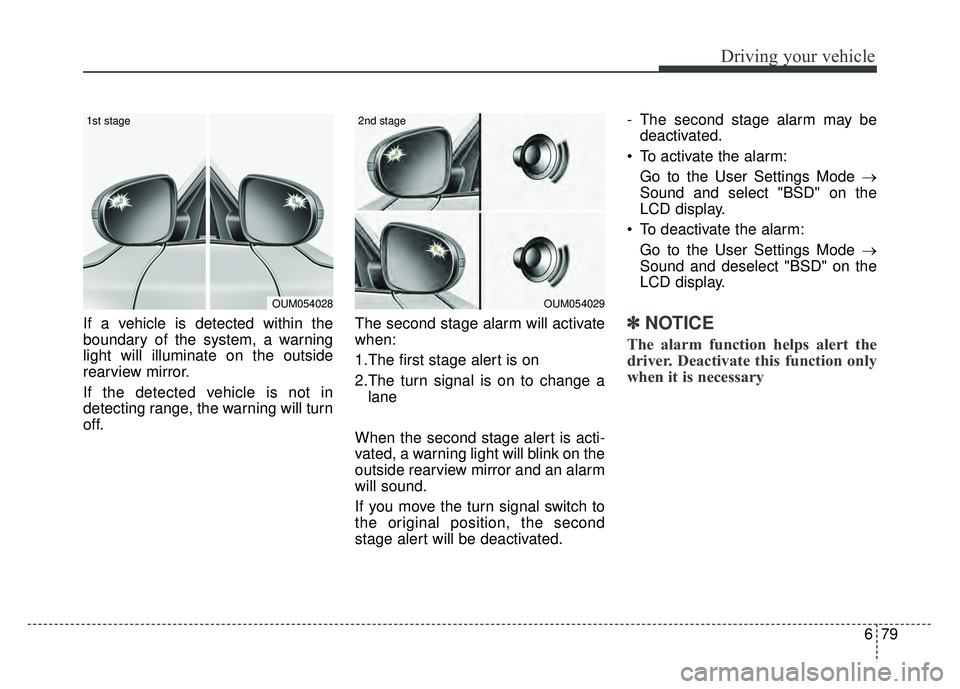
If a vehicle is detected within the
boundary of the system, a warning
light will illuminate on the outside
rearview mirror.
If the detected vehicle is not in
detecting range, the warning will turn
off.The second stage alarm will activate
when:
1.The first stage alert is on
2.The turn signal is on to change a
lane
When the second stage alert is acti-
vated, a warning light will blink on the
outside rearview mirror and an alarm
will sound.
If you move the turn signal switch to
the original position, the second
stage alert will be deactivated. - The second stage alarm may be
deactivated.
To activate the alarm: Go to the User Settings Mode →
Sound and select "BSD" on the
LCD display.
To deactivate the alarm: Go to the User Settings Mode →
Sound and deselect "BSD" on the
LCD display.✽ ✽
NOTICE
The alarm function helps alert the
driver. Deactivate this function only
when it is necessary
OUM054029
2nd stage
OUM054028
1st stage
Page 366 of 547
Driving your vehicle
86
6
Do not turn the steering wheel sud-
denly, when the LDWS warns you
that your vehicle is leaving the
lane.
To operate the LDWS, press the but-
ton with the engine start/stop button in
the ON position. The indicator illumi-
nates white on the cluster. To cancel
the LDWS, press LDWS button again.
The indicator on the cluster will go
off.
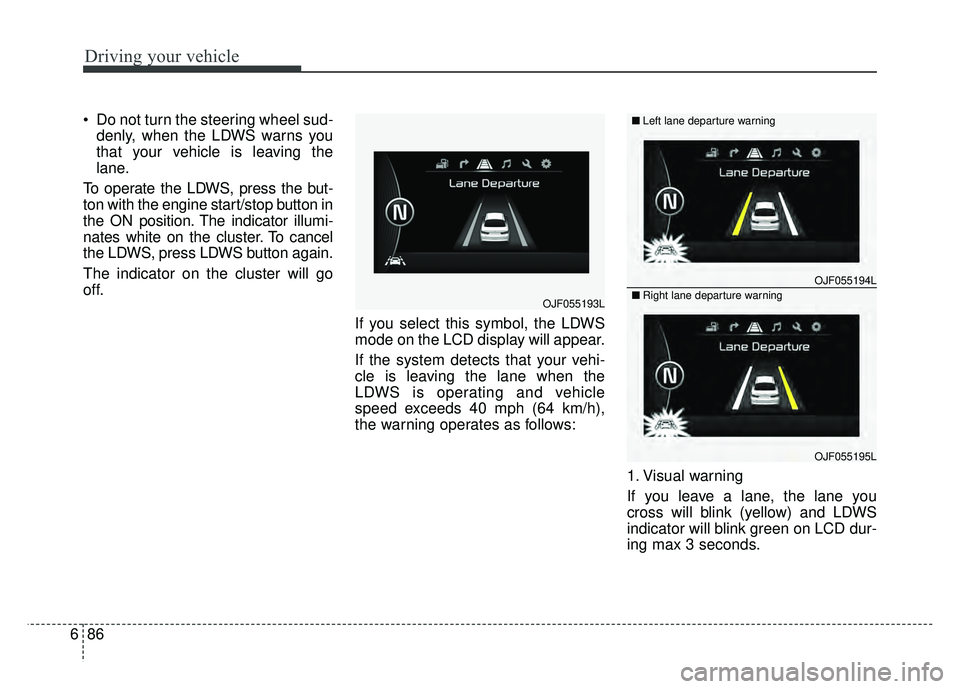
If you select this symbol, the LDWS
mode on the LCD display will appear.
If the system detects that your vehi-
cle is leaving the lane when the
LDWS is operating and vehicle
speed exceeds 40 mph (64 km/h),
the warning operates as follows:
1. Visual warning
If you leave a lane, the lane you
cross will blink (yellow) and LDWS
indicator will blink green on LCD dur-
ing max 3 seconds.
OJF055193L
OJF055194L
OJF055195L
■Left lane departure warning
■Right lane departure warning
Page 392 of 547

79
What to do in an emergency
TIRE PRESSURE MONITORING SYSTEM (TPMS)
(1) Low tire pressure telltale / TPMS malfunction indicator
(2) Low tire pressure position telltale (Shown on the LCD display)
Check tire pressure
You can check the tire pressure inthe information mode on the clus-
ter.
- Refer to “User settings mode” inchapter 4.
Tire pressure is displayed 1~2 min- utes later after driving.
If tire pressure is not displayed when the vehicle is stopped, “Drive
to display” message displays. After
driving, check the tire pressure.
You can change the tire pressure unit in the user settings mode on
the cluster.
- psi, kpa, bar (Refer to “User set-tings mode” in chapter 4).
✽ ✽ NOTICE
• The tire pressure may change due
to factors such as parking condi-
tion, driving style, and altitude
above sea level.
• Low tire pressure warning may sound when a tire’s pressure unit is
equal or higher than nearby tires.
This is a normal occurrence, which
is due to the change in tire pressure
along with tire temperature.
• The tire pressure shown on the dashboard may differ from the
tire pressure measured by tire
pressure gauge.
OJF065002
OJFHP047487L
Page 402 of 547
719
What to do in an emergency
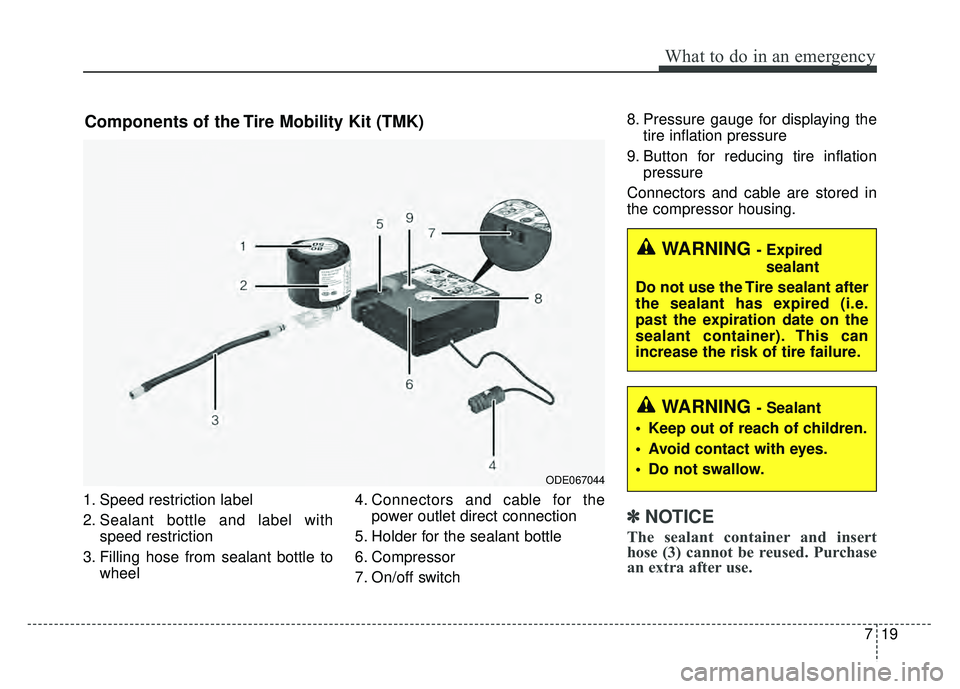
1. Speed restriction label
2. Sealant bottle and label withspeed restriction
3. Filling hose from sealant bottle to wheel 4. Connectors and cable for the
power outlet direct connection
5. Holder for the sealant bottle
6. Compressor
7. On/off switch 8. Pressure gauge for displaying the
tire inflation pressure
9. Button for reducing tire inflation pressure
Connectors and cable are stored in
the compressor housing.
✽ ✽ NOTICE
The sealant container and insert
hose (3) cannot be reused. Purchase
an extra after use.
ODE067044
Components of the Tire Mobility Kit (TMK)
WARNING - Sealant
• Keep out of reach of children.
Avoid contact with eyes.
Do not swallow.
WARNING - Expired sealant
Do not use the Tire sealant after
the sealant has expired (i.e.
past the expiration date on the
sealant container). This can
increase the risk of tire failure.
Page 464 of 547
Maintenance
52
8
3. Checking tire life (TIN : Tire
Identification Number)
Any tires that are over 6 years old,
based on the manufacturing date,
(including the spare tire) should be
replaced by new ones. You can find
the manufacturing date on the tire
sidewall (possibly on the inside of the
wheel), displaying the DOT Code.
The DOT Code is a series of num-
bers on a tire consisting of numbers
and English letters. The manufactur-
ing date is designated by the last four
digits (characters) of the DOT code.
DOT : XXXX XXXX OOOO
The front part of the DOT means a
plant code number, tire size and
tread pattern and the last four num-
bers indicate week and year manu-
factured.
For example:
DOT XXXX XXXX 1617 represents
that the tire was produced in the 16th
week of 2017.
4. Tire ply composition and mate-rial
The number of layers or plies of rub-
ber-coated fabric in the tire. Tire
manufacturers also must indicate the
materials in the tire, which include
steel, nylon, polyester, and others.
The letter "R" means radial ply con-
struction; the letter "D" means diago-
nal or bias ply construction; and the
letter "B" means belted-bias ply con-
struction.
5. Maximum permissible inflationpressure
This number is the greatest amount of
air pressure that should be put in the
tire. Do not exceed the maximum per-
missible inflation pressure. Refer to
the Tire and Loading Information label
for recommended inflation pressure.
6. Maximum load rating
This number indicates the maximum
load in kilograms and pounds that can
be carried by the tire. When replacing
the tires on the vehicle, always use a
tire that has the same load rating as
the factory installed tire.
7. Uniform tire quality grading
Quality grades can be found where
applicable on the tire sidewall
between tread shoulder and maxi-
mum section width.
For example:
TREADWEAR 440
TRACTION A
TEMPERATURE A
WARNING - Tire age
Replace tires within the recom-
mended time frame. Failure to
replace tires as recommended
can result in sudden tire failure,
which could lead to a loss of
control and an accident.
Page 473 of 547
861
Maintenance
✽
✽NOTICE
• When replacing fuse, turn the
ignition “OFF” and turn off
switches of all electrical devices
then remove battery (-) terminal.
• The actual fuse/relay panel label may differ from equipped items.
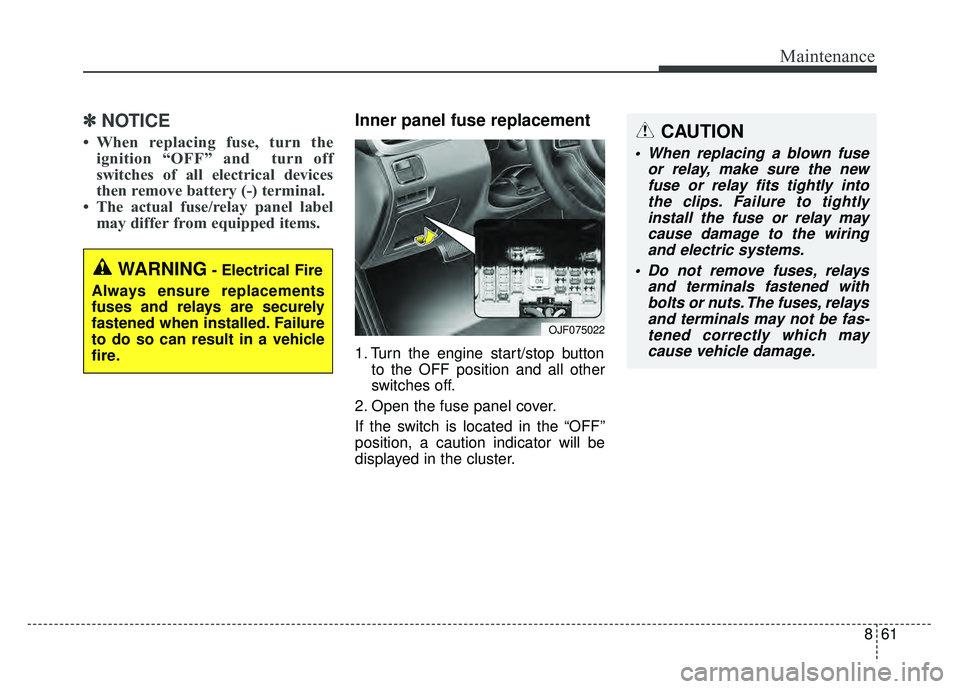
Inner panel fuse replacement
1. Turn the engine start/stop button
to the OFF position and all other
switches off.
2. Open the fuse panel cover.
If the switch is located in the “OFF”
position, a caution indicator will be
displayed in the cluster.
OJF075022
WARNING- Electrical Fire
Always ensure replacements
fuses and relays are securely
fastened when installed. Failure
to do so can result in a vehicle
fire.
CAUTION
When replacing a blown fuse or relay, make sure the newfuse or relay fits tightly intothe clips. Failure to tightlyinstall the fuse or relay maycause damage to the wiringand electric systems.
Do not remove fuses, relays and terminals fastened withbolts or nuts. The fuses, relaysand terminals may not be fas-tened correctly which maycause vehicle damage.
Page 475 of 547
863
Maintenance
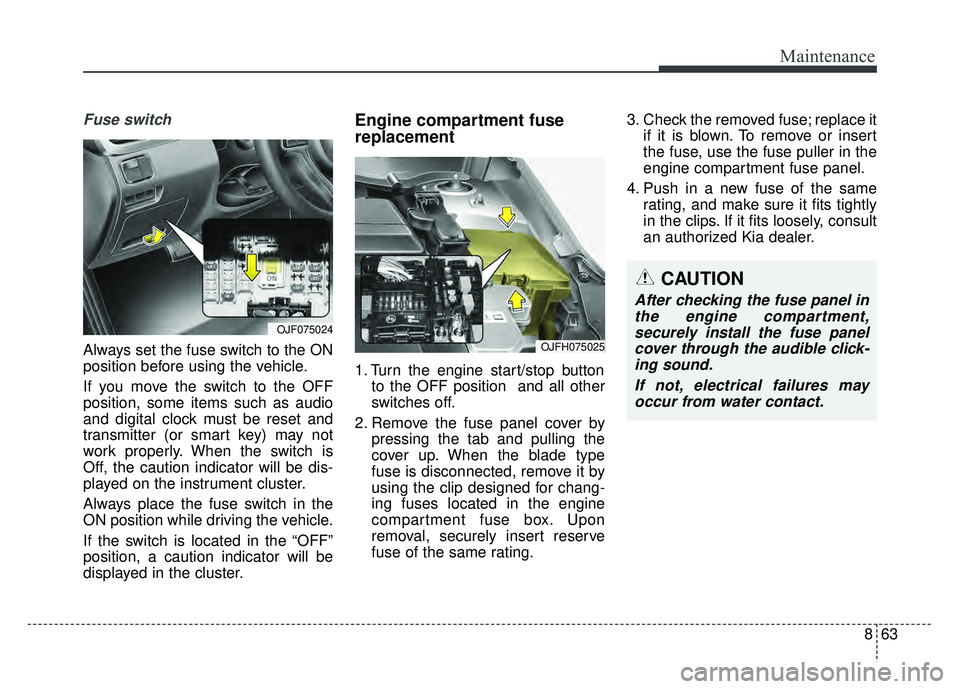
Fuse switch
Always set the fuse switch to the ON
position before using the vehicle.
If you move the switch to the OFF
position, some items such as audio
and digital clock must be reset and
transmitter (or smart key) may not
work properly. When the switch is
Off, the caution indicator will be dis-
played on the instrument cluster.
Always place the fuse switch in the
ON position while driving the vehicle.
If the switch is located in the “OFF”
position, a caution indicator will be
displayed in the cluster.
Engine compartment fuse
replacement
1. Turn the engine start/stop buttonto the OFF position and all other
switches off.
2. Remove the fuse panel cover by pressing the tab and pulling the
cover up. When the blade type
fuse is disconnected, remove it by
using the clip designed for chang-
ing fuses located in the engine
compartment fuse box. Upon
removal, securely insert reserve
fuse of the same rating. 3. Check the removed fuse; replace it
if it is blown. To remove or insert
the fuse, use the fuse puller in the
engine compartment fuse panel.
4. Push in a new fuse of the same rating, and make sure it fits tightly
in the clips. If it fits loosely, consult
an authorized Kia dealer.
OJF075024
CAUTION
After checking the fuse panel inthe engine compartment,securely install the fuse panelcover through the audible click-ing sound.
If not, electrical failures mayoccur from water contact.
OJFH075025
Page 524 of 547
97
Specifications, Consumer information, Reporting safety defects
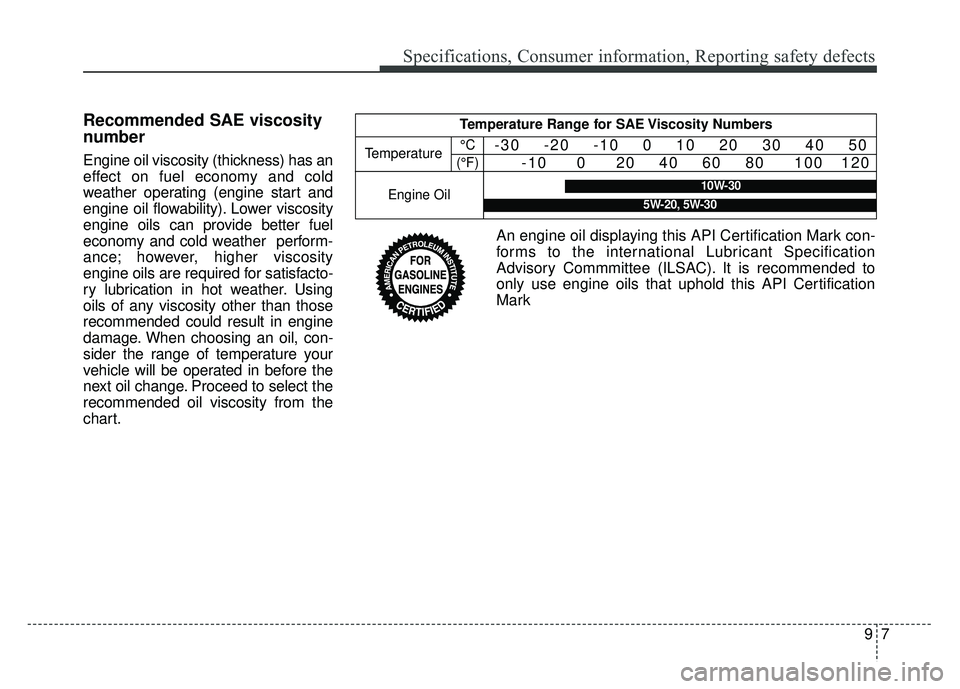
Recommended SAE viscosity
number
Engine oil viscosity (thickness) has an
effect on fuel economy and cold
weather operating (engine start and
engine oil flowability). Lower viscosity
engine oils can provide better fuel
economy and cold weather perform-
ance; however, higher viscosity
engine oils are required for satisfacto-
ry lubrication in hot weather. Using
oils of any viscosity other than those
recommended could result in engine
damage. When choosing an oil, con-
sider the range of temperature your
vehicle will be operated in before the
next oil change. Proceed to select the
recommended oil viscosity from the
chart.
Temperature Range for SAE Viscosity Numbers
Temperature°C
(°F)-30 -20 -10 0 10 20 30 40 50 -10 0 20 40 60 80 100 120
Engine Oil10W-30
5W-20, 5W-30
An engine oil displaying this API Certification Mark con-
forms to the international Lubricant Specification
Advisory Commmittee (ILSAC). It is recommended to
only use engine oils that uphold this API Certification
Mark
Page 537 of 547
I5
Index
Display illumination, see instrument panelillumination . . . . . . . . . . . . . . . . . . . . . . . . . . . . . . . 4-52
Displays, see instrument cluster . . . . . . . . . . . . . . . . . . 4-51
Door locks. . . . . . . . . . . . . . . . . . . . . . . . . . . . . . . . . . . 4-\
13 from outside the vehicle . . . . . . . . . . . . . . . . . . . . . . 4-13
from inside the vehicle . . . . . . . . . . . . . . . . . . . . . . . 4-14
Central door lock switch . . . . . . . . . . . . . . . . . . . . . 4-15
Child-protector rear door lock . . . . . . . . . . . . . . . . . 4-16
Drinks holders, see cup holders . . . . . . . . . . . . . . . . . 4-135
Drive mode integrated control system . . . . . . . . . . . . . 6-73 Hybrid vehicle . . . . . . . . . . . . . . . . . . . . . . . . . . . . . 6-73
ECO (Active ECO) mode. . . . . . . . . . . . . . . . . . . . . 6-73
SPORT mode . . . . . . . . . . . . . . . . . . . . . . . . . . . . . . 6-74
Driver position memory system . . . . . . . . . . . . . . . . . . 3-11
Driver's and passenger's front air bag . . . . . . . . . . . . . . 3-58
Driver's seat belt warning . . . . . . . . . . . . . . . . . . . . . . . 3-22
Driving at night . . . . . . . . . . . . . . . . . . . . . . . . . . . . . . . 6-92
Driving in flooded areas . . . . . . . . . . . . . . . . . . . . . . . . 6-94
Driving in the rain. . . . . . . . . . . . . . . . . . . . . . . . . . . . . 6-93
Driving off-road . . . . . . . . . . . . . . . . . . . . . . . . . . . . . . 6-94
ECO mode ( Active ECO system) . . . . . . . . . . . . . . . . 6-75
ECO mode (Drive mode integrated control system) . . 6-73
Economical operation . . . . . . . . . . . . . . . . . . . . . . . . . . 6-89
Electric parking brake (EPB) . . . . . . . . . . . . . . . . . . . . 6-21
Electric power steering . . . . . . . . . . . . . . . . . . . . . . . . . 4-42 Electrical equipment . . . . . . . . . . . . . . . . . . . . . . . . . . . 9-14
Electrochromic mirror (ECM) . . . . . . . . . . . . . . . . . . . 4-47
Electronic stability control (ESC) . . . . . . . . . . . . . . . . 6-34
Emergency fuel filler lid release(Hybrid) . . . . . . . . . . . 4-32
Emergency fuel filler lid release(Plug-in Hybrid) . . . . 4-35
Emergency starting . . . . . . . . . . . . . . . . . . . . . . . . . . . . . 7-5
Jump starting . . . . . . . . . . . . . . . . . . . . . . . . . . . . . . . 7-5
Emergency trunk safety release . . . . . . . . . . . . . . . . . . 4-18
Emergency while driving . . . . . . . . . . . . . . . . . . . . . . . . 7-3
Emission control system . . . . . . . . . . . . . . . . . . . . . . . 8-102 Crankcase emission control system . . . . . . . . . . . . 8-102
Evaporative emission control (including ORVR:Onboard Refueling Vapor Recovery) system. . . . 8-102
Exhaust emission control system . . . . . . . . . . . . . . 8-103
Engine . . . . . . . . . . . . . . . . . . . . . . . . . . . . . . . . . . . . \
. . . 9-2
Engine compartment . . . . . . . . . . . . . . . . . . . . . . . . . . . . 2-6
Engine compartment . . . . . . . . . . . . . . . . . . . . . . . . . . . . 8-3
Engine coolant temperature gauge . . . . . . . . . . . . . . . . 4-53
Engine maintenance mode(plug-in hybrid) . . . . . . . . . 8-26 Starting Engine Maintenance Mode. . . . . . . . . . . . . 8-26
Stopping Engine Maintenance Mode . . . . . . . . . . . . 8-26
Engine number . . . . . . . . . . . . . . . . . . . . . . . . . . . . . . . . 9-9
Engine oil . . . . . . . . . . . . . . . . . . . . . . . . . . . . . . . . . . . 8-\
24 Checking the engine oil level . . . . . . . . . . . . . . . . . . 8-24
Changing the engine oil and filter . . . . . . . . . . . . . . 8-25
Engine overheats . . . . . . . . . . . . . . . . . . . . . . . . . . . . . . . 7-7
E