climate control KIA OPTIMA PHEV 2019 User Guide
[x] Cancel search | Manufacturer: KIA, Model Year: 2019, Model line: OPTIMA PHEV, Model: KIA OPTIMA PHEV 2019Pages: 553, PDF Size: 11.97 MB
Page 265 of 553
4135
Features of your vehicle
Automatic climate control system
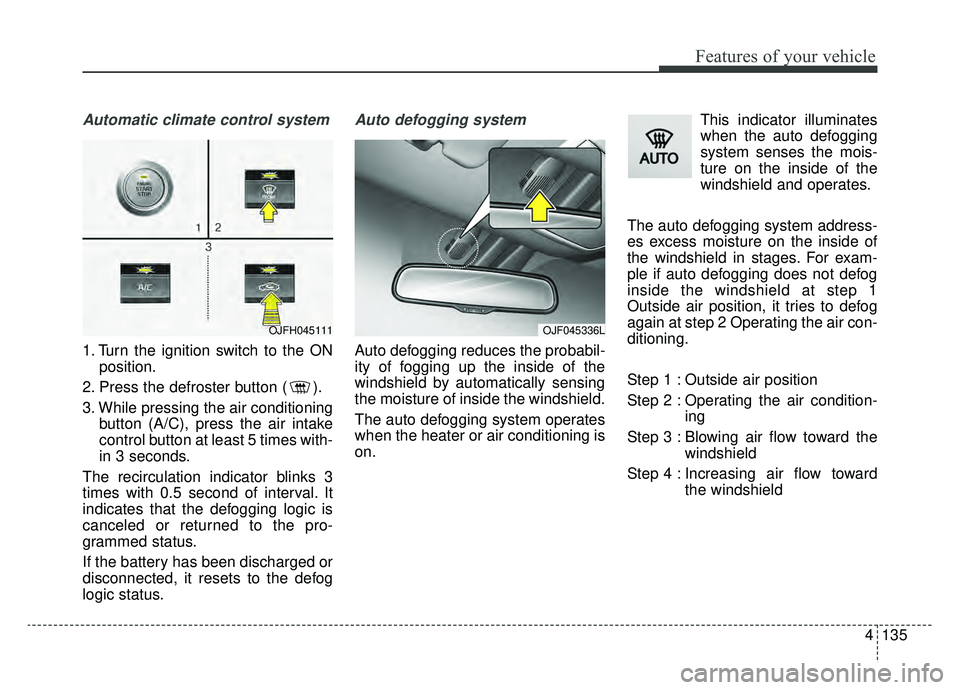
1. Turn the ignition switch to the ONposition.
2. Press the defroster button ( ).
3. While pressing the air conditioning button (A/C), press the air intake
control button at least 5 times with-
in 3 seconds.
The recirculation indicator blinks 3
times with 0.5 second of interval. It
indicates that the defogging logic is
canceled or returned to the pro-
grammed status.
If the battery has been discharged or
disconnected, it resets to the defog
logic status.
Auto defogging system
Auto defogging reduces the probabil-
ity of fogging up the inside of the
windshield by automatically sensing
the moisture of inside the windshield.
The auto defogging system operates
when the heater or air conditioning is
on. This indicator illuminates
when the auto defogging
system senses the mois-
ture on the inside of the
windshield and operates.
The auto defogging system address-
es excess moisture on the inside of
the windshield in stages. For exam-
ple if auto defogging does not defog
inside the windshield at step 1
Outside air position, it tries to defog
again at step 2 Operating the air con-
ditioning.
Step 1 : Outside air position
Step 2 : Operating the air condition- ing
Step 3 : Blowing air flow toward the windshield
Step 4 : Increasing air flow toward the windshield
OJF045336LOJFH045111
Page 266 of 553
Features of your vehicle
136
4
To cancel or reset the Auto Defogging
System
Press the front windshield defroster
button for 3 seconds when the igni-
tion switch is in the ON position.
When the Auto Defogging System is
canceled, ADS OFF symbol will blink
3 times and the ADS OFF will be dis-
played on the climate control infor-
mation screen.
When the Auto Defogging System is
reset, ADS OFF symbol will blink 6
times without a signal.
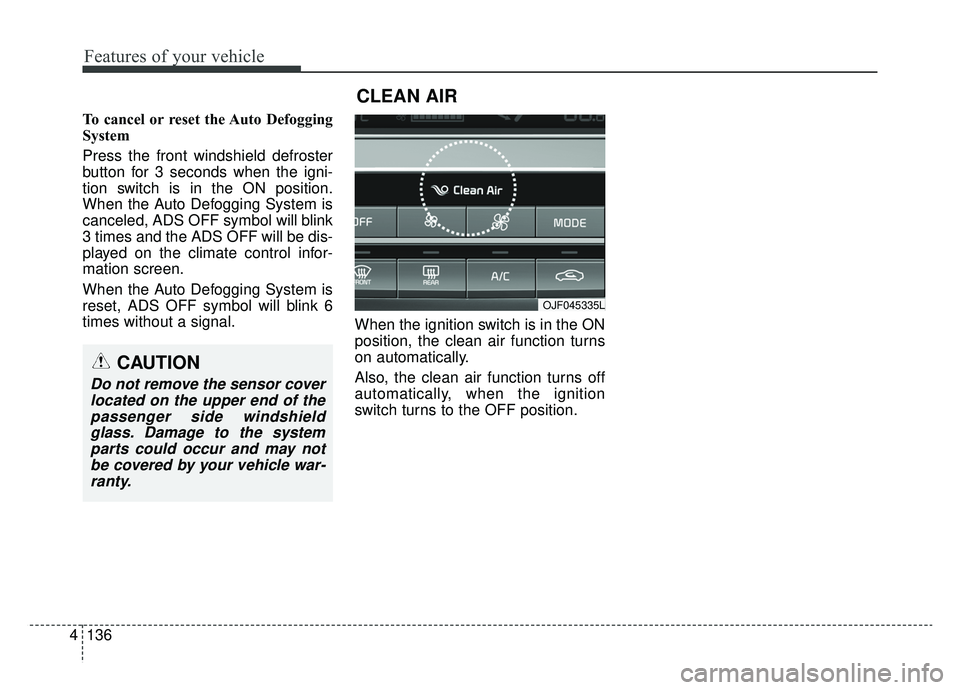
When the ignition switch is in the ON
position, the clean air function turns
on automatically.
Also, the clean air function turns off
automatically, when the ignition
switch turns to the OFF position.
OJF045335L
CLEAN AIR
CAUTION
Do not remove the sensor cover
located on the upper end of thepassenger side windshieldglass. Damage to the systemparts could occur and may notbe covered by your vehicle war-ranty.
Page 302 of 553
Driving your vehicle
20
6
In the event of brake failure
If service brakes fail to operate while
the vehicle is in motion, you can
make an emergency stop with the
parking brake. The stopping dis-
tance, however, will be much greater
than normal.
Disc brakes wear indicator
When your brake pads are worn and
new pads are required, you will hear
a high-pitched warning sound from
your front brakes or rear brakes. You
may hear this sound come and go or
it may occur whenever you depress
the brake pedal.
Please remember that some driving
conditions or climates may cause a
brake squeal when you first apply (or
lightly apply) the brakes. This is nor-
mal and does not indicate a problem
with your brakes.
Always replace the front or rear
brake pads as pairs.
WARNING- Parking
brake
Avoid applying the parking
brake to stop the vehicle while it
is moving except in an emer-
gency situation. Applying the
parking brake while the vehicle
is moving at normal speeds can
cause a sudden loss of control
of the vehicle. If you must use
the parking brake to stop the
vehicle, use great caution in
applying the brake.
WARNING- Brake wear
Do not ignore high pitched wear
sounds from your brakes. If you
ignore this audible warning, you
will eventually lose braking per-
formance, which could lead to a
serious accident.
CAUTION- Replace brake pads
Do not continue to drive withworn brake pads. Continuing todrive with worn brake pads candamage the braking system andresult in costly brake repairs.
Page 428 of 553
Maintenance
Engine compartment . . . . . . . . . . . . . . . . . . . . . . . . 8-3
Maintenance services . . . . . . . . . . . . . . . . . . . . . . . . 8-4
• Owner’s responsibility . . . . . . . . . . . . . . . . . . . . . . . . . 8-4
• Owner maintenance precautions . . . . . . . . . . . . . . . . . 8-5
Owner maintenance . . . . . . . . . . . . . . . . . . . . . . . . . 8-6
• Owner maintenance schedule. . . . . . . . . . . . . . . . . . . . 8-6
Scheduled maintenance service. . . . . . . . . . . . . . . . 8-8
Explanation of scheduled maintenance items . . . 8-14
Checking fluid levels . . . . . . . . . . . . . . . . . . . . . . . 8-17
Engine oil. . . . . . . . . . . . . . . . . . . . . . . . . . . . . . . . . 8-18
• Checking the engine oil level . . . . . . . . . . . . . . . . . . . 8-18
• Changing the engine oil and filter . . . . . . . . . . . . . . . 8-19
Engine maintenance mode (for plug-in Hybrid) . 8-20
• Starting engine maintenance mode . . . . . . . . . . . . . . 8-20
• Stopping engine maintenance mode . . . . . . . . . . . . . 8-20
Coolant . . . . . . . . . . . . . . . . . . . . . . . . . . . . . . . . . . 8-21\
• Checking the coolant level . . . . . . . . . . . . . . . . . . . . . 8-21
• Engine coolant . . . . . . . . . . . . . . . . . . . . . . . . . . . . . . . 8-22
• Inverter coolant . . . . . . . . . . . . . . . . . . . . . . . . . . . . . . 8-22
• Recommended coolant . . . . . . . . . . . . . . . . . . . . . . . . 8-23
• Changing the coolant . . . . . . . . . . . . . . . . . . . . . . . . . 8-24
Brake fluid . . . . . . . . . . . . . . . . . . . . . . . . . . . . . . . 8-25
• Checking the brake fluid level . . . . . . . . . . . . . . . . . . 8-25
Washer fluid . . . . . . . . . . . . . . . . . . . . . . . . . . . . . . 8-26
• Checking the washer fluid level . . . . . . . . . . . . . . . . . 8-26
Parking brake . . . . . . . . . . . . . . . . . . . . . . . . . . . . . 8-27
• Checking the parking brake. . . . . . . . . . . . . . . . . . . . 8-27
Air cleaner. . . . . . . . . . . . . . . . . . . . . . . . . . . . . . . . 8-28
• Filter replacement . . . . . . . . . . . . . . . . . . . . . . . . . . . . 8-28
Climate control air filter . . . . . . . . . . . . . . . . . . . . 8-30
• Filter inspection . . . . . . . . . . . . . . . . . . . . . . . . . . . . . . 8-30
Wiper blades . . . . . . . . . . . . . . . . . . . . . . . . . . . . . . 8-32
• Blade inspection . . . . . . . . . . . . . . . . . . . . . . . . . . . . . . 8-32
• Blade replacement . . . . . . . . . . . . . . . . . . . . . . . . . . . . 8-32
Battery . . . . . . . . . . . . . . . . . . . . . . . . . . . . . . . . . . . 8-\
36
• For best battery service . . . . . . . . . . . . . . . . . . . . . . . 8-36
• Recharging the battery . . . . . . . . . . . . . . . . . . . . . . . . 8-37
• Reset items . . . . . . . . . . . . . . . . . . . . . . . . . . . . . . . . . . 8-38\
Tires and wheels . . . . . . . . . . . . . . . . . . . . . . . . . . . 8-39
• Tire care . . . . . . . . . . . . . . . . . . . . . . . . . . . . . . . . . . . 8-\
39
• Recommended cold tire inflation pressures . . . . . . . 8-39
• Tire pressure . . . . . . . . . . . . . . . . . . . . . . . . . . . . . . . . 8-40
• Checking tire inflation pressure. . . . . . . . . . . . . . . . . 8-40
• Tire rotation . . . . . . . . . . . . . . . . . . . . . . . . . . . . . . . . . 8-41
• Wheel alignment and tire balance . . . . . . . . . . . . . . . 8-42
• Tire replacement . . . . . . . . . . . . . . . . . . . . . . . . . . . . . 8-43
• Wheel replacement . . . . . . . . . . . . . . . . . . . . . . . . . . . 8-43
• Tire traction . . . . . . . . . . . . . . . . . . . . . . . . . . . . . . . . . 8-44
8
Page 436 of 553
89
Maintenance
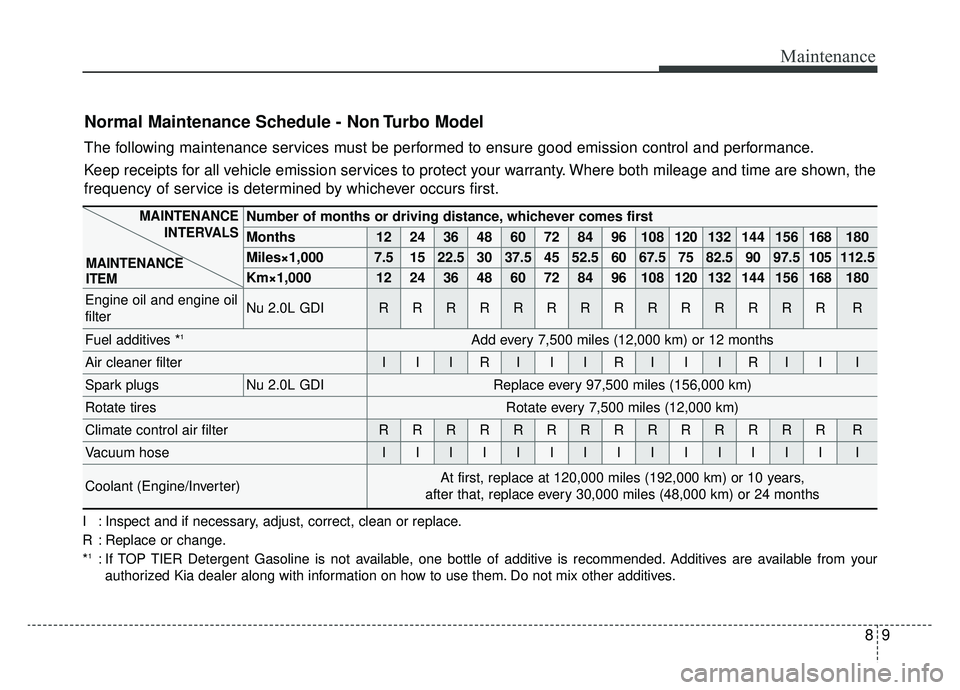
Normal Maintenance Schedule - Non Turbo Model
The following maintenance services must be performed to ensure good emission control and performance.
Keep receipts for all vehicle emission services to protect your warranty. Where both mileage and time are shown, the
frequency of service is determined by whichever occurs first.
Number of months or driving distance, whichever comes first
Months1224364860728496108120132144156168180
Miles×1,0007.51522.530 37.5 45 52.5 60 67.5 75 82.5 90 97.5 105 112.5
Km×1,00012 24 36 48 60 72 84 96 108 120 132 144 156 168 180
Engine oil and engine oil
filterNu 2.0L GDIRRRRRRRRRRRRRRR
Fuel additives *1Add every 7,500 miles (12,000 km) or 12 months
Air cleaner filterIIIRIIIRIIIRIII
Spark plugsNu 2.0L GDIReplace every 97,500 miles (156,000 km)
Rotate tiresRotate every 7,500 miles (12,000 km)
Climate control air filterRRRRRRRRRRRRRRR
Vacuum hoseIIIIIIIIIIIIIII
Coolant (Engine/Inverter)At first, replace at 120,000 miles (192,000 km) or 10 years,
after that, replace every 30,000 miles (48,000 km) or 24 months
MAINTENANCE INTERVALS
MAINTENANCE
ITEM
I : Inspect and if necessary, adjust, correct, clean or replace.
R : Replace or change.
*
1: If TOP TIER Detergent Gasoline is not available, one bottle of additive is recommended. Additives are available from your authorized Kia dealer along with information on how to use them. Do not mix other additives.
Page 440 of 553
813
Maintenance
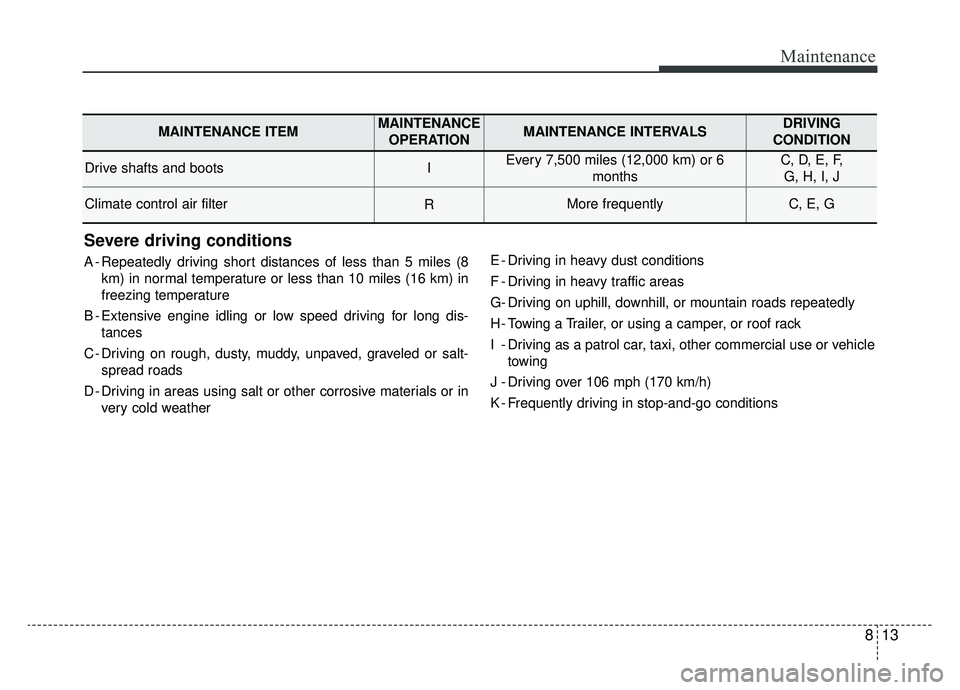
Severe driving conditions
A - Repeatedly driving short distances of less than 5 miles (8km) in normal temperature or less than 10 miles (16 km) in
freezing temperature
B - Extensive engine idling or low speed driving for long dis- tances
C - Driving on rough, dusty, muddy, unpaved, graveled or salt- spread roads
D - Driving in areas using salt or other corrosive materials or in very cold weather E - Driving in heavy dust conditions
F - Driving in heavy traffic areas
G- Driving on uphill, downhill, or mountain roads repeatedly
H - Towing a Trailer, or using a camper, or roof rack
I - Driving as a patrol car, taxi, other commercial use or vehicle
towing
J - Driving over 106 mph (170 km/h)
K - Frequently driving in stop-and-go conditions
MAINTENANCE ITEMMAINTENANCE OPERATIONMAINTENANCE INTERVALSDRIVING
CONDITION
Drive shafts and bootsIEvery 7,500 miles (12,000 km) or 6 monthsC, D, E, F,G, H, I, J
Climate control air filterRMore frequentlyC, E, G
Page 457 of 553
Maintenance
30
8
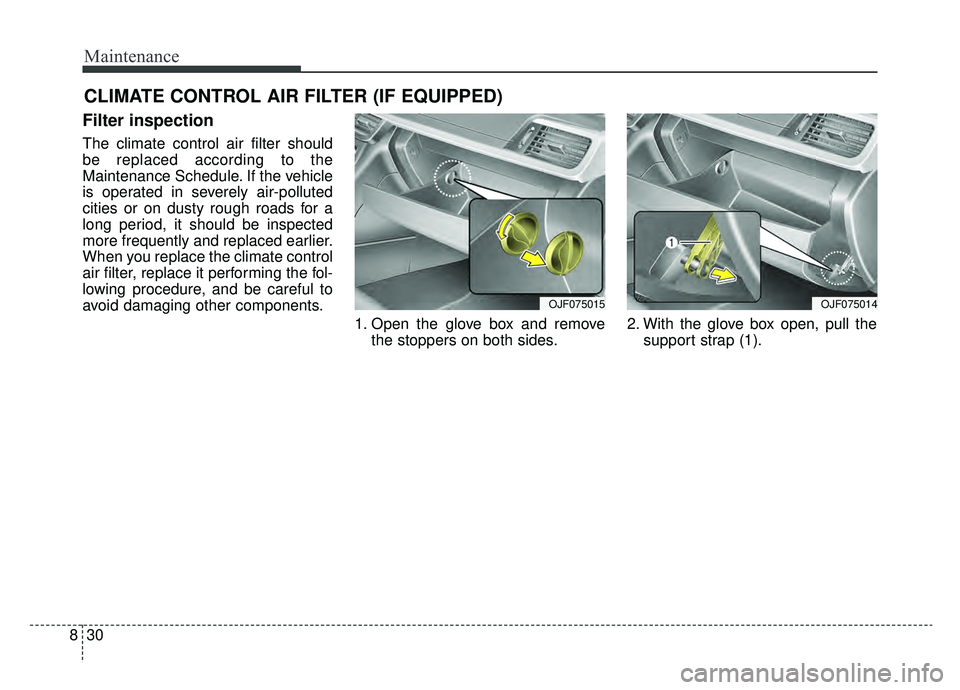
CLIMATE CONTROL AIR FILTER (IF EQUIPPED)
Filter inspection
The climate control air filter should
be replaced according to the
Maintenance Schedule. If the vehicle
is operated in severely air-polluted
cities or on dusty rough roads for a
long period, it should be inspected
more frequently and replaced earlier.
When you replace the climate control
air filter, replace it performing the fol-
lowing procedure, and be careful to
avoid damaging other components.
1. Open the glove box and removethe stoppers on both sides. 2. With the glove box open, pull the
support strap (1).
OJF075014OJF075015
Page 458 of 553
831
Maintenance
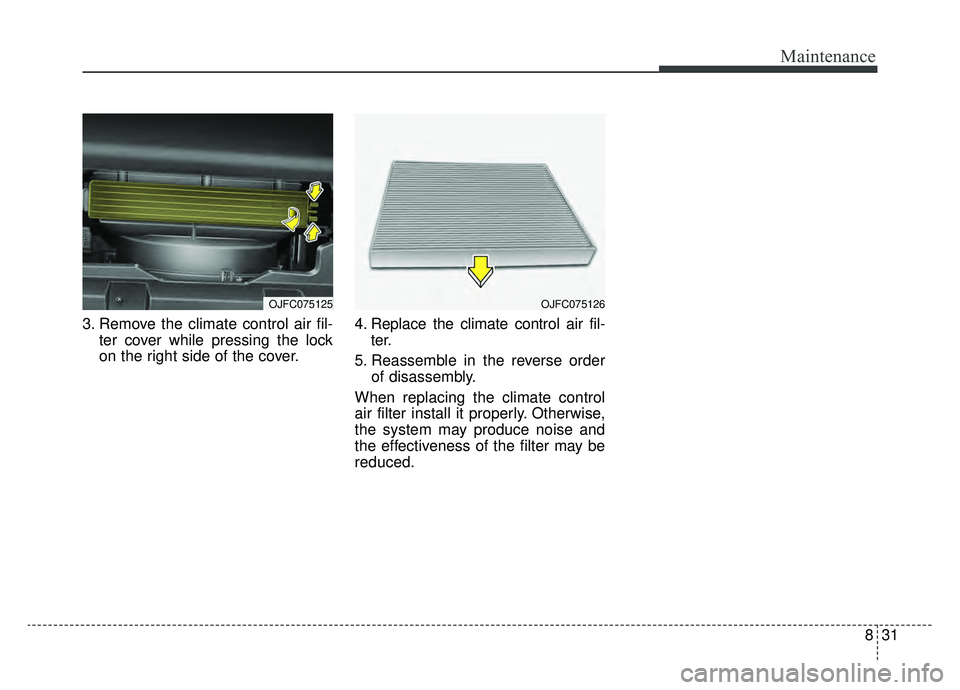
3. Remove the climate control air fil-ter cover while pressing the lock
on the right side of the cover. 4. Replace the climate control air fil-
ter.
5. Reassemble in the reverse order of disassembly.
When replacing the climate control
air filter install it properly. Otherwise,
the system may produce noise and
the effectiveness of the filter may be
reduced.
OJFC075125OJFC075126
Page 465 of 553
Maintenance
38
8
When recharging the battery,
observe the following precautions:
The battery must be removed from
the vehicle and placed in an area
with good ventilation.
Do not allow cigarettes, sparks, or flame near the battery.
Watch the battery during charging, and stop or reduce the charging
rate if the battery cells begin
gassing (boiling) violently or if the
temperature of the electrolyte of
any cell exceeds 120°F (49°C).
Wear eye protection when check- ing the battery during charging.
Disconnect the battery charger in the following order.
1. Turn off the battery charger main switch.
2. Unhook the negative clamp from the negative battery terminal.
3. Unhook the positive clamp from the positive battery terminal. Before performing maintenance or
recharging the battery, turn off all
accessories and stop the engine.
The negative battery cable must be removed first and installed last
when the battery is disconnected.Reset items
Items should be reset after the bat-
tery has been discharged or the bat-
tery has been disconnected.
Auto up/down window (See chapter 4)
Sunroof (See chapter 4)
Trip computer (See chapter 4)
Climate control system (See chapter 4)
Driver position memory system (See chapter 3)
Audio (See chapter 5)
Page 474 of 553
847
Maintenance
Tread wear
The tread wear grade is a compara-
tive rating based on the wear rate of
the tire when tested under controlled
conditions on a specified govern-
ment test course. For example, a tire
graded 150 would wear one-and-a-
half times (1½) as well on the gov-
ernment course as a tire graded 100.
The relative performance of tires
depends upon the actual conditions
of their use, however, and may
depart significantly from the norm
due to variations in driving habits,
service practices and differences in
road characteristics and climate.Tires degrade over time, even when
they are not being used. Regardless
of the remaining tread, we recom-
mend that tires be replaced after
approximately six (6) years of normal
service. Heat caused by hot climates
or frequent high loading conditions
can accelerate the aging process.
These grades are molded on the
side-walls of passenger vehicle tires.
The tires available as standard or
optional equipment on your vehicles
may vary with respect to grade.
Traction - AA, A, B & C
The traction grades, from highest to
lowest, are AA, A, B and C. Those
grades represent the tires ability to
stop on wet pavement as measured
under controlled conditions on spec-
ified government test surfaces of
asphalt and concrete. A tire marked
C may have poor traction perform-
ance.
The traction grade assigned to this
tire is based on straight-ahead brak-
ing traction tests, and does not
include acceleration, cornering,
hydroplaning, or peak traction char-
acteristics.