open hood KIA OPTIMA PHEV 2019 User Guide
[x] Cancel search | Manufacturer: KIA, Model Year: 2019, Model line: OPTIMA PHEV, Model: KIA OPTIMA PHEV 2019Pages: 553, PDF Size: 11.97 MB
Page 405 of 553
77
What to do in an emergency
IF THE ENGINE OVERHEATS
If your temperature gauge indicates
overheating, you will experience a
loss of power, or hear loud pinging or
knocking, the engine is probably too
hot. If this happens, you should:
1. Turn on the emergency warningflasher and stop in a safe place.
Move the shift lever to P (Park)
and engage the parking brake.
2. If hot steam does not come out from the engine room, carefully
open the engine room and check
whether the water pump connec-
tor is properly engaged. If the con-
nector is not properly engaged,
stop the engine immediately and
properly engage the connector.
Then, turn the engine on.
3. Turn on the air conditioner. 4. If the “HEV Warning” light turns on
in the driver instrument cluster, or
engine coolant or hot steam emits
from the engine coolant filler, stop
the engine immediately. Then, call
the nearest authorized Kia dealer
for assistance. If the “Engine
Warning” light remains illuminated
or the engine coolant is not flowing
out, keep the engine running.
Open the engine hood for ventila-
tion to help cool down the engine. 5. Check the coolant temperature
gauge on the instrument cluster to
make sure the coolant tempera-
ture is sufficiently cooled down. If
the engine coolant level is low,
please check the connecting parts
between the radiator hose, heater
hose, and water pump for any
signs of leakage. When there is no
sign of leakage, please refill the
engine coolant. If causes and
signs of engine overheating such
as warning light illumination,
engine coolant leakage, or cooling
fan malfunction are found, stop the
vehicle the earliest. Then, call the
nearest authorized Kia dealer for
assistance.
WARNING
While the engine is running,
keep hair, hands and clothing
away from moving parts such
as the fan and drive belts to pre-
vent injury.
Page 433 of 553
Maintenance
68
OWNER MAINTENANCE
The following lists are vehicle checks
and inspections that should be per-
formed by the owner or an author-
ized Kia dealer at the frequencies
indicated to help ensure safe,
dependable operation of your vehi-
cle.
Any adverse conditions should be
brought to the attention of your deal-
er as soon as possible.
These Owner Maintenance Checks
are generally not covered by war-
ranties and you may be charged for
labor, parts and lubricants used.Owner maintenance schedule
When you stop for fuel:
Check the engine oil level.
Check the coolant level in coolantreservoir.
Check the windshield washer fluid level.
Look for low or under-inflated tires.
While operating your vehicle:
Note any changes in the sound of the exhaust or any smell of
exhaust fumes in the vehicle.
Check for vibrations in the steering wheel. Notice any increased steer-
ing effort or looseness in the steer-
ing wheel, or change in its straight-
ahead position.
Notice if your vehicle constantly turns slightly or “pulls” to one side
when traveling on smooth, level
roads.
When stopping, listen and check for unusual sounds, pulling to one
side, increased brake pedal travel
or “hard-to-push” brake pedal.
If any slipping or changes in the operation of your transaxle occurs,
check the transaxle fluid level.
Check the automatic transaxle P (Park) function.
Check the parking brake.
Check for fluid leaks under your vehicle (water dripping from the air
conditioning system during or after
use is normal).
WARNING- Hot coolant
Be careful when checking your
engine coolant level when the
engine is hot. Scalding hot
coolant and steam may blow
out under pressure.
WARNING
When you open the engine
hood, turn the Hybrid system
off. If not, it may result in death
or serious injury because of the
high voltage flow.
Page 503 of 553
Maintenance
76
8
(1) Rear turn signal lamp
(2) Stop lamp (LED type)
(3) Tail lamp (LED type)
(4) Back-up lamp
(5) Side marker
(6) License plate lamp
(7) High mounted stop lamp (LED
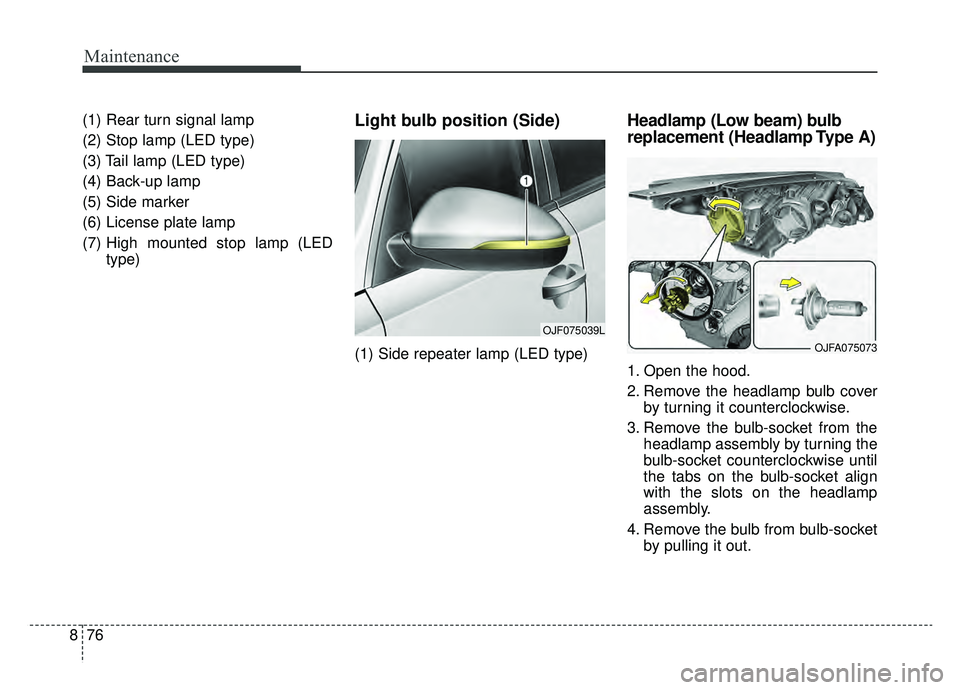
type)Light bulb position (Side)
(1) Side repeater lamp (LED type)
Headlamp (Low beam) bulb
replacement (Headlamp Type A)
1. Open the hood.
2. Remove the headlamp bulb coverby turning it counterclockwise.
3. Remove the bulb-socket from the headlamp assembly by turning the
bulb-socket counterclockwise until
the tabs on the bulb-socket align
with the slots on the headlamp
assembly.
4. Remove the bulb from bulb-socket by pulling it out.
OJF075039L
OJFA075073
Page 505 of 553
Maintenance
78
8
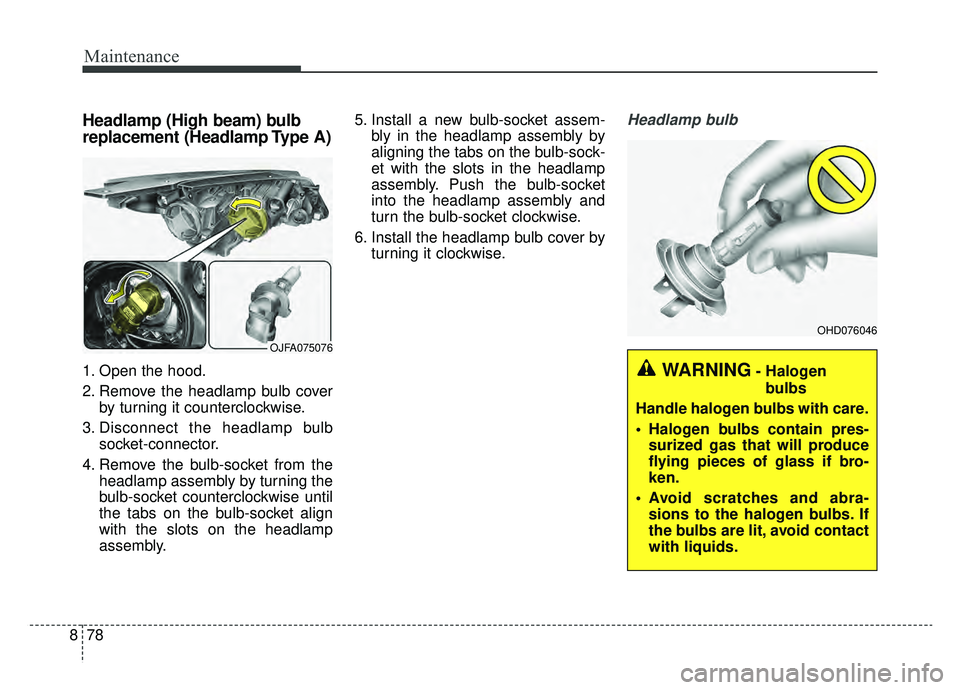
Headlamp (High beam) bulb
replacement (Headlamp Type A)
1. Open the hood.
2. Remove the headlamp bulb cover
by turning it counterclockwise.
3. Disconnect the headlamp bulb socket-connector.
4. Remove the bulb-socket from the headlamp assembly by turning the
bulb-socket counterclockwise until
the tabs on the bulb-socket align
with the slots on the headlamp
assembly. 5. Install a new bulb-socket assem-
bly in the headlamp assembly by
aligning the tabs on the bulb-sock-
et with the slots in the headlamp
assembly. Push the bulb-socket
into the headlamp assembly and
turn the bulb-socket clockwise.
6. Install the headlamp bulb cover by turning it clockwise.
Headlamp bulb
OJFA075076
WARNING- Halogen
bulbs
Handle halogen bulbs with care.
Halogen bulbs contain pres- surized gas that will produce
flying pieces of glass if bro-
ken.
Avoid scratches and abra- sions to the halogen bulbs. If
the bulbs are lit, avoid contact
with liquids.
OHD076046
Page 506 of 553
879
Maintenance
Never touch the glass with barehands. Residual oil may cause the
bulb to overheat and burst when lit.
A bulb should be operated only
when installed in a headlamp.
If a bulb becomes damaged or cracked, replace it immediately
and carefully dispose of it.
Wear eye protection when chang- ing a bulb. Allow the bulb to cool
down before handling it.Headlamp (Low/High
beam,LED type) bulb replace-
ment (Headlamp Type B)
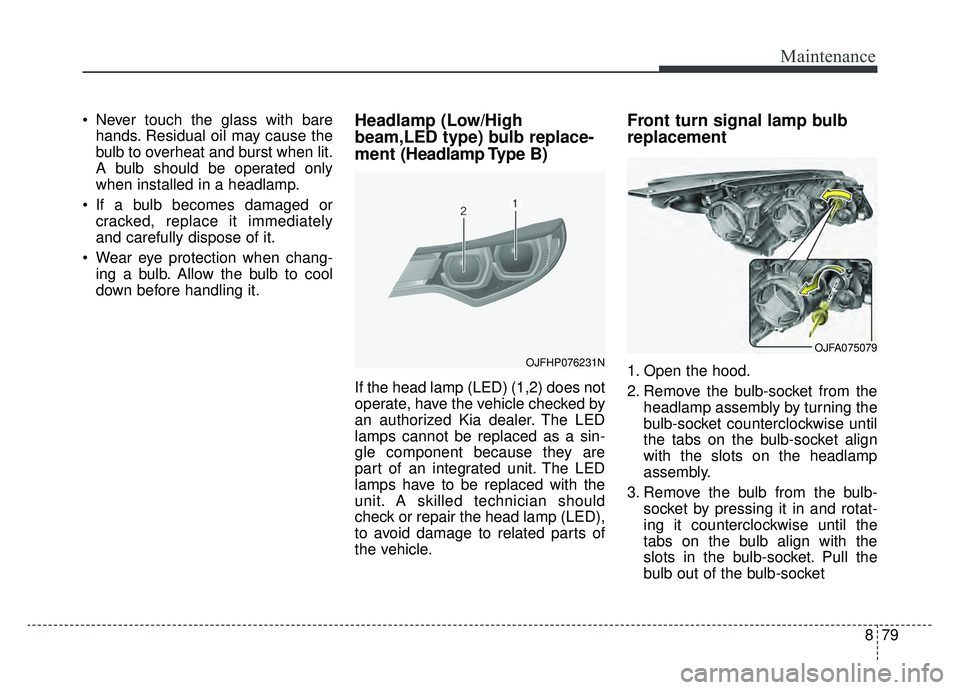
If the head lamp (LED) (1,2) does not
operate, have the vehicle checked by
an authorized Kia dealer. The LED
lamps cannot be replaced as a sin-
gle component because they are
part of an integrated unit. The LED
lamps have to be replaced with the
unit. A skilled technician should
check or repair the head lamp (LED),
to avoid damage to related parts of
the vehicle.
Front turn signal lamp bulb
replacement
1. Open the hood.
2. Remove the bulb-socket from the
headlamp assembly by turning the
bulb-socket counterclockwise until
the tabs on the bulb-socket align
with the slots on the headlamp
assembly.
3. Remove the bulb from the bulb- socket by pressing it in and rotat-
ing it counterclockwise until the
tabs on the bulb align with the
slots in the bulb-socket. Pull the
bulb out of the bulb-socket
OJFA075079OJFHP076231N
Page 546 of 553
I5
Index
FCA warning message and system control . . . . . . . 6-45
Limitation of the system . . . . . . . . . . . . . . . . . . . . . 6-51
Recognizing pedestrians. . . . . . . . . . . . . . . . . . . . . . 6-55
System malfunction . . . . . . . . . . . . . . . . . . . . . . . . . 6-49
System setting and activation . . . . . . . . . . . . . . . . . . 6-43
Fuel filler lid (Hybrid) . . . . . . . . . . . . . . . . . . . . . . . . . 4-30 Closing the fuel filler lid . . . . . . . . . . . . . . . . . . . . . 4-30
Emergency fuel filler lid release . . . . . . . . . . . . . . . 4-33
Opening the fuel filler lid. . . . . . . . . . . . . . . . . . . . . 4-30
Fuel filler lid (plug-in Hybrid) . . . . . . . . . . . . . . . . . . . 4-34 Closing the fuel filler lid . . . . . . . . . . . . . . . . . . . . . 4-36
Emergency fuel filler lid release . . . . . . . . . . . . . . . 4-36
Opening the fuel filler lid. . . . . . . . . . . . . . . . . . . . . 4-34
Fuel requirements . . . . . . . . . . . . . . . . . . . . . . . . . . . . . . 1-2 Do not use methanol . . . . . . . . . . . . . . . . . . . . . . . . . 1-3
Fuel additives . . . . . . . . . . . . . . . . . . . . . . . . . . . . . . . 1-4
Gasoline containing alcohol and methanol . . . . . . . . 1-2
Operation in foreign countries . . . . . . . . . . . . . . . . . . 1-4
Fuses . . . . . . . . . . . . . . . . . . . . . . . . . . . . . . . . . . . . \
. . . 8-54 Engine compartment fuse replacement . . . . . . . . . . 8-57
Fuse/relay panel description. . . . . . . . . . . . . . . . . . . 8-60
Inner panel fuse replacement . . . . . . . . . . . . . . . . . . 8-56
Gross vehicle weight. . . . . . . . . . . . . . . . . . . . . . . . . . . . 9-5 HEV (hybrid electric vehicle) system . . . . . . . . . . . . . . . H2
HEV/PHEV powertrain . . . . . . . . . . . . . . . . . . . . . . . . . 1-5
Hood . . . . . . . . . . . . . . . . . . . . . . . . . . . . . . . . . . . . \
. . . 4-28
Closing the hood . . . . . . . . . . . . . . . . . . . . . . . . . . . 4-29
Hood open warning . . . . . . . . . . . . . . . . . . . . . . . . . 4-28
Opening the hood . . . . . . . . . . . . . . . . . . . . . . . . . . . 4-28
If an accident occurs . . . . . . . . . . . . . . . . . . . . . . . . . . . 7-29
If the engine overheats . . . . . . . . . . . . . . . . . . . . . . . . . . 7-7
If the engine will not start . . . . . . . . . . . . . . . . . . . . . . . 7-4 If engine doesn't turn over or turns over slowly . . . . 7-4
If engine turns over normally but does not start . . . . 7-4
If you have a flat tire (With Tire Mobility Kit) . . . . . . 7-16 Checking the tire inflation pressure . . . . . . . . . . . . . 7-23
Components of the Tire Mobility Kit . . . . . . . . . . . 7-19
Distributing the sealant . . . . . . . . . . . . . . . . . . . . . . 7-22
Introduction . . . . . . . . . . . . . . . . . . . . . . . . . . . . . . . 7-17
Notes on the safe use of the Tire Mobility Kit . . . . 7-17
Technical Data . . . . . . . . . . . . . . . . . . . . . . . . . . . . . 7-23
Using the Tire Mobility Kit . . . . . . . . . . . . . . . . . . . 7-20
Important safety precautions . . . . . . . . . . . . . . . . . . . . . 3-2 Air bag hazards . . . . . . . . . . . . . . . . . . . . . . . . . . . . . 3-2
Always wear your seat belt . . . . . . . . . . . . . . . . . . . . 3-2
Control your speed . . . . . . . . . . . . . . . . . . . . . . . . . . . 3-3
G
H
I