fuse KIA OPTIMA PHEV 2019 Owner's Guide
[x] Cancel search | Manufacturer: KIA, Model Year: 2019, Model line: OPTIMA PHEV, Model: KIA OPTIMA PHEV 2019Pages: 553, PDF Size: 11.97 MB
Page 498 of 553
871
Maintenance
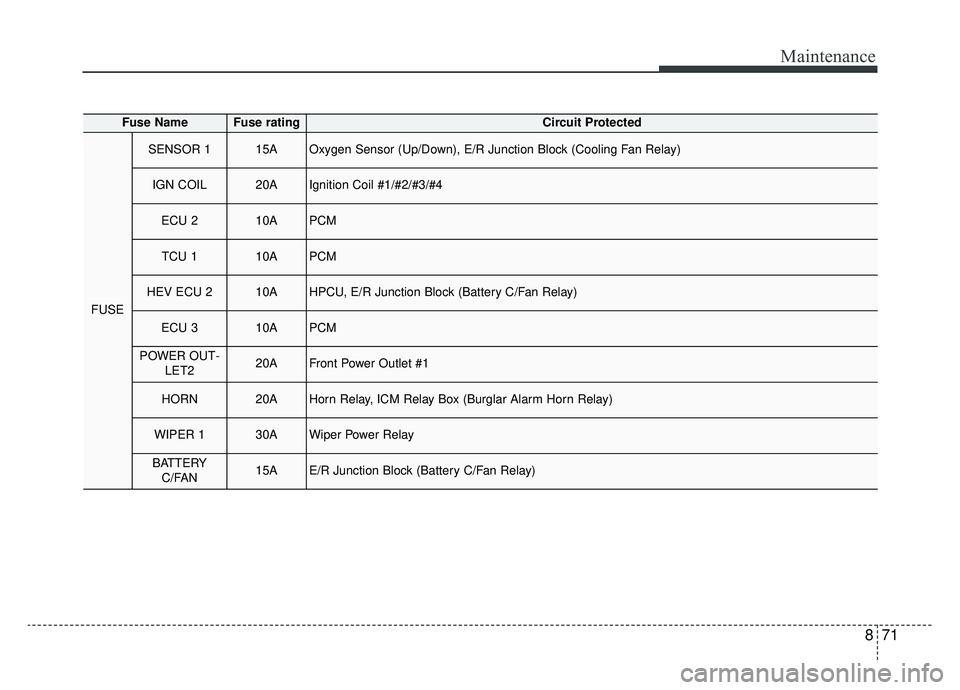
Fuse NameFuse ratingCircuit Protected
FUSE
SENSOR 115AOxygen Sensor (Up/Down), E/R Junction Block (Cooling Fan Relay)
IGN COIL20AIgnition Coil #1/#2/#3/#4
ECU 210APCM
TCU 110APCM
HEV ECU 210AHPCU, E/R Junction Block (Battery C/Fan Relay)
ECU 310APCM
POWER OUT-LET220AFront Power Outlet #1
HORN20AHorn Relay, ICM Relay Box (Burglar Alarm Horn Relay)
WIPER 130AWiper Power Relay
BATTERYC/FAN15AE/R Junction Block (Battery C/Fan Relay)
Page 500 of 553
873
Maintenance
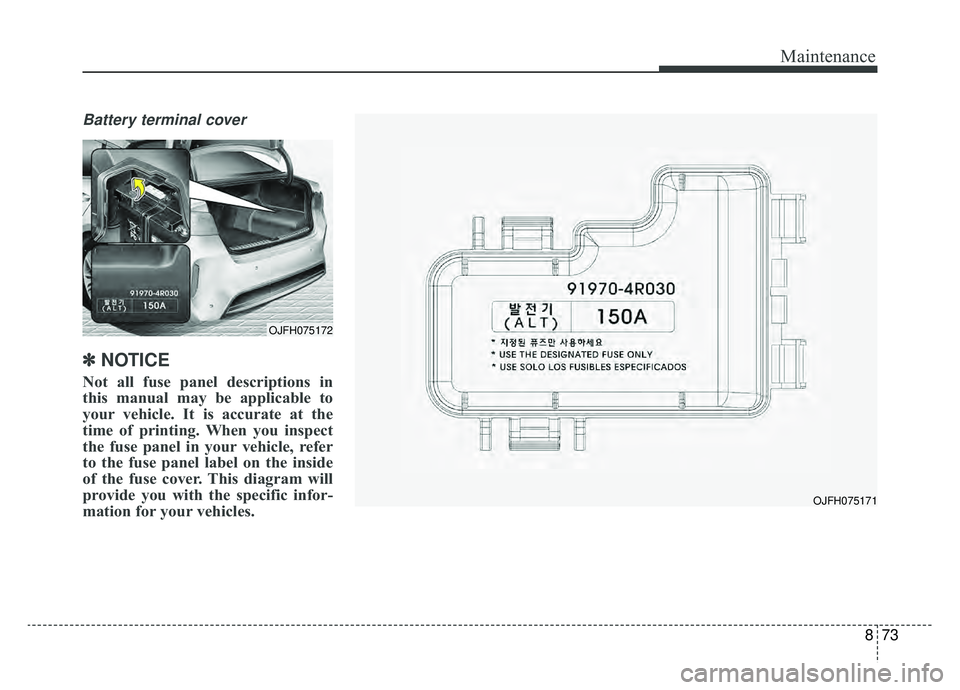
Battery terminal cover
✽ ✽NOTICE
Not all fuse panel descriptions in
this manual may be applicable to
your vehicle. It is accurate at the
time of printing. When you inspect
the fuse panel in your vehicle, refer
to the fuse panel label on the inside
of the fuse cover. This diagram will
provide you with the specific infor-
mation for your vehicles.
OJFH075172
OJFH075171
Page 501 of 553
Maintenance
74
8
LIGHT BULBS
Bulb replacement precaution
Please keep extra bulbs on hand
with appropriate wattage ratings in
case of emergencies.
Refer to “Bulb Wattage” in chapter 9.
When changing lamps, first turn off
the engine at a safe place, firmly
apply the parking brake and detach
the battery’s negative (-) terminal.
Use only bulbs of the specified
wattage.✽ ✽ NOTICE
• If the light bulb or lamp connector
is removed while the lamp is still
on, the fuse box's electronic sys-
tem may log it as a malfunction.
Therefore, a lamp malfunction
incident may be recorded as a
Diagnostic Trouble Code (DTC) in
the fuse box.
• It is normal for an operating lamp to flicker momentarily. This is due
to a stabilization function of the
vehicle’s electronic control device.
If the lamp lights up normally
after momentarily blinking, then
it is functioning as normal.
However, if the lamp continues to
flicker several times or turns off
completely, there may be an error
in the vehicle’s electronic control
device. Please have the vehicle
checked by an authorized Kia
dealer immediately.
WARNING- Working on
the lights
Prior to working on the lights,
firmly apply the parking brake,
ensure that the engine
start/stop button is in OFF posi-
tion and turn off the lights to
avoid sudden movement of the
vehicle that may cause burning
your fingers or receiving an
electric shock.
CAUTION -Light replace-
ment
Be sure to replace the burned- out bulb with one of the samewattage rating. Otherwise, itmay cause damage to the fuseor electric wiring system.
CAUTION -Headlamp
Lens
To prevent damage, do notclean the headlamp lens withchemical solvents or strongdetergents.
Page 502 of 553
875
Maintenance
If you don’t have the necessary tools,
the correct bulbs and the expertise,
consult an authorized Kia dealer. In
many cases, it is difficult to replace
vehicle light bulbs because other
parts of the vehicle must be removed
before you can get to the bulb. This is
especially true if you have to remove
the headlamp assembly to get to the
bulb(s).
Removing/installing the headlamp
assembly can result in damage to
the vehicle.
If non-genuine parts or substandard
bulbs are used, it may lead to blow-
ing a fuse or other wiring damages.
Do not install extra lamps or LEDs to
the vehicle. If additional lights are
installed, it may lead to lamp mal-
functions and flickering. Additionally,
the fuse box and other writing may
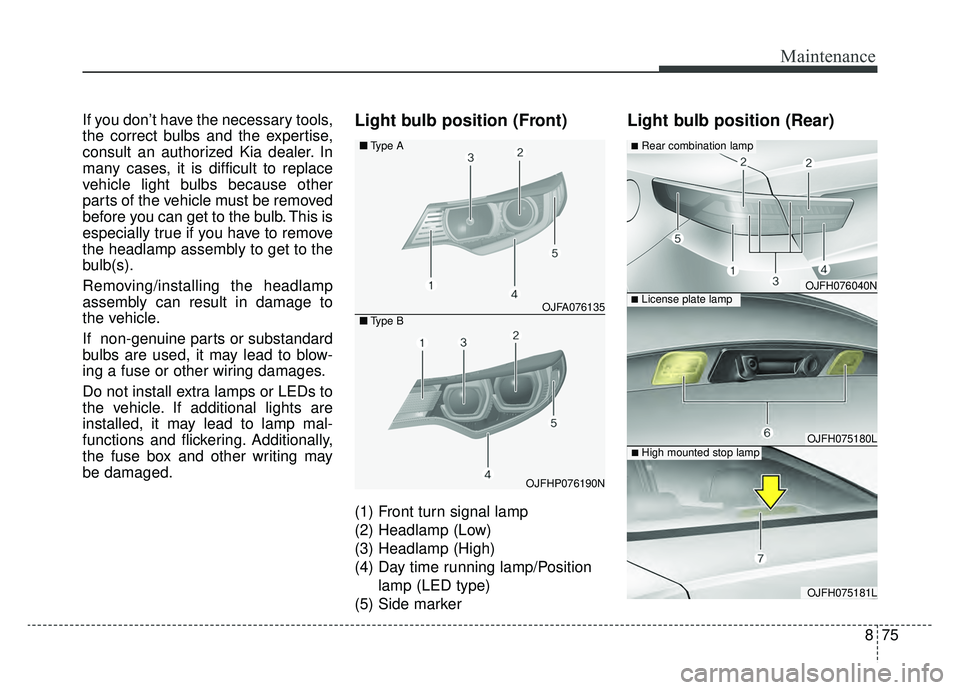
be damaged.Light bulb position (Front)
(1) Front turn signal lamp
(2) Headlamp (Low)
(3) Headlamp (High)
(4) Day time running lamp/Positionlamp (LED type)
(5) Side marker
Light bulb position (Rear)
OJFH076040N
OJFH075180L
OJFH075181L
■Rear combination lamp
■License plate lamp
■High mounted stop lamp
OJFA076135
OJFHP076190N
■ Type A
■Type B
Page 546 of 553
I5
Index
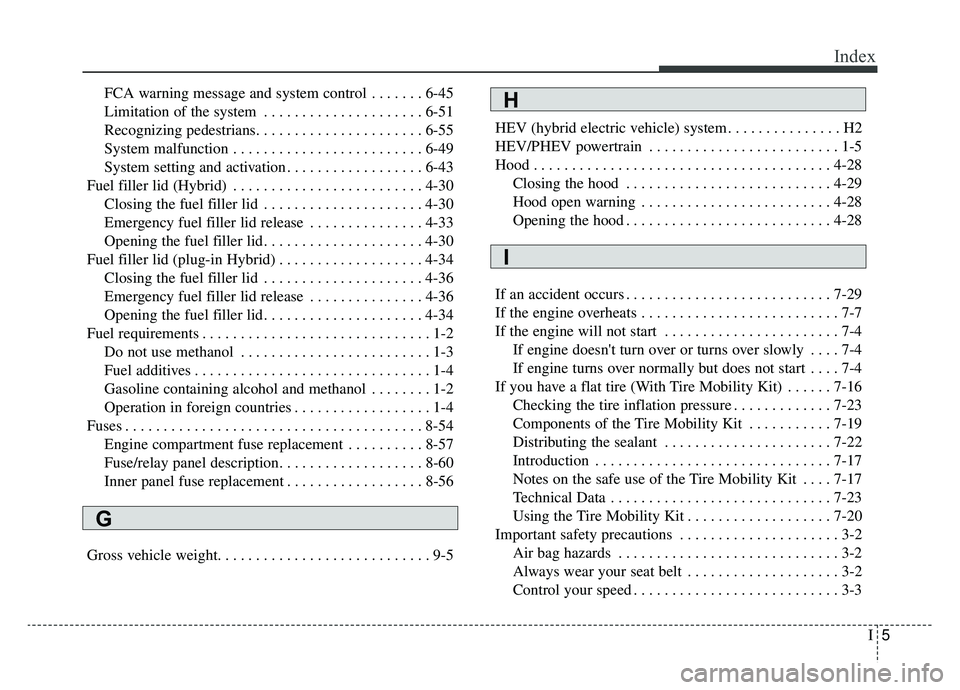
FCA warning message and system control . . . . . . . 6-45
Limitation of the system . . . . . . . . . . . . . . . . . . . . . 6-51
Recognizing pedestrians. . . . . . . . . . . . . . . . . . . . . . 6-55
System malfunction . . . . . . . . . . . . . . . . . . . . . . . . . 6-49
System setting and activation . . . . . . . . . . . . . . . . . . 6-43
Fuel filler lid (Hybrid) . . . . . . . . . . . . . . . . . . . . . . . . . 4-30 Closing the fuel filler lid . . . . . . . . . . . . . . . . . . . . . 4-30
Emergency fuel filler lid release . . . . . . . . . . . . . . . 4-33
Opening the fuel filler lid. . . . . . . . . . . . . . . . . . . . . 4-30
Fuel filler lid (plug-in Hybrid) . . . . . . . . . . . . . . . . . . . 4-34 Closing the fuel filler lid . . . . . . . . . . . . . . . . . . . . . 4-36
Emergency fuel filler lid release . . . . . . . . . . . . . . . 4-36
Opening the fuel filler lid. . . . . . . . . . . . . . . . . . . . . 4-34
Fuel requirements . . . . . . . . . . . . . . . . . . . . . . . . . . . . . . 1-2 Do not use methanol . . . . . . . . . . . . . . . . . . . . . . . . . 1-3
Fuel additives . . . . . . . . . . . . . . . . . . . . . . . . . . . . . . . 1-4
Gasoline containing alcohol and methanol . . . . . . . . 1-2
Operation in foreign countries . . . . . . . . . . . . . . . . . . 1-4
Fuses . . . . . . . . . . . . . . . . . . . . . . . . . . . . . . . . . . . . \
. . . 8-54 Engine compartment fuse replacement . . . . . . . . . . 8-57
Fuse/relay panel description. . . . . . . . . . . . . . . . . . . 8-60
Inner panel fuse replacement . . . . . . . . . . . . . . . . . . 8-56
Gross vehicle weight. . . . . . . . . . . . . . . . . . . . . . . . . . . . 9-5 HEV (hybrid electric vehicle) system . . . . . . . . . . . . . . . H2
HEV/PHEV powertrain . . . . . . . . . . . . . . . . . . . . . . . . . 1-5
Hood . . . . . . . . . . . . . . . . . . . . . . . . . . . . . . . . . . . . \
. . . 4-28
Closing the hood . . . . . . . . . . . . . . . . . . . . . . . . . . . 4-29
Hood open warning . . . . . . . . . . . . . . . . . . . . . . . . . 4-28
Opening the hood . . . . . . . . . . . . . . . . . . . . . . . . . . . 4-28
If an accident occurs . . . . . . . . . . . . . . . . . . . . . . . . . . . 7-29
If the engine overheats . . . . . . . . . . . . . . . . . . . . . . . . . . 7-7
If the engine will not start . . . . . . . . . . . . . . . . . . . . . . . 7-4 If engine doesn't turn over or turns over slowly . . . . 7-4
If engine turns over normally but does not start . . . . 7-4
If you have a flat tire (With Tire Mobility Kit) . . . . . . 7-16 Checking the tire inflation pressure . . . . . . . . . . . . . 7-23
Components of the Tire Mobility Kit . . . . . . . . . . . 7-19
Distributing the sealant . . . . . . . . . . . . . . . . . . . . . . 7-22
Introduction . . . . . . . . . . . . . . . . . . . . . . . . . . . . . . . 7-17
Notes on the safe use of the Tire Mobility Kit . . . . 7-17
Technical Data . . . . . . . . . . . . . . . . . . . . . . . . . . . . . 7-23
Using the Tire Mobility Kit . . . . . . . . . . . . . . . . . . . 7-20
Important safety precautions . . . . . . . . . . . . . . . . . . . . . 3-2 Air bag hazards . . . . . . . . . . . . . . . . . . . . . . . . . . . . . 3-2
Always wear your seat belt . . . . . . . . . . . . . . . . . . . . 3-2
Control your speed . . . . . . . . . . . . . . . . . . . . . . . . . . . 3-3
G
H
I