oil KIA OPTIMA PHEV 2019 Owner's Guide
[x] Cancel search | Manufacturer: KIA, Model Year: 2019, Model line: OPTIMA PHEV, Model: KIA OPTIMA PHEV 2019Pages: 553, PDF Size: 11.97 MB
Page 520 of 553
893
Maintenance
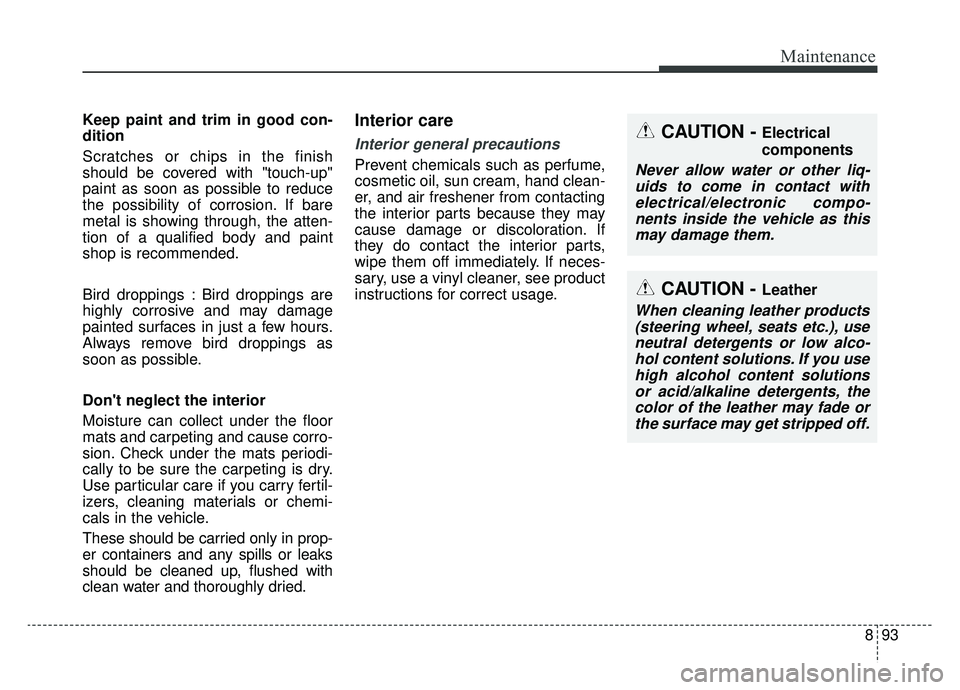
Keep paint and trim in good con-
dition
Scratches or chips in the finish
should be covered with "touch-up"
paint as soon as possible to reduce
the possibility of corrosion. If bare
metal is showing through, the atten-
tion of a qualified body and paint
shop is recommended.
Bird droppings : Bird droppings are
highly corrosive and may damage
painted surfaces in just a few hours.
Always remove bird droppings as
soon as possible.
Don't neglect the interior
Moisture can collect under the floor
mats and carpeting and cause corro-
sion. Check under the mats periodi-
cally to be sure the carpeting is dry.
Use particular care if you carry fertil-
izers, cleaning materials or chemi-
cals in the vehicle.
These should be carried only in prop-
er containers and any spills or leaks
should be cleaned up, flushed with
clean water and thoroughly dried.Interior care
Interior general precautions
Prevent chemicals such as perfume,
cosmetic oil, sun cream, hand clean-
er, and air freshener from contacting
the interior parts because they may
cause damage or discoloration. If
they do contact the interior parts,
wipe them off immediately. If neces-
sary, use a vinyl cleaner, see product
instructions for correct usage.
CAUTION - Electrical
components
Never allow water or other liq-uids to come in contact withelectrical/electronic compo-nents inside the vehicle as thismay damage them.
CAUTION - Leather
When cleaning leather products(steering wheel, seats etc.), useneutral detergents or low alco-hol content solutions. If you usehigh alcohol content solutionsor acid/alkaline detergents, thecolor of the leather may fade orthe surface may get stripped off.
Page 521 of 553
Maintenance
94
8
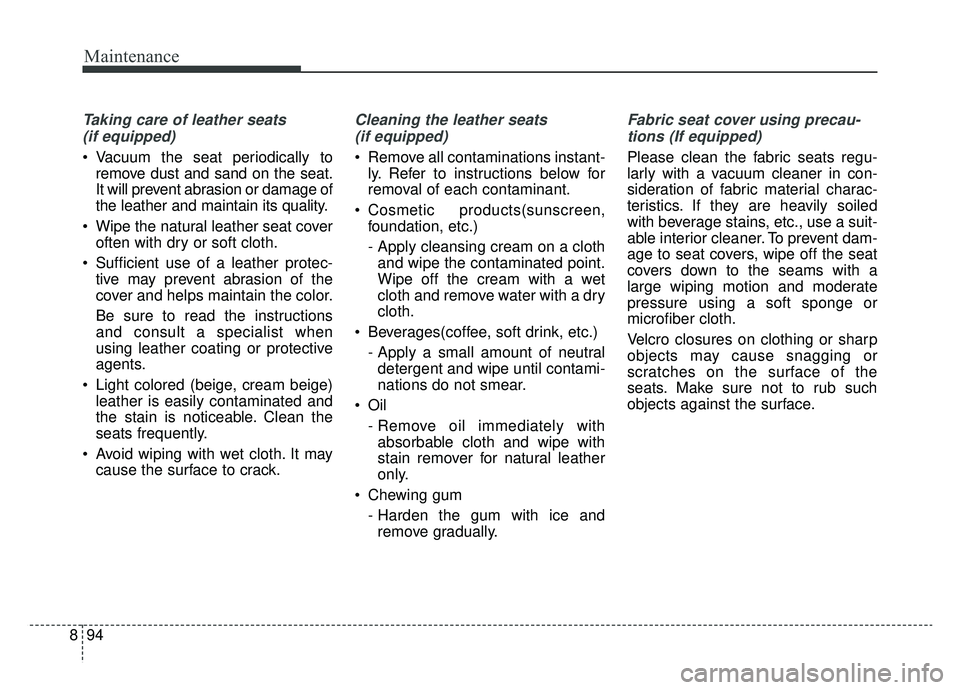
Taking care of leather seats
(if equipped)
Vacuum the seat periodically to remove dust and sand on the seat.
It will prevent abrasion or damage of
the leather and maintain its quality.
Wipe the natural leather seat cover often with dry or soft cloth.
Sufficient use of a leather protec- tive may prevent abrasion of the
cover and helps maintain the color.
Be sure to read the instructions
and consult a specialist when
using leather coating or protective
agents.
Light colored (beige, cream beige) leather is easily contaminated and
the stain is noticeable. Clean the
seats frequently.
Avoid wiping with wet cloth. It may cause the surface to crack.
Cleaning the leather seats
(if equipped)
Remove all contaminations instant- ly. Refer to instructions below for
removal of each contaminant.
Cosmetic products(sunscreen, foundation, etc.)
- Apply cleansing cream on a clothand wipe the contaminated point.
Wipe off the cream with a wet
cloth and remove water with a dry
cloth.
Beverages(coffee, soft drink, etc.) - Apply a small amount of neutraldetergent and wipe until contami-
nations do not smear.
Oil - Remove oil immediately withabsorbable cloth and wipe with
stain remover for natural leather
only.
Chewing gum - Harden the gum with ice andremove gradually.
Fabric seat cover using precau-
tions (If equipped)
Please clean the fabric seats regu-
larly with a vacuum cleaner in con-
sideration of fabric material charac-
teristics. If they are heavily soiled
with beverage stains, etc., use a suit-
able interior cleaner. To prevent dam-
age to seat covers, wipe off the seat
covers down to the seams with a
large wiping motion and moderate
pressure using a soft sponge or
microfiber cloth.
Velcro closures on clothing or sharp
objects may cause snagging or
scratches on the surface of the
seats. Make sure not to rub such
objects against the surface.
Page 522 of 553
895
Maintenance
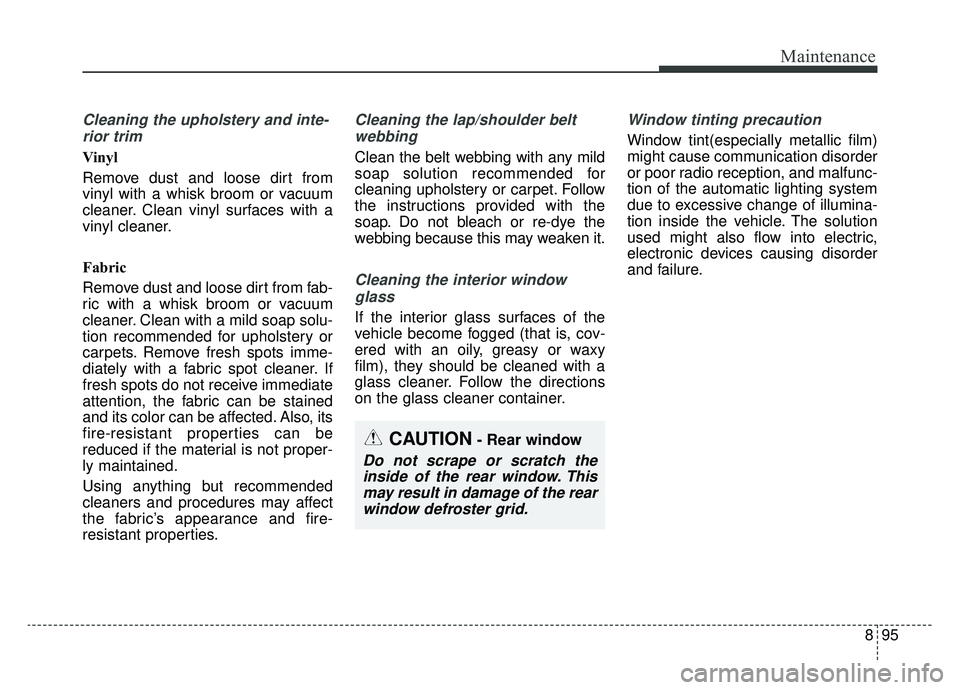
Cleaning the upholstery and inte-rior trim
Vinyl
Remove dust and loose dirt from
vinyl with a whisk broom or vacuum
cleaner. Clean vinyl surfaces with a
vinyl cleaner.
Fabric
Remove dust and loose dirt from fab-
ric with a whisk broom or vacuum
cleaner. Clean with a mild soap solu-
tion recommended for upholstery or
carpets. Remove fresh spots imme-
diately with a fabric spot cleaner. If
fresh spots do not receive immediate
attention, the fabric can be stained
and its color can be affected. Also, its
fire-resistant properties can be
reduced if the material is not proper-
ly maintained.
Using anything but recommended
cleaners and procedures may affect
the fabric’s appearance and fire-
resistant properties.
Cleaning the lap/shoulder beltwebbing
Clean the belt webbing with any mild
soap solution recommended for
cleaning upholstery or carpet. Follow
the instructions provided with the
soap. Do not bleach or re-dye the
webbing because this may weaken it.
Cleaning the interior windowglass
If the interior glass surfaces of the
vehicle become fogged (that is, cov-
ered with an oily, greasy or waxy
film), they should be cleaned with a
glass cleaner. Follow the directions
on the glass cleaner container.
Window tinting precaution
Window tint(especially metallic film)
might cause communication disorder
or poor radio reception, and malfunc-
tion of the automatic lighting system
due to excessive change of illumina-
tion inside the vehicle. The solution
used might also flow into electric,
electronic devices causing disorder
and failure.
CAUTION- Rear window
Do not scrape or scratch theinside of the rear window. Thismay result in damage of the rearwindow defroster grid.
Page 532 of 553
Specifications, Consumer information, Reporting safety defects
69
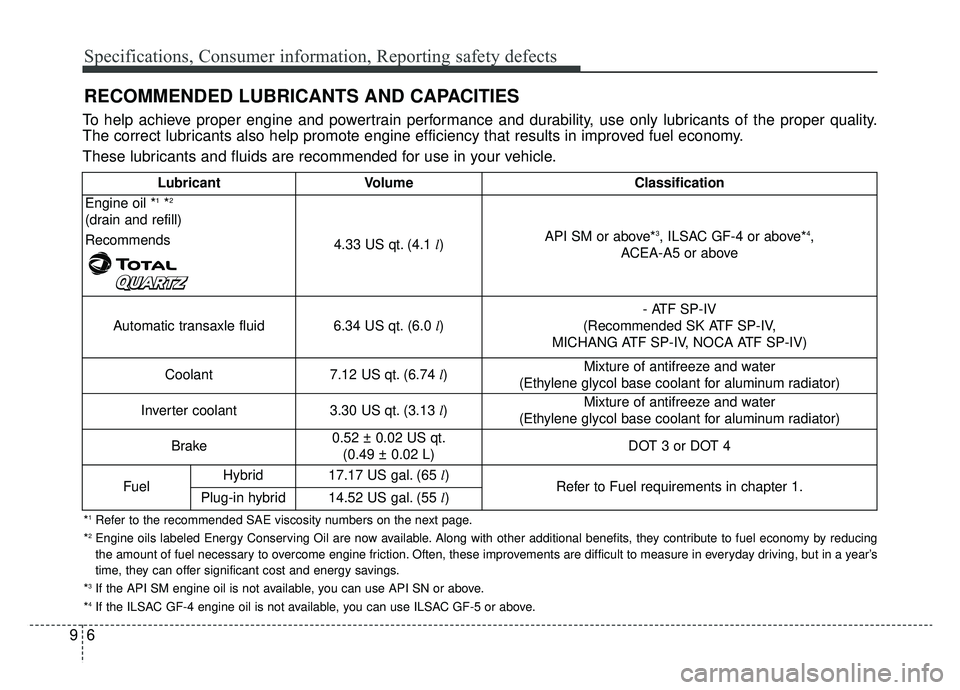
RECOMMENDED LUBRICANTS AND CAPACITIES
To help achieve proper engine and powertrain performance and durability, use only lubricants of the proper quality.
The correct lubricants also help promote engine efficiency that results in improved fuel economy.
These lubricants and fluids are recommended for use in your vehicle.
*1Refer to the recommended SAE viscosity numbers on the next page.
*2Engine oils labeled Energy Conserving Oil are now available. Along with other additional benefits, they contribute to fuel econo my by reducing
the amount of fuel necessary to overcome engine friction. Often, these improvements are difficult to measure in everyday driving, but in a year’s
time, they can offer significant cost and energy savings.
*
3If the API SM engine oil is not available, you can use API SN or above.
*4If the ILSAC GF-4 engine oil is not available, you can use ILSAC GF-5 or above.
Lubricant VolumeClassification
Engine oil *1*2
(drain and refill)
Recommends
4.33 US qt. (4.1 l)API SM or above*3, ILSAC GF-4 or above*4,
ACEA-A5 or above
Automatic transaxle fluid6.34 US qt. (6.0 l)
- ATF SP-IV
(Recommended SK ATF SP-IV,
MICHANG ATF SP-IV, NOCA ATF SP-IV)
Coolant7.12 US qt. (6.74 l)Mixture of antifreeze and water
(Ethylene glycol base coolant for aluminum radiator)
Inverter coolant3.30 US qt. (3.13 l)Mixture of antifreeze and water
(Ethylene glycol base coolant for aluminum radiator)
Brake0.52 ± 0.02 US qt. (0.49 ± 0.02 L)DOT 3 or DOT 4
FuelHybrid17.17 US gal. (65 l)Refer to Fuel requirements in chapter 1.Plug-in hybrid14.52 US gal. (55 l)
Page 533 of 553
97
Specifications, Consumer information, Reporting safety defects
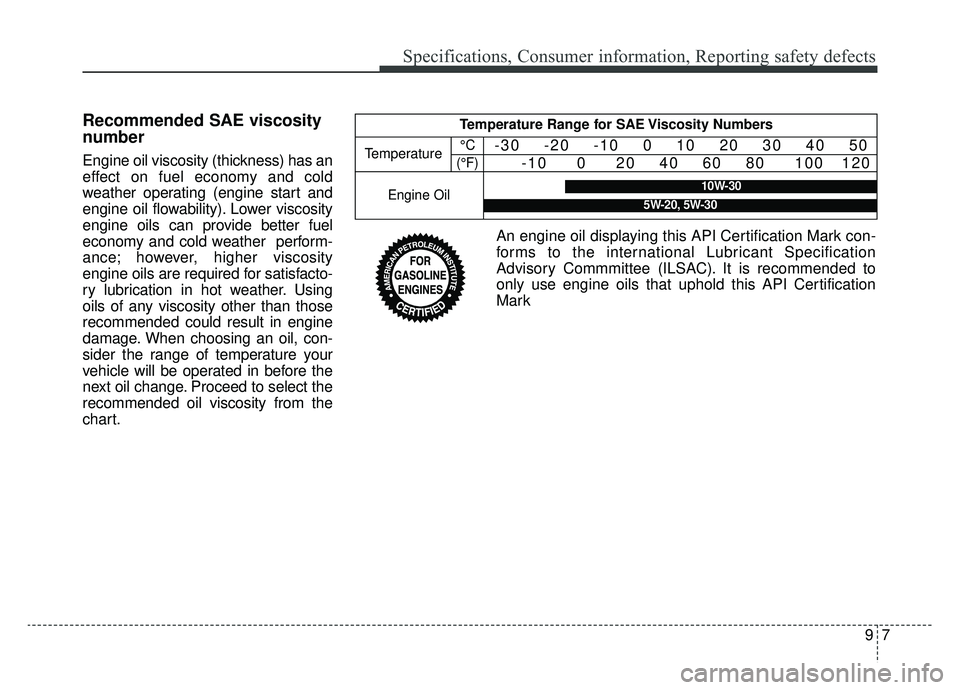
Recommended SAE viscosity
number
Engine oil viscosity (thickness) has an
effect on fuel economy and cold
weather operating (engine start and
engine oil flowability). Lower viscosity
engine oils can provide better fuel
economy and cold weather perform-
ance; however, higher viscosity
engine oils are required for satisfacto-
ry lubrication in hot weather. Using
oils of any viscosity other than those
recommended could result in engine
damage. When choosing an oil, con-
sider the range of temperature your
vehicle will be operated in before the
next oil change. Proceed to select the
recommended oil viscosity from the
chart.
Temperature Range for SAE Viscosity Numbers
Temperature°C
(°F)-30 -20 -10 0 10 20 30 40 50 -10 0 20 40 60 80 100 120
Engine Oil10W-30
5W-20, 5W-30
An engine oil displaying this API Certification Mark con-
forms to the international Lubricant Specification
Advisory Commmittee (ILSAC). It is recommended to
only use engine oils that uphold this API Certification
Mark
Page 535 of 553
99
Specifications, Consumer information, Reporting safety defects
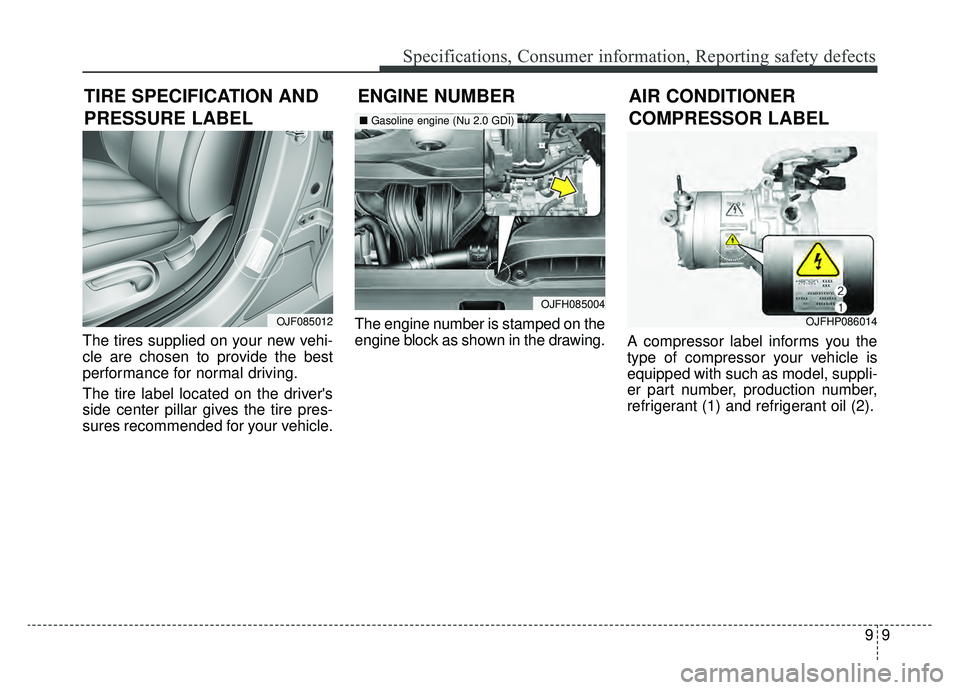
The tires supplied on your new vehi-
cle are chosen to provide the best
performance for normal driving.
The tire label located on the driver's
side center pillar gives the tire pres-
sures recommended for your vehicle.The engine number is stamped on the
engine block as shown in the drawing.
A compressor label informs you the
type of compressor your vehicle is
equipped with such as model, suppli-
er part number, production number,
refrigerant (1) and refrigerant oil (2).
ENGINE NUMBER
TIRE SPECIFICATION AND
PRESSURE LABEL
OJF085012
OJFH085004
■ Gasoline engine (Nu 2.0 GDI)
AIR CONDITIONER
COMPRESSOR LABEL
OJFHP086014
Page 545 of 553

Index
4I
Defroster . . . . . . . . . . . . . . . . . . . . . . . . . . . . . . . . . . . 4-\
117Rear window defroster . . . . . . . . . . . . . . . . . . . . . . 4-117
Dimensions . . . . . . . . . . . . . . . . . . . . . . . . . . . . . . . . . . . 9-\
2
Door locks. . . . . . . . . . . . . . . . . . . . . . . . . . . . . . . . . . . 4-\
13 Child-protector rear door lock . . . . . . . . . . . . . . . . . 4-16
Impact sensing door unlock system . . . . . . . . . . . . . 4-16
Operating door locks from inside the vehicle . . . . . 4-14
Operating door locks from outside the vehicle . . . . 4-13
Drive mode integrated control system . . . . . . . . . . . . . 6-82 Hybrid vehicle . . . . . . . . . . . . . . . . . . . . . . . . . . . . . 6-82
Limitation of Active ECO operation . . . . . . . . . . . . 6-83
When Active ECO is activated . . . . . . . . . . . . . . . . . 6-83
Driver position memory system (for power seat) . . . . . 3-11
Driving the hybrid/plug-in hybrid vehicle . . . . . . . . . . H21
Economical operation . . . . . . . . . . . . . . . . . . . . . . . . . 6-102
Electrical Equipment (U.S. only) . . . . . . . . . . . . . . . . . 9-14 Installation of a mobile two-way radio system . . . . 9-14
Electronic Parking Brake (EPB) . . . . . . . . . . . . . . . . . . 6-22
Electronic Stability Control (ESC) . . . . . . . . . . . . . . . . 6-34
Emergency starting . . . . . . . . . . . . . . . . . . . . . . . . . . . . . 7-5 Jump starting . . . . . . . . . . . . . . . . . . . . . . . . . . . . . . . 7-5
Push-starting . . . . . . . . . . . . . . . . . . . . . . . . . . . . . . . . 7-6 Emission control system . . . . . . . . . . . . . . . . . . . . . . . . 8-96
Crankcase emission control system . . . . . . . . . . . . . 8-96
Evaporative emission control (including ORVR:Onboard Refueling Vapor Recovery) system. . . . . 8-96
Exhaust emission control system . . . . . . . . . . . . . . . 8-97
Energy flow hybrid/plug-in hybrid vehicle . . . . . . . . . . H28
Engine . . . . . . . . . . . . . . . . . . . . . . . . . . . . . . . . . . . . \
. . . 9-2
Engine compartment . . . . . . . . . . . . . . . . . . . . . . . . . . . . 2-6
Engine compartment . . . . . . . . . . . . . . . . . . . . . . . . . . . . 8-3
Engine maintenance mode (for plug-in Hybrid) . . . . . 8-20 Starting engine maintenance mode . . . . . . . . . . . . . 8-20
Stopping engine maintenance mode . . . . . . . . . . . . 8-20
Engine number . . . . . . . . . . . . . . . . . . . . . . . . . . . . . . . . 9-9
Engine oil . . . . . . . . . . . . . . . . . . . . . . . . . . . . . . . . . . . 8-\
18 Changing the engine oil and filter . . . . . . . . . . . . . . 8-19
Checking the engine oil level . . . . . . . . . . . . . . . . . . 8-18
Engine start/stop button . . . . . . . . . . . . . . . . . . . . . . . . . 6-7 Engine start/stop button position . . . . . . . . . . . . . . . . 6-7
Illuminated engine start/stop button. . . . . . . . . . . . . . 6-7
Starting the hybrid system . . . . . . . . . . . . . . . . . . . . . 6-9
Explanation of scheduled maintenance items . . . . . . . 8-14
Exterior overview . . . . . . . . . . . . . . . . . . . . . . . . . . . . . . 2-2
Forward Collision-avoidance Assist (FCA) . . . . . . . . . 6-43 Brake operation . . . . . . . . . . . . . . . . . . . . . . . . . . . . 6-46
FCA front radar/Camera sensor . . . . . . . . . . . . . . . . 6-47
E
F
Page 552 of 553
I11
Index
Winter driving . . . . . . . . . . . . . . . . . . . . . . . . . . . . . . . 6-108Carry emergency equipment . . . . . . . . . . . . . . . . . 6-111
Change to "winter weight" oil if necessary . . . . . . 6-110
Check battery and cables . . . . . . . . . . . . . . . . . . . . 6-110
Check spark plugs and ignition system . . . . . . . . . 6-110
Don’t let your parking brake freeze . . . . . . . . . . . . 6-111
Don't let ice and snow accumulate underneath . . . 6-111
Snowy or icy conditions . . . . . . . . . . . . . . . . . . . . . 6-108
To keep locks from freezing. . . . . . . . . . . . . . . . . . 6-111
Use approved window washer anti-freeze in system. . . . . . . . . . . . . . . . . . . . . . . . . . . . . . . . . . 6-11\
1
Use high quality ethylene glycol coolant. . . . . . . . 6-110
Wiper blades . . . . . . . . . . . . . . . . . . . . . . . . . . . . . . . . . 8-32 Blade inspection . . . . . . . . . . . . . . . . . . . . . . . . . . . . 8-32
Blade replacement . . . . . . . . . . . . . . . . . . . . . . . . . . 8-32
Wipers and washers . . . . . . . . . . . . . . . . . . . . . . . . . . 4-111 Front windshield washers. . . . . . . . . . . . . . . . . . . . 4-112
Windshield wipers . . . . . . . . . . . . . . . . . . . . . . . . . 4-111