brake KIA OPTIMA PHEV 2020 Owners Manual
[x] Cancel search | Manufacturer: KIA, Model Year: 2020, Model line: OPTIMA PHEV, Model: KIA OPTIMA PHEV 2020Pages: 597, PDF Size: 14.2 MB
Page 558 of 597
Maintenance
90
7
APPEARANCE CARE
Exterior care
Exterior general caution
It is very important to follow the label
directions when using any chemical
cleaner or polish. Read all warning
and caution statements that appear
on the label.
Finish maintenance
Washing
To help protect your vehicle’s finish
from rust and deterioration, wash it
thoroughly and frequently at least
once a month with lukewarm or cold
water.
If you use your vehicle for off-road
driving, you should wash it after each
off-road trip. Pay special attention to
the removal of any accumulation of
salt, dirt, mud, and other foreign mate-
rials. Make sure the drain holes in the
lower edges of the doors and rocker
panels are kept clear and clean.
Insects, tar, tree sap, bird droppings,
industrial pollution and similar
deposits can damage your vehicle’s
finish if not removed immediately. Even prompt washing with plain water
may not completely remove all these
deposits. A mild soap, safe for use on
painted surfaces, may be used.
After washing, rinse the vehicle thor-
oughly with lukewarm or cold water.
Do not allow soap to dry on the finish.
After washing the vehicle, test the
brakes while driving slowly to see if
they have been affected by water. If
braking performance is impaired, dry
the brakes by applying them lightly
while maintaining a slow forward
speed.
Page 561 of 597
793
Maintenance
Underbody maintenance
Road salt and other corrosive chemi-
cals are used in cold weather states to
melt snow and prevent ice accumula-
tion. If these chemicals are not regu-
larly removed, they will corrode the
vehicle underbody and over time dam-
age fuel lines, the fuel tank retention
system, the vehicle suspension, the
exhaust system, and even the body
frame. The National Highway Traffic
Safety Administration has warned all
vehicle owners of all brands of the
need to take the following steps:
Wash the undercarriage of yourvehicle regularly during the winter
and whenever your vehicle has
been exposed to such salts or
chemicals.
Do a thorough washing of the undercarriage at the end of the
winter.
Use professional service techni- cians or governmental inspection
stations to annually inspect for cor-
rosion. Immediately seek an inspection of
your vehicle if you become visually
aware of corrosion flaking or scal-
ing or if you become aware of a
change in vehicle performance,
such as soft or spongey brakes,
fluids leaking, impairment of direc-
tional control, suspension noises
or rattling metal straps.
Aluminum wheel maintenance
The aluminum wheels are coated
with a clear protective finish.
Do not use any abrasive cleaner,polishing compound, solvent, or
wire brushes on aluminum wheels.
They may scratch the finish.
Clean the wheel when it has cooled.
Use only a mild soap or neutral detergent, and rinse thoroughly with
water. Also, be sure to clean the
wheels after driving on salted roads.
This helps prevent corrosion.
Avoid washing the wheels with highspeed vehicle wash brushes.
Do not use any alkaline or acid detergents It may damage and cor-
rode the aluminum wheels coated
with a clear protective finish.
Page 562 of 597
Maintenance
94
7
Corrosion protection
Protecting your vehicle from corrosion
By using advanced design and con-
struction practices to combat corro-
sion, we produce vehicles of excel-
lent quality. However, this is only part
of the job. To achieve the long-term
corrosion resistance your vehicle can
deliver, the owner's cooperation and
assistance is also required.
Common causes of corrosion
The most common causes of corro-
sion on your vehicle are:
Road salt, dirt and moisture that is
allowed to accumulate underneath
the vehicle.
Removal of paint or protective coatings by stones, gravel, abra-
sion or minor scrapes and dents
which leave unprotected metal
exposed to corrosion. High-corrosion areas
If you live in an area where your vehi-
cle is regularly exposed to corrosive
materials, corrosion protection is
particularly important. Some of the
common causes of accelerated cor-
rosion are road salts, dust control
chemicals, ocean air and industrial
pollution.
Moisture breeds corrosion
Moisture creates the conditions in
which corrosion is most likely to
occur. For example, corrosion is
accelerated by high humidity, partic-
ularly when temperatures are just
above freezing. In such conditions,
the corrosive material is kept in con-
tact with the vehicle’s surface by
moisture that evaporates slowly.
Mud is particularly corrosive
because it dries slowly and holds
moisture in contact with the vehicle.
Although the mud appears to be dry,
it can still retain the moisture and
promote corrosion.WARNING
After washing the vehicle, test
the brakes while driving slowly
to see if they have been affected
by water. If braking performance
is impaired, dry the brakes by
applying them lightly while
maintaining a slow forward
speed.
Page 576 of 597
Specifications, Consumer information, Reporting safety defects
68
RECOMMENDED LUBRICANTS AND CAPACITIES
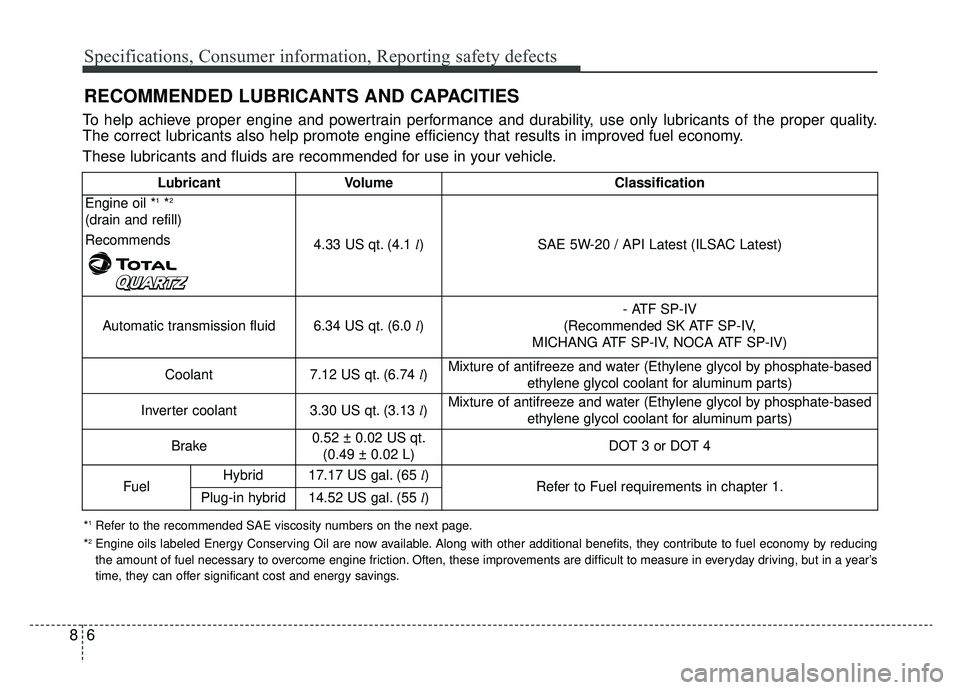
To help achieve proper engine and powertrain performance and durability, use only lubricants of the proper quality.
The correct lubricants also help promote engine efficiency that results in improved fuel economy.
These lubricants and fluids are recommended for use in your vehicle.
*1Refer to the recommended SAE viscosity numbers on the next page.
*2Engine oils labeled Energy Conserving Oil are now available. Along with other additional benefits, they contribute to fuel econo my by reducing
the amount of fuel necessary to overcome engine friction. Often, these improvements are difficult to measure in everyday driving, but in a year’s
time, they can offer significant cost and energy savings.
Lubricant VolumeClassification
Engine oil *1*2
(drain and refill)
Recommends
4.33 US qt. (4.1 l)SAE 5W-20 / API Latest (ILSAC Latest)
Automatic transmission fluid6.34 US qt. (6.0 l)
- ATF SP-IV
(Recommended SK ATF SP-IV,
MICHANG ATF SP-IV, NOCA ATF SP-IV)
Coolant7.12 US qt. (6.74 l)Mixture of antifreeze and water (Ethylene glycol by phosphate-based
ethylene glycol coolant for aluminum parts)
Inverter coolant3.30 US qt. (3.13 l)Mixture of antifreeze and water (Ethylene glycol by phosphate-basedethylene glycol coolant for aluminum parts)
Brake0.52 ± 0.02 US qt.(0.49 ± 0.02 L)DOT 3 or DOT 4
FuelHybrid17.17 US gal. (65 l)Refer to Fuel requirements in chapter 1.Plug-in hybrid14.52 US gal. (55 l)
Page 588 of 597

I3
Index
Brake fluid ....................................................................7-25\
Checking the brake fluid level ....................................7-25
Brake system..................................................................5-19 Anti-lock Brake System (ABS) ..................................5-33
Auto hold ....................................................................5-29\
Electronic Parking Brake (EPB) ................................5-22
Electronic Stability Control (ESC) ............................5-34
Good braking practices ..............................................5-41
Hill-start Assist Control (HAC) ..................................5-40
Parking brake - Foot type ..........................................5-21
Power brakes ..............................................................5-19
Vehicle Stability Management (VSM)........................5-39
Warning messages ......................................................5-31
Bulb wattage ....................................................................8-3
Checking fluid levels ....................................................7-17
Child Restraint System (CRS) ......................................3-33 Children always in the rear ........................................3-33
Installing a Child Restraint System (CRS) ................3-37
Selecting a Child Restraint System (CRS) ................3-34
Clean air ......................................................................4-\
137
Climate control air filter ................................................7-30 Filter inspection ..........................................................7-30
Consumer assistance (U.S. only) ..................................8-11 Emergency roadside assistance ..................................8-11
Registering your vehicle in a foreign country ............8-13 Toll free consumer assistance ....................................8-11
Trip interruption ..........................................................8-12
Coolant ........................................................................\
..7-21 Changing the coolant ..................................................7-24
Checking the coolant level..........................................7-21
Engine coolant ............................................................7-22
Inverter coolant ..........................................................7-22
Recommended coolant ................................................7-23
Cruise Control System ..................................................5-72 To cancel cruise control, do one of the following ......5-74
To decrease the cruising speed ..................................5-74
To increase cruise control set speed ..........................5-73
To resume cruising speed at more than approximately 20 mph (30 km/h) ....................................................5-75
To set cruise control speed..........................................5-73
To temporarily accelerate with the cruise control on ..5-74
To turn cruise control off, do one of the following ....5-75
Declaration of Conformity ..........................................4-156 FCC ........................................................................\
..4-156
Defroster ......................................................................4-\
118 Rear window defroster ..............................................4-118
Dimensions ......................................................................8-\
2
Door locks......................................................................4-\
13 Child-protector rear door lock ....................................4-16
Impact sensing door unlock system ............................4-16
C
D
Page 589 of 597

Index
4I
Operating door locks from inside the vehicle ............4-14
Operating door locks from outside the vehicle ..........4-13
Drive mode integrated control system ..........................5-96 Hybrid vehicle ............................................................5-96
Limitation of ECO operation ......................................5-97
When ECO is activated ..............................................5-97
Driver Attention Warning (DAW)................................5-125 Resetting the system ................................................5-127
System disabled ........................................................5-127
System malfunction ..................................................5-128
System setting and activation ..................................5-125
ECO system ..................................................................5-98 Limitation of ECO operation ......................................5-99
Plug-in hybrid vehicle ................................................5-98
When ECO is activated ..............................................5-99
Economical operation ..................................................5-130
Electrical equipment (U.S. only) ..................................8-14 Installation of a mobile two-way radio system ..........8-14
Emergency starting ..........................................................6-5 Jump starting ................................................................6-5
Push-starting ................................................................6-6 Emission control system ................................................7-99
Crankcase emission control system ............................7-99
Evaporative emission control (including ORVR : Onboard Refueling Vapor Recovery) system ..........7-99
Exhaust emission control system ..............................7-100
Engine ........................................................................\
......8-2
Engine compartment ................................................2-6, 7-3
Engine maintenance mode (for plug-in Hybrid) ..........7-20 Starting Engine Maintenance Mode ..........................7-20
Stopping Engine Maintenance Mode..........................7-20
Engine number ................................................................8-9
Engine oil ......................................................................7-\
18 Changing the engine oil and filter ..............................7-19
Checking the engine oil level ....................................7-18
Engine start/stop button ..................................................5-7 Engine start/stop button position ..................................5-7
Illuminated engine start/stop button ............................5-7
Starting the hybrid system ............................................5-9
Explanation of scheduled maintenance items ..............7-14
Exterior overview ............................................................2-2
Forward Collision-avoidance Assist (FCA) system ......5-43 Brake operation ..........................................................5-47
FCA sensor (Front view camera)................................5-48
FCA warning message and system control ................5-45
Limitation of the system ............................................5-51
E
F
Page 590 of 597
I5
Index
System malfunction ....................................................5-49
System setting and activation ....................................5-43
Forward Collision-avoidance Assist (FCA) system - sensor fusion type (front radar+front view camera) ..5-57Brake operation ..........................................................5-61
FCA sensor (front radar + front view camera) ..........5-62
FCA warning message and system control ................5-59
Limitation of the system ............................................5-65
System malfunction ....................................................5-64
System setting and activation ....................................5-57
Fuel filler lid (Hybrid) ..................................................4-31 Closing the fuel filler lid ............................................4-31
Emergency fuel filler lid release ................................4-34
Opening the fuel filler lid ..........................................4-31
Fuel filler lid (plug-in Hybrid) ......................................4-35 Closing the fuel filler lid ............................................4-37
Emergency fuel filler lid release ................................4-37
Opening the fuel filler lid ..........................................4-35
Fuel requirements ............................................................1-2 Do not use methanol ....................................................1-2
Fuel additives ................................................................1-3
Gasoline containing alcohol and methanol ..................1-2
Operation in foreign countries ......................................1-4
Fuses ........................................................................\
......7-53 Engine compartment fuse replacement ......................7-57
Fuse/relay panel description ......................................7-59
Inner panel fuse replacement ......................................7-55 Gross vehicle weight........................................................8-5\
HEV/PHEV powertrain ..................................................1-5
Hood ........................................................................\
......4-29
Closing the hood ........................................................4-30
Hood open warning ....................................................4-29
Opening the hood ........................................................4-29
If an accident occurs ......................................................6-29
If the engine overheats ....................................................6-7
If the engine will not start ..............................................6-4 If engine doesn't turn over or turns over slowly ..........6-4
If engine turns over normally but does not start ..........6-4
If you have a flat tire (With Tire Mobility Kit) ............6-16 Checking the tire inflation pressure ............................6-23
Components of the Tire Mobility Kit ........................6-19
Distributing the sealant ..............................................6-22
Introduction ................................................................6-17
Notes on the safe use of the Tire Mobility Kit ..........6-17
Technical Data ............................................................6-23
Using the Tire Mobility Kit ........................................6-20G
H
I
Page 593 of 597
Index
8I
Owner maintenance ........................................................7-6Owner maintenance schedule ......................................7-6
Panoramic sunroof ........................................................4-38 Closing the sunroof ....................................................4-43
Resetting the sunroof ..................................................4-43
Sliding the sunroof ......................................................4-41
Sunroof open warning ................................................4-39
Sunshade ....................................................................4-40\
Tilting the sunroof ......................................................4-42
Parking brake ................................................................7-27 Checking the parking brake ........................................7-27
Parking distance warning - reverse ................................4-99 Non-operational conditions of the parking distance warning-reverse system ..........................................4-100
Operation of the parking distance warning-reverse ....4-99
Parking distance warning-reverse system precautions ..............................................................4-101
Self-diagnosis............................................................4-101
Rearview monitor ........................................................4-102
Recommended lubricants and capacities ........................8-6 Recommended SAE viscosity number ........................8-7
Refrigerant label ............................................................8-10 Reporting safety defects (U.S. only) ............................8-15
Road warning ..................................................................6-2
Hazard warning flasher ................................................6-2
Scheduled maintenance service ......................................7-8
Seat ........................................................................\
..........3-4 Driver position memory system (for power seat) ......3-11
Front seat adjustment - manual ....................................3-7
Front seat adjustment - power ......................................3-8
Headrest (for front seat) ..............................................3-12
Rear seat adjustment ..................................................3-15
Seatback pocket ..........................................................3-15
Seat belts ........................................................................\
3-21 Care of seat belts ........................................................3-32
Pre-tensioner seat belt ................................................3-28
Seat belt precautions ..................................................3-30
Seat belt restraint system ............................................3-21
Smart cruise control with Stop & Go system ................5-76 Limitations of the system............................................5-9\
0
Smart Cruise Control speed ........................................5-78
Smart Cruise Control switch ......................................5-78
To adjust the sensitivity of smart cruise control ........5-89
To convert to cruise control mode ..............................5-89
Vehicle to vehicle distance setting ..............................5-83
When the lane ahead is clear ......................................5-84
When there is a vehicle ahead of you in your lane ....5-85
R
S
P
Page 595 of 597
Index
10I
Tire rotation ................................................................7-41
Tire sidewall labeling ..................................................7-44
Tire traction ................................................................7-44
Wheel alignment and tire balance ..............................7-42
Wheel replacement ....................................................7-43
Towing ........................................................................\
..6-24 Emergency towing ......................................................6-26
Removable towing hook ............................................6-25
Towing service ............................................................6-24
Trailer Towing..............................................................5-139
Vehicle break-in process ..................................................1-5
Vehicle certification label ................................................8-8
Vehicle data collection and event data recorders ............1-6
Vehicle Identification Number (VIN) ..............................8-8
Vehicle load limit ........................................................5-140 Certification label......................................................5-143
Tire and loading information label ..........................5-140
Vehicle modifications ......................................................1-5
Vehicle weight ............................................................5-144 Base curb weight ......................................................5-144
Cargo weight ............................................................5-144
GAW (Gross Axle Weight) ......................................5-144
GAWR (Gross Axle Weight Rating) ........................5-144
GVW (Gross Vehicle Weight) ..................................5-144 GVWR (Gross Vehicle Weight Rating) ....................5-144
Vehicle curb weight ..................................................5-144
Warning and indicator lights..........................................4-84 Indicator lights ............................................................4-92
Warning lights ............................................................4-84
Washer fluid ..................................................................7-26 Checking the washer fluid level..................................7-26
Welcome system ..........................................................4-117 Headlight (Headlamp) escort function......................4-117
Interior light ..............................................................4-117
Pocket lamp ..............................................................4-117
Windows ........................................................................\
4-24 Power windows ..........................................................4-25
Windshield defrosting and defogging..........................4-134 Automatic climate control system ............................4-134
Defogging logic ........................................................4-135
Winter driving ..............................................................5-136 Carry emergency equipment ....................................5-139
Change to "winter weight" oil if necessary ..............5-138
Check battery and cables ..........................................5-138
Check spark plugs and ignition system ....................5-138
Don't let your parking brake freeze ..........................5-139
Don't let ice and snow accumulate underneath ........5-139
Snowy or icy conditions ..........................................5-136
To keep locks from freezing ....................................5-139
V
W