engine coolant KIA OPTIMA PHEV 2020 Owner's Manual
[x] Cancel search | Manufacturer: KIA, Model Year: 2020, Model line: OPTIMA PHEV, Model: KIA OPTIMA PHEV 2020Pages: 597, PDF Size: 14.2 MB
Page 490 of 597
Maintenance
22
7
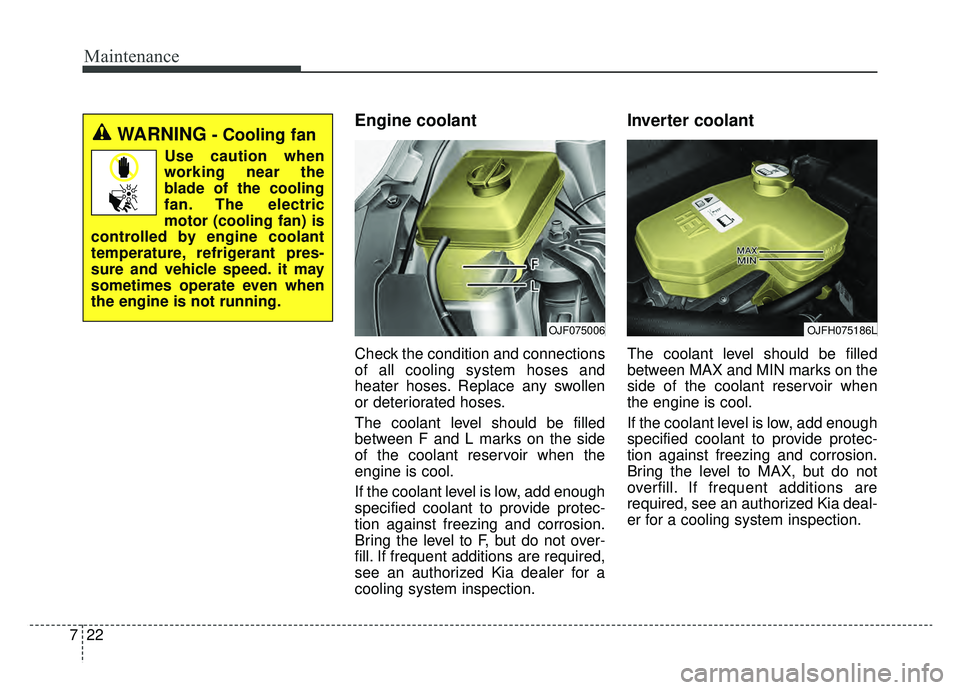
Engine coolant
Check the condition and connections
of all cooling system hoses and
heater hoses. Replace any swollen
or deteriorated hoses.
The coolant level should be filled
between F and L marks on the side
of the coolant reservoir when the
engine is cool.
If the coolant level is low, add enough
specified coolant to provide protec-
tion against freezing and corrosion.
Bring the level to F, but do not over-
fill. If frequent additions are required,
see an authorized Kia dealer for a
cooling system inspection.
Inverter coolant
The coolant level should be filled
between MAX and MIN marks on the
side of the coolant reservoir when
the engine is cool.
If the coolant level is low, add enough
specified coolant to provide protec-
tion against freezing and corrosion.
Bring the level to MAX, but do not
overfill. If frequent additions are
required, see an authorized Kia deal-
er for a cooling system inspection.
OJF075006OJFH075186L
WARNING- Cooling fan
Use caution when
working near the
blade of the cooling
fan. The electric
motor (cooling fan) is
controlled by engine coolant
temperature, refrigerant pres-
sure and vehicle speed. it may
sometimes operate even when
the engine is not running.
Page 491 of 597
723
Maintenance
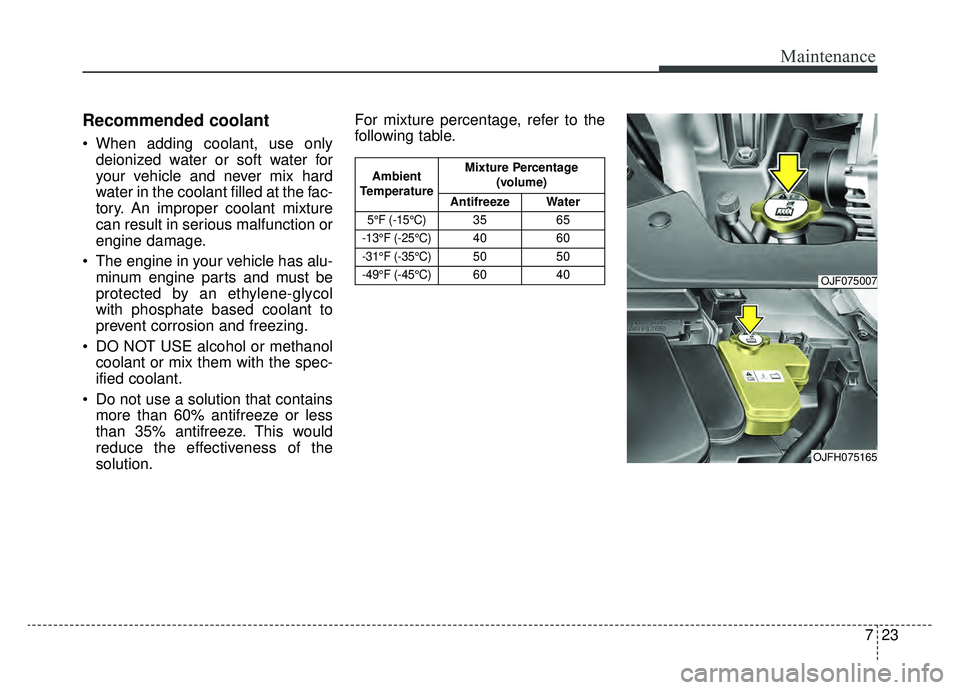
Recommended coolant
When adding coolant, use onlydeionized water or soft water for
your vehicle and never mix hard
water in the coolant filled at the fac-
tory. An improper coolant mixture
can result in serious malfunction or
engine damage.
The engine in your vehicle has alu- minum engine parts and must be
protected by an ethylene-glycol
with phosphate based coolant to
prevent corrosion and freezing.
DO NOT USE alcohol or methanol coolant or mix them with the spec-
ified coolant.
Do not use a solution that contains more than 60% antifreeze or less
than 35% antifreeze. This would
reduce the effectiveness of the
solution. For mixture percentage, refer to the
following table.
Ambient
Temperature Mixture Percentage
(volume)
Antifreeze Water
5°F (-15°C)35 65
-13°F (-25°C)4060
-31°F (-35°C)5050
-49°F (-45°C)6040OJF075007
OJFH075165
Page 492 of 597
Maintenance
24
7
Changing the coolant
Have the coolant changed by an
authorized Kia dealer according to
the Maintenance Schedule at the
beginning of this chapter.
CAUTION
Put a thick cloth or fabric
around the radiator cap beforerefilling the coolant in order toprevent the coolant from over-flowing into engine parts suchas the generator.
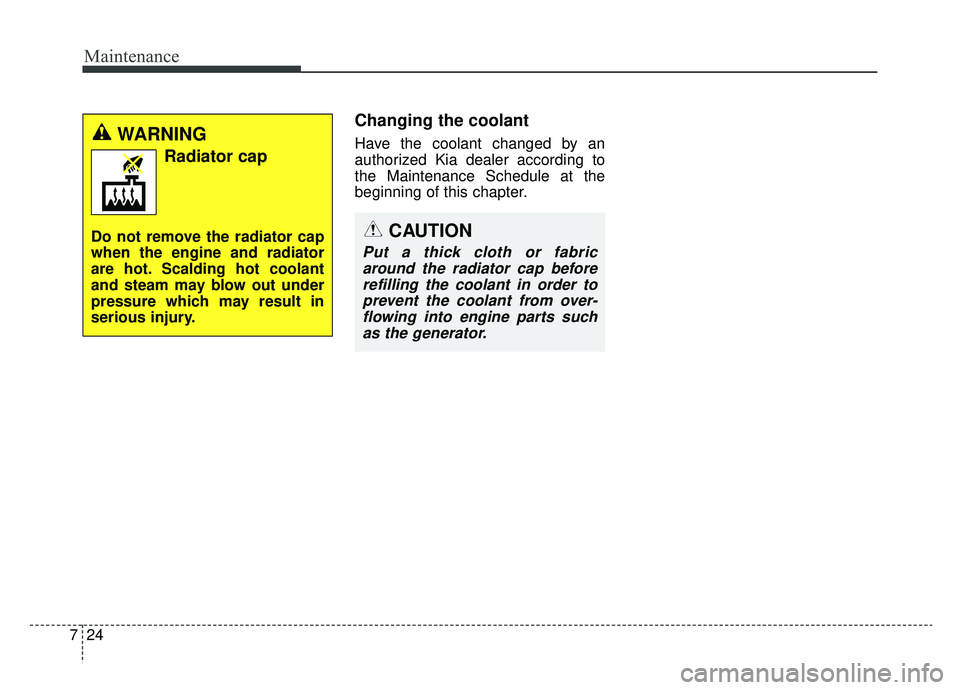
WARNING
Radiator cap
Do not remove the radiator cap
when the engine and radiator
are hot. Scalding hot coolant
and steam may blow out under
pressure which may result in
serious injury.
Page 568 of 597
Maintenance
100
7
Canister
Fuel vapors generated inside the fuel
tank are absorbed and stored in the
onboard canister. When the engine is
running, the fuel vapors absorbed in
the canister are drawn into the surge
tank through the purge control sole-
noid valve.
Purge Control Solenoid Valve
(PCSV)
The purge control solenoid valve is
controlled by the Engine Control
Module (ECM); when the engine
coolant temperature is low during
idling, the PCSV closes so that evap-
orated fuel is not taken into the
engine. After the engine warms up
during ordinary driving, the PCSV
opens to introduce evaporated fuel to
the engine.
3. Exhaust emission control system
The Exhaust Emission Control
System is a highly effective system
which controls exhaust emissions
while maintaining good vehicle per-
formance.
Engine exhaust gas precautions
(carbon monoxide)
Carbon monoxide can be present with other exhaust fumes.
Therefore, if you smell exhaust
fumes of any kind inside your vehi-
cle, have it inspected and repaired
immediately. If you ever suspect
exhaust fumes are coming into
your vehicle, drive it only with all
the windows fully open. Have your
vehicle checked and repaired
immediately.
WARNING - Exhaust
Engine exhaust gases contain
carbon monoxide (CO). Though
colorless and odorless, it is
dangerous and could be lethal if
inhaled. Follow the instructions
on this page to avoid CO poi-
soning.
Page 576 of 597
Specifications, Consumer information, Reporting safety defects
68
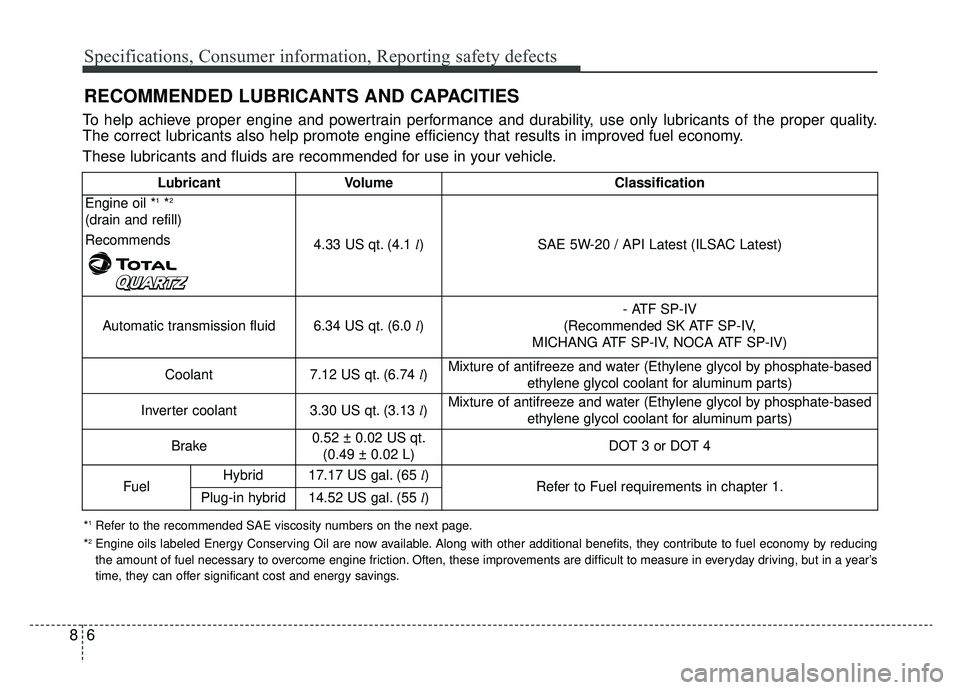
RECOMMENDED LUBRICANTS AND CAPACITIES
To help achieve proper engine and powertrain performance and durability, use only lubricants of the proper quality.
The correct lubricants also help promote engine efficiency that results in improved fuel economy.
These lubricants and fluids are recommended for use in your vehicle.
*1Refer to the recommended SAE viscosity numbers on the next page.
*2Engine oils labeled Energy Conserving Oil are now available. Along with other additional benefits, they contribute to fuel econo my by reducing
the amount of fuel necessary to overcome engine friction. Often, these improvements are difficult to measure in everyday driving, but in a year’s
time, they can offer significant cost and energy savings.
Lubricant VolumeClassification
Engine oil *1*2
(drain and refill)
Recommends
4.33 US qt. (4.1 l)SAE 5W-20 / API Latest (ILSAC Latest)
Automatic transmission fluid6.34 US qt. (6.0 l)
- ATF SP-IV
(Recommended SK ATF SP-IV,
MICHANG ATF SP-IV, NOCA ATF SP-IV)
Coolant7.12 US qt. (6.74 l)Mixture of antifreeze and water (Ethylene glycol by phosphate-based
ethylene glycol coolant for aluminum parts)
Inverter coolant3.30 US qt. (3.13 l)Mixture of antifreeze and water (Ethylene glycol by phosphate-basedethylene glycol coolant for aluminum parts)
Brake0.52 ± 0.02 US qt.(0.49 ± 0.02 L)DOT 3 or DOT 4
FuelHybrid17.17 US gal. (65 l)Refer to Fuel requirements in chapter 1.Plug-in hybrid14.52 US gal. (55 l)
Page 588 of 597

I3
Index
Brake fluid ....................................................................7-25\
Checking the brake fluid level ....................................7-25
Brake system..................................................................5-19 Anti-lock Brake System (ABS) ..................................5-33
Auto hold ....................................................................5-29\
Electronic Parking Brake (EPB) ................................5-22
Electronic Stability Control (ESC) ............................5-34
Good braking practices ..............................................5-41
Hill-start Assist Control (HAC) ..................................5-40
Parking brake - Foot type ..........................................5-21
Power brakes ..............................................................5-19
Vehicle Stability Management (VSM)........................5-39
Warning messages ......................................................5-31
Bulb wattage ....................................................................8-3
Checking fluid levels ....................................................7-17
Child Restraint System (CRS) ......................................3-33 Children always in the rear ........................................3-33
Installing a Child Restraint System (CRS) ................3-37
Selecting a Child Restraint System (CRS) ................3-34
Clean air ......................................................................4-\
137
Climate control air filter ................................................7-30 Filter inspection ..........................................................7-30
Consumer assistance (U.S. only) ..................................8-11 Emergency roadside assistance ..................................8-11
Registering your vehicle in a foreign country ............8-13 Toll free consumer assistance ....................................8-11
Trip interruption ..........................................................8-12
Coolant ........................................................................\
..7-21 Changing the coolant ..................................................7-24
Checking the coolant level..........................................7-21
Engine coolant ............................................................7-22
Inverter coolant ..........................................................7-22
Recommended coolant ................................................7-23
Cruise Control System ..................................................5-72 To cancel cruise control, do one of the following ......5-74
To decrease the cruising speed ..................................5-74
To increase cruise control set speed ..........................5-73
To resume cruising speed at more than approximately 20 mph (30 km/h) ....................................................5-75
To set cruise control speed..........................................5-73
To temporarily accelerate with the cruise control on ..5-74
To turn cruise control off, do one of the following ....5-75
Declaration of Conformity ..........................................4-156 FCC ........................................................................\
..4-156
Defroster ......................................................................4-\
118 Rear window defroster ..............................................4-118
Dimensions ......................................................................8-\
2
Door locks......................................................................4-\
13 Child-protector rear door lock ....................................4-16
Impact sensing door unlock system ............................4-16
C
D