door lock KIA OPTIMA PHEV 2020 Owners Manual
[x] Cancel search | Manufacturer: KIA, Model Year: 2020, Model line: OPTIMA PHEV, Model: KIA OPTIMA PHEV 2020Pages: 597, PDF Size: 14.2 MB
Page 16 of 597
H9
AC Charge
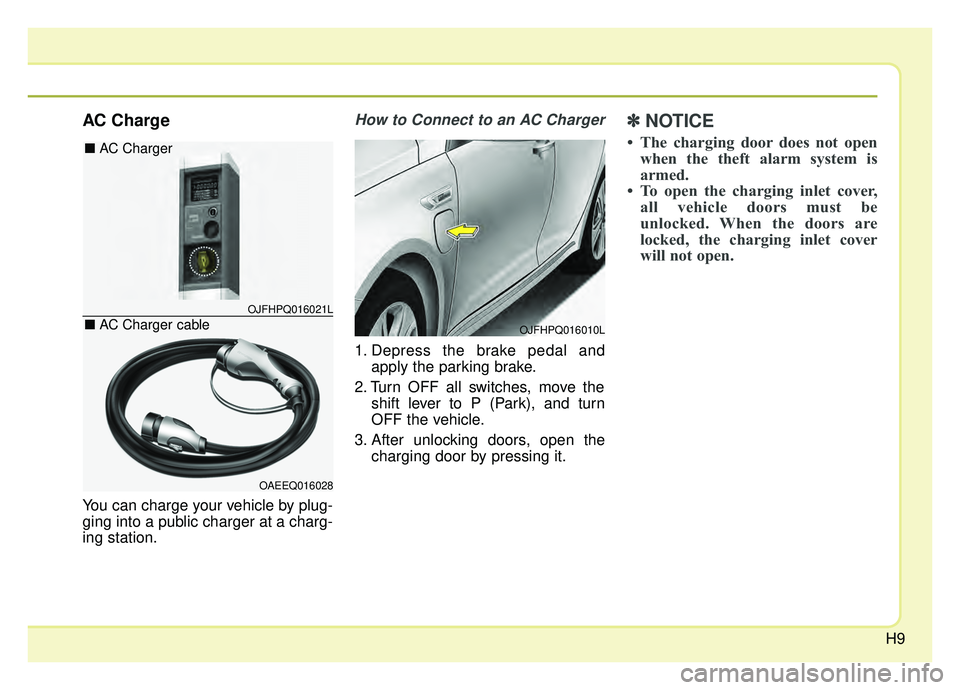
You can charge your vehicle by plug-
ging into a public charger at a charg-
ing station.
How to Connect to an AC Charger
1. Depress the brake pedal andapply the parking brake.
2. Turn OFF all switches, move the shift lever to P (Park), and turn
OFF the vehicle.
3. After unlocking doors, open the charging door by pressing it.
✽ ✽NOTICE
• The charging door does not open
when the theft alarm system is
armed.
• To open the charging inlet cover, all vehicle doors must be
unlocked. When the doors are
locked, the charging inlet cover
will not open.
OJFHPQ016010L
OJFHPQ016021L
OAEEQ016028
■ AC Charger
■ AC Charger cable
Page 18 of 597

H11
7. After charging has started, theestimated charging time is dis-
played on the instrument cluster
for about 1 minute. It is also dis-
played when the driver's door is
opened with charging in progress.
When scheduled charging is set,
the estimated charging time is dis-
played as “--” .
Unlock Charging Door in
Emergency
If the charging door does not open
due to battery discharge, open the
hood and slightly pull the emergency
cable which is located in headlamp
cover as shown above.
The charging door will then open.
Charging Status
Checking Charging Status
You can monitor the charging status
outside of the vehicle when charging
the high-voltage battery.
OJFHPQ018041L
OJFHP076232NOJFHPQ016009L
Page 19 of 597
H12
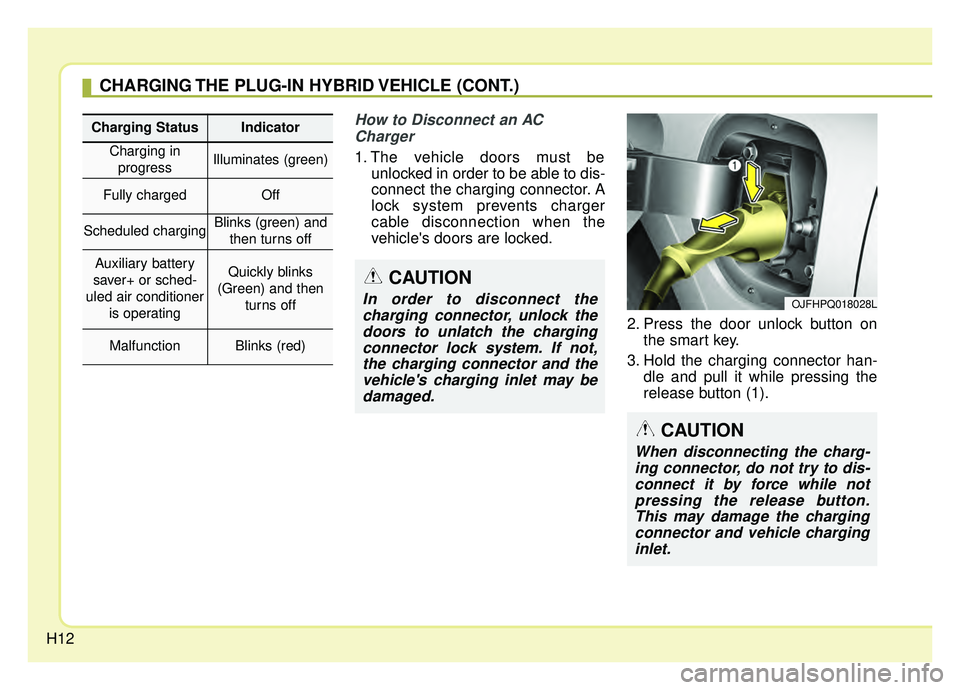
How to Disconnect an ACCharger
1. The vehicle doors must be unlocked in order to be able to dis-
connect the charging connector. A
lock system prevents charger
cable disconnection when the
vehicle's doors are locked.
2. Press the door unlock button onthe smart key.
3. Hold the charging connector han- dle and pull it while pressing the
release button (1).
OJFHPQ018028L
Charging StatusIndicator
Charging in
progressIlluminates (green)
Fully chargedOff
Scheduled chargingBlinks (green) and then turns off
Auxiliary battery
saver+ or sched-
uled air conditioner is operatingQuickly blinks
(Green) and then turns off
MalfunctionBlinks (red)
CHARGING THE PLUG-IN HYBRID VEHICLE (CONT.)
CAUTION
In order to disconnect thecharging connector, unlock thedoors to unlatch the chargingconnector lock system. If not,the charging connector and thevehicle's charging inlet may bedamaged.
CAUTION
When disconnecting the charg-ing connector, do not try to dis-connect it by force while notpressing the release button.This may damage the chargingconnector and vehicle charginginlet.
Page 23 of 597
H16
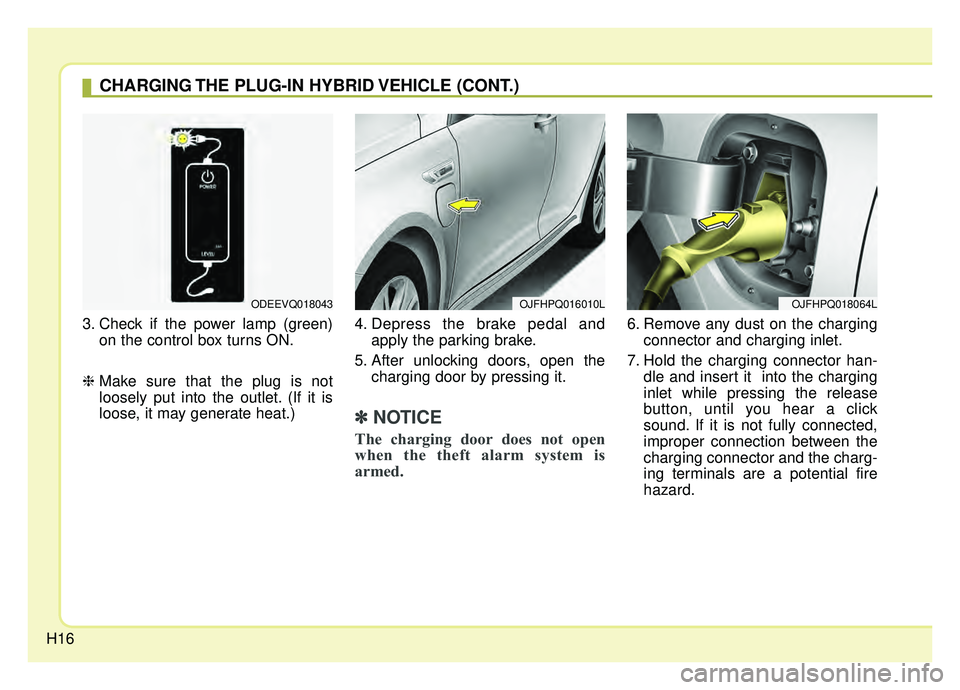
3. Check if the power lamp (green)on the control box turns ON.
❈ Make sure that the plug is not
loosely put into the outlet. (If it is
loose, it may generate heat.) 4. Depress the brake pedal and
apply the parking brake.
5. After unlocking doors, open the charging door by pressing it.
✽ ✽NOTICE
The charging door does not open
when the theft alarm system is
armed.
6. Remove any dust on the charging
connector and charging inlet.
7. Hold the charging connector han- dle and insert it into the charging
inlet while pressing the release
button, until you hear a click
sound. If it is not fully connected,
improper connection between the
charging connector and the charg-
ing terminals are a potential fire
hazard.
OJFHPQ016010L
CHARGING THE PLUG-IN HYBRID VEHICLE (CONT.)
ODEEVQ018043OJFHPQ018064L
Page 25 of 597

H18
10. After charging has started, theestimated charging time is dis-
played on the instrument cluster
for about 1 minute. It is also dis-
played when the driver's door is
opened with charging in progress.
When scheduled charging is set,
the estimated charging time is dis-
played as "--".
Unlock Charging Door in
Emergency
If the charging door does not open
due to battery discharge, open the
hood and slightly pull the emergency
cable which is located in headlamp
cover as shown above.
The charging door will then open.
Checking Charging Status
You can monitor the charging status
outside of the vehicle when charging
the high-voltage battery.
CHARGING THE PLUG-IN HYBRID VEHICLE (CONT.)
OJFHPQ016009L
OJFHPQ018041L
OJFHP076232N
Page 30 of 597
H23
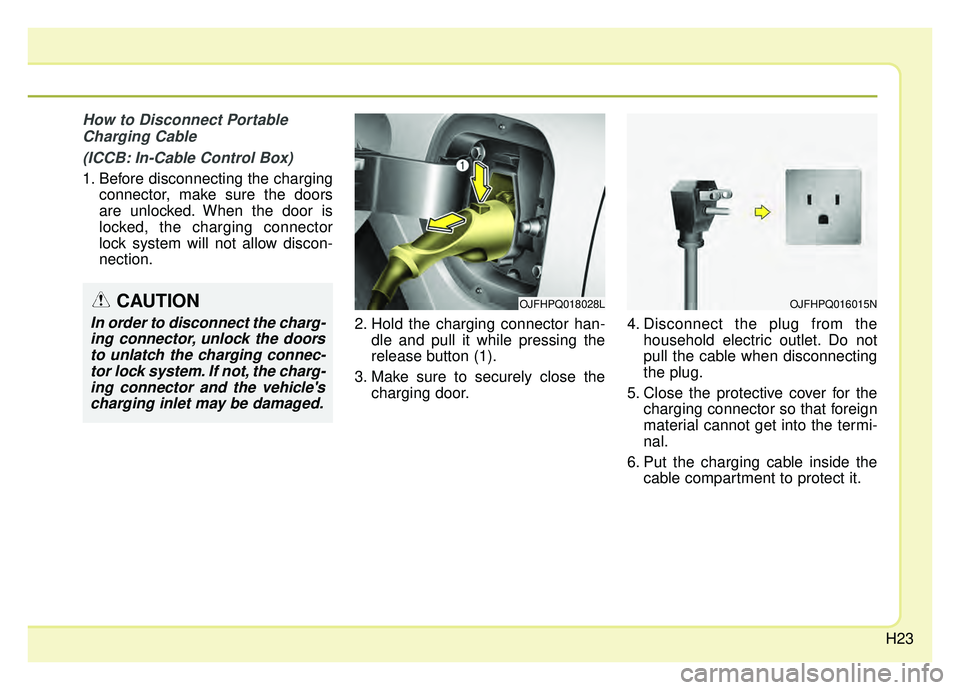
How to Disconnect PortableCharging Cable
(ICCB: In-Cable Control Box)
1. Before disconnecting the charging connector, make sure the doors
are unlocked. When the door is
locked, the charging connector
lock system will not allow discon-
nection.
2. Hold the charging connector han-dle and pull it while pressing the
release button (1).
3. Make sure to securely close the charging door. 4. Disconnect the plug from the
household electric outlet. Do not
pull the cable when disconnecting
the plug.
5. Close the protective cover for the charging connector so that foreign
material cannot get into the termi-
nal.
6. Put the charging cable inside the cable compartment to protect it.
OJFHPQ016015NCAUTION
In order to disconnect the charg-ing connector, unlock the doorsto unlatch the charging connec-tor lock system. If not, the charg-ing connector and the vehicle'scharging inlet may be damaged.
OJFHPQ018028L
Page 64 of 597
23
Your vehicle at a glance
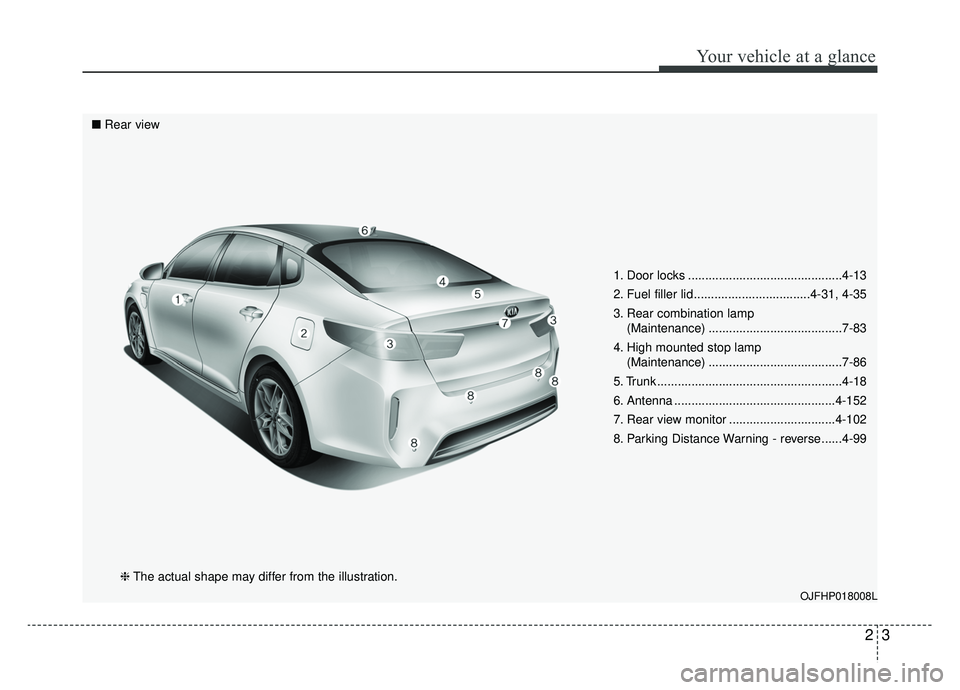
1. Door locks .............................................4-13
2. Fuel filler lid ..................................4-31, 4-35
3. Rear combination lamp (Maintenance) .......................................7-83
4. High mounted stop lamp (Maintenance) .......................................7-86
5. Trunk ......................................................4-18
6. Antenna ...............................................4-152
7. Rear view monitor ...............................4-102
8. Parking Distance Warning - reverse ......4-99
OJFHP018008L
■ Rear view
❈The actual shape may differ from the illustration.
Page 65 of 597

Your vehicle at a glance
42
INTERIOR OVERVIEW
1. Inside door handle.................................4-14
2. Driver position memory button ..............3-11
3. Power window switch ............................4-24
4. Central door lock switch ........................4-15
5. Power window lock button .....................4-28
6. Outside rearview mirror control .............4-50
7. Outside rearview mirror folding .............4-51
8. Fuel filler lid open button..............4-31, 4-35
9. Seat .........................................................3-4
10. ESC off button .....................................5-34
11. Instrument panel illumination control ..4-54
12. BCW On/Off button ...........................5-101
13. LKA On/Off button .............................5-117
14. Steering wheel ....................................4-44
15. Tilt and telescopic steering control lever .....................................................4-45
16. Inner fuse panel ..................................7-59
17. Brake pedal .........................................5-23
18. Parking brake pedal ............................5-21
19. Hood release lever ..............................4-29
OJFHP018011N❈ The actual shape may differ from the illustration.
Page 91 of 597
Safety features of your vehicle
24
3
Lap/shoulder belt
Height adjustment
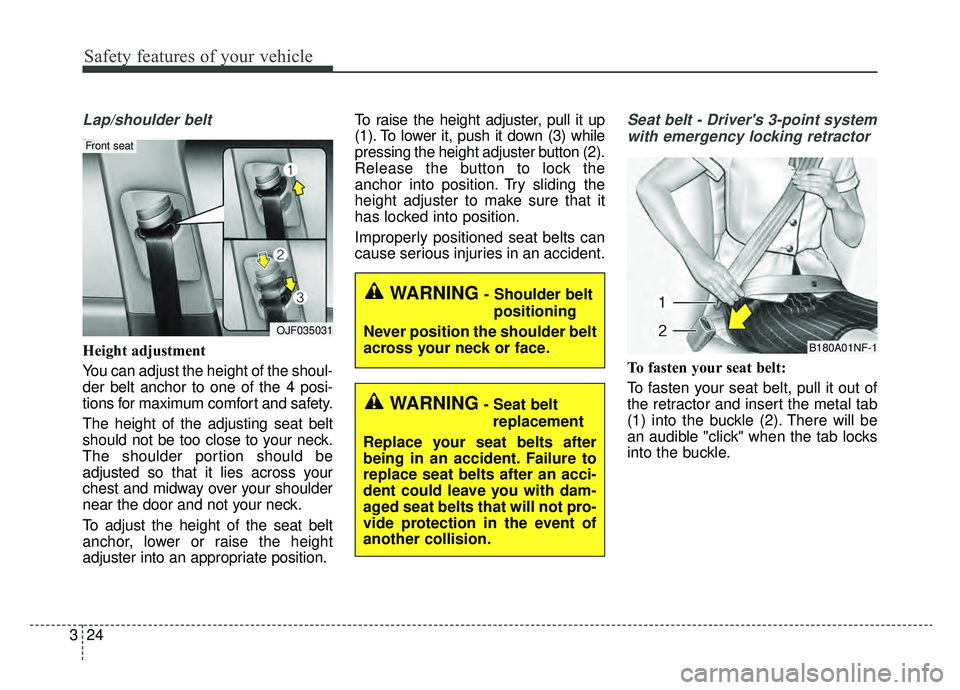
You can adjust the height of the shoul-
der belt anchor to one of the 4 posi-
tions for maximum comfort and safety.
The height of the adjusting seat belt
should not be too close to your neck.
The shoulder portion should be
adjusted so that it lies across your
chest and midway over your shoulder
near the door and not your neck.
To adjust the height of the seat belt
anchor, lower or raise the height
adjuster into an appropriate position. To raise the height adjuster, pull it up
(1). To lower it, push it down (3) while
pressing the height adjuster button (2).
Release the button to lock the
anchor into position. Try sliding the
height adjuster to make sure that it
has locked into position.
Improperly positioned seat belts can
cause serious injuries in an accident.
Seat belt - Driver's 3-point system
with emergency locking retractor
To fasten your seat belt:
To fasten your seat belt, pull it out of
the retractor and insert the metal tab
(1) into the buckle (2). There will be
an audible "click" when the tab locks
into the buckle.
B180A01NF-1
OJF035031
Front seat
WARNING- Shoulder belt positioning
Never position the shoulder belt
across your neck or face.
WARNING- Seat belt replacement
Replace your seat belts after
being in an accident. Failure to
replace seat belts after an acci-
dent could leave you with dam-
aged seat belts that will not pro-
vide protection in the event of
another collision.
Page 93 of 597
Safety features of your vehicle
26
3
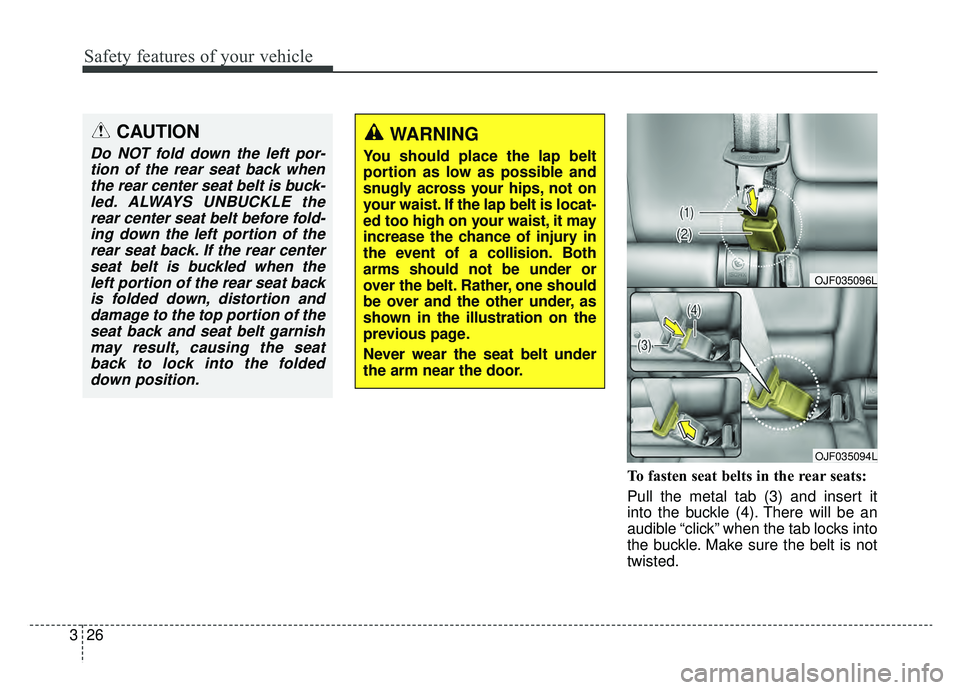
To fasten seat belts in the rear seats:
Pull the metal tab (3) and insert it
into the buckle (4). There will be an
audible “click” when the tab locks into
the buckle. Make sure the belt is not
twisted.
CAUTION
Do NOT fold down the left por-
tion of the rear seat back whenthe rear center seat belt is buck-led. ALWAYS UNBUCKLE therear center seat belt before fold-ing down the left portion of therear seat back. If the rear centerseat belt is buckled when theleft portion of the rear seat backis folded down, distortion anddamage to the top portion of theseat back and seat belt garnishmay result, causing the seatback to lock into the foldeddown position.
WARNING
You should place the lap belt
portion as low as possible and
snugly across your hips, not on
your waist. If the lap belt is locat-
ed too high on your waist, it may
increase the chance of injury in
the event of a collision. Both
arms should not be under or
over the belt. Rather, one should
be over and the other under, as
shown in the illustration on the
previous page.
Never wear the seat belt under
the arm near the door.
OJF035096L
OJF035094L