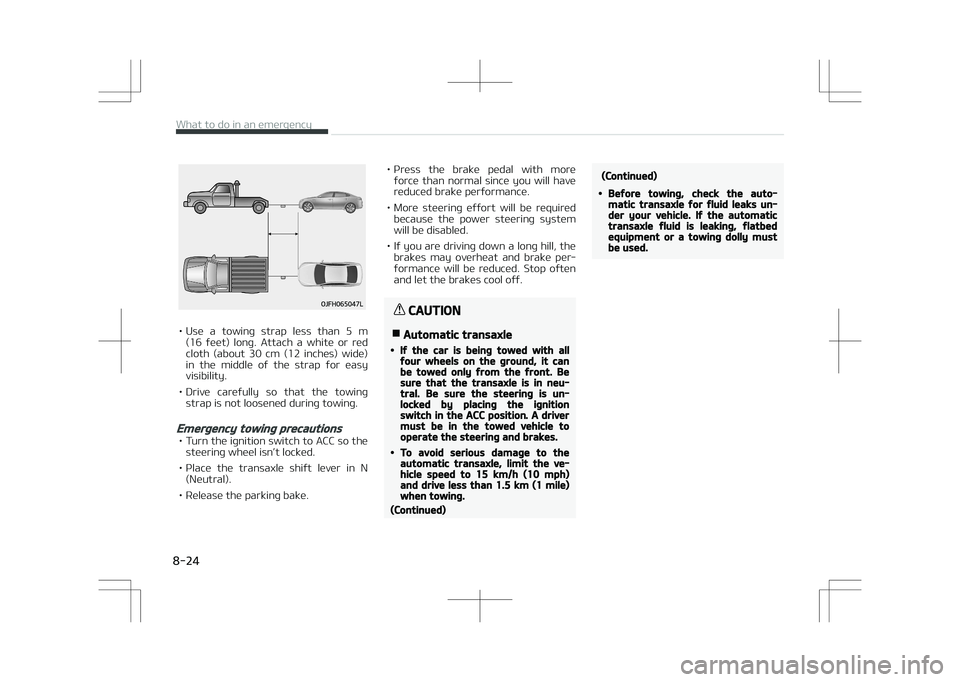
• Use a towing strap less than 5 m(16 feet) long. Attach a white or red
cloth (about 30 cm (12 inches) wide) in the middle of the strap for easy
visibility.
• Drive carefully so that the towing strap is not loosened during towing.
Emergency towing precautions
• Turn the ignition switch to ACC so thesteering wheel isn’t locked.
• Place the transaxle shift lever in N (Neutral).
• Release the parking bake. • Press the brake pedal with more
force than normal since you will have
reduced brake performance.
• More steering effort will be required because the power steering system
will be disabled.
• If you are driving down a long hill, the brakes may overheat and brake per‐formance will be reduced. Stop often
and let the brakes cool off.
CAUTION
nAutomatic transaxle
•If the car is being towed with allfour wheels on the ground, it canbe towed only from the front. Besure that the transaxle is in neu‐tral. Be sure the steering is un‐locked by placing the ignitionswitch in the ACC position. A drivermust be in the towed vehicle tooperate the steering and brakes.
•To avoid serious damage to theautomatic transaxle, limit the ve‐hicle speed to 15 km/h (10 mph)and drive less than 1.5 km (1 mile)when towing.
(Continued)
(Continued)
•Before towing, check the auto‐matic transaxle for fluid leaks un‐der your vehicle. If the automatictransaxle fluid is leaking, flatbedequipment or a towing dolly mustbe used.
What to do in an emergency
8-24
SCHEDULED MAINTENANCE SERVICE
Scheduled maintenance service
precaution
Follow the Normal Maintenance Sched‐
ule if the vehicle is usually operated
where none of the following conditions apply. If any of the following conditions
apply, follow the Maintenance Under
Severe Usage Conditions. • Repeated driving short distance of less than 8 km (5 miles) in normaltemperature or less than 16 km
(10 miles) in freezing temperature
• Extensive engine idling or low speed driving for long distances
• Driving on rough, dusty, muddy, un‐ paved, graveled or salt-spread roads
• Driving in areas using salt or other corrosive materials or in very cold
weather
• Driving in heavy dust condition
• Driving in heavy traffic area
• Driving on uphill, downhill, or moun‐ tain road repeatedly
• Towing a trailer or using a camper, or roof rack
• Driving as a patrol car, taxi, other commercial use of vehicle towing
• Driving over 170 km/h (106 mph) • Frequently driving in stop-and-go
condition
If your vehicle is operated under the
above conditions, you should inspect,
replace or refill more frequently than the following Normal Maintenance
Schedule. After the periods or distance
shown in the chart, continue to follow the prescribed maintenance intervals.
Maintenance
9-08