flat tire KIA PICANTO 2006 User Guide
[x] Cancel search | Manufacturer: KIA, Model Year: 2006, Model line: PICANTO, Model: KIA PICANTO 2006Pages: 281, PDF Size: 9.89 MB
Page 209 of 281
631
In case of an emergency
1 23456789
3rd stage: What to do when
checking the tire inflationpressure
1. Open the lid from theTireMobilityKit.
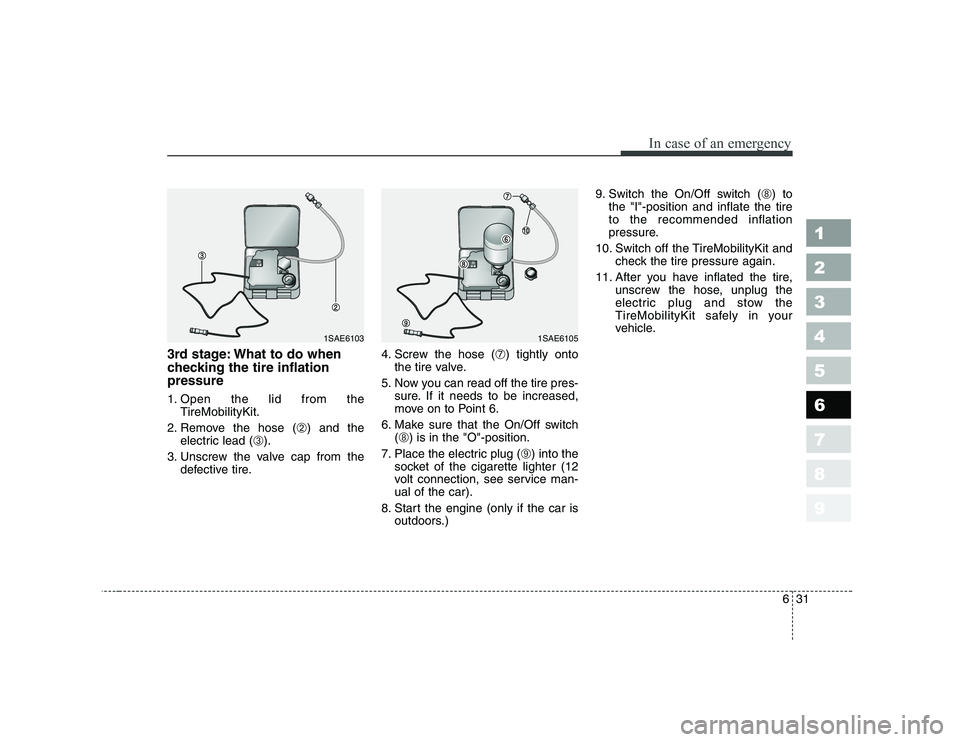
2. Remove the hose ( ➁) and the
electric lead ( ➂).
3. Unscrew the valve cap from the defective tire. 4. Screw the hose (
➆) tightly onto
the tire valve.
5. Now you can read off the tire pres- sure. If it needs to be increased,
move on to Point 6.
6. Make sure that the On/Off switch (➇ ) is in the "O"-position.
7. Place the electric plug ( ➈) into the
socket of the cigarette lighter (12
volt connection, see service man-ual of the car).
8. Start the engine (only if the car is outdoors.) 9. Switch the On/Off switch (
➇) to
the "I"-position and inflate the tireto the recommended inflation
pressure.
10. Switch off the TireMobilityKit and check the tire pressure again.
11. After you have inflated the tire, unscrew the hose, unplug the
electric plug and stow the
TireMobilityKit safely in your
vehicle.
1SAE61051SAE6103
Page 210 of 281
In case of an emergency
32
6
1 23456789
Notes on the safe use of the TireMobilityKit
Park your car at the side of the
road so that you can work with the
TireMobilityKit away from moving
traffic. Place your warning triangle
in a prominent place to make pass-
ing vehicles aware of your location.
To be sure your vehicle won't move, even when your're on fairly
level ground, always set your park-
ing brake.
Only use the TireMobilityKit for sealing/inflation passenger car
tires. Do not use on motorcycles,
bicycles or any other type of tires.
Do not remove any foreign objects - such as nails or screws - that
have penetrated the tire. Before using the TireMobilityKit
read the precautionary advice
printed on the sealant bottle!
Provided the car is outdoors, leave the engine running. Otherwise
operating the compressor may
eventually drain the car battery.
Never leave the TireMobilityKit unattended while it is being used.
Do not leave the compressor run- ning for more than 10 min. at a time
or it may overheat.
Do not use the TireMobilityKit if the ambient temperature is below -
30°C / -20°F.
Do not use the sealing compound after its expiration date which can
be found on the label of the bottle.
Keep away from children.CAUTION
Do not use the TireMobilityKit if the tire was severely damagedby driving with insufficient airpressure (e.g. if the tire has bulges, cuts, cracks or similardefects). Only seal puncturedareas located well within the tread region of the tire. Damageto the sidewall may not besealed for safety reasons.
Page 213 of 281
635
In case of an emergency
1 23456789
Tire pressure gauge (If equipped)
Tires normally lose some air in day-
to-day use, and you may have to add
a few pounds of air periodically and it
is not usually a sign of a leaking tire,
but of normal wear. Always check tirepressure when the tires are coldbecause tire pressure increases with
temperature.To check the tire pressure, take the
following steps;
1.Unscrew the inflation valve cap
that is located on the rim of the tire.
2.Press and hold the gauge against the tire valve. Some air will escape
as you begin and more will escape
if you don't press the gauge in firm-
ly.
3.A firm non-leaking push will acti- vate the gauge.
4.Read the tire pressure on the gauge to know whether the tire
pressure is low or high.
5.Adjust the tire pressures to the specified pressure. Refer to“Recommended Inflation Pressure”on the page 8-2.
6.Reinstall the inflation valve cap.
Page 223 of 281
Maintenance
10
7
1 23456789
OWNER MAINTENANCE
Owner maintenance schedule
The following lists are vehicle checks and inspections that should be per-
formed by the owner or an AuthorizedKia Dealer at the frequencies indicat-
ed to help ensure safe, dependable
operation of your vehicle.
Any adverse conditions should be
brought to the attention of your deal-
er as soon as possible.
These Owner Maintenance Checks
are generally not covered by war-
ranties and you may be charged for
labor, parts and lubricants used.
When you stop for fuel:
Check the engine oil level.
Check coolant level in coolant reservoir.
Check the windshield washer fluid level. Look for low or under-inflated tires.
While operating your vehicle:
Note any changes in the sound of
the exhaust or any smell of
exhaust fumes in the vehicle.
Check for vibrations in the steering wheel. Notice any increased steer-
ing effort or looseness in the steer-
ing wheel, or change in its straight-ahead position.
Notice if your vehicle constantly turns slightly or “pulls” to one side
when traveling on smooth, levelroad.
When stopping, listen and check for strange sounds, pulling to one
side, increased brake pedal travel
or “hard-to-push” brake pedal.
If any slipping or changes in the operation of your transaxle occurs,
check the transaxle fluid level.
Check automatic transaxle P (Park) function.
Check parking brake.
Check for fluid leaks under your vehicle (water dripping from the air conditioning system after use is
normal).
At least monthly:
Check coolant level in the coolantrecovery reservoir.
Check the operation of all exterior lights, including the stoplights, turn
signals and hazard warning flash-
ers.
Check the inflation pressures of all tires including the spare.
At least twice a year
(i.e., every Spring and Fall) :
Check radiator, heater and air con- ditioning hoses for leaks or da-
mage.
Check windshield washer spray and wiper operation. Clean wiper
blades with clean cloth dampened
with washer fluid.
Check headlight alignment.
Check muffler, exhaust pipes, shields and clamps.
Check the lap/shoulder belts for wear and function.
Check for worn tires and loose wheel lug nuts.
WARNING
Be careful when checking your
engine coolant level when the
engine is hot. Scalding hot
coolant and steam may blow out
under pressure. This could
cause serious injury.
Page 253 of 281
Maintenance
40
7
1 23456789
TIRES AND WHEELS
Tires care
For proper maintenance, safety, and
maximum fuel economy, you must
always maintain recommended tire
inflation pressures and stay within
the load limits and weight distribution
recommended for your vehicle. Inflation pressures All tire pressures (including the
spare) should be checked every day
when the tires are cold. “Cold Tires”
means the vehicle has not been driv-
en for at least three hours or drivenless than 1.6 km (one mile).
Recommended pressures must be
maintained for the best ride, top vehi-
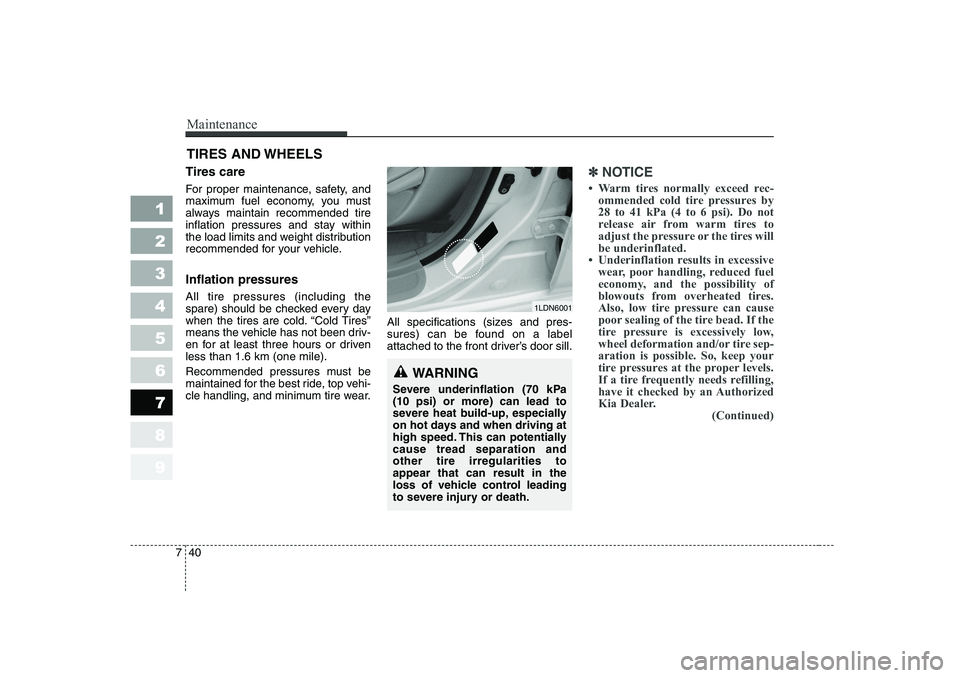
cle handling, and minimum tire wear. All specifications (sizes and pres-
sures) can be found on a label
attached to the front driver’s door sill.
✽✽
NOTICE
Page 259 of 281
Maintenance
46
7
1 23456789
Checking a tire life
Tire strength and performance
decline with age. Any tires that are
over 6 year old, including the spare
(determined by the tire manufacturedate), should be replaced regardless
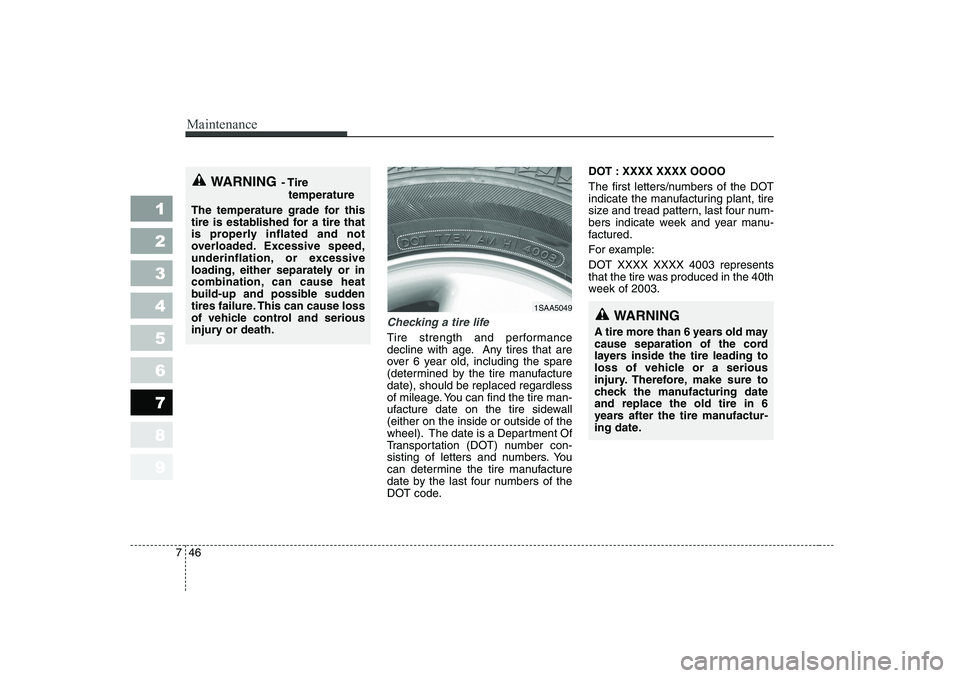
of mileage. You can find the tire man-
ufacture date on the tire sidewall(either on the inside or outside of the
wheel). The date is a Department Of
Transportation (DOT) number con-
sisting of letters and numbers. You
can determine the tire manufacture
date by the last four numbers of the
DOT code. DOT : XXXX XXXX OOOO
The first letters/numbers of the DOT
indicate the manufacturing plant, tire
size and tread pattern, last four num-
bers indicate week and year manu-
factured.
For example:
DOT XXXX XXXX 4003 represents
that the tire was produced in the 40th
week of 2003.
WARNING
A tire more than 6 years old may
cause separation of the cord
layers inside the tire leading to
loss of vehicle or a serious
injury. Therefore, make sure to
check the manufacturing dateand replace the old tire in 6
years after the tire manufactur-
ing date.
WARNING - Tire
temperature
The temperature grade for this
tire is established for a tire that
is properly inflated and not
overloaded. Excessive speed,
underinflation, or excessive
loading, either separately or in
combination, can cause heat
build-up and possible sudden
tires failure. This can cause loss
of vehicle control and serious
injury or death.
1SAA5049
Page 275 of 281
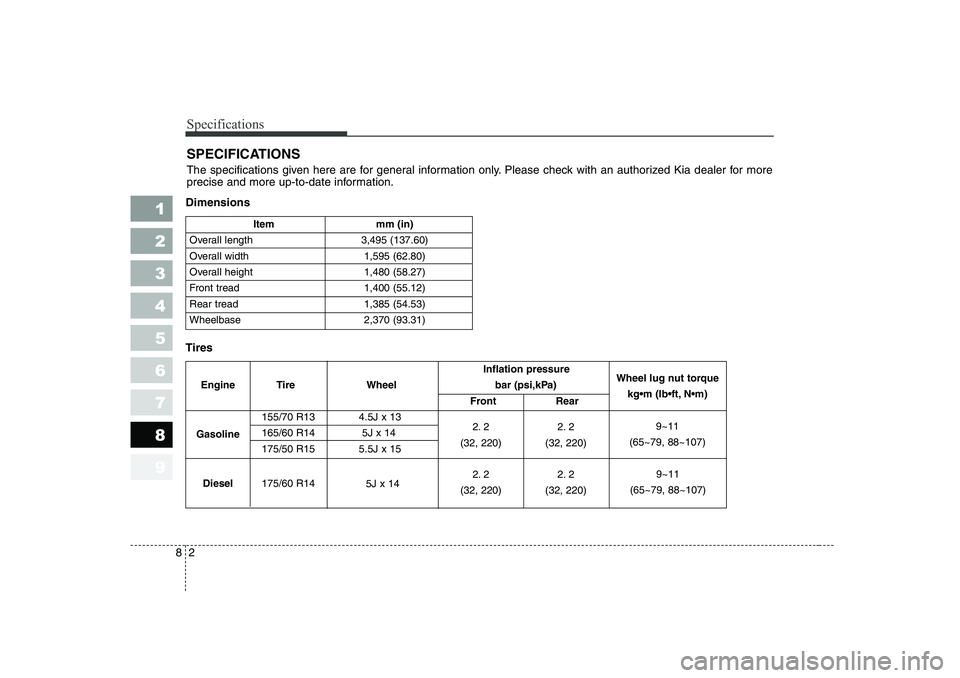
Dimensions Tires
Inflation pressure
Tire Wheel bar (psi,kPa) Front Rear
155/70 R13 4.5J x 13 165/60 R14 5J x 14175/50 R15 5.5J x 15
Specifications
2
8
1 23456789
Item mm (in)
Overall length 3,495 (137.60)
Overall width 1,595 (62.80)
Overall height 1,480 (58.27)
Front tread 1,400 (55.12)
Rear tread 1,385 (54.53)
Wheelbase 2,370 (93.31)
SPECIFICATIONS
The specifications given here are for general information only. Please check with an authorized Kia dealer for more
precise and more up-to-date information.
Wheel lug nut torquekg•m (lbft, Nm)
9~11
(65~79, 88~107)
Engine
Gasoline Diesel 175/60 R14 5J x 14 2. 2
(32, 220) 2. 2
(32, 220)
2. 2
(32, 220) 2. 2
(32, 220) 9~11
(65~79, 88~107)
Page 279 of 281
Index
2
9
1 23456789
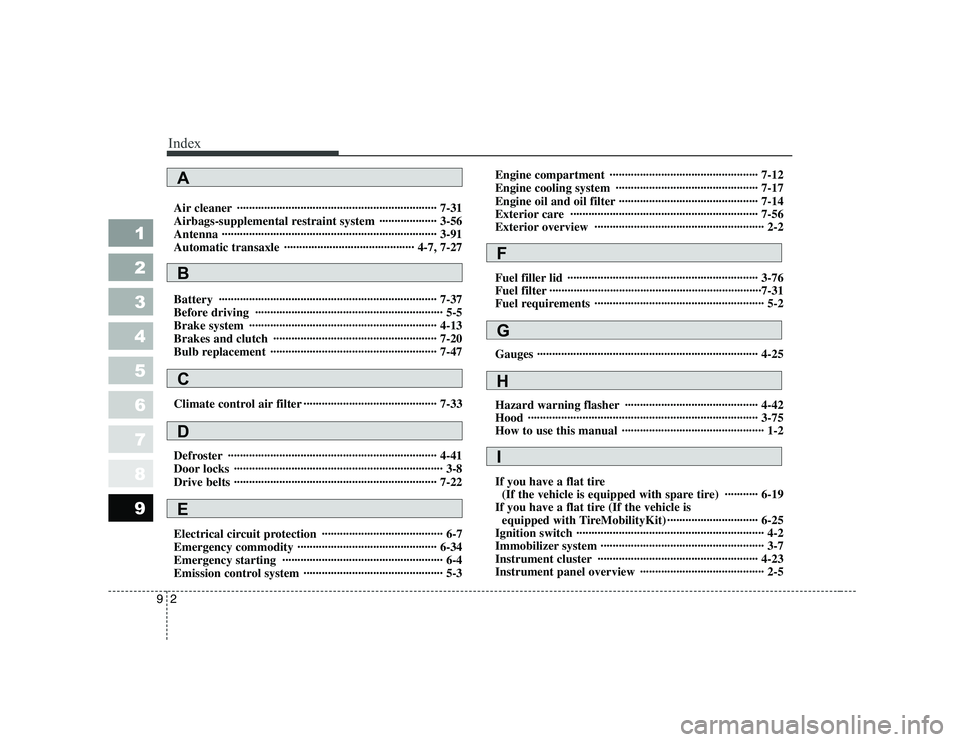
Air cleaner ·································································· 7-31
Airbags-supplemental restraint system ··················· 3-56
Antenna ······································································· 3-91
Automatic transaxle ··········································· 4-7, 7-27
Battery ········································································ 7-37
Before driving ······························································ 5-5
Brake system ······························································ 4-13
Brakes and clutch ······················································ 7-20
Bulb replacement ······················································· 7-47
Climate control air filter ············································ 7-33
Defroster ····································································· 4-41
Door locks ····································································· 3-8
Drive belts ··································································· 7-22
Electrical circuit protection ········································ 6-7
Emergency commodity ·············································· 6-34
Emergency starting ····················································· 6-4
Emission control system ·············································· 5-3 Engine compartment ················································· 7-12
Engine cooling system ··············································· 7-17
Engine oil and oil filter ·············································· 7-14
Exterior care ······························································ 7-56
Exterior overview ························································ 2-2
Fuel filler lid ······························································· 3-76
Fuel filter ······································································7-31
Fuel requirements ························································ 5-2
Gauges ········································································· 4-25
Hazard warning flasher ············································ 4-42
Hood ············································································ 3-75
How to use this manual ··············································· 1-2
If you have a flat tire
(If the vehicle is equipped with spare tire) ··········· 6-19
If you have a flat tire (If the vehicle is
equipped with TireMobilityKit) ······························ 6-25
Ignition switch ······························································ 4-2
Immobilizer system ······················································ 3-7
Instrument cluster ····················································· 4-23
Instrument panel overview ········································· 2-5
A
B
C
D
E
F
G
H
I