child lock KIA PICANTO 2008 User Guide
[x] Cancel search | Manufacturer: KIA, Model Year: 2008, Model line: PICANTO, Model: KIA PICANTO 2008Pages: 335, PDF Size: 12.98 MB
Page 190 of 335
511
Driving your vehicle
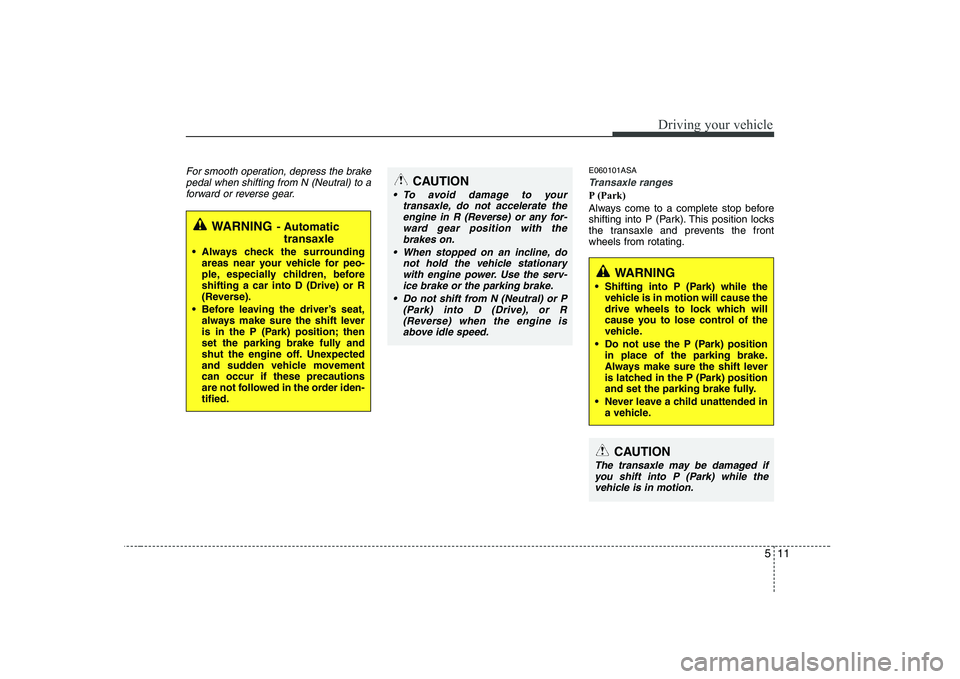
For smooth operation, depress the brakepedal when shifting from N (Neutral) to aforward or reverse gear.E060101ASA
Transaxle ranges
P (Park)
Always come to a complete stop before
shifting into P (Park). This position locks
the transaxle and prevents the frontwheels from rotating.
WARNING - Automatic
transaxle
Always check the surrounding areas near your vehicle for peo-
ple, especially children, beforeshifting a car into D (Drive) or R
(Reverse).
Before leaving the driver’s seat, always make sure the shift lever
is in the P (Park) position; then
set the parking brake fully and
shut the engine off. Unexpected
and sudden vehicle movementcan occur if these precautions
are not followed in the order iden-tified.
CAUTION
To avoid damage to your
transaxle, do not accelerate theengine in R (Reverse) or any for-ward gear position with the
brakes on.
When stopped on an incline, do not hold the vehicle stationarywith engine power. Use the serv-ice brake or the parking brake.
Do not shift from N (Neutral) or P (Park) into D (Drive), or R(Reverse) when the engine is above idle speed.
WARNING
Shifting into P (Park) while the vehicle is in motion will cause the
drive wheels to lock which will
cause you to lose control of the
vehicle.
Do not use the P (Park) position in place of the parking brake.
Always make sure the shift lever
is latched in the P (Park) position
and set the parking brake fully.
Never leave a child unattended in a vehicle.
CAUTION
The transaxle may be damaged if
you shift into P (Park) while the vehicle is in motion.
Page 231 of 335
What to do in an emergency
8
6
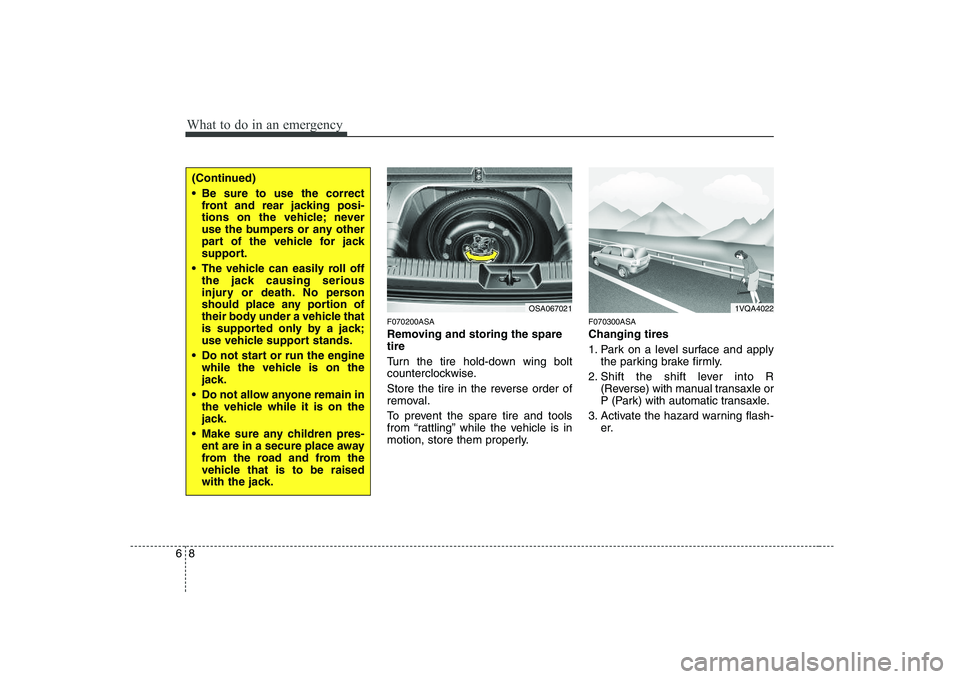
F070200ASA
Removing and storing the spare tire
Turn the tire hold-down wing bolt
counterclockwise.
Store the tire in the reverse order of
removal.
To prevent the spare tire and tools
from “rattling” while the vehicle is in
motion, store them properly. F070300ASA Changing tires
1. Park on a level surface and apply
the parking brake firmly.
2. Shift the shift lever into R (Reverse) with manual transaxle or
P (Park) with automatic transaxle.
3. Activate the hazard warning flash- er.
OSA067021
(Continued)
Be sure to use the correctfront and rear jacking posi-
tions on the vehicle; never
use the bumpers or any other
part of the vehicle for jack
support.
The vehicle can easily roll off the jack causing serious
injury or death. No person
should place any portion of
their body under a vehicle that
is supported only by a jack;
use vehicle support stands.
Do not start or run the engine while the vehicle is on the
jack.
Do not allow anyone remain in the vehicle while it is on the
jack.
Make sure any children pres- ent are in a secure place away
from the road and from the
vehicle that is to be raised
with the jack.
1VQA4022
Page 333 of 335
Index
2
I
Air bag - supplemental restraint system ························3-36
Air cleaner ·····································································7-34
Appearance care·····························································7-64
Audio system ·································································4-77
Automatic climate control system ·································4-60
Automatic transaxle ·······················································5-10
Automatic transaxle fluid ··············································7-29
Battery············································································7-39
Before driving ··································································5-3
Brake system··································································5-16
Brakes/clutch fluid ·························································7-27
Bulb wattage ····································································9-2
Child restraint system ····················································3-26
Climate control air filter ················································7-35
Defroster ········································································4-50
Dimensions ······································································9-2
Door locks········································································4-8 Economical operation ····················································5-26
Emergency commodity ··················································6-28
Emergency starting ··························································6-4
Emission control system ················································7-70
Engine compartment ················································2-4, 7-2
Engine coolant ·······························································7-25
Engine number ·································································8-3
Engine oil ·······································································7-23
Explanation of scheduled maintenance items ···············7-21
Fuel filler lid ··································································4-17
Fuel filter ·······································································7-32
Fuel requirements ····························································1-2
Fuses ··············································································7-51
Hazard warning flasher··················································4-40
Hood···············································································4-15
How to use this manual ···················································1-2
If the engine overheats·····················································6-6
A
B
C
D
E
F
H
I