wheel KIA PICANTO 2008 Repair Manual
[x] Cancel search | Manufacturer: KIA, Model Year: 2008, Model line: PICANTO, Model: KIA PICANTO 2008Pages: 335, PDF Size: 12.98 MB
Page 298 of 335
747
Maintenance
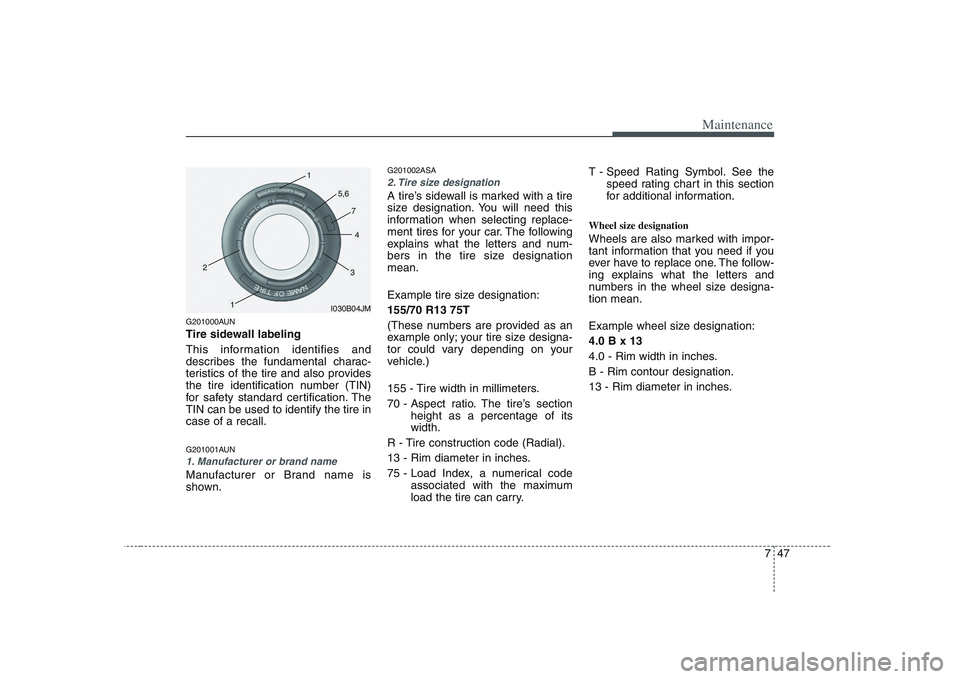
G201000AUN
Tire sidewall labeling
This information identifies and
describes the fundamental charac-
teristics of the tire and also provides
the tire identification number (TIN)
for safety standard certification. TheTIN can be used to identify the tire incase of a recall.
G201001AUN
1. Manufacturer or brand name
Manufacturer or Brand name is
shown.G201002ASA
2. Tire size designation
A tire’s sidewall is marked with a tire
size designation. You will need this
information when selecting replace-
ment tires for your car. The following
explains what the letters and num-
bers in the tire size designationmean.
Example tire size designation: 155/70 R13 75T
(These numbers are provided as an
example only; your tire size designa-
tor could vary depending on your
vehicle.)
155 - Tire width in millimeters.
70 - Aspect ratio. The tire’s section
height as a percentage of its width.
R - Tire construction code (Radial).
13 - Rim diameter in inches.
75 - Load Index, a numerical code associated with the maximum
load the tire can carry. T - Speed Rating Symbol. See the
speed rating chart in this section
for additional information.
Wheel size designation
Wheels are also marked with impor-
tant information that you need if you
ever have to replace one. The follow-
ing explains what the letters and
numbers in the wheel size designa-tion mean.
Example wheel size designation: 4.0 B x 13
4.0 - Rim width in inches.B - Rim contour designation.
13 - Rim diameter in inches.
I030B04JM
1
1
23
4
5,6
7
Page 299 of 335
Maintenance
48
7
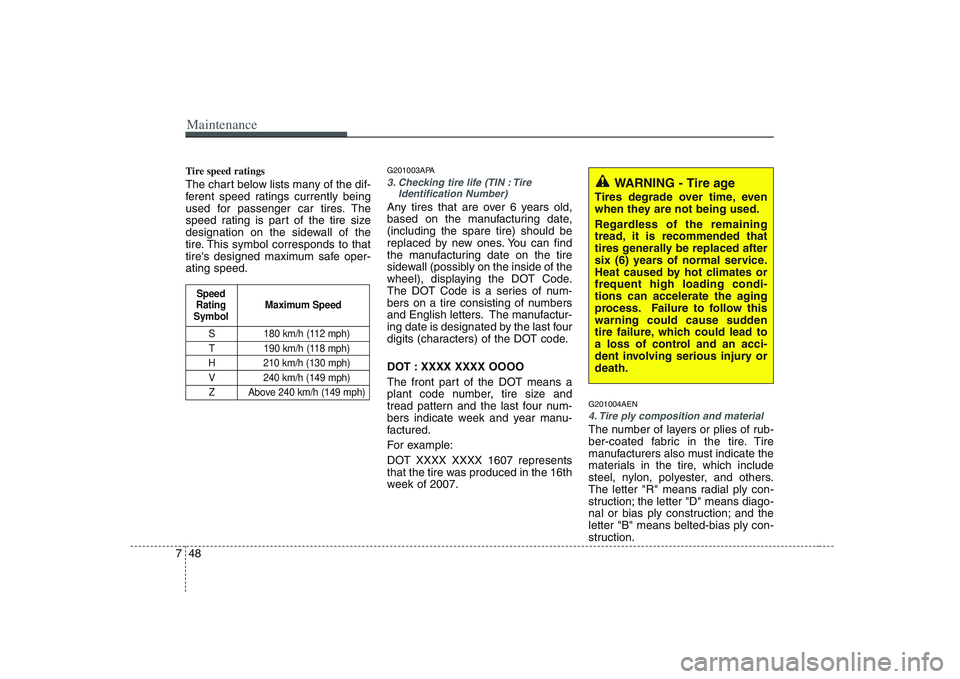
Tire speed ratings
The chart below lists many of the dif-
ferent speed ratings currently being
used for passenger car tires. The
speed rating is part of the tire size
designation on the sidewall of the
tire. This symbol corresponds to that
tire's designed maximum safe oper-ating speed. G201003APA
3. Checking tire life (TIN : Tire
Identification Number)
Any tires that are over 6 years old,
based on the manufacturing date,(including the spare tire) should be
replaced by new ones. You can find
the manufacturing date on the tire
sidewall (possibly on the inside of the
wheel), displaying the DOT Code.
The DOT Code is a series of num-
bers on a tire consisting of numbers
and English letters. The manufactur-
ing date is designated by the last four
digits (characters) of the DOT code.
DOT : XXXX XXXX OOOO
The front part of the DOT means a
plant code number, tire size and
tread pattern and the last four num-
bers indicate week and year manu-
factured.
For example:
DOT XXXX XXXX 1607 represents
that the tire was produced in the 16th
week of 2007. G201004AEN
4. Tire ply composition and material
The number of layers or plies of rub-
ber-coated fabric in the tire. Tire
manufacturers also must indicate the
materials in the tire, which include
steel, nylon, polyester, and others.
The letter "R" means radial ply con-
struction; the letter "D" means diago-
nal or bias ply construction; and theletter "B" means belted-bias ply con-
struction.
S 180 km/h (112 mph)
T 190 km/h (118 mph)
H 210 km/h (130 mph) V 240 km/h (149 mph)Z Above 240 km/h (149 mph)
Maximum Speed
Speed
Rating
Symbol
WARNING - Tire age
Tires degrade over time, even
when they are not being used.
Regardless of the remaining
tread, it is recommended that
tires generally be replaced after
six (6) years of normal service.
Heat caused by hot climates orfrequent high loading condi-
tions can accelerate the aging
process. Failure to follow this
warning could cause sudden
tire failure, which could lead to
a loss of control and an acci-
dent involving serious injury ordeath.
Page 301 of 335
Maintenance
50
7
Temperature -A, B & C
The temperature grades are A (the
highest), B, and C, representing the
tire’s resistance to the generation ofheat and its ability to dissipate heatwhen tested under controlled condi-
tions on a specified indoor laboratorytest wheel.
Sustained high temperature can
cause the material of the tire to
degenerate and reduce tire life, and
excessive temperature can lead to
sudden tire failure. Grades B and A
represent higher levels of perform-
ance on the laboratory test wheel
than the minimum required by law.
WARNING - Tire
temperature
The temperature grade for this
tire is established for a tire that
is properly inflated and not
overloaded. Excessive speed,
underinflation, or excessive
loading, either separately or in
combination, can cause heat
build-up and sudden tire failure.
This can cause loss of vehicle
control and serious injury ordeath.
Page 317 of 335
Maintenance
66
7
G230105ASA
Underbody maintenance
Corrosive materials used for ice and
snow removal and dust control may col-
lect on the underbody. If these materials
are not removed, accelerated rusting can
occur on the underbody parts such as
the fuel lines, frame, floor pan and
exhaust system, even though they have
been treated with rust protection.
Thoroughly flush the vehicle underbody
and wheel openings with lukewarm or
cold water once a month, after off-road
driving and at the end of each winter. Payspecial attention to these areas because
it is difficult to see all the mud and dirt. It
will do more harm than good to wet down
the road grime without removing it. The
lower edges of the doors, rocker panels,
and frame members have drain holes
that should not be allowed to clog with
dirt; trapped water in these areas can
cause rusting. G230106AUN
Aluminum wheel maintenance
The aluminum wheels are coated with a
clear protective finish.
Do not use any abrasive cleaner, pol-
ishing compound, solvent, or wire
brushes on aluminum wheels. They
may scratch or damage the finish.
Use only a mild soap or neutral deter- gent, and rinse thoroughly with water.
Also, be sure to clean the wheels after
driving on salted roads. This helps pre-
vent corrosion.
Avoid washing the wheels with high- speed car wash brushes.
Do not use any acid detergent. It may damage and corrode the aluminum
wheels coated with a clear protectivefinish.
WARNING
After washing the vehicle, test the
brakes while driving slowly to see if
they have been affected by water. If
braking performance is impaired,
dry the brakes by applying them
lightly while maintaining a slow for-
ward speed.
Page 327 of 335
9
Dimensions / 9-2 Bulb wattage / 9-2
Tires and wheels / 9-3Recommended lubricants and capacities / 9-4
Specifications
Page 328 of 335
Specifications
2
9
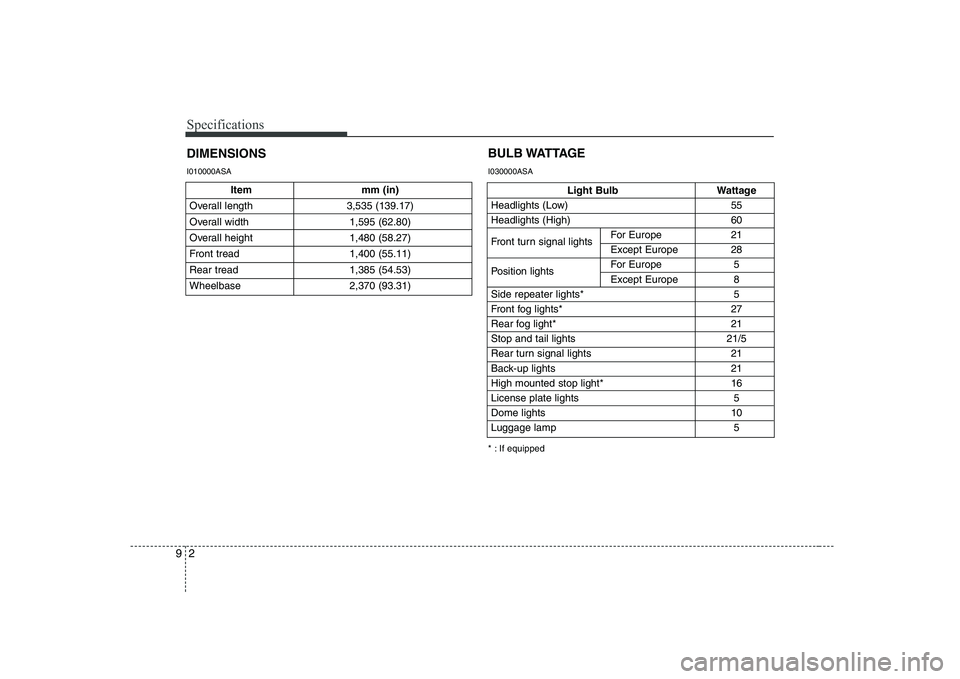
Item mm (in)
Overall length 3,535 (139.17)
Overall width 1,595 (62.80)
Overall height 1,480 (58.27)
Front tread 1,400 (55.11)
Rear tread 1,385 (54.53)
Wheelbase 2,370 (93.31)
DIMENSIONS
Light Bulb Wattage
Headlights (Low) 55
Headlights (High) 60
Front turn signal lights For Europe 21
Except Europe 28
Position lights For Europe 5
Except Europe 8
Side repeater lights* 5
Front fog lights* 27
Rear fog light* 21
Stop and tail lights 21/5
Rear turn signal lights 21
Back-up lights 21
High mounted stop light* 16
License plate lights 5Dome lights 10
Luggage lamp 5
BULB WATTAGE
* : If equipped
I010000ASA
I030000ASA
Page 329 of 335
93
Specifications
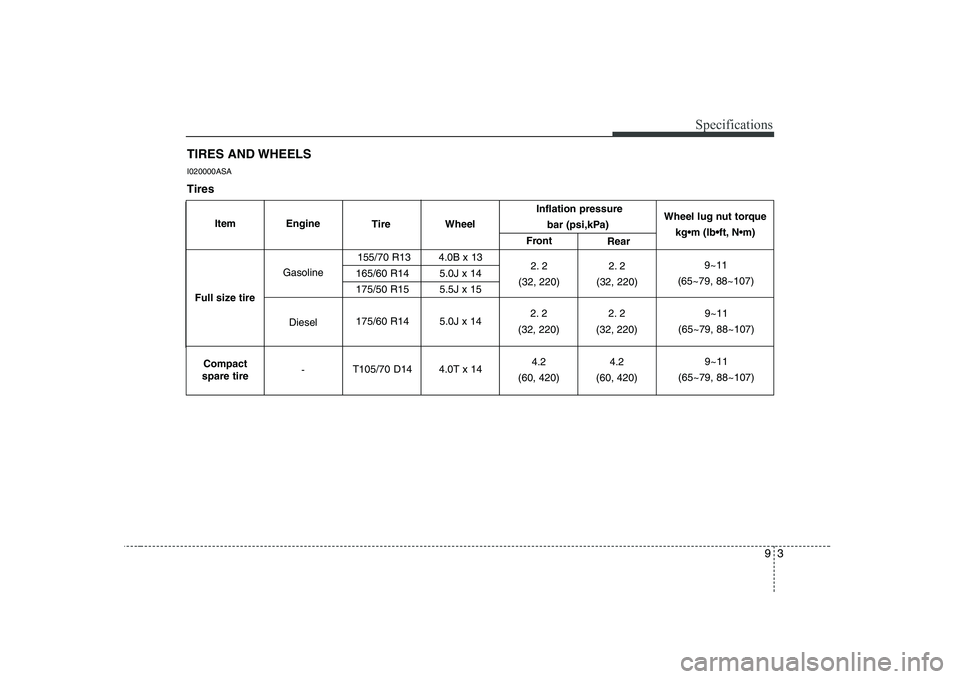
TIRES AND WHEELS
I020000ASA Tires
Wheel lug nut torque
Inflation pressure
bar (psi,kPa)
Front Rear
9~11
(65~79, 88~107)
155/70 R13
165/60 R14 175/50 R15 175/60 R14
T105/70 D14 4.0B x 13
5.0J x 14 5.5J x 15 5.0J x 14
4.0T x 14 2. 2
(32, 220) 2. 2
(32, 220)
2. 2
(32, 220) 2. 2
(32, 220) 9~11
(65~79, 88~107)
Tire
Engine
Gasoline
Diesel - 4.2
(60, 420) 4.2
(60, 420) 9~11
(65~79, 88~107)
Item
Full size tire Compact
spare tire Wheel
Page 334 of 335
I3
Index
If the engine will not start ···············································6-3
If you have a flat tire (with spare tire) ····························6-7
If you have a flat tire (with TireMobilityKit) ················6-15
In case of an emergency while driving····························6-2
Indicator symbols on the instrument cluster ···················1-6
Instrument cluster ··························································4-25
Instrument panel overview ··············································2-3
Interior features······························································4-72
Interior light ···································································4-49
Interior overview ·····························································2-2
Key positions ···································································5-4
Keys ·················································································4-2
Light bulbs ·····································································7-58
Lighting··········································································4-41
Maintenance services ·······················································7-4
Manual climate control system······································4-51
Manual transaxle······························································5-7
Mirrors ···········································································4-22 Owner maintenance ·························································7-6
Parking brake ································································7-31
Rear parking assist system·············································4-38
Recommended lubricants and capacities ·························9-4
Remote keyless entry ·······················································4-4
Road warning ···································································6-2
Scheduled maintenance service ·······································7-8
Seat belts ········································································3-15
Seats ·················································································3-2
Special driving conditions ·············································5-28
Starting the engine ···························································5-5
Steering wheel································································4-20
Storage compartment ·····················································4-70
Tailgate ···········································································4-11
K
L
M
O
P
R
S
T
Page 335 of 335
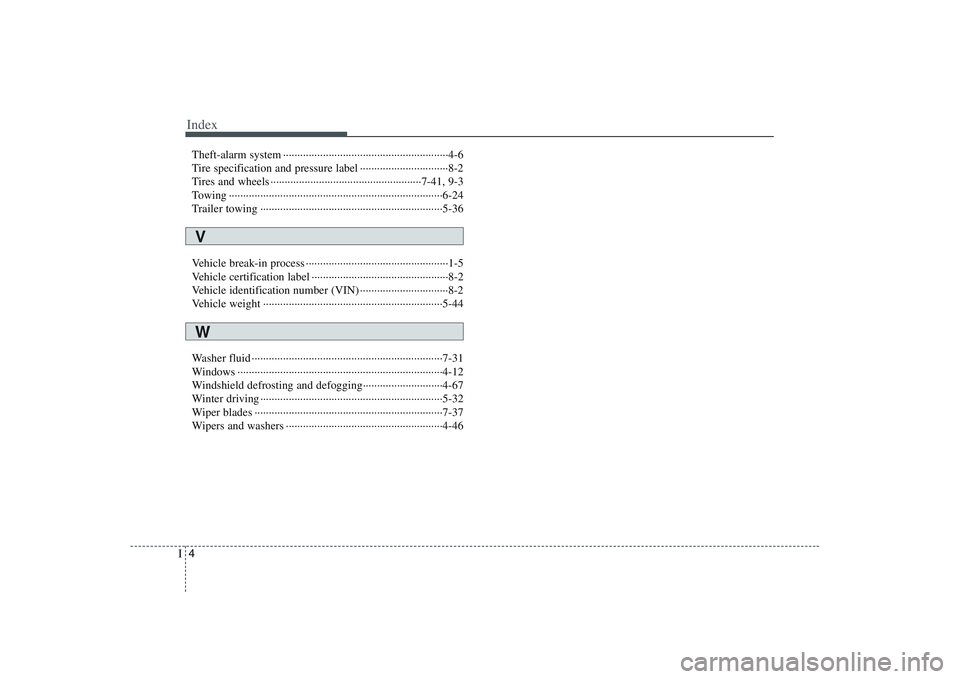
Index
4
I
Theft-alarm system ··························································4-6
Tire specification and pressure label ·······························8-2
Tires and wheels ·····················································7-41, 9-3
Towing ···········································································6-24
Trailer towing ································································5-36
Vehicle break-in process ··················································1-5
Vehicle certification label ················································8-2
Vehicle identification number (VIN) ·······························8-2
Vehicle weight ·······························································5-44
Washer fluid ···································································7-31
Windows ········································································4-12
Windshield defrosting and defogging····························4-67
Winter driving ································································5-32
Wiper blades ··································································7-37
Wipers and washers ·······················································4-46
V
W