air bag KIA PICANTO 2008 Owners Manual
[x] Cancel search | Manufacturer: KIA, Model Year: 2008, Model line: PICANTO, Model: KIA PICANTO 2008Pages: 335, PDF Size: 12.98 MB
Page 9 of 335
Introduction
6
1
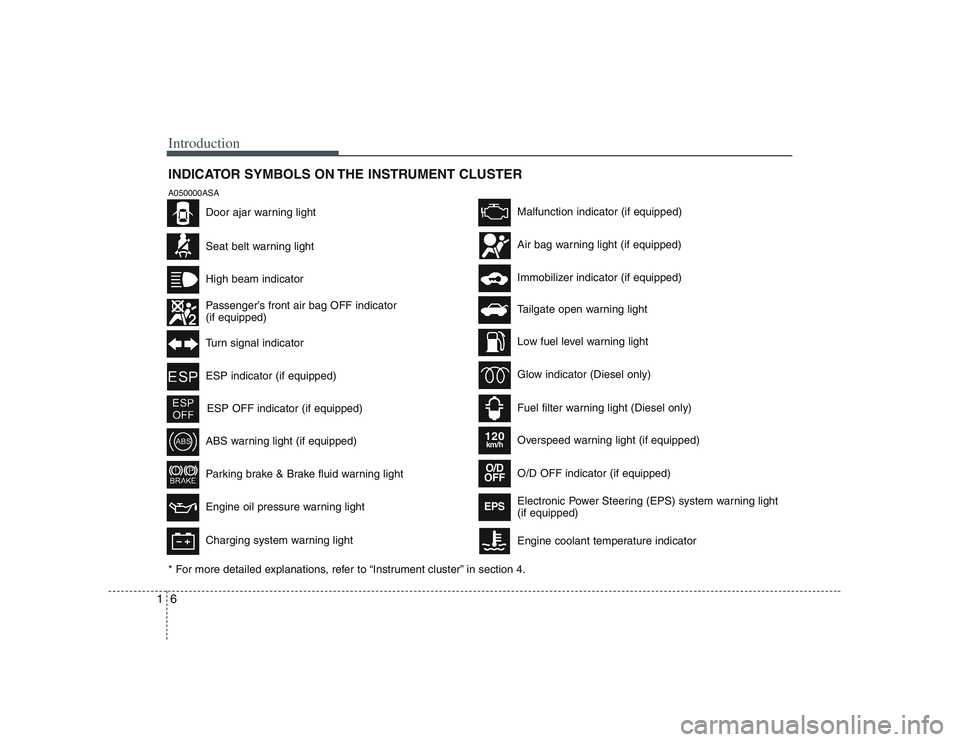
INDICATOR SYMBOLS ON THE INSTRUMENT CLUSTER
Seat belt warning light
High beam indicator
Passenger’s front air bag OFF indicator (if equipped)
Turn signal indicator
ABS warning light (if equipped)
Parking brake & Brake fluid warning light
Engine oil pressure warning light
ESP indicator (if equipped)
ESP OFF indicator (if equipped)
Malfunction indicator (if equipped)
Air bag warning light (if equipped)
Immobilizer indicator (if equipped)
Low fuel level warning light
Glow indicator (Diesel only)
Fuel filter warning light (Diesel only)
* For more detailed explanations, refer to “Instrument cluster” in section 4.
Charging system warning light
A050000ASA
Door ajar warning light
Overspeed warning light (if equipped)
120km/h
Tailgate open warning light O/D OFF indicator (if equipped)
O/D
OFF
Electronic Power Steering (EPS) system warning light (if equipped) EPS
Engine coolant temperature indicator
Page 12 of 335
23
Your vehicle at a glance
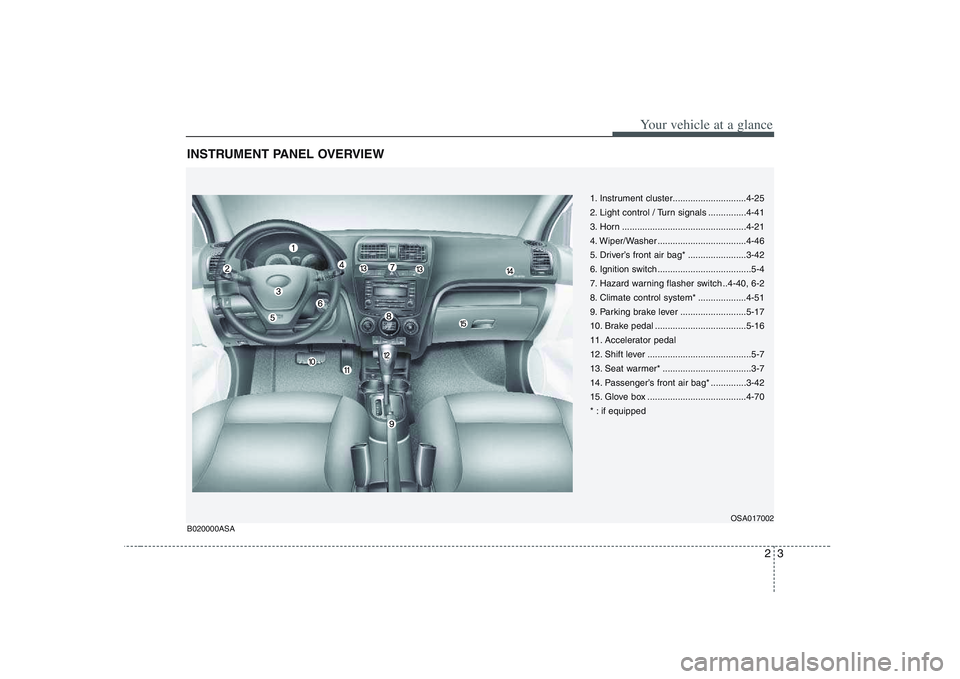
INSTRUMENT PANEL OVERVIEW
1. Instrument cluster.............................4-25
2. Light control / Turn signals ...............4-41
3. Horn .................................................4-21
4. Wiper/Washer ...................................4-46
5. Driver’s front air bag* .......................3-42
6. Ignition switch .....................................5-4
7. Hazard warning flasher switch ..4-40, 6-2
8. Climate control system* ...................4-51
9. Parking brake lever ..........................5-17
10. Brake pedal ....................................5-16
11. Accelerator pedal
12. Shift lever .........................................5-7
13. Seat warmer* ...................................3-7
14. Passenger’s front air bag* ..............3-42
15. Glove box .......................................4-70
* : if equippedOSA017002
B020000ASA
Page 15 of 335
3
Seats / 3-2 Seat belts / 3-15
Child restraint system / 3-26
Air bag - supplemental restraint system / 3-36
Safety features of your vehicle
Page 17 of 335
33
Safety features of your vehicle
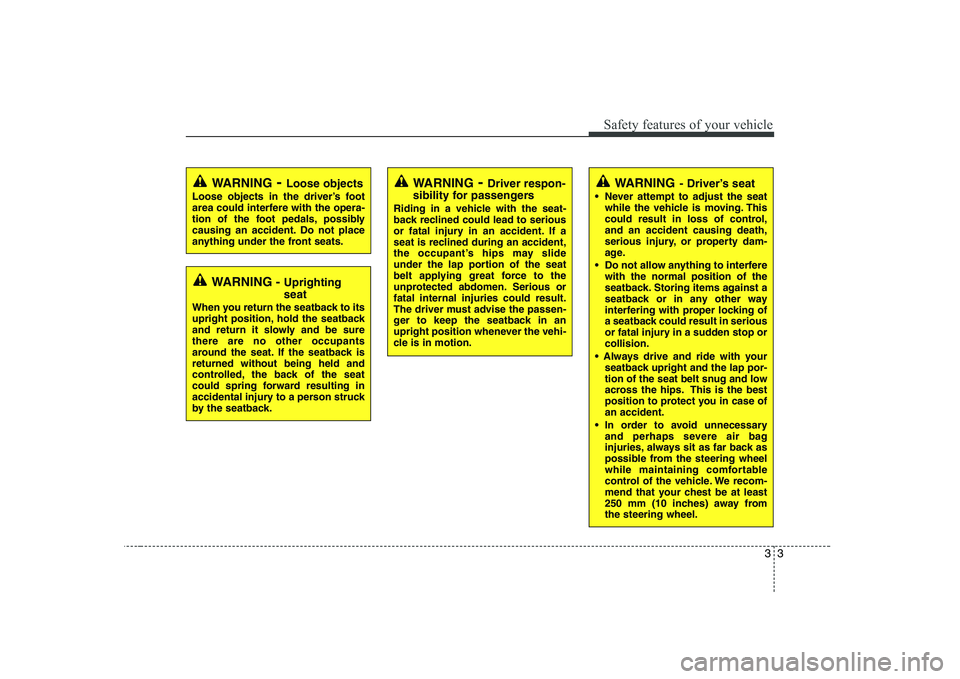
WARNING- Driver’s seat
Never attempt to adjust the seat while the vehicle is moving. This
could result in loss of control,and an accident causing death,
serious injury, or property dam-
age.
Do not allow anything to interfere with the normal position of the
seatback. Storing items against a
seatback or in any other way
interfering with proper locking of
a seatback could result in serious
or fatal injury in a sudden stop orcollision.
seatback upright and the lap por-
tion of the seat belt snug and low
across the hips. This is the best
position to protect you in case ofan accident.
In order to avoid unnecessary and perhaps severe air bag
injuries, always sit as far back as
possible from the steering wheel
while maintaining comfortable
control of the vehicle. We recom-
mend that your chest be at least
250 mm (10 inches) away fromthe steering wheel.
WARNING - Uprighting seat
When you return the seatback to its
upright position, hold the seatback
and return it slowly and be surethere are no other occupants
around the seat. If the seatback isreturned without being held and
controlled, the back of the seat
could spring forward resulting in
accidental injury to a person struck
by the seatback.
WARNING - Loose objects
Loose objects in the driver’s foot
area could interfere with the opera-
tion of the foot pedals, possibly
causing an accident. Do not place
anything under the front seats.WARNING - Driver respon-
sibility for passengers
Riding in a vehicle with the seat-
back reclined could lead to serious
or fatal injury in an accident. If a
seat is reclined during an accident,
the occupant’s hips may slide
under the lap portion of the seat
belt applying great force to the
unprotected abdomen. Serious orfatal internal injuries could result.
The driver must advise the passen-
ger to keep the seatback in an
upright position whenever the vehi-
cle is in motion.
Page 35 of 335
321
Safety features of your vehicle
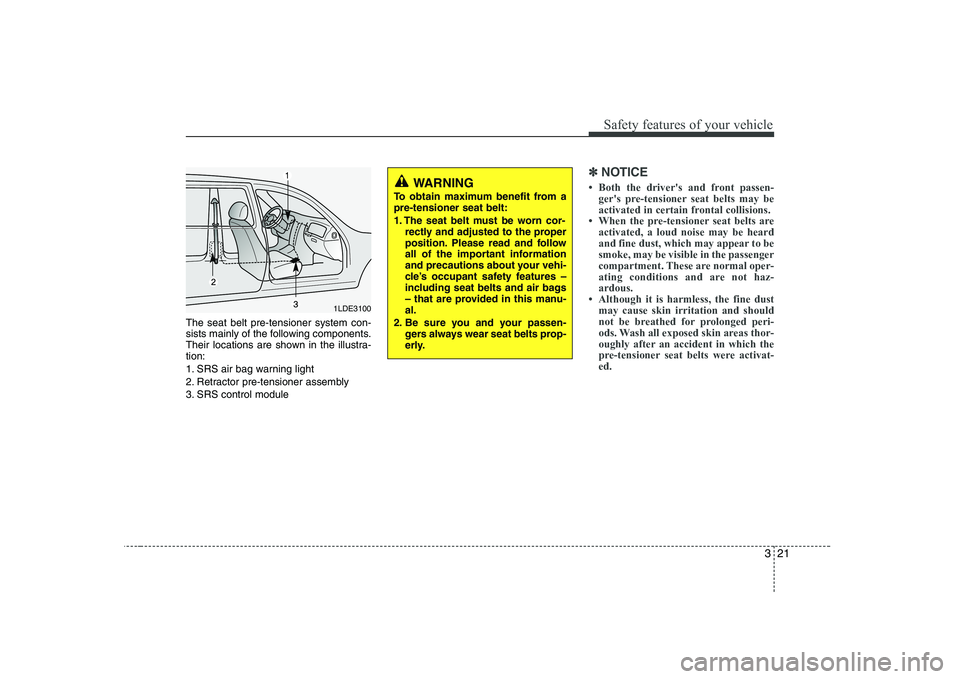
The seat belt pre-tensioner system con-
sists mainly of the following components.
Their locations are shown in the illustra-tion:
1. SRS air bag warning light
2. Retractor pre-tensioner assembly
3. SRS control module
✽✽NOTICE
Page 36 of 335
Safety features of your vehicle
22
3
✽✽
NOTICE
Because the sensor that activates the
SRS air bag is connected with the pre-
tensioner seat belt, the SRS air bag
warning light on the instrument
panel will illuminate for approximately
6 seconds after the ignition switch hasbeen turned to the ON position, andthen it should turn off.WARNING
Pre-tensioners are designed to operate only one time. After acti-
vation, pre-tensioner seat belts
must be replaced. All seat belts,
of any type, should always be
replaced after they have been
worn during a collision.
The pre-tensioner seat belt assembly mechanisms become
hot during activation. Do not
touch the pre-tensioner seat belt
assemblies for several minutes
after they have been activated.
Do not attempt to inspect or replace the pre-tensioner seat
belts yourself. This must be done
by an authorized KIA dealer.
Do not strike the pre-tensioner seat belt assemblies.
Do not attempt to service or repair the pre-tensioner seat belt
system in any manner.
(Continued)
CAUTION
If the pre-tensioner seat belt is notworking properly, this warning light will illuminate even if there is no malfunction of the SRS air bag. If
the SRS air bag warning light does not illuminate when the ignitionswitch is turned ON, or if it remains illuminated after illuminating for
approximately 6 seconds, or if it illuminates while the vehicle is being driven, please have anauthorized KIA dealer inspect the
pre-tensioner seat belt and SRS airbag system as soon as possible.
(Continued)
Improper handling of the pre-ten- sioner seat belt assemblies, and failure to heed the warnings not
to strike, modify, inspect, replace,
service or repair the pre-tension-
er seat belt assemblies may lead
to improper operation or inadver-
tent activation and serious injury.
Always wear the seat belts when driving or riding in a motor vehi-
cle.
Page 37 of 335
323
Safety features of your vehicle
C020300AUN Seat belt precautionsC020306AUN
Infant or small child
You should be aware of the specific
requirements in your country. Child
and/or infant seats must be properly
placed and installed in the rear seat. For
more information about the use of these
restraints, refer to the “Child restraint sys-
tem” in this section.
✽✽
NOTICE
Small children are best protected from
injury in an accident when properly
restrained in the rear seat by a child
restraint system that meets the require-
ments of the Safety Standards of your
country. Before buying any child
restraint system, make sure that it has alabel certifying that it meets Safety
Standards of your country. The restraint
must be appropriate for your child'sheight and weight. Check the label on
the child restraint for this information.
Refer to “Child restraint system” in thissection.
WARNING
All occupants of the vehicle must wear their seat belts at all times.
Seat belts and child restraintsreduce the risk of serious or fatal
injuries for all occupants in the
event of a collision or sudden stop.
Without a seat belt, occupants
could be shifted too close to a
deploying air bag, strike the interior
structure or be thrown from the
vehicle. Properly worn seat belts
greatly reduce these hazards.
Always follow the precautions
about seat belts, air bags and occu-pant seating contained in this man-ual.
WARNING
Every person in your vehicle needs
to be properly restrained at all
times, including infants and chil-
dren. Never hold a child in yourarms or lap when riding in a vehi-
cle. The violent forces created dur-
ing a crash will tear the child from
your arms and throw the child
against the interior. Always use a
child restraint appropriate for your
child's height and weight.
Page 39 of 335
325
Safety features of your vehicle
C020305APA
Do not lie down
To reduce the chance of injuries in the event
of an accident and to achieve maximum
effectiveness of the restraint system, all pas-sengers should be sitting up and the front
and rear seats should be in an upright posi-
tion when the car is moving. A seat belt can-
not provide proper protection if the person is
lying down in the rear seat or if the front andrear seats are in a reclined position.C020400AEN Care of seat belts
Seat belt systems should never be disas-
sembled or modified. In addition, care
should be taken to assure that seat belts
and belt hardware are not damaged by
seat hinges, doors or other abuse.
C020401AEN
Periodic inspection
All seat belts should be inspected peri-
odically for wear or damage of any kind.
Any damaged parts should be replaced
as soon as possible.
C020402AUN
Keep belts clean and dry
Seat belts should be kept clean and dry.
If belts become dirty, they can be
cleaned by using a mild soap solution
and warm water. Bleach, dye, strong
detergents or abrasives should not be
used because they may damage and
weaken the fabric. C020403ASA
When to replace seat belts
The entire in-use seat belt assembly or
assemblies should be replaced if the
vehicle has been involved in an accident.
This should be done even if no damage
is visible. Additional questions concern-
ing seat belt operation should be directed
by an authorized KIA dealer.
WARNING
Riding with a reclined seatback
increases your chance of serious or
fatal injuries in the event of a colli-
sion or sudden stop. The protection
of your restraint system (seat belts
and air bags) is greatly reduced by
reclining your seat. Seat belts must
be snug against your hips and
chest to work properly. The more
the seatback is reclined, the greater
the chance that an occupant's hipswill slide under the lap belt causingserious internal injuries or the
occupant's neck could strike the
shoulder belt. Drivers and passen-
gers should always sit well back in
their seats, properly belted, andwith the seat backs upright.
WARNING
When you return the rear seatback to its upright position after the rear
seatback has been folded down, be
careful not to damage the seat belt
webbing or buckle. Be sure that the
webbing or buckle does not get
caught or pinched in the rear seat.
A seat belt with damaged webbing
or buckle could possibly fail during
a collision or sudden stop, result-
ing in serious injury. If the webbing
or buckles are damaged, get them
replaced immediately.
Page 40 of 335
Safety features of your vehicle
26
3
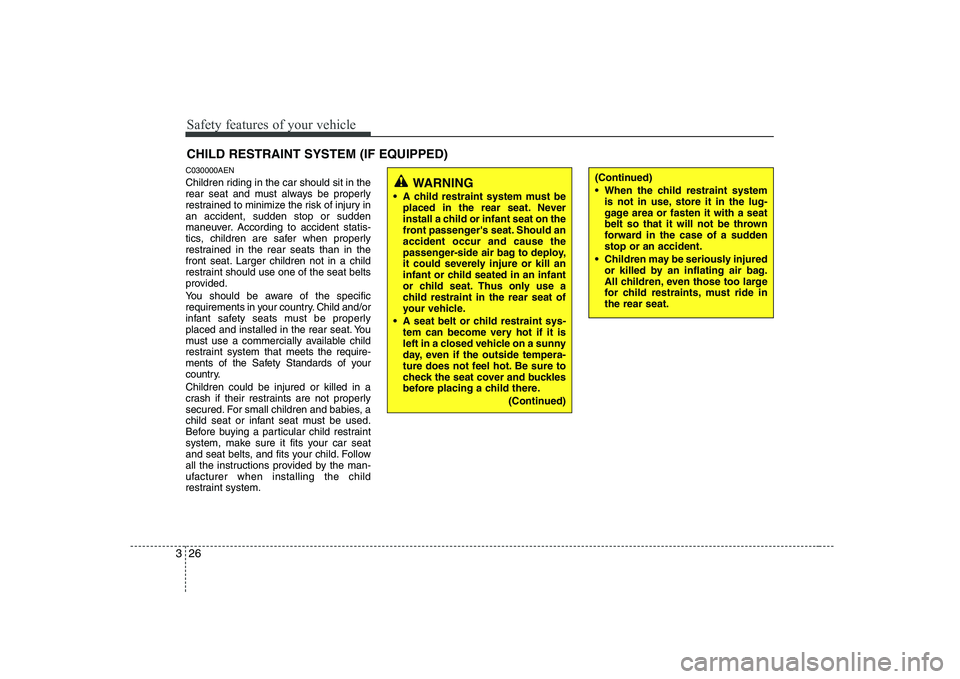
CHILD RESTRAINT SYSTEM (IF EQUIPPED)
C030000AEN
Children riding in the car should sit in the
rear seat and must always be properly
restrained to minimize the risk of injury inan accident, sudden stop or sudden
maneuver. According to accident statis-
tics, children are safer when properly
restrained in the rear seats than in the
front seat. Larger children not in a child
restraint should use one of the seat belts
provided.
You should be aware of the specific
requirements in your country. Child and/or
infant safety seats must be properly
placed and installed in the rear seat. You
must use a commercially available child
restraint system that me ets the require-
ments of the Safety Standards of your
country. Children could be injured or killed in a
crash if their restraints are not properly
secured. For small children and babies, a
child seat or infant seat must be used.
Before buying a particular child restraint
system, make sure it fits your car seat
and seat belts, and fits your child. Follow
all the instructions provided by the man-
ufacturer when installing the child
restraint system.
WARNING
A child restraint system must be placed in the rear seat. Never
install a child or infant seat on the
front passenger's seat. Should anaccident occur and cause the
passenger-side air bag to deploy,
it could severely injure or kill an
infant or child seated in an infant
or child seat. Thus only use a
child restraint in the rear seat of
your vehicle.
A seat belt or child restraint sys- tem can become very hot if it is
left in a closed vehicle on a sunny
day, even if the outside tempera-
ture does not feel hot. Be sure to
check the seat cover and buckles
before placing a child there.
(Continued)(Continued)
When the child restraint systemis not in use, store it in the lug-
gage area or fasten it with a seat
belt so that it will not be thrown
forward in the case of a suddenstop or an accident.
Children may be seriously injured or killed by an inflating air bag.
All children, even those too large
for child restraints, must ride inthe rear seat.
Page 41 of 335
327
Safety features of your vehicle
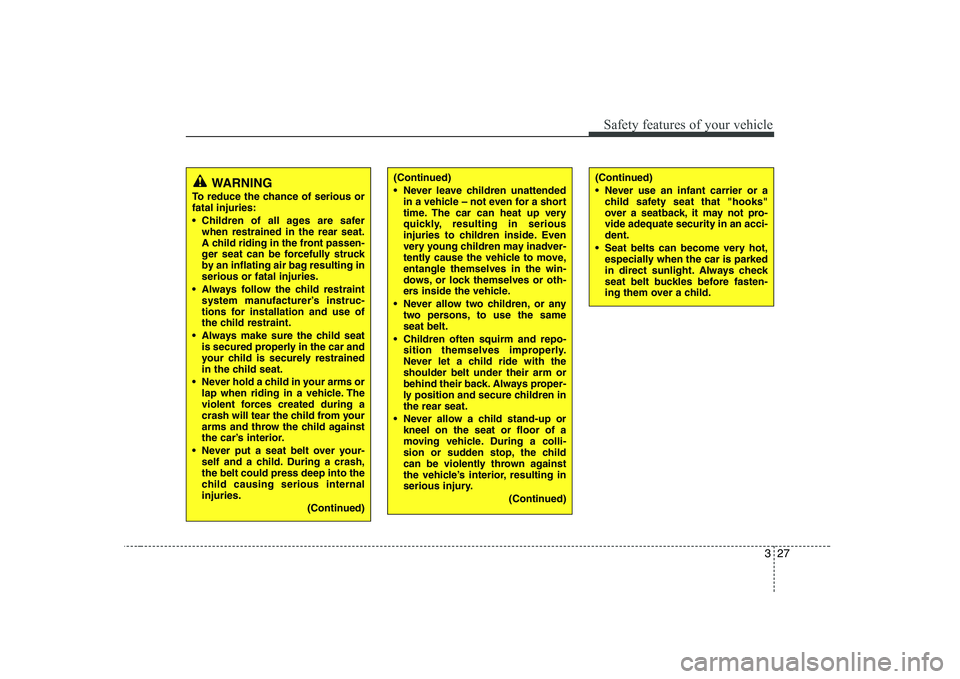
WARNING
To reduce the chance of serious or fatal injuries:
Children of all ages are safer when restrained in the rear seat.
A child riding in the front passen-
ger seat can be forcefully struck
by an inflating air bag resulting inserious or fatal injuries.
Always follow the child restraint system manufacturer’s instruc-
tions for installation and use of
the child restraint.
Always make sure the child seat is secured properly in the car and
your child is securely restrained
in the child seat.
Never hold a child in your arms or lap when riding in a vehicle. The
violent forces created during a
crash will tear the child from your
arms and throw the child against
the car’s interior.
Never put a seat belt over your- self and a child. During a crash,the belt could press deep into the
child causing serious internalinjuries.
(Continued)(Continued)
Never leave children unattendedin a vehicle – not even for a short
time. The car can heat up very
quickly, resulting in serious
injuries to children inside. Even
very young children may inadver-
tently cause the vehicle to move,entangle themselves in the win-
dows, or lock themselves or oth-
ers inside the vehicle.
Never allow two children, or any two persons, to use the sameseat belt.
Children often squirm and repo- sition themselves improperly.
Never let a child ride with theshoulder belt under their arm or
behind their back. Always proper-
ly position and secure children inthe rear seat.
Never allow a child stand-up or kneel on the seat or floor of a
moving vehicle. During a colli-
sion or sudden stop, the child
can be violently thrown against
the vehicle’s interior, resulting in
serious injury.
(Continued)(Continued)
Never use an infant carrier or achild safety seat that "hooks"
over a seatback, it may not pro-vide adequate security in an acci-dent.
Seat belts can become very hot, especially when the car is parked
in direct sunlight. Always check
seat belt buckles before fasten-
ing them over a child.