maintenance schedule KIA PICANTO 2010 Owner's Manual
[x] Cancel search | Manufacturer: KIA, Model Year: 2010, Model line: PICANTO, Model: KIA PICANTO 2010Pages: 336, PDF Size: 33.02 MB
Page 280 of 336
727
Maintenance
G070200AUN Changing the coolant
Have coolant changed by an authorized KIA dealer according to the MaintenanceSchedule at the beginning of this section.G080100ASA
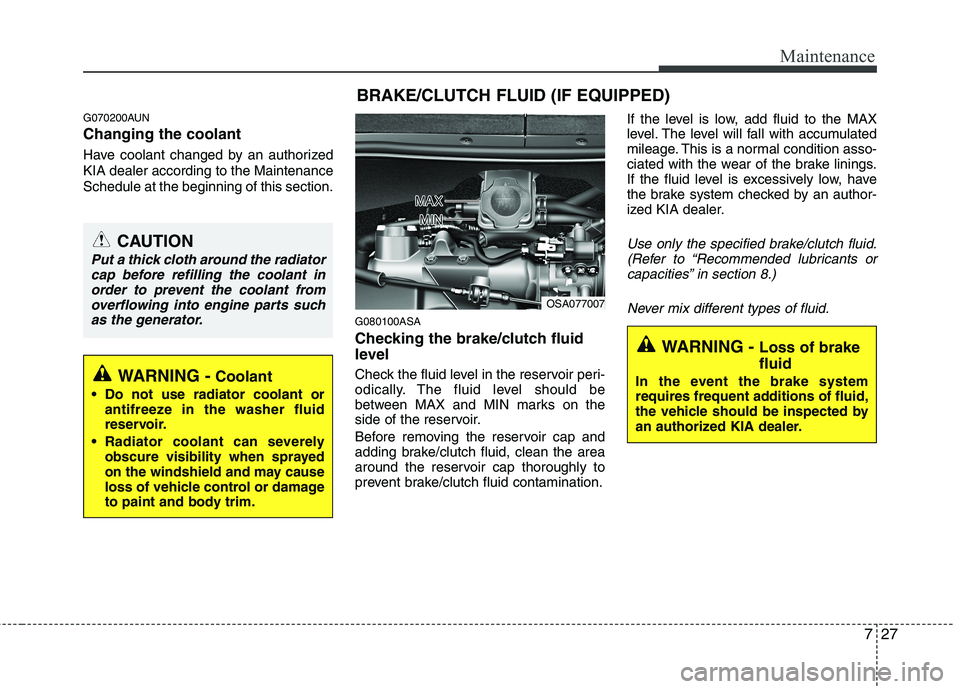
Checking the brake/clutch fluid
level
Check the fluid level in the reservoir peri-
odically. The fluid level should be
between MAX and MIN marks on the
side of the reservoir.
Before removing the reservoir cap and
adding brake/clutch fluid, clean the area
around the reservoir cap thoroughly to
prevent brake/clutch fluid contamination.If the level is low, add fluid to the MAX
level. The level will fall with accumulated
mileage. This is a normal condition asso-
ciated with the wear of the brake linings.
If the fluid level is excessively low, have
the brake system checked by an author-
ized KIA dealer.
Use only the specified brake/clutch fluid.
(Refer to “Recommended lubricants orcapacities” in section 8.)
Never mix different types of fluid.CAUTION
Put a thick cloth around the radiatorcap before refilling the coolant in order to prevent the coolant from
overflowing into engine parts suchas the generator.
WARNING - Coolant
Do not use radiator coolant or antifreeze in the washer fluid
reservoir.
Radiator coolant can severely obscure visibility when sprayed
on the windshield and may cause
loss of vehicle control or damage
to paint and body trim.
BRAKE/CLUTCH FLUID (IF EQUIPPED)
OSA077007
WARNING - Loss of brake fluid
In the event the brake system
requires frequent additions of fluid,
the vehicle should be inspected by
an authorized KIA dealer.
Page 283 of 336
Maintenance
30
7
✽✽
NOTICE
The “COLD” range is for reference only
and should NOT be used to determine
the transaxle fluid level.
✽
✽ NOTICE
New automatic transaxle fluid should be
red. The red dye is added so the assem-
bly plant can identify it as automatic
transaxle fluid and distinguish it from
engine oil or antifreeze. The red dye,
which is not an indicator of fluid quali-
ty, is not permanent. As the vehicle is
driven, the automatic transaxle fluid
will begin to look darker. The color may
eventually appear light brown.
Therefore, have an authorized KIA
dealer change the automatic transaxle
fluid according to the Scheduled
Maintenance at the beginning of this
section.
Use only the specified automatic
transaxle fluid. (Refer to "Recommended
lubricants or capacities" in section 8.)
G100200AUN Changing the automatic transaxle fluid
Have the automatic transaxle fluid
changed by an authorized KIA dealeraccording to the Maintenance Scheduleat the beginning of this section.
WARNING - Transaxle fluid
The transaxle fluid level should be
checked when the engine is at nor-
mal operating temperature. This
means that the engine, radiator,
radiator hose and exhaust system
etc., are very hot. Exercise great
care not to burn yourself during
this procedure.
CAUTION
Low fluid level causes transaxle slippage. Overfilling can causefoaming, loss of fluid and transaxlemalfunction.
The use of a non-specified fluid could cause transaxle malfunc-tion and failure.
WARNING - Parking brake
To avoid sudden movement of the
vehicle, apply the parking brake
and depress the brake pedal before
moving the shift lever.
Page 288 of 336

735
Maintenance
Replace the filter according to the
Maintenance Schedule.
If the vehicle is operated in extremelydusty or sandy areas, replace the ele-ment more often than the usual recom-
mended intervals. (Refer to“Maintenance under severe usage condi-tions” in this section.)
G170100ASA Filter inspection The climate control air filter should be replaced according to the maintenance
schedule. If the vehicle is operated in
severely air-polluted cities or on dusty
rough roads for a long period, it should
be inspected more frequently. However, it
should be inspected when the air flow
volume rapidly drops. When you clean
the climate control air filter, clean it by
performing the following procedure, and
be careful to avoid damaging other com-
ponents. G170200ASA Filter replacement
1. With the glove box open, remove the
stoppers on both sides to allow the
glove box to hang freely on the hinges.
CAUTION
Do not drive with the air cleaner
removed; this will cause exces-sive engine wear.
When removing the air cleaner fil- ter, be careful that dust or dirt
does not enter the air intake, ordamage may result.
Use a KIA genuine part. Using non-genuine parts could damagethe air flow sensor or turbocharg-
er.
CLIMATE CONTROL AIR FILTER (IF EQUIPPED)
OSA077016
Page 323 of 336
Maintenance
70
7
EMISSION CONTROL SYSTEM (IF EQUIPPED)
G270000AUN
The emission control system of your
vehicle is covered by a written limited
warranty. Please see the warranty infor-
mation contained in the Warranty &
Maintenance booklet in your vehicle.
Your vehicle is equipped with an emis-
sion control system to meet all applicable
emission regulations. There are three emission control sys-
tems, as follows.
(1) Crankcase emission control system
(2) Evaporative emission control system(3) Exhaust emission control system In order to assure the proper function of
the emission control systems, it is rec-
ommended that you have your car
inspected and maintained by an author-
ized KIA dealer in accordance with the
maintenance schedule in this manual. Caution for the Inspection and
Maintenance Test (With Electronic
Stability Program (ESP) system)
To prevent the vehicle from misfir-
ing during dynamometer testing,
turn the Electronic Stability
Program (ESP) system off by press-
ing the ESP switch.
After dynamometer testing is com- pleted, turn the ESP system back on
by pressing the ESP switch again. G270100AUN
1. Crankcase emission control
system
The positive crankcase ventilation sys-
tem is employed to prevent air pollution
caused by blow-by gases being emitted
from the crankcase. This system supplies
fresh filtered air to the crankcase through
the air intake hose. Inside the crankcase,
the fresh air mixes with blow-by gases,
which then pass through the PCV valveinto the induction system.
G270200AUN
2. Evaporative emission control system
The Evaporative Emission Control
System is designed to prevent fuel
vapors from escaping into the atmos-
phere.
Page 334 of 336
Index
2
I
Air bag - supplemental restraint system ························3-36
Air cleaner ·····································································7-34
Appearance care·····························································7-64
Audio system ·································································4-77
Automatic climate control system ·································4-60
Automatic transaxle ·······················································5-10
Automatic transaxle fluid ··············································7-29
Battery············································································7-38
Before driving ··································································5-3
Brake system··································································5-16
Brakes/clutch fluid ·························································7-27
Bulb wattage ····································································8-2
Child restraint system ····················································3-26
Climate control air filter ················································7-35
Defroster ········································································4-51
Dimensions ······································································8-2
Door locks········································································4-8 Economical operation ····················································5-26
Emergency commodity ··················································6-28
Emergency starting ··························································6-4
Emission control system ················································7-70
Engine compartment ················································2-4, 7-2
Engine coolant ·······························································7-25
Engine number ·································································8-7
Engine oil ·······································································7-23
Explanation of scheduled maintenance items ···············7-21
Fuel filler lid ··································································4-17
Fuel filter········································································7-32
Fuel requirements ····························································1-2
Fuses ··············································································7-51
Hazard warning flasher ··········································4-41, 6-2
Hood···············································································4-15
How to use this manual ···················································1-2
If the engine overheats·····················································6-6
A
B
C
D
E
F
H
I
Page 335 of 336

I3
Index
If the engine will not start ···············································6-3
If you have a flat tire (with spare tire)·····························6-7
If you have a flat tire (with TireMobilityKit) ················6-15
In case of an emergency while driving ····························6-2
Indicator symbols on the instrument cluster ···················1-6
Instrument cluster ··························································4-25
Instrument panel overview···············································2-3
Interior features······························································4-72
Interior light ···································································4-50
Interior overview······························································2-2
Key positions ···································································5-4
Keys ·················································································4-2
Light bulbs ·····································································7-58
Lighting··········································································4-41
Maintenance services ·······················································7-4
Manual climate control system······································4-52
Manual transaxle······························································5-7
Mirrors ···········································································4-22 Owner maintenance ·························································7-6
Parking brake ································································7-31
Rear parking assist system·············································4-38
Recommended lubricants and capacities ·························8-4
Remote keyless entry ·······················································4-4
Road warning ···································································6-2
Scheduled maintenance service ·······································7-8
Seat belts ········································································3-14
Seats ·················································································3-2
Special driving conditions ·············································5-28
Starting the engine ···························································5-5
Steering wheel ·······························································4-19
Storage compartment ·····················································4-70
Tailgate···········································································4-11
K
L
M
O
P
R
S
T