air filter KIA PICANTO 2011 User Guide
[x] Cancel search | Manufacturer: KIA, Model Year: 2011, Model line: PICANTO, Model: KIA PICANTO 2011Pages: 336, PDF Size: 24.51 MB
Page 271 of 336
Maintenance
18
7
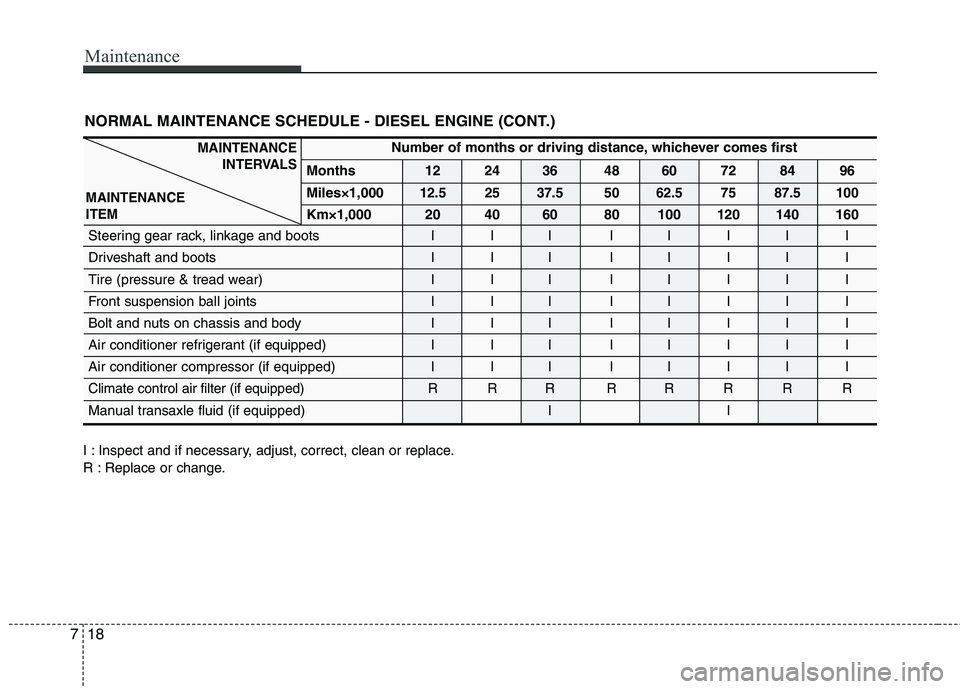
NORMAL MAINTENANCE SCHEDULE - DIESEL ENGINE (CONT.)
Number of months or driving distance, whichever comes first
Months 12 24 36 48 60 72 84 96 Miles×1,000
12.5 25 37.5 50 62.5 75 87.5 100
Km×1,000 20 40 60 80 100 120 140 160
Steering gear rack, linkage and boots I I I I I I I I
Driveshaft and boots I I I I I I I I
Tire (pressure & tread wear) I I I I I I I I
Front suspension ball joints I I I I I I I I
Bolt and nuts on chassis and body I I I I I I I I
Air conditioner refrigerant (if equipped) I I I I I I I I
Air conditioner compressor (if equipped) I I I I I I I I
Climate control air filter (if equipped) R R R R R R R R
Manual transaxle fluid (if equipped) I I
I : Inspect and if necessary, adjust, correct, clean or replace.
R : Replace or change.
MAINTENANCE
INTERVALS
MAINTENANCE ITEM
Page 272 of 336
719
Maintenance
G040400ASA
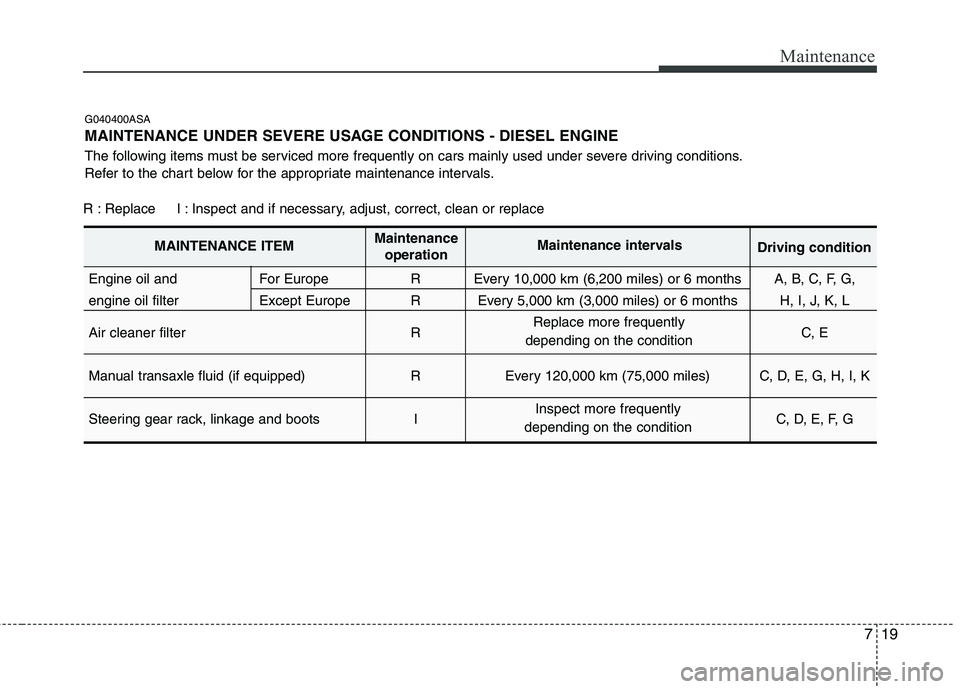
MAINTENANCE UNDER SEVERE USAGE CONDITIONS - DIESEL ENGINE
The following items must be serviced more frequently on cars mainly used under severe driving conditions.
Refer to the chart below for the appropriate maintenance intervals.
R : Replace I : Inspect and if necessary, adjust, correct, clean or replace
MAINTENANCE ITEMMaintenance
operation Maintenance intervals
Driving condition
Replace more frequently
depending on the condition
Engine oil and For Europe R Every 10,000 km (6,200 miles) or 6 months A, B, C, F, G,
engine oil filter Except Europe R Every 5,000 km (3,000 miles) or 6 months H, I, J, K, L
Air cleaner filter R
C, E
Manual transaxle fluid (if equipped) R Every 120,000 km (75,000 miles) C, D, E, G, H, I, K
Steering gear rack, linkage and boots I C, D, E, F, G
Inspect more frequently
depending on the condition
Page 273 of 336
Maintenance
20
7
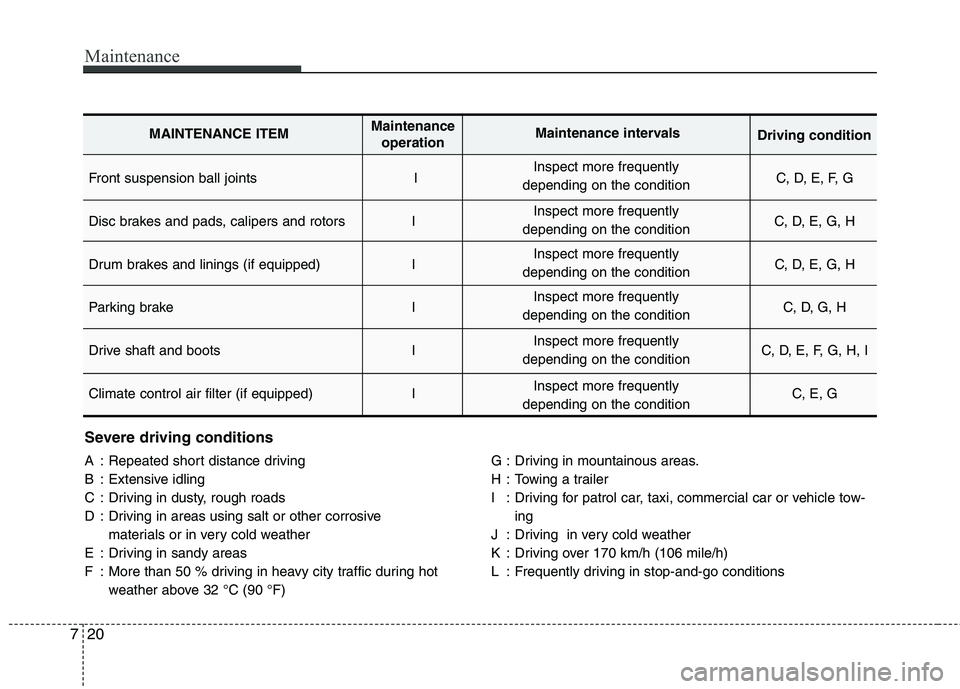
Severe driving conditions
A : Repeated short distance driving
B : Extensive idling
C : Driving in dusty, rough roads
D : Driving in areas using salt or other corrosive
materials or in very cold weather
E : Driving in sandy areas
F : More than 50 % driving in heavy city traffic during hot weather above 32 °C (90 °F) G : Driving in mountainous areas.
H : Towing a trailer
I : Driving for patrol car, taxi, commercial car or vehicle tow-
ing
J : Driving in very cold weather
K : Driving over 170 km/h (106 mile/h)
L : Frequently driving in stop-and-go conditions
Front suspension ball joints I C, D, E, F, G
Disc brakes and pads, calipers and rotors I C, D, E, G, H
Drum brakes and linings (if equipped) I C, D, E, G, H
Parking brake I C, D, G, H
Drive shaft and boots I C, D, E, F, G, H, I
Climate control air filter (if equipped) I C, E, G
MAINTENANCE ITEMMaintenance
operation Maintenance intervals
Driving condition
Inspect more frequently
depending on the condition
Inspect more frequently
depending on the condition
Inspect more frequently
depending on the condition
Inspect more frequently
depending on the condition
Inspect more frequently
depending on the condition
Inspect more frequently
depending on the condition
Page 275 of 336
Maintenance
22
7
G050800AUN
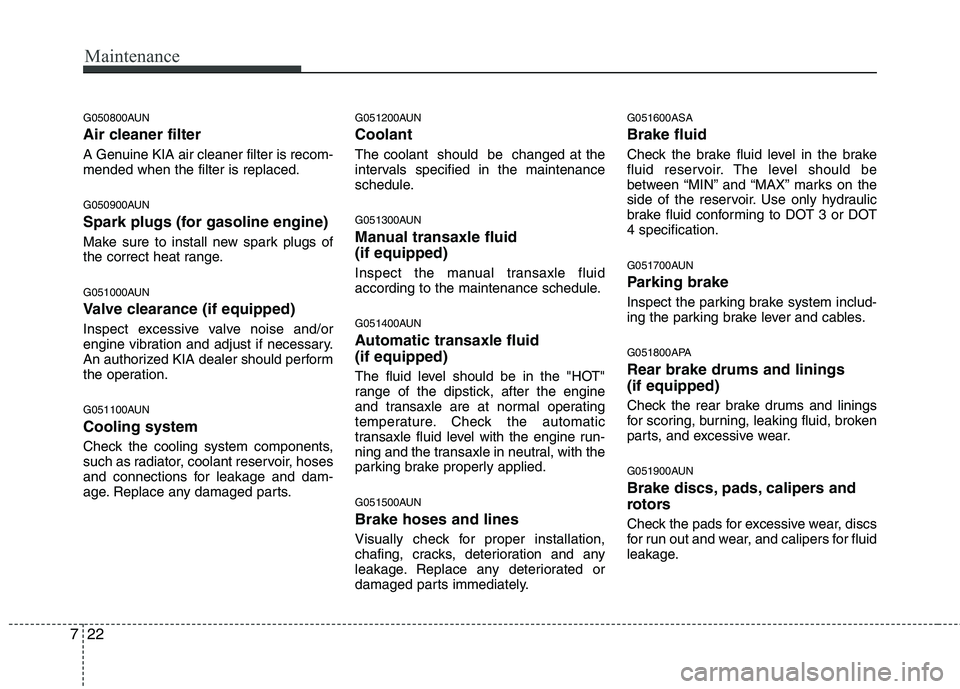
Air cleaner filter
A Genuine KIA air cleaner filter is recom- mended when the filter is replaced.
G050900AUN
Spark plugs (for gasoline engine)
Make sure to install new spark plugs of
the correct heat range.
G051000AUN
Valve clearance (if equipped)
Inspect excessive valve noise and/or
engine vibration and adjust if necessary.
An authorized KIA dealer should perform
the operation.
G051100AUN Cooling system
Check the cooling system components,
such as radiator, coolant reservoir, hoses
and connections for leakage and dam-
age. Replace any damaged parts. G051200AUN Coolant The coolant should be changed at the
intervals specified in the maintenance
schedule.
G051300AUN
Manual transaxle fluid (if equipped)
Inspect the manual transaxle fluid
according to the maintenance schedule.
G051400AUN
Automatic transaxle fluid (if equipped)
The fluid level should be in the "HOT"
range of the dipstick, after the engine
and transaxle are at normal operating
temperature. Check the automatic
transaxle fluid level with the engine run-
ning and the transaxle in neutral, with the
parking brake properly applied.
G051500AUN Brake hoses and lines
Visually check for proper installation,
chafing, cracks, deterioration and any
leakage. Replace any deteriorated or
damaged parts immediately.G051600ASA Brake fluid
Check the brake fluid level in the brake
fluid reservoir. The level should be
between “MIN” and “MAX” marks on the
side of the reservoir. Use only hydraulic
brake fluid conforming to DOT 3 or DOT4 specification.
G051700AUN
Parking brake
Inspect the parking brake system includ-
ing the parking brake lever and cables.
G051800APA Rear brake drums and linings (if equipped)
Check the rear brake drums and linings
for scoring, burning, leaking fluid, broken
parts, and excessive wear.
G051900AUN
Brake discs, pads, calipers and
rotors
Check the pads for excessive wear, discs
for run out and wear, and calipers for fluid
leakage.
Page 286 of 336
733
Maintenance
G150300ASA
Extracting air from the fuel filter
If you drive until you have no fuel left or if
you replace the fuel filter, be sure to
extract air from the fuel system as it
makes it difficult to start the engine.
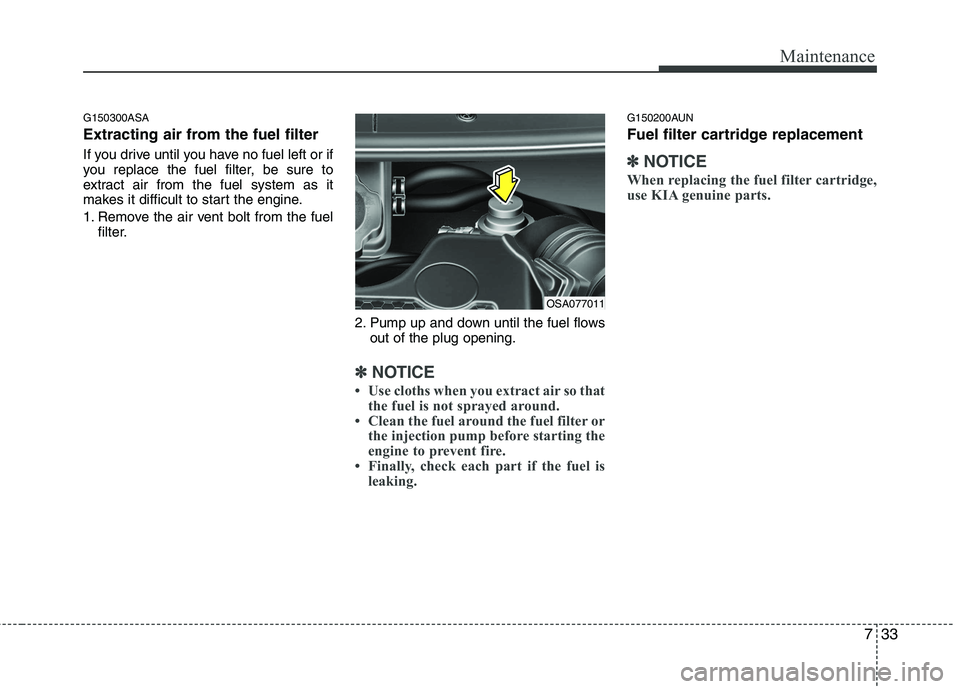
1. Remove the air vent bolt from the fuelfilter.
2. Pump up and down until the fuel flowsout of the plug opening.
✽✽ NOTICE
Use cloths when you extract air so that the fuel is not sprayed around.
Clean the fuel around the fuel filter or the injection pump before starting the
engine to prevent fire.
Finally, check each part if the fuel is
leaking.
G150200AUN
Fuel filter cartridge replacement
✽✽ NOTICE
When replacing the fuel filter cartridge,
use KIA genuine parts.
OSA077011
Page 287 of 336
Maintenance
34
7
AIR CLEANER
G160100AUN Filter replacement
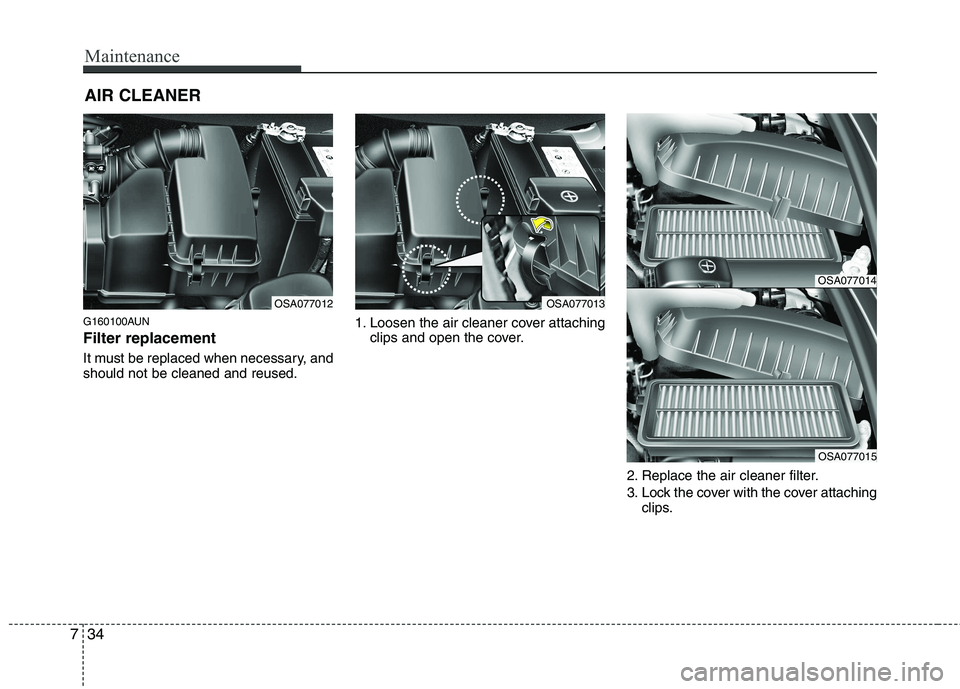
It must be replaced when necessary, and should not be cleaned and reused. 1. Loosen the air cleaner cover attaching
clips and open the cover.
2. Replace the air cleaner filter.
3. Lock the cover with the cover attachingclips.
OSA077012OSA077013
OSA077014
OSA077015
Page 288 of 336
735
Maintenance
Replace the filter according to the
Maintenance Schedule.
If the vehicle is operated in extremelydusty or sandy areas, replace the ele-ment more often than the usual recom-
mended intervals. (Refer to“Maintenance under severe usage condi-tions” in this section.)
G170100ASA Filter inspection The climate control air filter should be replaced according to the maintenance
schedule. If the vehicle is operated in
severely air-polluted cities or on dusty
rough roads for a long period, it should
be inspected more frequently. However, it
should be inspected when the air flow
volume rapidly drops. When you clean
the climate control air filter, clean it by
performing the following procedure, and
be careful to avoid damaging other com-
ponents. G170200ASA Filter replacement
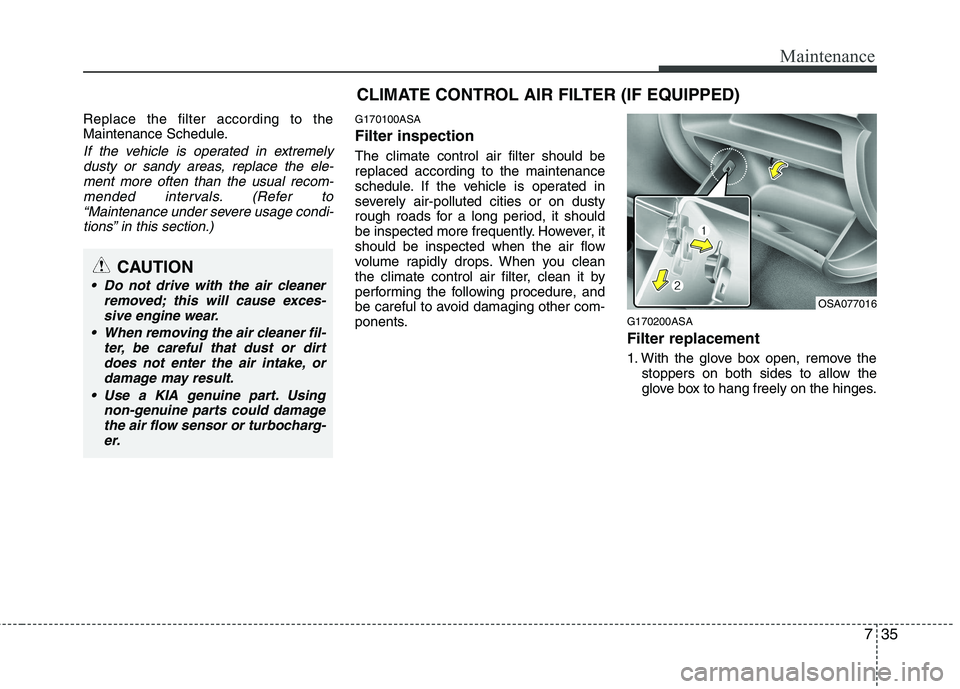
1. With the glove box open, remove the
stoppers on both sides to allow the
glove box to hang freely on the hinges.
CAUTION
Do not drive with the air cleaner
removed; this will cause exces-sive engine wear.
When removing the air cleaner fil- ter, be careful that dust or dirt
does not enter the air intake, ordamage may result.
Use a KIA genuine part. Using non-genuine parts could damagethe air flow sensor or turbocharg-
er.
CLIMATE CONTROL AIR FILTER (IF EQUIPPED)
OSA077016
Page 289 of 336
Maintenance
36
7
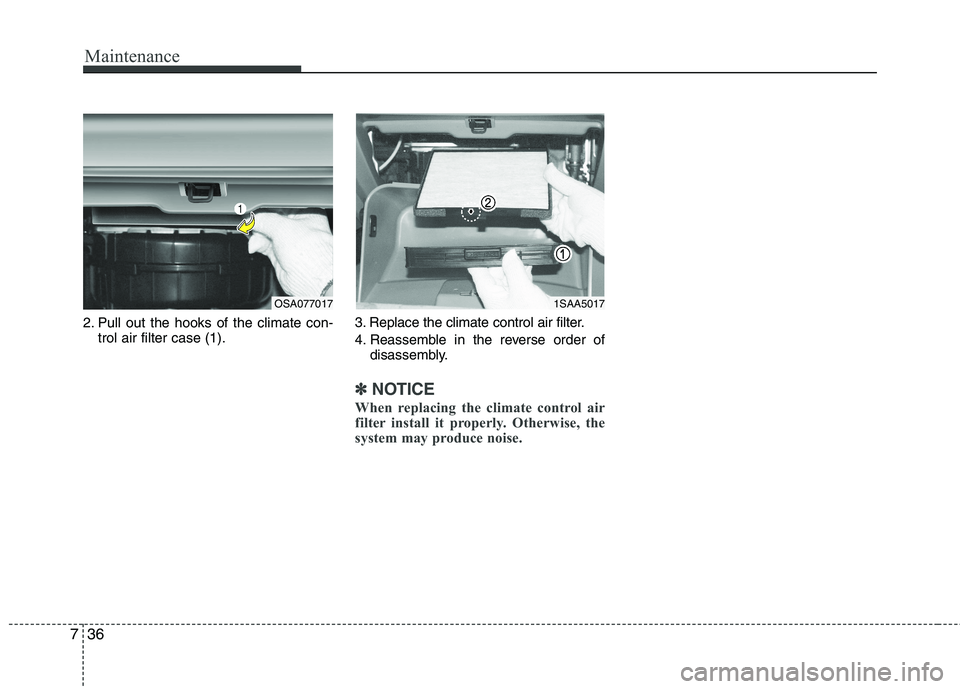
2. Pull out the hooks of the climate con-
trol air filter case (1). 3. Replace the climate control air filter.
4. Reassemble in the reverse order of
disassembly.
✽✽ NOTICE
When replacing the climate control air
filter install it properly. Otherwise, the
system may produce noise.
OSA0770171SAA5017
Page 310 of 336
757
Maintenance
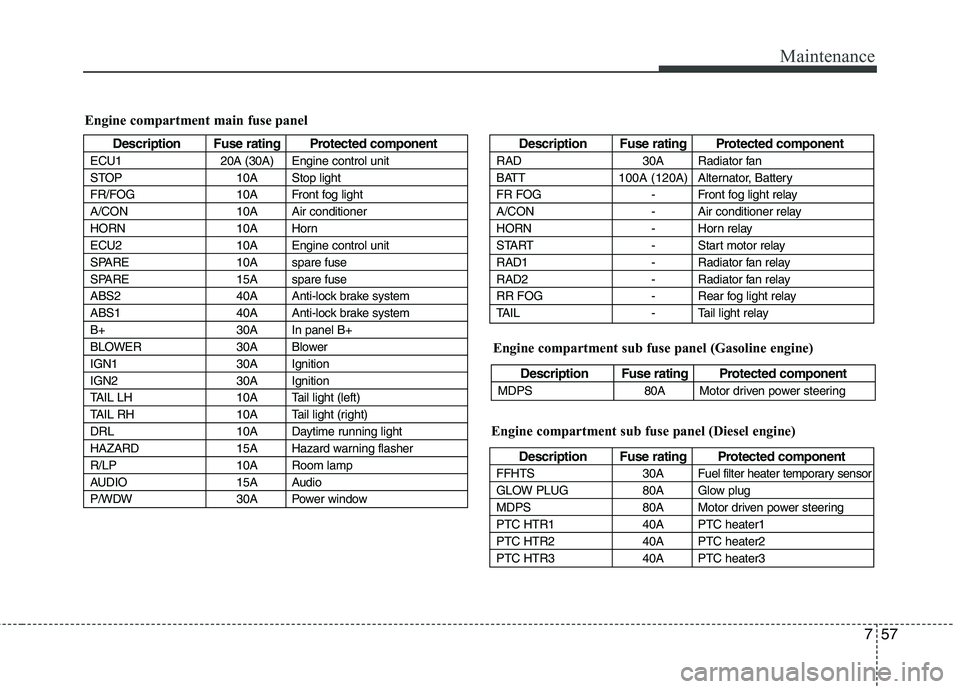
Engine compartment main fuse panel
Description Fuse rating Protected component
ECU1 20A (30A) Engine control unit
STOP 10A Stop light
FR/FOG 10A Front fog light
A/CON 10A Air conditioner
HORN 10A Horn
ECU2 10A Engine control unit
SPARE 10A spare fuse
SPARE 15A spare fuse
ABS2 40A Anti-lock brake system
ABS1 40A Anti-lock brake system
B+ 30A In panel B+
BLOWER 30A Blower
IGN1 30A Ignition
IGN2 30A Ignition
TAIL LH 10A Tail light (left)
TAIL RH 10A Tail light (right)
DRL 10A Daytime running light
HAZARD 15A Hazard warning flasher
R/LP 10A Room lamp
AUDIO 15A Audio
P/WDW 30A Power windowDescription Fuse rating Protected component
RAD 30A Radiator fan
BATT 100A (120A) Alternator, Battery
FR FOG - Front fog light relay
A/CON - Air conditioner relay
HORN - Horn relay
START - Start motor relay
RAD1 - Radiator fan relay
RAD2 - Radiator fan relay
RR FOG - Rear fog light relay
TAIL - Tail light relay
Engine compartment sub fuse panel (Diesel engine)
Description Fuse rating Protected component
FFHTS 30A
Fuel filter heater temporary sensor
GLOW PLUG 80A Glow plug
MDPS 80A Motor driven power steering
PTC HTR1 40A PTC heater1
PTC HTR2 40A PTC heater2
PTC HTR3 40A PTC heater3
Engine compartment sub fuse panel (Gasoline engine)
Description Fuse rating Protected component
MDPS 80A Motor driven power steering
Page 323 of 336
Maintenance
70
7
EMISSION CONTROL SYSTEM (IF EQUIPPED)
G270000AUN
The emission control system of your
vehicle is covered by a written limited
warranty. Please see the warranty infor-
mation contained in the Warranty &
Maintenance booklet in your vehicle.
Your vehicle is equipped with an emis-
sion control system to meet all applicable
emission regulations. There are three emission control sys-
tems, as follows.
(1) Crankcase emission control system
(2) Evaporative emission control system(3) Exhaust emission control system In order to assure the proper function of
the emission control systems, it is rec-
ommended that you have your car
inspected and maintained by an author-
ized KIA dealer in accordance with the
maintenance schedule in this manual. Caution for the Inspection and
Maintenance Test (With Electronic
Stability Program (ESP) system)
To prevent the vehicle from misfir-
ing during dynamometer testing,
turn the Electronic Stability
Program (ESP) system off by press-
ing the ESP switch.
After dynamometer testing is com- pleted, turn the ESP system back on
by pressing the ESP switch again.
G270100AUN
1. Crankcase emission control system
The positive crankcase ventilation sys-
tem is employed to prevent air pollution
caused by blow-by gases being emitted
from the crankcase. This system supplies
fresh filtered air to the crankcase through
the air intake hose. Inside the crankcase,
the fresh air mixes with blow-by gases,
which then pass through the PCV valveinto the induction system.
G270200AUN
2. Evaporative emission control system
The Evaporative Emission Control
System is designed to prevent fuel vapors
from escaping into the atmosphere. G270201AUN
Canister
Fuel vapors generated inside the fuel tank are absorbed and stored in the
onboard canister. When the engine is
running, the fuel vapors absorbed in the
canister are drawn into the surge tank
through the purge control solenoid valve.
G270202AUN
Purge Control Solenoid Valve (PCSV)
The purge control solenoid valve is con-
trolled by the Engine Control Module
(ECM); when the engine coolant temper-
ature is low during idling, the PCSV clos-
es so that evaporated fuel is not taken
into the engine. After the engine warms-
up during ordinary driving, the PCSV
opens to introduce evaporated fuel to the
engine.
G270300AUN
3. Exhaust emission control
system
The Exhaust Emission Control System is
a highly effective system which controls
exhaust emissions while maintaining
good vehicle performance.