child restraint KIA PICANTO 2011 Owner's Manual
[x] Cancel search | Manufacturer: KIA, Model Year: 2011, Model line: PICANTO, Model: KIA PICANTO 2011Pages: 336, PDF Size: 24.51 MB
Page 62 of 336
Safety features of your vehicle
48
3
C040600ASA
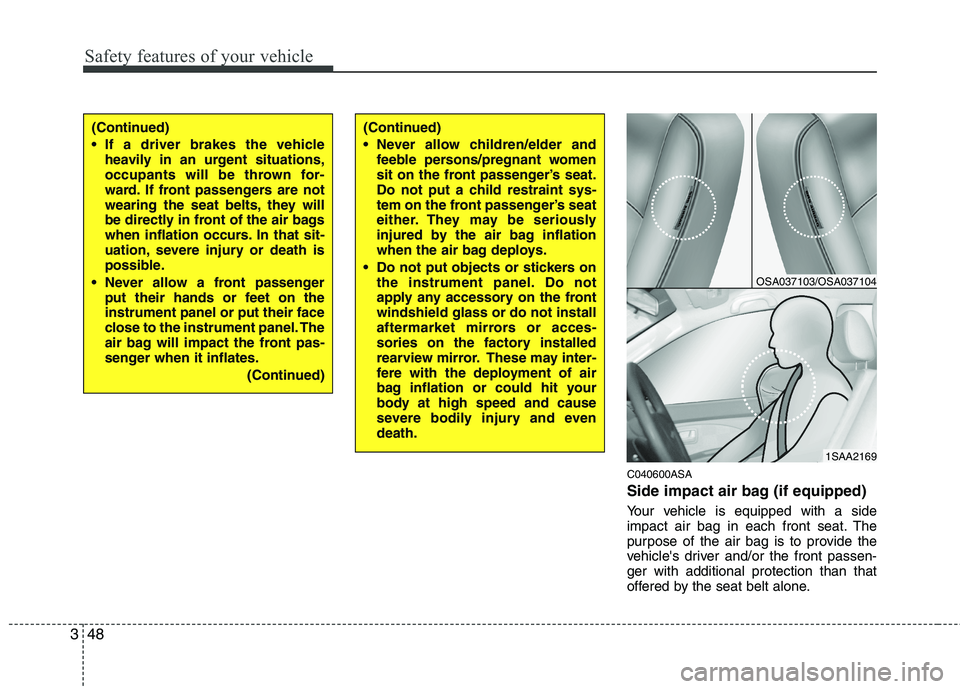
Side impact air bag (if equipped)
Your vehicle is equipped with a side
impact air bag in each front seat. The
purpose of the air bag is to provide the
vehicle's driver and/or the front passen-ger with additional protection than that
offered by the seat belt alone.
1SAA2169
(Continued)
If a driver brakes the vehicle
heavily in an urgent situations,
occupants will be thrown for-
ward. If front passengers are not
wearing the seat belts, they will
be directly in front of the air bags
when inflation occurs. In that sit-
uation, severe injury or death is
possible.
Never allow a front passenger put their hands or feet on theinstrument panel or put their face
close to the instrument panel. The
air bag will impact the front pas-
senger when it inflates.
(Continued)(Continued)
Never allow children/elder andfeeble persons/pregnant women
sit on the front passenger’s seat.
Do not put a child restraint sys-
tem on the front passenger’s seat
either. They may be seriously
injured by the air bag inflation
when the air bag deploys.
Do not put objects or stickers on the instrument panel. Do not
apply any accessory on the frontwindshield glass or do not install
aftermarket mirrors or acces-
sories on the factory installed
rearview mirror. These may inter-
fere with the deployment of air
bag inflation or could hit your
body at high speed and cause
severe bodily injury and evendeath.
OSA037103/OSA037104
Page 63 of 336
349
Safety features of your vehicle
The side impact air bags are designed to
deploy only during certain side-impact
collisions, depending on the crash sever-
ity, angle, speed and point of impact. Theside impact air bags are not designed to
deploy in all side impact situations.(Continued)
Do not use any accessory seatcovers.
Use of seat covers could reduce or prevent the effectiveness of the system.
Do not install any accessories on the side or near the side impact
air bag.
Do not place any objects over the air bag or between the air bag
and yourself.
Do not place any objects (an umbrella, bag, etc.) between the
front door and the front seat.
Such objects may become dan-
gerous projectiles and cause
injury if the supplemental side
impact air bag inflates.
To prevent unexpected deploy- ment of the side impact air bag
that may result in personal injury,
avoid impact to the side impact
sensor when the ignition switchis on.
If the seat or seat cover is dam- aged, have the vehicle checked
and repaired by an authorized
KIA dealer because your vehicleis equipped with side impact air
bags.
WARNING
The side impact air bag is sup- plemental to the driver's and the
passenger's seat belt systems
and is not a substitute for them.
Therefore your seat belts must be
worn at all times while the vehicle
is in motion. The air bags deploy
only in certain side impact condi-
tions severe enough to cause
significant injury to the vehicleoccupants.
For best protection from the side impact air bag system and to
avoid being injured by the
deploying side impact air bag,
both front seat occupants shouldsit in an upright position with the
seat belt properly fastened. Thedriver's hands should be placedon the steering wheel at the 9:00
and 3:00 positions. The passen-
ger's arms and hands should beplaced on their laps.
(Continued)
WARNING
In order for side air bags to pro- vide the best protection, both
front seat occupants should sit inan upright position with the seat
belts properly fastened.
Importantly, children should sit in
a proper child restraint system inthe rear seat.
When a child is seated in the front passenger’s seat, the child
must be seated in the proper
child restraint system. Make sure
to position the child restraint sys-
tem as far away from the door
side as possible, and secure the
child restraint system in a lockedposition.
Do not allow the passengers to lean their heads or bodies onto
doors, put their arms on the
doors, stretch their arms out of
the window, or place objects
between the doors and passen-
gers when they are seated onseats equipped with side air
bags.
(Continued)
Page 70 of 336
Safety features of your vehicle
56
3
C041300AUN
Additional safety precautions Never let passengers ride in the
cargo area or on top of a folded-
down back seat. All occupants should
sit upright, fully back in their seats with
their seat belts on and their feet on the
floor.
Passengers should not move out of
or change seats while the vehicle is
moving. A passenger who is not wear-
ing a seat belt during a crash or emer-
gency stop can be thrown against the
inside of the vehicle, against other
occupants, or out of the vehicle.
Each seat belt is designed torestrain one occupant. If more than
one person uses the same seat belt,
they could be seriously injured or killedin a collision.
Do not use any accessories on seatbelts. Devices claiming to improve
occupant comfort or reposition the seat
belt can reduce the protection provided
by the seat belt and increase the
chance of serious injury in a crash.
Passengers should not place hardor sharp objects between them-
selves and the air bags. Carrying
hard or sharp objects on your lap or in
your mouth can result in injuries if an
air bag inflates.
Keep occupants away from the air
bag covers. All occupants should sit
upright, fully back in their seats with
their seat belts on and their feet on the
floor. If occupants are too close to the
air bag covers, they could be injured if
the air bags inflate.
Do not attach or place objects on or
near the air bag covers. Any object
attached to or placed on the front or
side air bag covers could interfere with
the proper operation of the air bags.
Do not modify the front seats.Modification of the front seats could
interfere with the operation of the sup-
plemental restraint system sensing
components or side air bags.
Do not place items under the frontseats. Placing items under the front
seats could interfere with the operation
of the supplemental restraint system
sensing components and wiring har-
nesses.
Never hold an infant or child on yourlap. The infant or child could be seri-
ously injured or killed in the event of a
crash. All infants and children should
be properly restrained in appropriate
child safety seats or seat belts in therear seat. C041400AUN
Adding equipment to or modifying
your air bag-equipped vehicle
If you modify your vehicle by changing
your vehicle's frame, bumper system,
front end or side sheet metal or ride
height, this may affect the operation of
your vehicle's air bag system.
WARNING
Sitting improperly or out of posi- tion can cause occupants to be
shifted too close to a deploying
air bag, strike the interior struc-
ture or be thrown from the vehicle
resulting in serious injury ordeath.
Always sit upright with the seat- back in an upright position, cen-tered on the seat cushion with
your seat belt on, legs comfort-
ably extended and your feet on
the floor.
Page 334 of 336
Index
2
I
Air bag - supplemental restraint system ························3-36
Air cleaner ·····································································7-34
Appearance care·····························································7-64
Audio system ·································································4-77
Automatic climate control system ·································4-60
Automatic transaxle ·······················································5-10
Automatic transaxle fluid ··············································7-29
Battery············································································7-38
Before driving ··································································5-3
Brake system··································································5-16
Brakes/clutch fluid ·························································7-27
Bulb wattage ····································································8-2
Child restraint system ····················································3-26
Climate control air filter ················································7-35
Defroster ········································································4-51
Dimensions ······································································8-2
Door locks········································································4-8 Economical operation ····················································5-26
Emergency commodity ··················································6-28
Emergency starting ··························································6-4
Emission control system ················································7-70
Engine compartment ················································2-4, 7-2
Engine coolant ·······························································7-25
Engine number ·································································8-7
Engine oil ·······································································7-23
Explanation of scheduled maintenance items ···············7-21
Fuel filler lid ··································································4-17
Fuel filter········································································7-32
Fuel requirements ····························································1-2
Fuses ··············································································7-51
Hazard warning flasher ··········································4-41, 6-2
Hood···············································································4-15
How to use this manual ···················································1-2
If the engine overheats·····················································6-6
A
B
C
D
E
F
H
I