engine coolant KIA PICANTO 2011 Owner's Manual
[x] Cancel search | Manufacturer: KIA, Model Year: 2011, Model line: PICANTO, Model: KIA PICANTO 2011Pages: 336, PDF Size: 24.51 MB
Page 275 of 336
Maintenance
22
7
G050800AUN
Air cleaner filter
A Genuine KIA air cleaner filter is recom- mended when the filter is replaced.
G050900AUN
Spark plugs (for gasoline engine)
Make sure to install new spark plugs of
the correct heat range.
G051000AUN
Valve clearance (if equipped)
Inspect excessive valve noise and/or
engine vibration and adjust if necessary.
An authorized KIA dealer should perform
the operation.
G051100AUN Cooling system
Check the cooling system components,
such as radiator, coolant reservoir, hoses
and connections for leakage and dam-
age. Replace any damaged parts. G051200AUN Coolant The coolant should be changed at the
intervals specified in the maintenance
schedule.
G051300AUN
Manual transaxle fluid (if equipped)
Inspect the manual transaxle fluid
according to the maintenance schedule.
G051400AUN
Automatic transaxle fluid (if equipped)
The fluid level should be in the "HOT"
range of the dipstick, after the engine
and transaxle are at normal operating
temperature. Check the automatic
transaxle fluid level with the engine run-
ning and the transaxle in neutral, with the
parking brake properly applied.
G051500AUN Brake hoses and lines
Visually check for proper installation,
chafing, cracks, deterioration and any
leakage. Replace any deteriorated or
damaged parts immediately.G051600ASA Brake fluid
Check the brake fluid level in the brake
fluid reservoir. The level should be
between “MIN” and “MAX” marks on the
side of the reservoir. Use only hydraulic
brake fluid conforming to DOT 3 or DOT4 specification.
G051700AUN
Parking brake
Inspect the parking brake system includ-
ing the parking brake lever and cables.
G051800APA Rear brake drums and linings (if equipped)
Check the rear brake drums and linings
for scoring, burning, leaking fluid, broken
parts, and excessive wear.
G051900AUN
Brake discs, pads, calipers and
rotors
Check the pads for excessive wear, discs
for run out and wear, and calipers for fluid
leakage.
Page 278 of 336
725
Maintenance
ENGINE COOLANT
G070000AUN The high-pressure cooling system has a
reservoir filled with year-round antifreeze
coolant. The reservoir is filled at the fac-
tory.
Check the antifreeze protection and
coolant level at least once a year, at thebeginning of the winter season, and
before traveling to a colder climate. G070100ASA
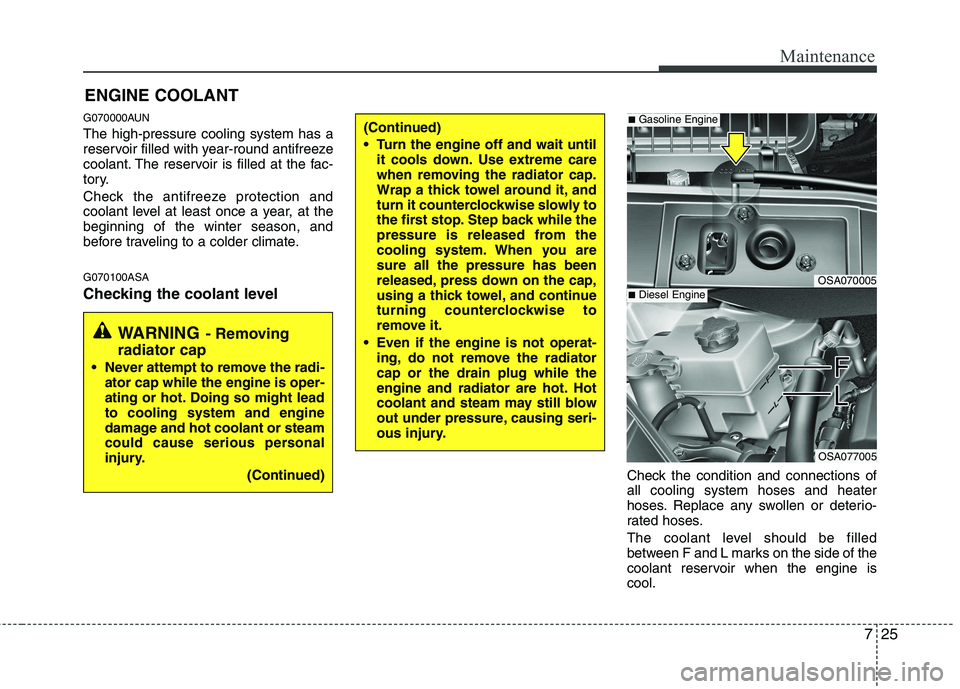
Checking the coolant level Check the condition and connections of all cooling system hoses and heater
hoses. Replace any swollen or deterio-
rated hoses.
The coolant level should be filled
between F and L marks on the side of the
coolant reservoir when the engine iscool.
WARNING- Removing
radiator cap
Never attempt to remove the radi- ator cap while the engine is oper-
ating or hot. Doing so might leadto cooling system and engine
damage and hot coolant or steam
could cause serious personal
injury.
(Continued)
(Continued)
Turn the engine off and wait untilit cools down. Use extreme care
when removing the radiator cap.
Wrap a thick towel around it, and
turn it counterclockwise slowly to
the first stop. Step back while the
pressure is released from the
cooling system. When you aresure all the pressure has been
released, press down on the cap,
using a thick towel, and continue
turning counterclockwise to
remove it.
Even if the engine is not operat- ing, do not remove the radiatorcap or the drain plug while the
engine and radiator are hot. Hot
coolant and steam may still blow
out under pressure, causing seri-
ous injury.
OSA070005
OSA077005
■Gasoline Engine
■Diesel Engine
Page 279 of 336
Maintenance
26
7
If the coolant level is low, add enough
specified coolant to provide protection
against freezing and corrosion. Bring the
level to F, but do not overfill. If frequent
additions are required, see an authorized
KIA dealer for a cooling system inspec-tion.
G070101AUN
Recommended engine coolant
When adding coolant, use only deion-
ized water or soft water for your vehicle
and never mix hard water in the
coolant filled at the factory. An improp-
er coolant mixture can result in serious
malfunction or engine damage.
The engine in your vehicle has alu- minum engine parts and must be pro-
tected by an ethylene-glycol-based
coolant to prevent corrosion and freez-ing.
DO NOT USE alcohol or methanol coolant or mix them with the specifiedcoolant.
Do not use a solution that contains more than 60% antifreeze or less than
35% antifreeze, which would reduce
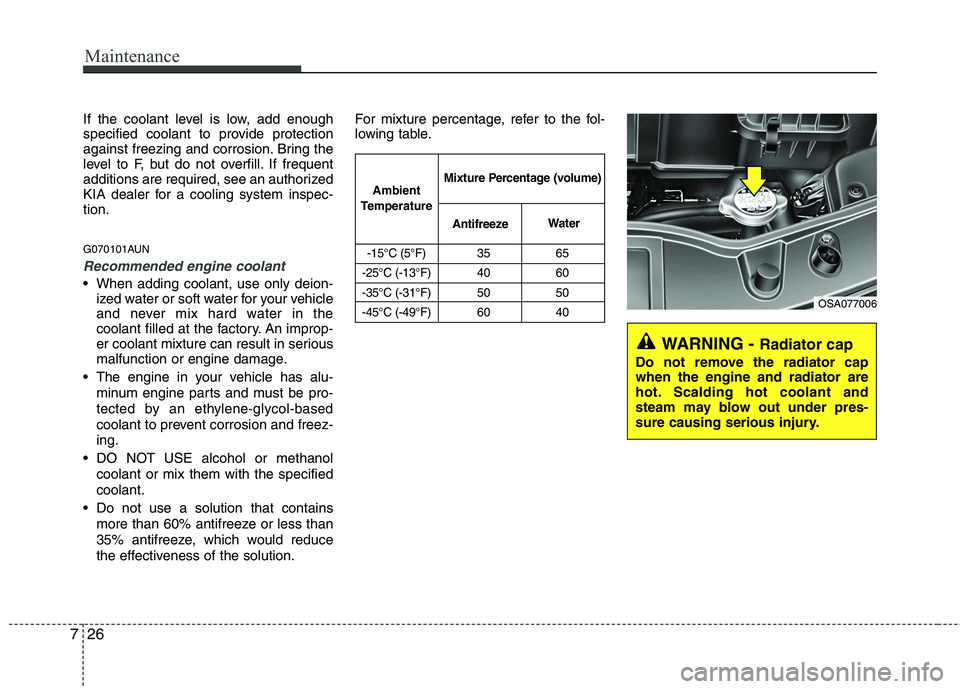
the effectiveness of the solution. For mixture percentage, refer to the fol-
lowing table.
-15°C (5°F) 35 65
-25°C (-13°F) 40 60
-35°C (-31°F) 50 50
-45°C (-49°F) 60 40
Ambient
Temperature Mixture Percentage (volume)
Antifreeze Water
WARNING -
Radiator cap
Do not remove the radiator cap when the engine and radiator are
hot. Scalding hot coolant and
steam may blow out under pres-
sure causing serious injury.
OSA077006
Page 280 of 336
727
Maintenance
G070200AUN Changing the coolant
Have coolant changed by an authorized KIA dealer according to the MaintenanceSchedule at the beginning of this section.G080100ASA
Checking the brake/clutch fluid
level
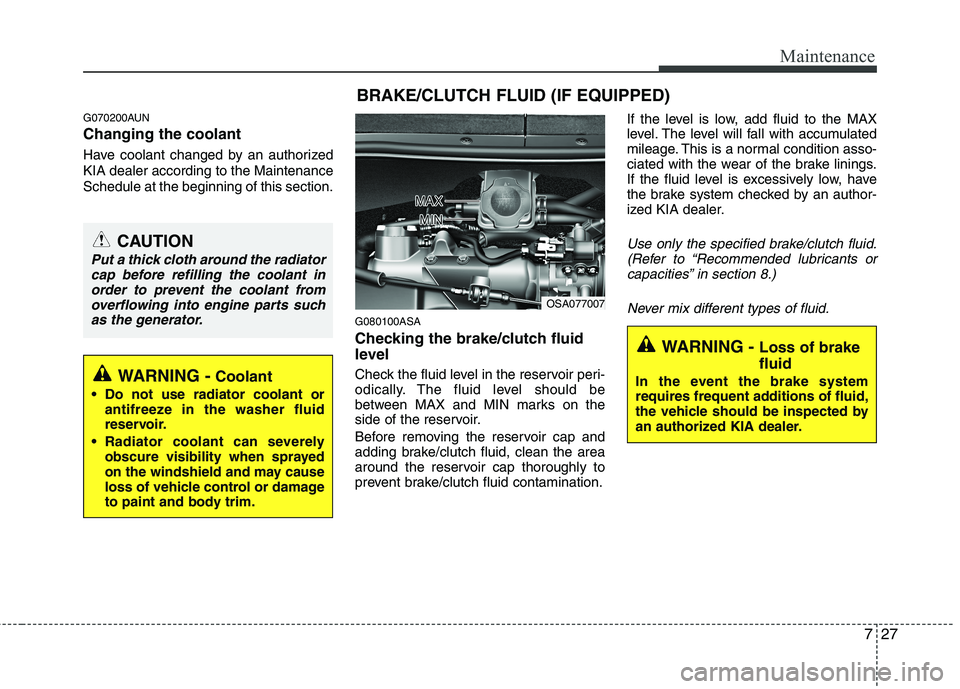
Check the fluid level in the reservoir peri-
odically. The fluid level should be
between MAX and MIN marks on the
side of the reservoir.
Before removing the reservoir cap and
adding brake/clutch fluid, clean the area
around the reservoir cap thoroughly to
prevent brake/clutch fluid contamination.If the level is low, add fluid to the MAX
level. The level will fall with accumulated
mileage. This is a normal condition asso-
ciated with the wear of the brake linings.
If the fluid level is excessively low, have
the brake system checked by an author-
ized KIA dealer.
Use only the specified brake/clutch fluid.
(Refer to “Recommended lubricants orcapacities” in section 8.)
Never mix different types of fluid.CAUTION
Put a thick cloth around the radiatorcap before refilling the coolant in order to prevent the coolant from
overflowing into engine parts suchas the generator.
WARNING - Coolant
Do not use radiator coolant or antifreeze in the washer fluid
reservoir.
Radiator coolant can severely obscure visibility when sprayed
on the windshield and may cause
loss of vehicle control or damage
to paint and body trim.
BRAKE/CLUTCH FLUID (IF EQUIPPED)
OSA077007
WARNING - Loss of brake fluid
In the event the brake system
requires frequent additions of fluid,
the vehicle should be inspected by
an authorized KIA dealer.
Page 323 of 336
Maintenance
70
7
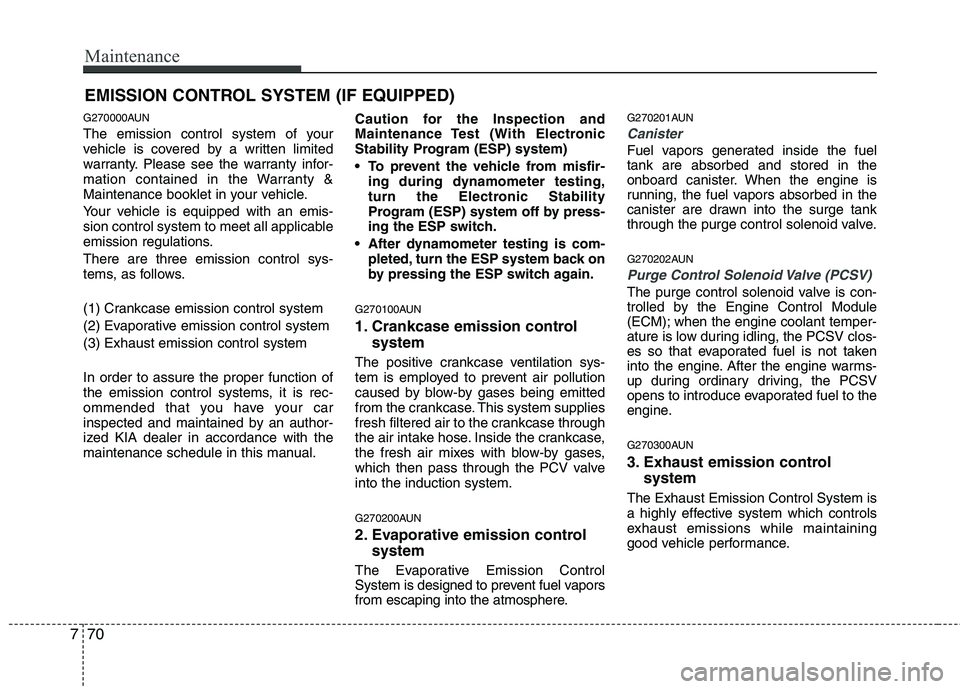
EMISSION CONTROL SYSTEM (IF EQUIPPED)
G270000AUN
The emission control system of your
vehicle is covered by a written limited
warranty. Please see the warranty infor-
mation contained in the Warranty &
Maintenance booklet in your vehicle.
Your vehicle is equipped with an emis-
sion control system to meet all applicable
emission regulations. There are three emission control sys-
tems, as follows.
(1) Crankcase emission control system
(2) Evaporative emission control system(3) Exhaust emission control system In order to assure the proper function of
the emission control systems, it is rec-
ommended that you have your car
inspected and maintained by an author-
ized KIA dealer in accordance with the
maintenance schedule in this manual. Caution for the Inspection and
Maintenance Test (With Electronic
Stability Program (ESP) system)
To prevent the vehicle from misfir-
ing during dynamometer testing,
turn the Electronic Stability
Program (ESP) system off by press-
ing the ESP switch.
After dynamometer testing is com- pleted, turn the ESP system back on
by pressing the ESP switch again.
G270100AUN
1. Crankcase emission control system
The positive crankcase ventilation sys-
tem is employed to prevent air pollution
caused by blow-by gases being emitted
from the crankcase. This system supplies
fresh filtered air to the crankcase through
the air intake hose. Inside the crankcase,
the fresh air mixes with blow-by gases,
which then pass through the PCV valveinto the induction system.
G270200AUN
2. Evaporative emission control system
The Evaporative Emission Control
System is designed to prevent fuel vapors
from escaping into the atmosphere. G270201AUN
Canister
Fuel vapors generated inside the fuel tank are absorbed and stored in the
onboard canister. When the engine is
running, the fuel vapors absorbed in the
canister are drawn into the surge tank
through the purge control solenoid valve.
G270202AUN
Purge Control Solenoid Valve (PCSV)
The purge control solenoid valve is con-
trolled by the Engine Control Module
(ECM); when the engine coolant temper-
ature is low during idling, the PCSV clos-
es so that evaporated fuel is not taken
into the engine. After the engine warms-
up during ordinary driving, the PCSV
opens to introduce evaporated fuel to the
engine.
G270300AUN
3. Exhaust emission control
system
The Exhaust Emission Control System is
a highly effective system which controls
exhaust emissions while maintaining
good vehicle performance.
Page 329 of 336
Specifications & Consumer information
4
8
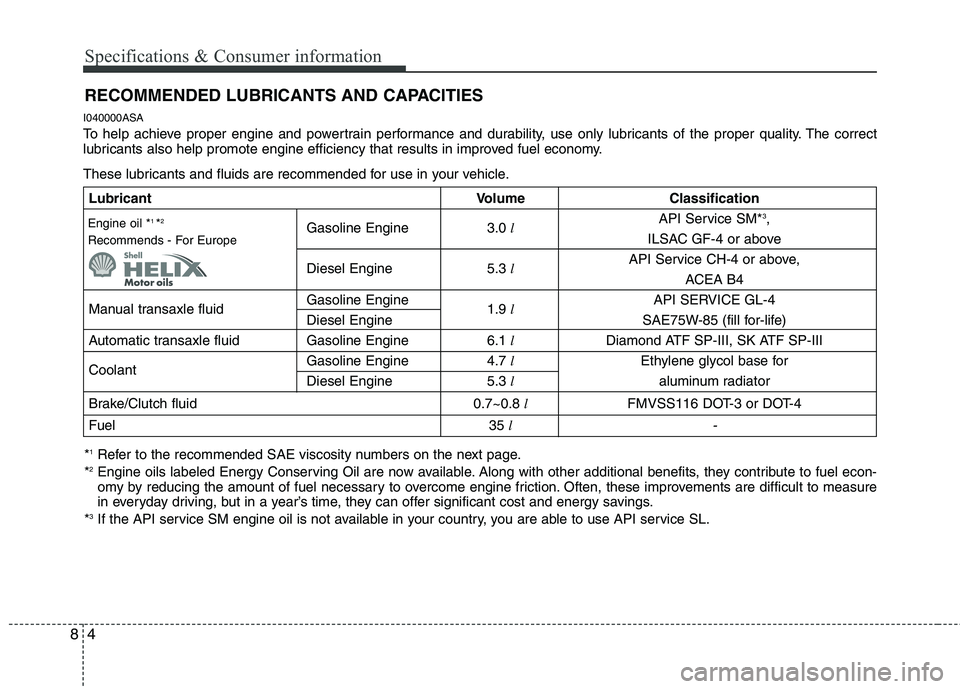
RECOMMENDED LUBRICANTS AND CAPACITIES
I040000ASA
To help achieve proper engine and powertrain performance and durability, use only lubricants of the proper quality. The correct
lubricants also help promote engine efficiency that results in improved fuel economy.
These lubricants and fluids are recommended for use in your vehicle.
* 1
Refer to the recommended SAE viscosity numbers on the next page.
* 2
Engine oils labeled Energy Conserving Oil are now available. Along with other additional benefits, they contribute to fuel econ-
omy by reducing the amount of fuel necessary to overcome engine friction. Often, these improvements are difficult to measure
in everyday driving, but in a year’s time, they can offer significant cost and energy savings.
* 3
If the API service SM engine oil is not available in your country, you are able to use API service SL.
Lubricant Volume Classification
Gasoline Engine 3.0 lAPI Service SM*
3
,
ILSAC GF-4 or above
Diesel Engine 5.3 lAPI Service CH-4 or above,
ACEA B4
Manual transaxle fluid Gasoline Engine
1.9 l API SERVICE GL-4
Diesel Engine SAE75W-85 (fill for-life)
Automatic transaxle fluid Gasoline Engine 6.1 lDiamond ATF SP-III, SK ATF SP-III
Coolant Gasoline Engine 4.7
lEthylene glycol base for
Diesel Engine 5.3 laluminum radiator
Brake/Clutch fluid 0.7~0.8 l FMVSS116 DOT-3 or DOT-4
Fuel 35 l
-
Engine oil * 1
*2
Recommends - For Europe
Page 334 of 336
Index
2
I
Air bag - supplemental restraint system ························3-36
Air cleaner ·····································································7-34
Appearance care·····························································7-64
Audio system ·································································4-77
Automatic climate control system ·································4-60
Automatic transaxle ·······················································5-10
Automatic transaxle fluid ··············································7-29
Battery············································································7-38
Before driving ··································································5-3
Brake system··································································5-16
Brakes/clutch fluid ·························································7-27
Bulb wattage ····································································8-2
Child restraint system ····················································3-26
Climate control air filter ················································7-35
Defroster ········································································4-51
Dimensions ······································································8-2
Door locks········································································4-8 Economical operation ····················································5-26
Emergency commodity ··················································6-28
Emergency starting ··························································6-4
Emission control system ················································7-70
Engine compartment ················································2-4, 7-2
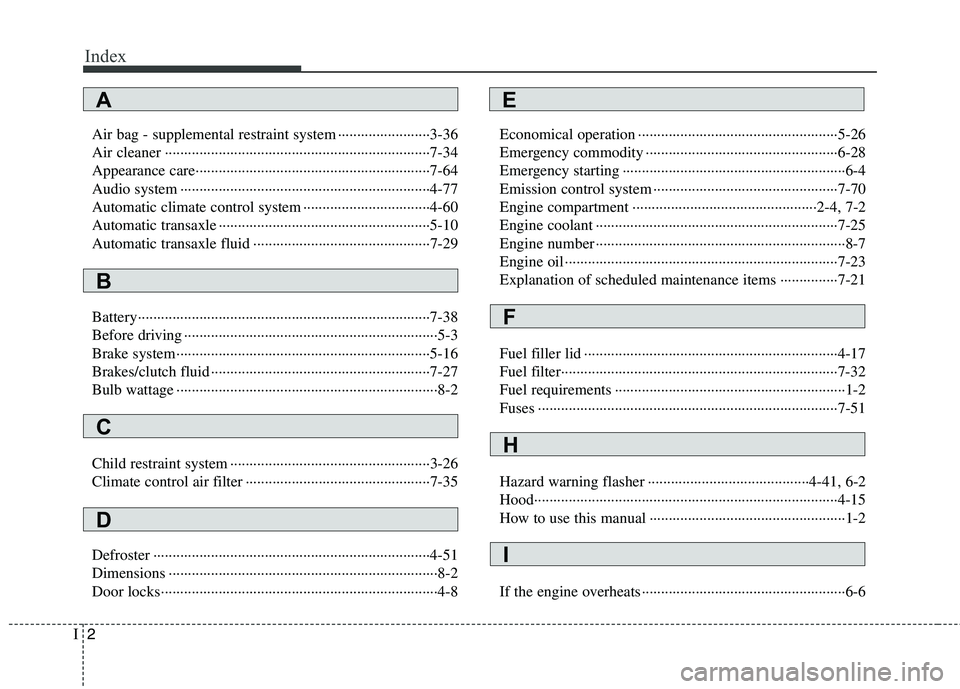
Engine coolant ·······························································7-25
Engine number ·································································8-7
Engine oil ·······································································7-23
Explanation of scheduled maintenance items ···············7-21
Fuel filler lid ··································································4-17
Fuel filter········································································7-32
Fuel requirements ····························································1-2
Fuses ··············································································7-51
Hazard warning flasher ··········································4-41, 6-2
Hood···············································································4-15
How to use this manual ···················································1-2
If the engine overheats·····················································6-6
A
B
C
D
E
F
H
I