warning light KIA PICANTO 2011 Owner's Manual
[x] Cancel search | Manufacturer: KIA, Model Year: 2011, Model line: PICANTO, Model: KIA PICANTO 2011Pages: 336, PDF Size: 24.51 MB
Page 88 of 336
417
Features of your vehicle
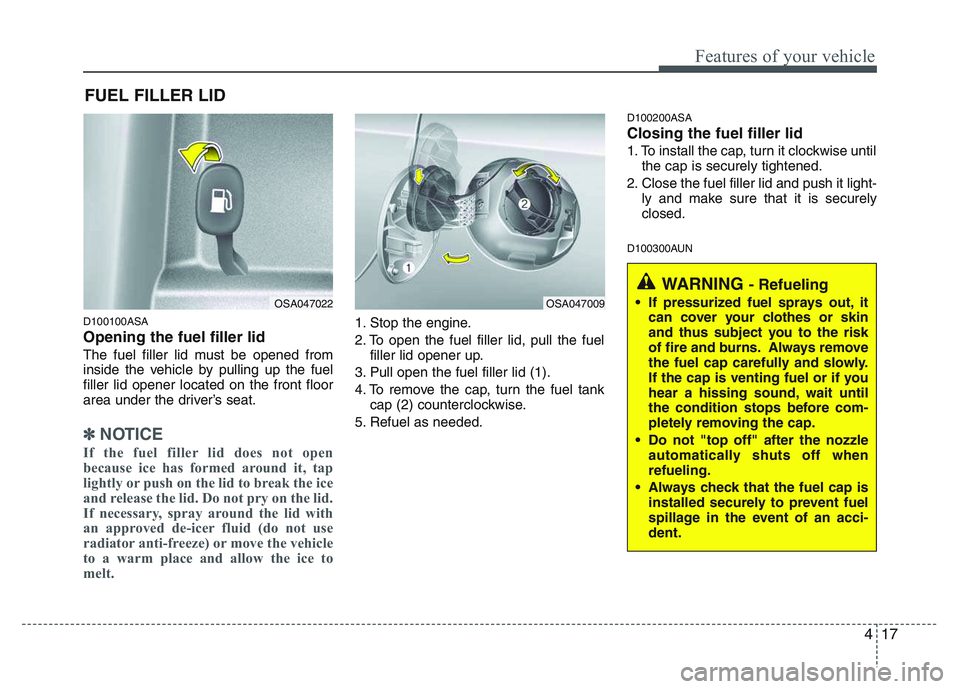
D100100ASA Opening the fuel filler lid
The fuel filler lid must be opened from
inside the vehicle by pulling up the fuelfiller lid opener located on the front floor
area under the driver’s seat.
✽✽NOTICE
If the fuel filler lid does not open
because ice has formed around it, tap
lightly or push on the lid to break the ice
and release the lid. Do not pry on the lid.
If necessary, spray around the lid with
an approved de-icer fluid (do not use
radiator anti-freeze) or move the vehicle
to a warm place and allow the ice to
melt.
1. Stop the engine.
2. To open the fuel filler lid, pull the fuel filler lid opener up.
3. Pull open the fuel filler lid (1).
4. To remove the cap, turn the fuel tank cap (2) counterclockwise.
5. Refuel as needed. D100200ASA Closing the fuel filler lid
1. To install the cap, turn it clockwise until
the cap is securely tightened.
2. Close the fuel filler lid and push it light- ly and make sure that it is securely closed.
D100300AUN
FUEL FILLER LID
OSA047022OSA047009
WARNING
- Refueling
If pressurized fuel sprays out, it can cover your clothes or skin
and thus subject you to the risk
of fire and burns. Always remove
the fuel cap carefully and slowly.
If the cap is venting fuel or if you
hear a hissing sound, wait until
the condition stops before com-
pletely removing the cap.
Do not "top off" after the nozzle automatically shuts off whenrefueling.
Always check that the fuel cap is installed securely to prevent fuel
spillage in the event of an acci-dent.
Page 91 of 336
Features of your vehicle
20
4
✽✽
NOTICE
If the power steering drive belt breaks or if the power steering pump mal-
functions, the steering effort will
greatly increase.
If the vehicle is parked for extended periods outside in cold weather (below
-10°C/14°F), the power steering may
require increased effort when the
engine is first started. This is caused
by increased fluid viscosity due to the
cold weather and does not indicate a
malfunction.
When this happens, increase the
engine RPM by depressing the accel-
erator until the RPM reaches 1,500
rpm then release or let the engine idle
for two or three minutes to warm up
the fluid. D130200ASA
Electric power steering (if equipped)
Power steering uses the motor to assist
you in steering the vehicle. If the engine
is off or if the power steering system
becomes inoperative, the vehicle may
still be steered, but it will require
increased steering effort.
The motor driven power steering is con-
trolled by power steering control unit
which sense the steering wheel torque,
steering wheel position and vehicle
speed to command the motor.
The steering effort becomes heavier as
the vehicle’s speed increases and
becomes lighter as the vehicle’s speed
decreases for better control of the steer-ing wheel.
Should you notice any change in the
effort required to steer during normal
vehicle operation, have the power steer-
ing checked by an authorized Kia dealer.
✽✽ NOTICE
The following symptoms may occur dur-
ing normal vehicle operation:
The EPS warning light does not illu- minate. (Continued)(Continued)
The steering effort is high immediate-
ly after turning the ignition switch on.
This happens as the system performs
the EPS system diagnostics. When the
diagnostics is completed, the steering
wheel will return to its normal condi-
tion.
A click noise may be heard from the
EPS relay after the ignition switch is
turned to the ON or LOCK position.
Motor noise may be heard when the vehicle is at a stop or at a low driving
speed.
If the Electric Power Steering System
does not operate normally, the warn-
ing light will illuminate on the instru-
ment cluster. The steering wheel may
become difficult to control or operate
abnormally. Take your vehicle to an
authorized Kia dealer and have the
vehicle checked as soon as possible.
The steering effort increases if the steering wheel is rotated continuously
when the vehicle is not in motion.
However, after a few minutes, it will
return to its normal condition.
When you operate the steering wheel
in low temperature, abnormal noise
could occur. If temperature rises, the
noise will disappear. This is a normal
condition.
Page 92 of 336
421
Features of your vehicle
D130300AUN Tilt steering (if equipped)
Tilt steering allows you to adjust the
steering wheel before you drive. You can
also raise it to give your legs more room
when you exit and enter the vehicle.
The steering wheel should be positioned
so that it is comfortable for you to drive,
while permitting you to see the instru-
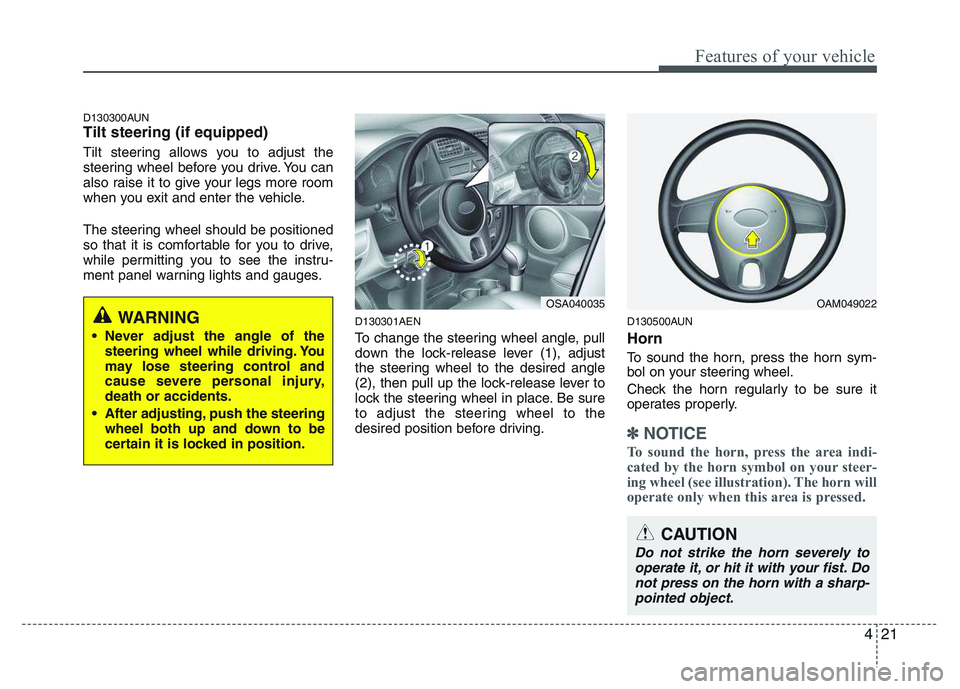
ment panel warning lights and gauges.D130301AEN
To change the steering wheel angle, pull
down the lock-release lever (1), adjust
the steering wheel to the desired angle
(2), then pull up the lock-release lever to
lock the steering wheel in place. Be sure
to adjust the steering wheel to the
desired position before driving.D130500AUN Horn
To sound the horn, press the horn sym-
bol on your steering wheel.
Check the horn regularly to be sure it
operates properly.
✽✽
NOTICE
To sound the horn, press the area indi-
cated by the horn symbol on your steer-
ing wheel (see illustration). The horn will
operate only when this area is pressed.
OSA040035
CAUTION
Do not strike the horn severely to operate it, or hit it with your fist. Donot press on the horn with a sharp- pointed object.
OAM049022
WARNING
Never adjust the angle of the steering wheel while driving. You
may lose steering control and
cause severe personal injury,death or accidents.
After adjusting, push the steering wheel both up and down to be
certain it is locked in position.
Page 93 of 336
Features of your vehicle
22
4
D140100ASA
Inside rearview mirror
Adjust the rearview mirror so that the
center view through the rear window is
seen. Make this adjustment before you
start driving.
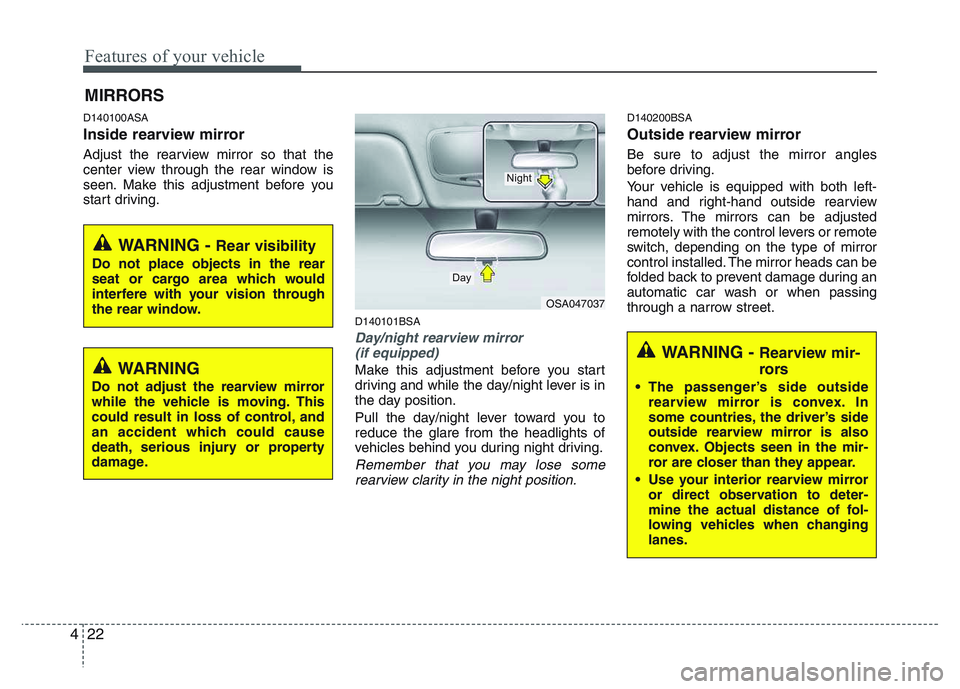
D140101BSA
Day/night rearview mirror (if equipped)
Make this adjustment before you start
driving and while the day/night lever is in
the day position.
Pull the day/night lever toward you to reduce the glare from the headlights of
vehicles behind you during night driving.
Remember that you may lose somerearview clarity in the night position.
D140200BSA
Outside rearview mirror Be sure to adjust the mirror angles
before driving.
Your vehicle is equipped with both left-
hand and right-hand outside rearview
mirrors. The mirrors can be adjusted
remotely with the control levers or remote
switch, depending on the type of mirror
control installed. The mirror heads can be
folded back to prevent damage during an
automatic car wash or when passing
through a narrow street.
MIRRORS
WARNING -
Rear visibility
Do not place objects in the rear
seat or cargo area which would
interfere with your vision through
the rear window.
OSA047037
Day
Night
WARNING - Rearview mir-
rors
The passenger’s side outside rearview mirror is convex. In
some countries, the driver’s side
outside rearview mirror is also
convex. Objects seen in the mir-
ror are closer than they appear.
Use your interior rearview mirror or direct observation to deter-
mine the actual distance of fol-
lowing vehicles when changinglanes.
WARNING
Do not adjust the rearview mirror
while the vehicle is moving. This
could result in loss of control, and
an accident which could cause
death, serious injury or property
damage.
Page 96 of 336
425
Features of your vehicle
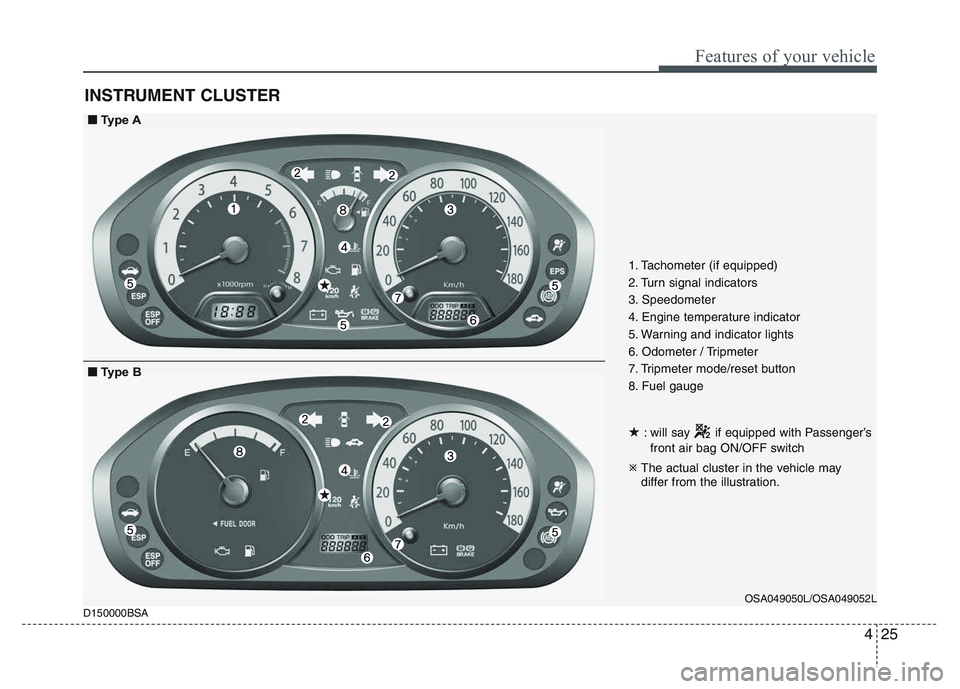
INSTRUMENT CLUSTER
D150000BSA
1. Tachometer (if equipped)
2. Turn signal indicators
3. Speedometer
4. Engine temperature indicator
5. Warning and indicator lights
6. Odometer / Tripmeter
7. Tripmeter mode/reset button
8. Fuel gauge OSA049050L/OSA049052L
■■Type A
★ : will say if equipped with Passenger’s
front air bag ON/OFF switch
The actual cluster in the vehicle may
differ from the illustration.
■■
Type B
★
★
Page 97 of 336
Features of your vehicle
26
4
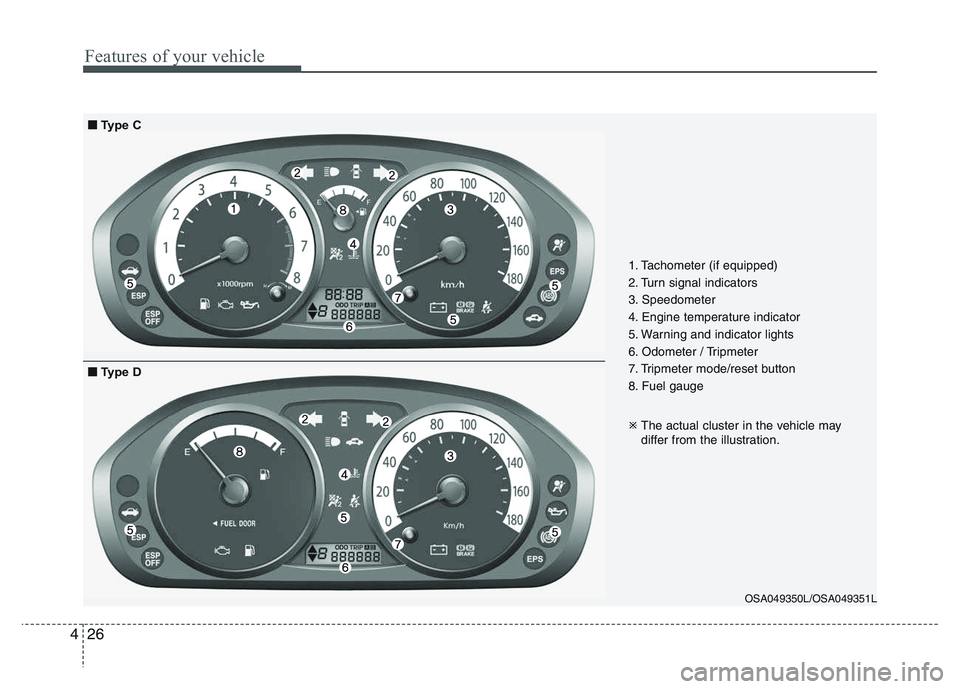
1. Tachometer (if equipped)
2. Turn signal indicators
3. Speedometer
4. Engine temperature indicator
5. Warning and indicator lights
6. Odometer / Tripmeter
7. Tripmeter mode/reset button
8. Fuel gauge
OSA049350L/OSA049351L
■■Type C
The actual cluster in the vehicle may
differ from the illustration.
■
■
Type D
Page 99 of 336
Features of your vehicle
28
4
When the door is open, or if the engine is
not started within 1 minute, the tachome-
ter pointer may move slightly to the ON
position with the engine OFF. This move-
ment is normal and will not affect the
accuracy of the tachometer once the
engine is running. D150204AUNFuel gauge
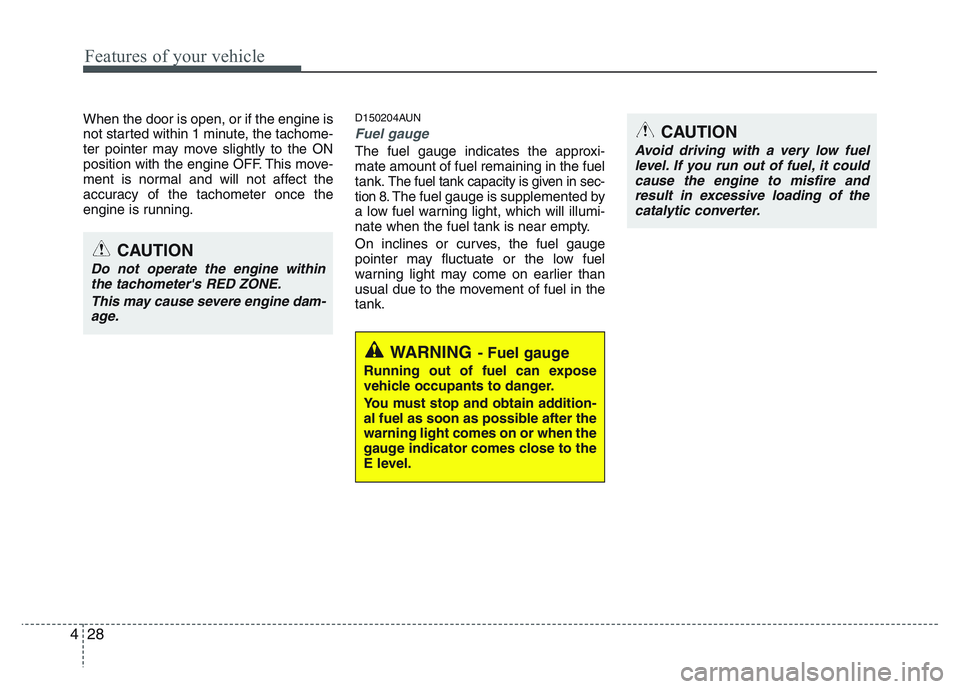
The fuel gauge indicates the approxi- mate amount of fuel remaining in the fueltank.
The fuel tank capacity is given in sec-
tion 8.The fuel gauge is supplemented by
a low fuel warning light, which will illumi-
nate when the fuel tank is near empty.
On inclines or curves, the fuel gauge
pointer may fluctuate or the low fuel
warning light may come on earlier than
usual due to the movement of fuel in thetank.
CAUTION
Avoid driving with a very low fuel
level. If you run out of fuel, it could
cause the engine to misfire and result in excessive loading of thecatalytic converter.
WARNING - Fuel gauge
Running out of fuel can expose
vehicle occupants to danger.
You must stop and obtain addition-
al fuel as soon as possible after thewarning light comes on or when the
gauge indicator comes close to the
E level.
CAUTION
Do not operate the engine within the tachometer's RED ZONE.
This may cause severe engine dam-age.
Page 101 of 336
Features of your vehicle
30
4
D150300AUN
Warnings and indicators
All warning lights are checked by turning
the ignition switch ON (do not start the
engine). Any light that does not illuminate
should be checked by an authorized KIA
dealer.
After starting the engine, check to make
sure that all warning lights are off. If anyare still on, this indicates a situation that
needs attention. When releasing the
parking brake, the brake system warning
light should go off. The fuel warning light
will stay on if the fuel level is low. D150301BSA
Engine temperature
indicator
The indicator shows the temperature of the engine coolant when the ignition
switch is ON. The red indicator illuminates if the tem-
perature of the engine coolant is above120±3°C (248±5.5°F).
Do not continue driving with an overheat-
ed engine. If your vehicle overheats, refer
to “Overheating” in the Index.
✽✽ NOTICE
If the red engine temperature indicator
illuminates, it indicates overheating that
may damage the engine.
D150302AUN
Air bag warning light (if equipped)
This warning light will illuminate for
approximately 6 seconds each time you
turn the ignition switch to the ON posi-tion. This light also comes on when the
Supplemental Restraint System (SRS) is
not working properly. If the air bag warn-
ing light does not come on, or continu-
ously remains on after operating for
about 6 seconds when you turned the
ignition switch to the ON position or start-
ed the engine, or if it comes on while
driving, have the SRS inspected by an
authorized KIA dealer.
Red
Page 102 of 336
431
Features of your vehicle
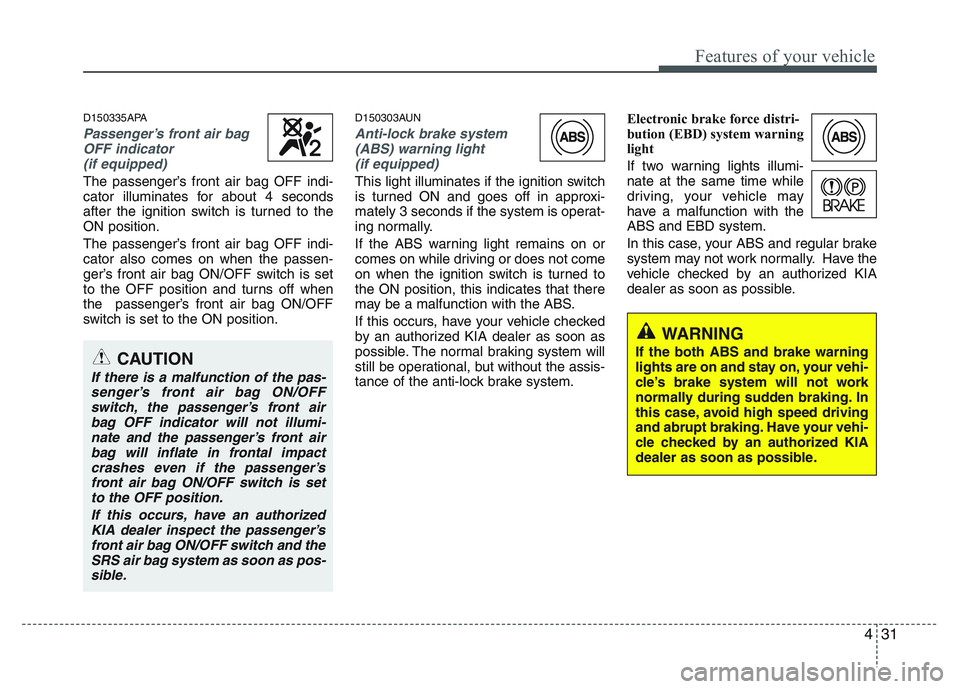
D150335APA
Passenger’s front air bagOFF indicator
(if equipped)
The passenger’s front air bag OFF indi-
cator illuminates for about 4 seconds
after the ignition switch is turned to theON position.
The passenger’s front air bag OFF indi- cator also comes on when the passen-
ger’s front air bag ON/OFF switch is set
to the OFF position and turns off when
the passenger’s front air bag ON/OFF
switch is set to the ON position. D150303AUN
Anti-lock brake system
(ABS) warning light
(if equipped)
This light illuminates if the ignition switch
is turned ON and goes off in approxi-
mately 3 seconds if the system is operat-
ing normally.
If the ABS warning light remains on or
comes on while driving or does not come
on when the ignition switch is turned tothe ON position, this indicates that there
may be a malfunction with the ABS.
If this occurs, have your vehicle checked
by an authorized KIA dealer as soon as
possible. The normal braking system will
still be operational, but without the assis-
tance of the anti-lock brake system. Electronic brake force distri-
bution (EBD) system warning
light
If two warning lights illumi- nate at the same time while
driving, your vehicle may
have a malfunction with theABS and EBD system.
In this case, your ABS and regular brake
system may not work normally. Have the
vehicle checked by an authorized KIA
dealer as soon as possible.
CAUTION
If there is a malfunction of the pas-
senger’s front air bag ON/OFFswitch, the passenger’s front airbag OFF indicator will not illumi-
nate and the passenger’s front airbag will inflate in frontal impact crashes even if the passenger’sfront air bag ON/OFF switch is set
to the OFF position.
If this occurs, have an authorizedKIA dealer inspect the passenger’sfront air bag ON/OFF switch and theSRS air bag system as soon as pos-
sible.
WARNING
If the both ABS and brake warning
lights are on and stay on, your vehi-
cle’s brake system will not work
normally during sudden braking. In
this case, avoid high speed driving
and abrupt braking. Have your vehi-
cle checked by an authorized KIA
dealer as soon as possible.
Page 103 of 336
Features of your vehicle
32
4
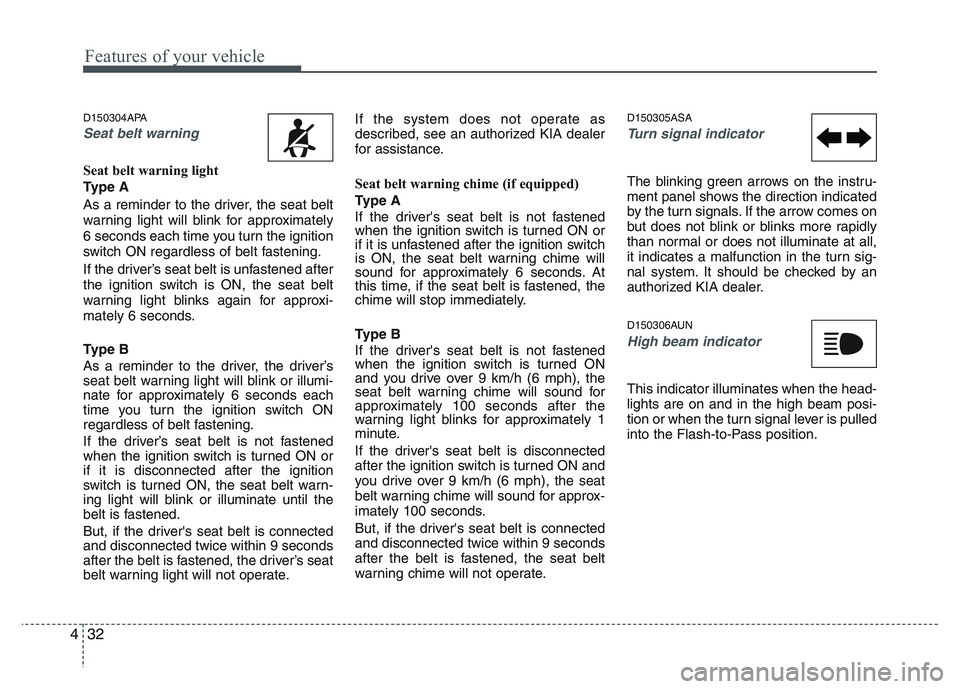
D150304APA
Seat belt warning
Seat belt warning light
Type A
As a reminder to the driver, the seat belt
warning light will blink for approximately
6 seconds each time you turn the ignition
switch ON regardless of belt fastening.
If the driver’s seat belt is unfastened after
the ignition switch is ON, the seat belt
warning light blinks again for approxi-
mately 6 seconds.
Type B
As a reminder to the driver, the driver’s
seat belt warning light will blink or illumi-
nate for approximately 6 seconds each
time you turn the ignition switch ON
regardless of belt fastening.
If the driver’s seat belt is not fastened
when the ignition switch is turned ON orif it is disconnected after the ignition
switch is turned ON, the seat belt warn-
ing light will blink or illuminate until the
belt is fastened.
But, if the driver's seat belt is connected and disconnected twice within 9 seconds
after the belt is fastened, the driver’s seat
belt warning light will not operate. If the system does not operate as
described, see an authorized KIA dealer
for assistance.
Seat belt warning chime (if equipped)
Type A
If the driver's seat belt is not fastened
when the ignition switch is turned ON or
if it is unfastened after the ignition switch
is ON, the seat belt warning chime will
sound for approximately 6 seconds. At
this time, if the seat belt is fastened, the
chime will stop immediately.
Type B
If the driver's seat belt is not fastened
when the ignition switch is turned ON
and you drive over 9 km/h (6 mph), the
seat belt warning chime will sound for
approximately 100 seconds after the
warning light blinks for approximately 1
minute.
If the driver's seat belt is disconnected
after the ignition switch is turned ON and
you drive over 9 km/h (6 mph), the seat
belt warning chime will sound for approx-
imately 100 seconds.
But, if the driver's seat belt is connected and disconnected twice within 9 seconds
after the belt is fastened, the seat belt
warning chime will not operate.D150305ASA
Turn signal indicator
The blinking green arrows on the instru-
ment panel shows the direction indicated
by the turn signals. If the arrow comes on
but does not blink or blinks more rapidly
than normal or does not illuminate at all,
it indicates a malfunction in the turn sig-
nal system. It should be checked by an
authorized KIA dealer.
D150306AUN
High beam indicator
This indicator illuminates when the head- lights are on and in the high beam posi-
tion or when the turn signal lever is pulled
into the Flash-to-Pass position.