fuel KIA PICANTO 2011 Service Manual
[x] Cancel search | Manufacturer: KIA, Model Year: 2011, Model line: PICANTO, Model: KIA PICANTO 2011Pages: 336, PDF Size: 24.51 MB
Page 323 of 336
Maintenance
70
7
EMISSION CONTROL SYSTEM (IF EQUIPPED)
G270000AUN
The emission control system of your
vehicle is covered by a written limited
warranty. Please see the warranty infor-
mation contained in the Warranty &
Maintenance booklet in your vehicle.
Your vehicle is equipped with an emis-
sion control system to meet all applicable
emission regulations. There are three emission control sys-
tems, as follows.
(1) Crankcase emission control system
(2) Evaporative emission control system(3) Exhaust emission control system In order to assure the proper function of
the emission control systems, it is rec-
ommended that you have your car
inspected and maintained by an author-
ized KIA dealer in accordance with the
maintenance schedule in this manual. Caution for the Inspection and
Maintenance Test (With Electronic
Stability Program (ESP) system)
To prevent the vehicle from misfir-
ing during dynamometer testing,
turn the Electronic Stability
Program (ESP) system off by press-
ing the ESP switch.
After dynamometer testing is com- pleted, turn the ESP system back on
by pressing the ESP switch again.
G270100AUN
1. Crankcase emission control system
The positive crankcase ventilation sys-
tem is employed to prevent air pollution
caused by blow-by gases being emitted
from the crankcase. This system supplies
fresh filtered air to the crankcase through
the air intake hose. Inside the crankcase,
the fresh air mixes with blow-by gases,
which then pass through the PCV valveinto the induction system.
G270200AUN
2. Evaporative emission control system
The Evaporative Emission Control
System is designed to prevent fuel vapors
from escaping into the atmosphere. G270201AUN
Canister
Fuel vapors generated inside the fuel tank are absorbed and stored in the
onboard canister. When the engine is
running, the fuel vapors absorbed in the
canister are drawn into the surge tank
through the purge control solenoid valve.
G270202AUN
Purge Control Solenoid Valve (PCSV)
The purge control solenoid valve is con-
trolled by the Engine Control Module
(ECM); when the engine coolant temper-
ature is low during idling, the PCSV clos-
es so that evaporated fuel is not taken
into the engine. After the engine warms-
up during ordinary driving, the PCSV
opens to introduce evaporated fuel to the
engine.
G270300AUN
3. Exhaust emission control
system
The Exhaust Emission Control System is
a highly effective system which controls
exhaust emissions while maintaining
good vehicle performance.
Page 324 of 336
771
Maintenance
G270301AUN
Vehicle modifications
This vehicle should not be modified.
Modification of your vehicle could affect
its performance, safety or durability and
may even violate governmental safety
and emissions regulations.
In addition, damage or performance
problems resulting from any modification
may not be covered under warranty.
G270302AUN
Engine exhaust gas precautions (car-bon monoxide)
Carbon monoxide can be present with other exhaust fumes. Therefore, if you
smell exhaust fumes of any kind inside
your vehicle, have it inspected and
repaired immediately. If you ever sus-
pect exhaust fumes are coming into
your vehicle, drive it only with all the
windows fully open. Have your vehicle
checked and repaired immediately. Do not operate the engine in confined
or closed areas (such as garages) any
more than it is necessary to move the
vehicle in or out of the area.
When the vehicle is stopped in an open area for more than a short time
with the engine running, adjust the
ventilation system (as needed) to draw
outside air into the vehicle.
Never sit in a parked or stopped vehi- cle for any extended time with the
engine running.
When the engine stalls or fails to start, excessive attempts to restart the
engine may cause damage to theemission control system. G270303AUN
Operating precautions for catalytic
converters (if equipped)
Your vehicle is equipped with a catalytic
converter emission control device.
Therefore, the following precautions
must be observed:
Use only UNLEADED FUEL for gaso- line engines.
Do not operate the vehicle when there are signs of engine malfunction, such
as misfire or a noticeable loss of per-
formance.
WARNING - Exhaust
Engine exhaust gases contain car-
bon monoxide (CO). Though color-
less and odorless, it is dangerousand could be lethal if inhaled.
Follow the instructions on this
page to avoid CO poisoning.
WARNING - Fire
A hot exhaust system can ignite
flammable items under your vehi-
cle. Do not park, idle or drive the
vehicle over or near flammable
objects, such as grass, vegetation,
paper, leaves, etc.
Page 325 of 336
Maintenance
72
7
Do not misuse or abuse the engine.
Examples of misuse are coasting with the ignition off and descending steep
grades in gear with the ignition off.
Do not operate the engine at high idle speed for extended periods (5 minutesor more).
Do not modify or tamper with any part of the engine or emission control sys-
tem. All inspections and adjustments
must be made by an authorized KIA
dealer.
Avoid driving with a very low fuel level. If you run out of gasoline, it couldcause the engine to misfire and result
in excessive loading of the catalytic
converter.
Failure to observe these precautionscould result in damage to the catalytic
converter and to your vehicle.
Additionally, such actions could void your
warranties.Diesel Particulate Filter (if equipped)
The Diesel Particulate Filter (DPF) sys-
tem removes the soot emitted from the
vehicle.
Unlike a disposable air filter, the DPF
system automatically burns (oxidizes)
and removes the accumulated soot
according to the driving condition. In
other words, the active burning by engine
control system and high exhaust gas
temperature caused by normal/high driv-
ing condition burns and removes the
accumulated soot.
However, if the vehicle continues to be
driven at low speed for long time, the
accumulated soot may not be automati-
cally removed because of low exhaust
gas temperature. In this particular case,the amount of soot is out of detection
limit, the soot oxidation process by
engine control system may not happen
and the malfunction indicator light may
blink. When the malfunction indicator light
blinks, it may stop blinking by driving the
vehicle at more than 60km/h (37 mph) orat more than second gear with 1500 ~
2000 engine rpm for a certain time (for
about 25 minutes). If the malfunction indicator light contin-
ues to be blinked in spite of the proce-
dure, please visit an authorized KIA deal-
er and then check the DPF system.
If you continue to drive with the malfunc-
tion indicator light blinking for a long
time, the DPF system can be damaged
and fuel consumption can be worsen.
CAUTION -
Diesel Fuel
(if equipped with DPF)
It is recommended to use the regu- lated automotive diesel fuel for
diesel vehicle equipped with the DPF system.
If you use diesel fuel including highsulfur (more than 50 ppm sulfur)and unspecified additives, it can
cause the DPF system to be dam- aged and white smoke can be emit-ted.
Page 329 of 336
Specifications & Consumer information
4
8
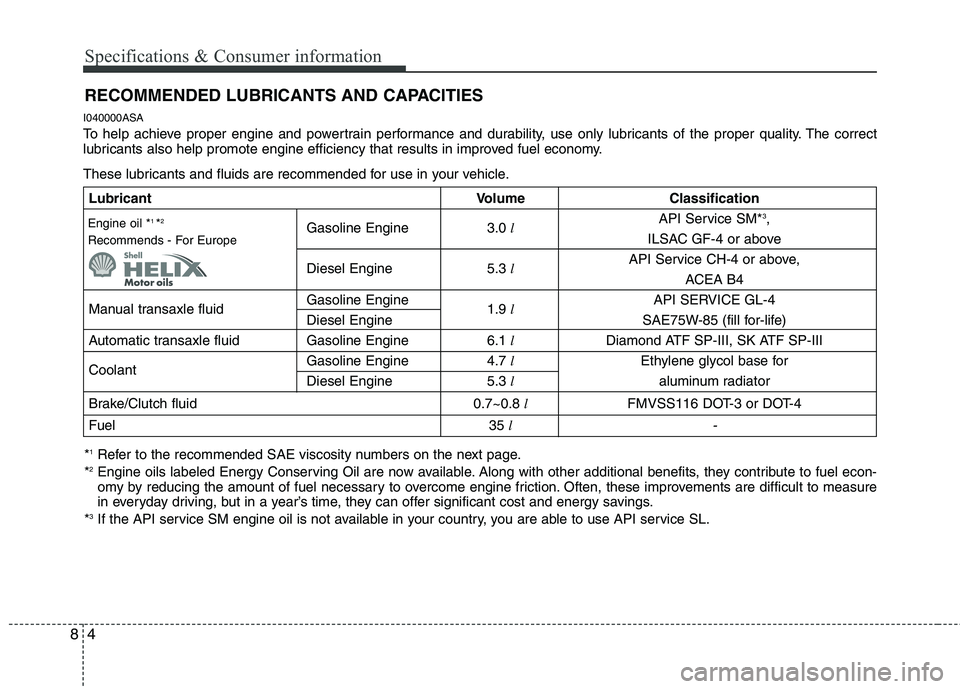
RECOMMENDED LUBRICANTS AND CAPACITIES
I040000ASA
To help achieve proper engine and powertrain performance and durability, use only lubricants of the proper quality. The correct
lubricants also help promote engine efficiency that results in improved fuel economy.
These lubricants and fluids are recommended for use in your vehicle.
* 1
Refer to the recommended SAE viscosity numbers on the next page.
* 2
Engine oils labeled Energy Conserving Oil are now available. Along with other additional benefits, they contribute to fuel econ-
omy by reducing the amount of fuel necessary to overcome engine friction. Often, these improvements are difficult to measure
in everyday driving, but in a year’s time, they can offer significant cost and energy savings.
* 3
If the API service SM engine oil is not available in your country, you are able to use API service SL.
Lubricant Volume Classification
Gasoline Engine 3.0 lAPI Service SM*
3
,
ILSAC GF-4 or above
Diesel Engine 5.3 lAPI Service CH-4 or above,
ACEA B4
Manual transaxle fluid Gasoline Engine
1.9 l API SERVICE GL-4
Diesel Engine SAE75W-85 (fill for-life)
Automatic transaxle fluid Gasoline Engine 6.1 lDiamond ATF SP-III, SK ATF SP-III
Coolant Gasoline Engine 4.7
lEthylene glycol base for
Diesel Engine 5.3 laluminum radiator
Brake/Clutch fluid 0.7~0.8 l FMVSS116 DOT-3 or DOT-4
Fuel 35 l
-
Engine oil * 1
*2
Recommends - For Europe
Page 330 of 336
85
Specifications & Consumer information
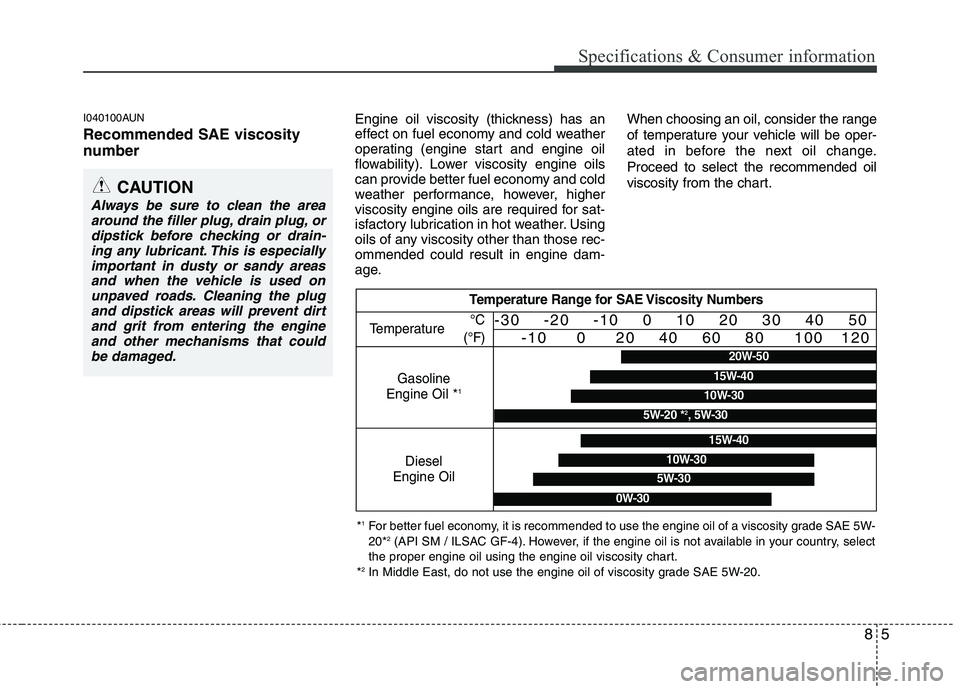
I040100AUN Recommended SAE viscosity
number Engine oil viscosity (thickness) has an
effect on fuel economy and cold weather
operating (engine start and engine oil
flowability). Lower viscosity engine oils
can provide better fuel economy and cold
weather performance, however, higher
viscosity engine oils are required for sat-
isfactory lubrication in hot weather. Using
oils of any viscosity other than those rec-ommended could result in engine dam-
age.When choosing an oil, consider the range
of temperature your vehicle will be oper-
ated in before the next oil change.Proceed to select the recommended oil
viscosity from the chart.
CAUTION
Always be sure to clean the area
around the filler plug, drain plug, or
dipstick before checking or drain-ing any lubricant. This is especiallyimportant in dusty or sandy areas
and when the vehicle is used on unpaved roads. Cleaning the plugand dipstick areas will prevent dirt and grit from entering the engine and other mechanisms that could
be damaged.
Temperature Range for SAE Viscosity Numbers
Temperature
Gasoline
Engine Oil * 1°C
(°F)-30 -20 -10 0 10 20 30 40 50 -10 0 20 40 60 80 100 120
Diesel
Engine Oil
5W-30
15W-40
10W-30
0W-30
* 1
For better fuel economy, it is recommended to use the engine oil of a viscosity grade SAE 5W- 20* 2
(API SM / ILSAC GF-4). However, if the engine oil is not available in your country, select
the proper engine oil using the engine oil viscosity chart.
* 2
In Middle East, do not use the engine oil of viscosity grade SAE 5W-20.
20W-50
10W-30
15W-40
5W-20 * 2
, 5W-30
Page 334 of 336
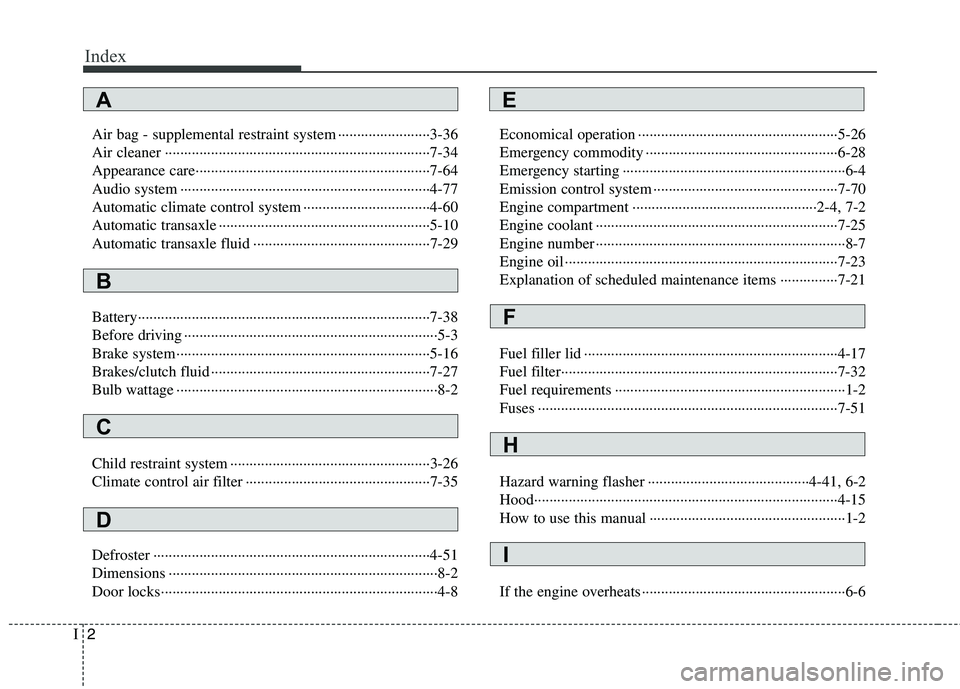
Index
2
I
Air bag - supplemental restraint system ························3-36
Air cleaner ·····································································7-34
Appearance care·····························································7-64
Audio system ·································································4-77
Automatic climate control system ·································4-60
Automatic transaxle ·······················································5-10
Automatic transaxle fluid ··············································7-29
Battery············································································7-38
Before driving ··································································5-3
Brake system··································································5-16
Brakes/clutch fluid ·························································7-27
Bulb wattage ····································································8-2
Child restraint system ····················································3-26
Climate control air filter ················································7-35
Defroster ········································································4-51
Dimensions ······································································8-2
Door locks········································································4-8 Economical operation ····················································5-26
Emergency commodity ··················································6-28
Emergency starting ··························································6-4
Emission control system ················································7-70
Engine compartment ················································2-4, 7-2
Engine coolant ·······························································7-25
Engine number ·································································8-7
Engine oil ·······································································7-23
Explanation of scheduled maintenance items ···············7-21
Fuel filler lid ··································································4-17
Fuel filter········································································7-32
Fuel requirements ····························································1-2
Fuses ··············································································7-51
Hazard warning flasher ··········································4-41, 6-2
Hood···············································································4-15
How to use this manual ···················································1-2
If the engine overheats·····················································6-6
A
B
C
D
E
F
H
I