park assist KIA PICANTO 2012 User Guide
[x] Cancel search | Manufacturer: KIA, Model Year: 2012, Model line: PICANTO, Model: KIA PICANTO 2012Pages: 840, PDF Size: 41.16 MB
Page 312 of 840
65
What to do in an emergency
EMERGENCY STARTING
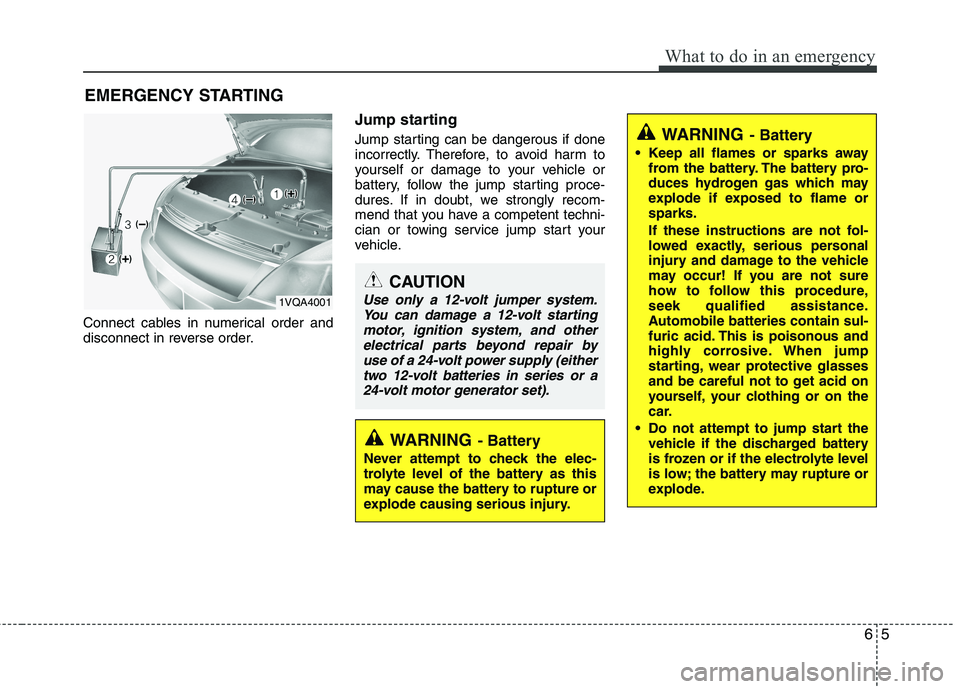
Connect cables in numerical order and
disconnect in reverse order. Jump starting
Jump starting can be dangerous if done
incorrectly. Therefore, to avoid harm to
yourself or damage to your vehicle or
battery, follow the jump starting proce-
dures. If in doubt, we strongly recom-
mend that you have a competent techni-
cian or towing service jump start your
vehicle.
CAUTION
Use only a 12-volt jumper system.
You can damage a 12-volt startingmotor, ignition system, and other
electrical parts beyond repair byuse of a 24-volt power supply (eithertwo 12-volt batteries in series or a24-volt motor generator set).
WARNING - Battery
• Keep all flames or sparks away from the battery. The battery pro-
duces hydrogen gas which may
explode if exposed to flame orsparks.
If these instructions are not fol-
lowed exactly, serious personal
injury and damage to the vehicle
may occur! If you are not sure
how to follow this procedure,
seek qualified assistance.
Automobile batteries contain sul-
furic acid. This is poisonous and
highly corrosive. When jump
starting, wear protective glasses
and be careful not to get acid on
yourself, your clothing or on the
car.
Do not attempt to jump start the vehicle if the discharged battery
is frozen or if the electrolyte level
is low; the battery may rupture or
explode.
WARNING - Battery
Never attempt to check the elec-
trolyte level of the battery as this
may cause the battery to rupture or
explode causing serious injury.
1VQA4001
Page 314 of 840
67
What to do in an emergency
IF THE ENGINE OVERHEATS
If your temperature gauge indicates over-
heating, you experience a loss of power,
or hear loud pinging or knocking, the
engine is probably too hot. If this hap-
pens, you should:
1. Pull off the road and stop as soon as it is safe to do so.
2. Place the shift lever in P (Park) and set the parking brake. If the air condition-
ing is on, turn it off.
3. If engine coolant is running out under the car or steam is coming out from
the hood, stop the engine. Do not openthe hood until the coolant has stopped
running or the steaming has stopped.
If there is no visible loss of engine
coolant and no steam, leave the
engine running and check to be sure
the engine cooling fan is operating. If
the fan is not running, turn the engine
off. 4. Check to see if the water pump drive
belt is missing. If it is not missing,
check to see that it is tight. If the drive
belt seems to be satisfactory, check for
coolant leaking from the radiator,
hoses or under the car. (If the air con-
ditioning had been in use, it is normal
for cold water to be draining from it
when you stop).
5. If the water pump drive belt is broken or engine coolant is leaking out, stop the engine immediately and call the
nearest authorized KIA dealer for
assistance. 6. If you cannot find the cause of the
overheating, wait until the engine tem-
perature has returned to normal. Then,if coolant has been lost, carefully add
coolant to the reservoir to bring the
fluid level in the reservoir up to the
halfway mark.
7. Proceed with caution, keeping alert for further signs of overheating. If over-heating happens again, call an author-
ized KIA dealer for assistance.
WARNING
While the engine is running, keep
hair, hands and clothing away from
moving parts such as the fan and
drive belts to prevent injury.
WARNING
Do not remove the radiator cap
when the engine is hot. This can
allow coolant to be blown out of the
opening and cause serious burns.
CAUTION
Serious loss of coolant indicates there is a leak in the cooling systemand this should be checked as soonas possible by an authorized KIA dealer.
Page 390 of 840
Maintenance
58
7
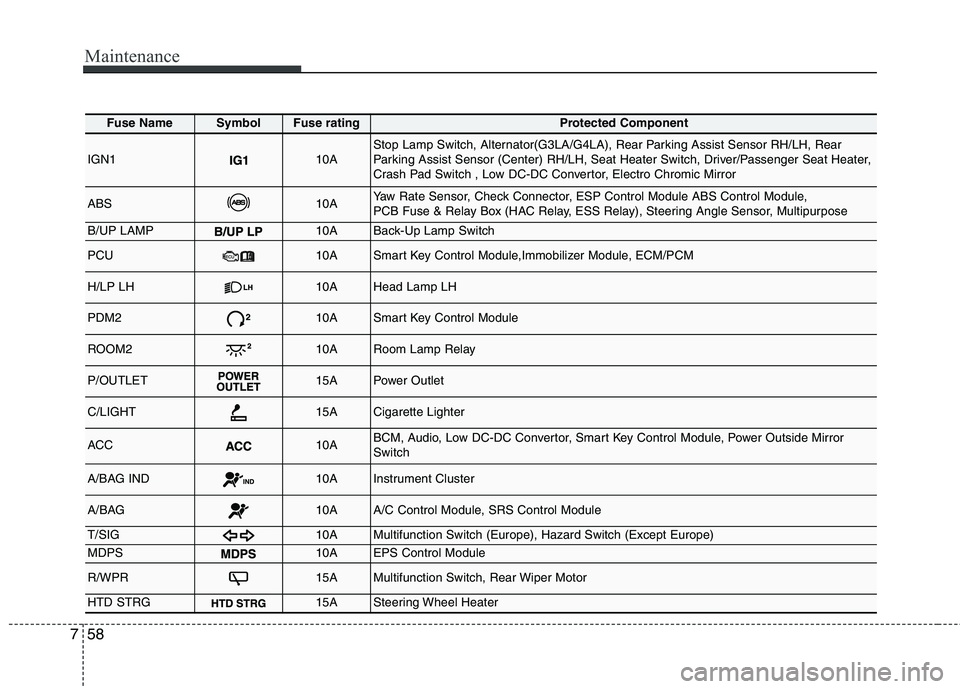
Fuse NameSymbolFuse ratingProtected Component
IGN110AStop Lamp Switch, Alternator(G3LA/G4LA), Rear Parking Assist Sensor RH/LH, Rear
Parking Assist Sensor (Center) RH/LH, Seat Heater Switch, Driver/Passenger Seat Heater,
Crash Pad Switch , Low DC-DC Convertor, Electro Chromic Mirror
ABS10AYaw Rate Sensor, Check Connector, ESP Control Module ABS Control Module,
PCB Fuse & Relay Box (HAC Relay, ESS Relay), Steering Angle Sensor, Multipurpose
B/UP LAMP10ABack-Up Lamp Switch
PCU10ASmart Key Control Module,Immobilizer Module, ECM/PCM
H/LP LH10AHead Lamp LH
PDM210ASmart Key Control Module
ROOM210ARoom Lamp Relay
P/OUTLET15APower Outlet
C/LIGHT15ACigarette Lighter
ACC10ABCM, Audio, Low DC-DC Convertor, Smart Key Control Module, Power Outside Mirror Switch
A/BAG IND10AInstrument Cluster
A/BAG10AA/C Control Module, SRS Control Module
T/SIG10AMultifunction Switch (Europe), Hazard Switch (Except Europe)
MDPS10AEPS Control Module
R/WPR15AMultifunction Switch, Rear Wiper Motor
HTD STRG15ASteering Wheel Heater
Page 419 of 840
Index
2
I
Air bags..........................................................................3-39
Air bag warning label ..............................................3-61
Air bag warning light ..............................................3-42
Curtain air bag..........................................................3-52
Driver's and passenger's front air bag ......................3-46
Side air bag ..............................................................3-51
Air cleaner ....................................................................7-31
Antenna ........................................................................4-110
Anti-lock brake system (ABS) ......................................5-36
Appearance care ............................................................7-70 Exterior care ............................................................7-70
Interior care ..............................................................7-75
Ashtray ........................................................................4-104
Audio system ..............................................................4-110 Antenna ..................................................................4-110
Aux, USB and iPod................................................4-112
Steering wheel audio control ................................4-111
Automatic climate control system ................................4-93 Air conditioning ......................................................4-99
Automatic heating and air conditioning ..................4-94
Manual heating and air conditioning ......................4-95
Automatic transaxle ......................................................5-27 Shift lock system ......................................................5-30 Base curb weight ..........................................................5-63
Battery............................................................................7-38
Battery saver function ....................................................4-70
Before driving ..................................................................5-3
Bi-fuel system ................................................................5-17
Bottle holders, see cup holders ....................................4-105
Brake system..................................................................5-33
Anti-lock brake system (ABS) ................................5-36
Electronic stability program (ESP) ..........................5-38
Hill-start assist control (HAC) ................................5-42
Emergency Stop Signal (ESS) ................................5-43
Parking brake ..........................................................5-34
Power brakes ............................................................5-33
Vehicle stability management (VSM) ......................5-42
Brake fluid ....................................................................7-27
Bulb replacement ..........................................................7-62
Bulb wattage ....................................................................8-2
Button start/stop, see engine start/stop button ................5-6
Capacities (Lubricants) ....................................................8-4 Care Exterior care ..............................................................7-70
Interior care ..............................................................7-75
Tire care ....................................................................7-41
AB
C
Page 424 of 840
I7
Index
Parking brake inspect ......................................................7-30
Parking brake ..................................................................5-34
Passenger's front air bag ................................................3-46
Power brakes ..................................................................5-33
Power outlet ..................................................................4-106
Power steering (Electronic) ............................................4-35
Power window lock button ............................................4-24
Pre-tensioner seat belt ....................................................3-22
Push starting......................................................................6-6
Rear seat............................................................................3-9
Rear parking assist system ..............................................4-66Recommended cold tire inflation pressures....................7-41
Recommended lubricants and capacities ..........................8-4
Recommended SAE viscosity number........................8-5
Remote keyless entry ......................................................4-10
Road warning ....................................................................6-2
Rocking the vehicle ........................................................5-47 Scheduled maintenance service ........................................7-6
Maintenance under severe usage conditions ............7-17Normal maintenance schedule ....................................7-7
Seat belts ........................................................................3-15 Pre-tensioner seat belt ..............................................3-22
Lap belt......................................................................3-20
Lap/shoulder belt ......................................................3-18
Seat belt warning ......................................................3-16
Seatback pocket ................................................................3-8
Seats ..................................................................................3-2 Headrest ..............................................................3-5, 3-9
Folding the rear seat ..................................................3-10
Front seat adjustment - manual ..................................3-4
Rear seat ......................................................................3-9
Seatback pocket ..........................................................3-8
Shift lock system ............................................................5-30
Side air bag ....................................................................3-51
Smart key ..........................................................................4-9
Smooth cornering............................................................5-48
Snow tires........................................................................5-51Spare tire Removing and storing the spare tire ..........................6-9
P
R
S
Page 431 of 840
Introduction
2
1
We want to help you get the greatest
possible driving pleasure from your vehi-
cle. Your Owner’s Manual can assist you
in many ways. We strongly recommend
that you read the entire manual. In order
to minimise the chance of death or injury,
you must read the WARNING and CAU-
TION sections in the manual.
Illustrations complement the words in this
manual to best explain how to enjoy your
vehicle. By reading your manual, you
learn about features, important safety
information, and driving tips under vari-
ous road conditions.
The general layout of the manual is pro-
vided in the Table of Contents. Use the
index when looking for a specific area or
subject; it has an alphabetical listing of all
information in your manual.
Sections: This manual has eight sections
plus an index. Each section begins with a
brief list of contents so you can tell at a
glance if that section has the information
you want. You will find various WARNINGs,
CAUTIONs, and NOTICEs in this manu-
al. These WARNINGs were prepared to
enhance your personal safety. You should
carefully read and follow ALL procedures
and recommendations provided in these
WARNINGs, CAUTIONs and NOTICEs.
✽✽
NOTICE
A NOTICE indicates interesting or help-
ful information is being provided.
Petrol engine
Unleaded
For Europe
For the optimal vehicle performance, we
recommend you to use unleaded petrolwhich complies with EN 228 and has an
octane rating of RON (Research Octane
Number) 95 / AKI (Anti Knock Index) 91
or higher.
You may use unleaded petrol with an
octane rating of RON 91~94 / AKI 87~90
but it may result in slight performance
reduction of the vehicle.
Except Europe
Your new KIA vehicle is designed to use
only unleaded fuel having an Octane
Rating of RON (Research Octane
Number) 91 / AKI (Anti-Knock Index) 87
or higher.
Your new vehicle is designed to obtain
maximum performance with UNLEADED
FUEL, as well as minimise exhaust emis-
sions and spark plug fouling.
HOW TO USE THIS MANUAL
WARNING
A WARNING indicates a situation in
which harm, serious bodily injury ordeath could result if the warning isignored.
CAUTION
A CAUTION indicates a situation in which damage to your vehicle couldresult if the caution is ignored.
FUEL REQUIREMENTS
Page 500 of 840
4
Keys / 4-3
Remote keyless entry / 4-6
Smart key / 4-9
Theft-alarm system / 4-11
Door locks / 4-14
Tailgate / 4-18
Windows / 4-20
Bonnet / 4-25
Fuel filler lid / 4-27
Sunroof / 4-30
Steering wheel / 4-34
Mirrors / 4-37
Instrument cluster / 4-41
Rear parking assist system / 4-63
Hazard warning flasher / 4-66
Lighting / 4-67
Wipers and washers / 4-74
Interior light / 4-78
Defroster / 4-80
Manual climate control system / 4-81
Automatic climate control system / 4-90
Windscreen defrosting and defogging / 4-97
Features of your vehicle
Page 548 of 840
449
Features of your vehicle
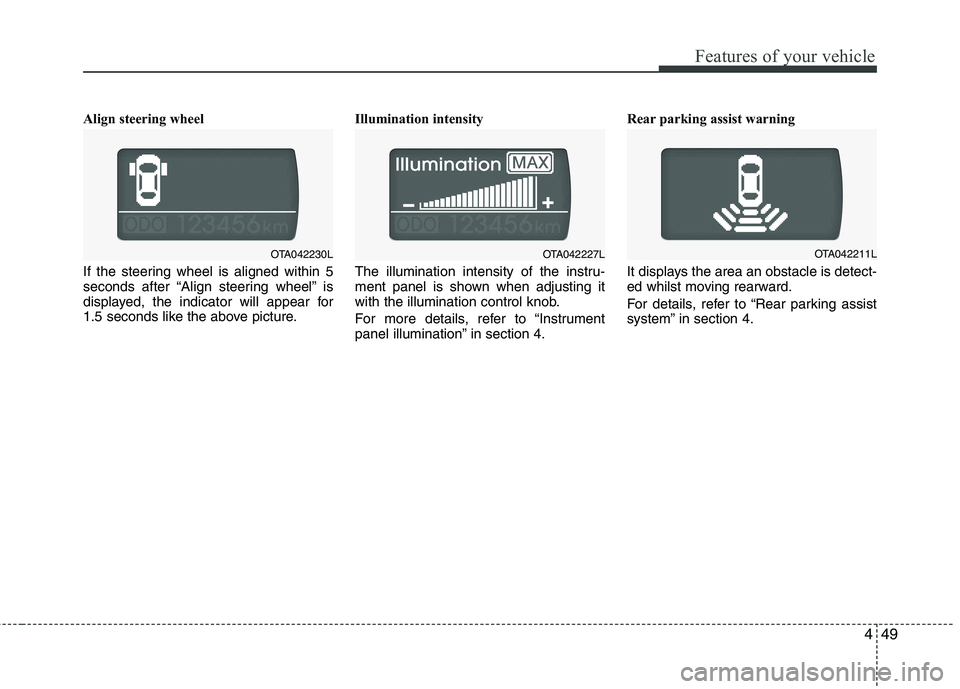
Align steering wheel
If the steering wheel is aligned within 5
seconds after “Align steering wheel” is
displayed, the indicator will appear for
1.5 seconds like the above picture.Illumination intensity
The illumination intensity of the instru-
ment panel is shown when adjusting it
with the illumination control knob.
For more details, refer to “Instrument
panel illumination” in section 4.Rear parking assist warning
It displays the area an obstacle is detect-
ed whilst moving rearward.
For details, refer to “Rear parking assist
system” in section 4.
OTA042230LOTA042227LOTA042211L
Page 562 of 840
463
Features of your vehicle
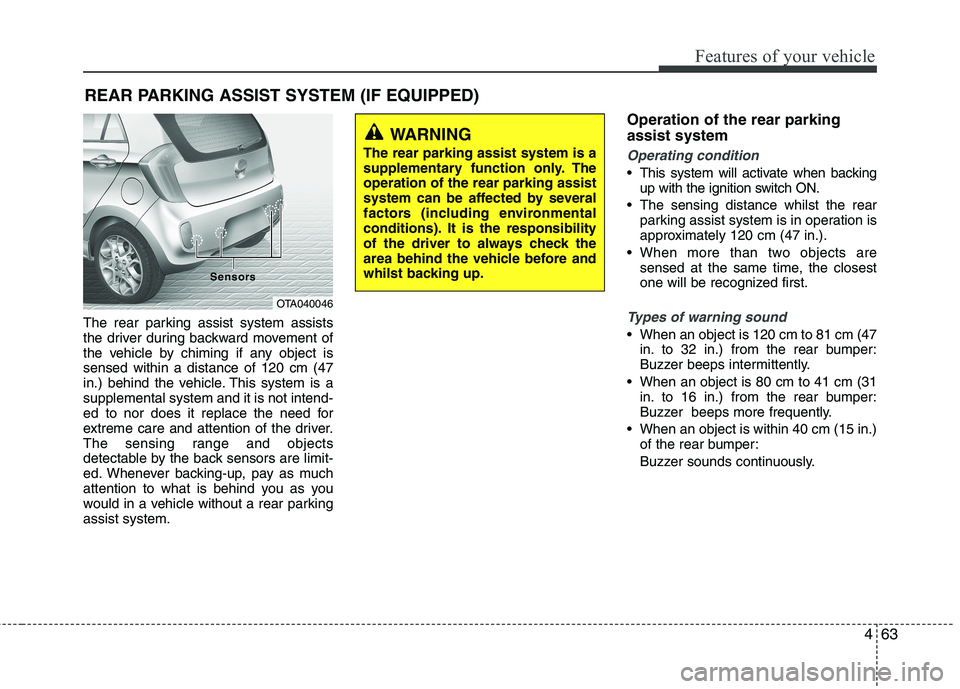
The rear parking assist system assists
the driver during backward movement of
the vehicle by chiming if any object issensed within a distance of 120 cm (47
in.) behind the vehicle. This system is asupplemental system and it is not intend-
ed to nor does it replace the need for
extreme care and attention of the driver.
The sensing range and objects
detectable by the back sensors are limit-
ed. Whenever backing-up, pay as much
attention to what is behind you as you
would in a vehicle without a rear parkingassist system.Operation of the rear parking assist system
Operating condition
This system will activate when backing
up with the ignition switch ON.
The sensing distance whilst the rear parking assist system is in operation is
approximately 120 cm (47 in.).
When more than two objects are sensed at the same time, the closest
one will be recognized first.
Types of warning sound
When an object is 120 cm to 81 cm (47in. to 32 in.) from the rear bumper:
Buzzer beeps intermittently.
When an object is 80 cm to 41 cm (31 in. to 16 in.) from the rear bumper:
Buzzer beeps more frequently.
When an object is within 40 cm (15 in.) of the rear bumper:
Buzzer sounds continuously.
REAR PARKING ASSIST SYSTEM (IF EQUIPPED)
OTA040046
SensorSensorss
WARNING
The rear parking assist system is a
supplementary function only. Theoperation of the rear parking assist
system can be affected by several
factors (including environmental
conditions). It is the responsibility
of the driver to always check the
area behind the vehicle before and
whilst backing up.
Page 563 of 840
Features of your vehicle
64
4
Non-operational conditions of rear parking assist system
The rear parking assist system may
not operate properly when:
1. Moisture is frozen to the sensor. (It will
operate normally when the moisture has been cleared.)
2. The sensor is covered with foreign matter, such as snow or water, or the
sensor cover is blocked. (It will operate
normally when the material is removed
or the sensor is no longer blocked.)
3. Driving on uneven road surfaces (unpaved roads, gravel, bumps, gradi-ent).
4. Objects generating excessive noise (vehicle horns, loud motorcycle
engines, or truck air brakes) are within
range of the sensor.
5. Heavy rain or water spray exists.
6. Wireless transmitters or mobile phones are within range of the sensor.
7. The sensor is covered with snow.
8. Trailer towing The detecting range may decrease when:
1. The sensor is stained with foreign mat-
ter such as snow or water. (The sens-
ing range will return to normal when
removed.)
2. Outside air temperature is extremely hot or cold.
The following objects may not be rec-
ognized by the sensor:
1. Sharp or slim objects such as ropes, chains or small poles.
2. Objects which tend to absorb the sen- sor frequency such as clothes, spongy
material or snow.
3. Undetectable objects smaller than 1 m (40 in.) in height and narrower than 14
cm (6 in.) in diameter. Rear parking assist system pre- cautions
The rear parking assist system may
not sound sequentially depending on the speed and shapes of the objectsdetected.
The rear parking assist system may malfunction if the vehicle bumperheight or sensor installation has been
modified or damaged. Any non-factory
installed equipment or accessories
may also interfere with the sensor per-
formance.
The sensor may not recognize objects less than 40 cm (15 in.) from the sen-
sor, or it may sense an incorrect dis-
tance. Use caution.
When the sensor is frozen or stained with snow, dirt, or water, the sensor
may be inoperative until the stains are
removed using a soft cloth.
Do not push, scratch or strike the sen- sor. Sensor damage could occur.