height KIA PICANTO 2014 User Guide
[x] Cancel search | Manufacturer: KIA, Model Year: 2014, Model line: PICANTO, Model: KIA PICANTO 2014Pages: 1003, PDF Size: 44.67 MB
Page 272 of 1003
529
Driving your vehicle
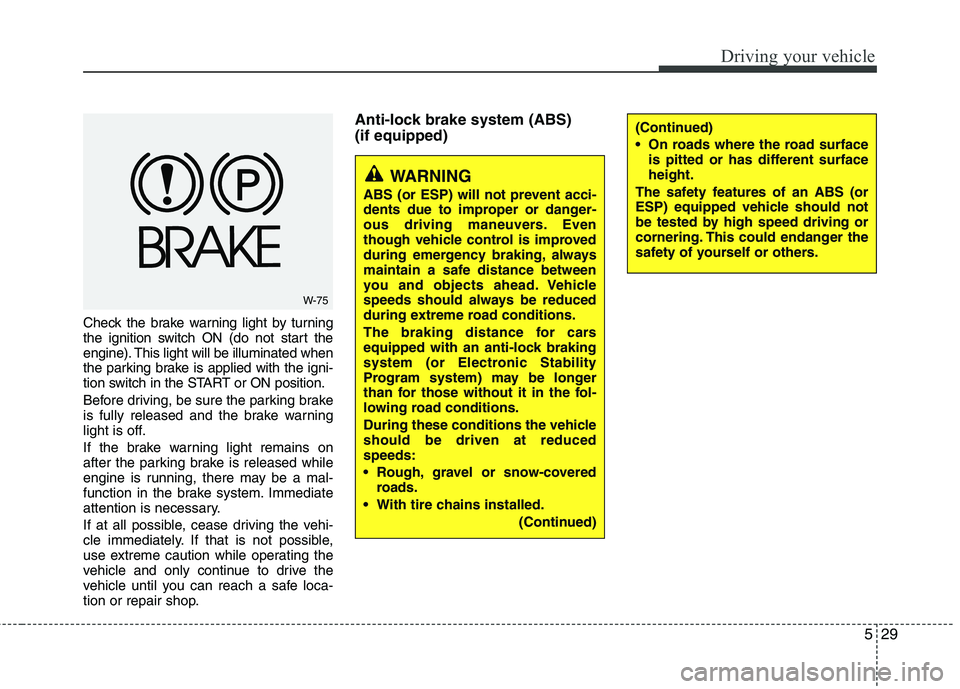
Check the brake warning light by turning
the ignition switch ON (do not start the
engine). This light will be illuminated when
the parking brake is applied with the igni-
tion switch in the START or ON position.
Before driving, be sure the parking brake
is fully released and the brake warning
light is off.
If the brake warning light remains on
after the parking brake is released while
engine is running, there may be a mal-
function in the brake system. Immediate
attention is necessary.
If at all possible, cease driving the vehi-
cle immediately. If that is not possible,
use extreme caution while operating the
vehicle and only continue to drive the
vehicle until you can reach a safe loca-
tion or repair shop.Anti-lock brake system (ABS) (if equipped)
W-75
WARNING
ABS (or ESP) will not prevent acci-
dents due to improper or danger-
ous driving maneuvers. Even
though vehicle control is improved
during emergency braking, always
maintain a safe distance between
you and objects ahead. Vehicle
speeds should always be reduced
during extreme road conditions.
The braking distance for cars
equipped with an anti-lock braking
system (or Electronic Stability
Program system) may be longer
than for those without it in the fol-
lowing road conditions.
During these conditions the vehicle should be driven at reducedspeeds:
Rough, gravel or snow-covered roads.
With tire chains installed. (Continued)
(Continued)
On roads where the road surfaceis pitted or has different surface height.
The safety features of an ABS (or
ESP) equipped vehicle should not
be tested by high speed driving or
cornering. This could endanger the
safety of yourself or others.
Page 370 of 1003
745
Maintenance
Compact spare tire replacement (if equipped)
A compact spare tire has a shorter
tread life than a regular size tire.
Replace it when you can see the
tread wear indicator bars on the tire.The replacement compact spare tire
should be the same size and design
tire as the one provided with your
new vehicle and should be mountedon the same compact spare tire
wheel. The compact spare tire is notdesigned to be mounted on a regular
size wheel, and the compact spare
tire wheel is not designed for mount-
ing a regular size tire. Wheel replacement
When replacing the metal wheels for
any reason, make sure the new
wheels are equivalent to the original
factory units in diameter, rim widthand offset.
Tire traction
Tire traction can be reduced if you
drive on worn tires, tires that are
improperly inflated or on slippery
road surfaces. Tires should be
replaced when tread wear indicators
appear. Slow down whenever there
is rain, snow or ice on the road toreduce the possibility of losing con-
trol of the vehicle. Tire maintenance In addition to proper inflation, correct wheel alignment helps to decrease
tire wear. If you find a tire is worn
unevenly, have your dealer check thewheel alignment.
When you have new tires installed,
make sure they are balanced. This
will increase vehicle ride comfort and
tire life. Additionally, a tire should
always be rebalanced if it is removedfrom the wheel.
WARNING
A wheel that is not the correct
size may adversely affect wheel
and bearing life, braking and
stopping abilities, handling char-
acteristics, ground clearance,
body-to-tire clearance, snow
chain clearance, speedometer
and odometer calibration, head-
light aim and bumper height.
Page 371 of 1003
Maintenance
46
7
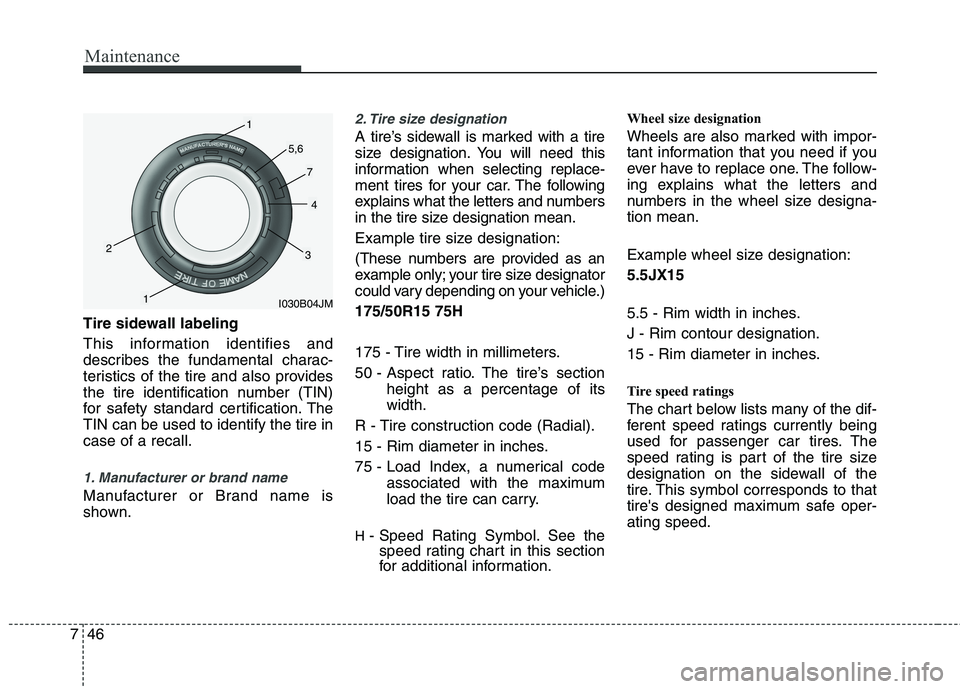
Tire sidewall labeling
This information identifies and
describes the fundamental charac-
teristics of the tire and also provides
the tire identification number (TIN)
for safety standard certification. TheTIN can be used to identify the tire incase of a recall.
1. Manufacturer or brand name
Manufacturer or Brand name is
shown.
2. Tire size designation
A tire’s sidewall is marked with a tire
size designation. You will need this
information when selecting replace-
ment tires for your car. The following
explains what the letters and numbers
in the tire size designation mean.
Example tire size designation:
(These numbers are provided as an
example only; your tire size designator
could vary depending on your vehicle.) 175/50R15 75H
175 - Tire width in millimeters.
50 - Aspect ratio. The tire’s section
height as a percentage of its width.
R - Tire construction code (Radial).
15 - Rim diameter in inches.
75 - Load Index, a numerical code associated with the maximum
load the tire can carry.
H - Speed Rating Symbol. See the
speed rating chart in this section
for additional information. Wheel size designation
Wheels are also marked with impor-
tant information that you need if you
ever have to replace one. The follow-
ing explains what the letters and
numbers in the wheel size designa-tion mean.
Example wheel size designation: 5.5JX15
5.5 - Rim width in inches. J - Rim contour designation.
15 - Rim diameter in inches.
Tire speed ratings
The chart below lists many of the dif-
ferent speed ratings currently being
used for passenger car tires. The
speed rating is part of the tire size
designation on the sidewall of the
tire. This symbol corresponds to that
tire's designed maximum safe oper-ating speed.
I030B04JM
1
1
23
4
5,6
7
Page 404 of 1003
![KIA PICANTO 2014 User Guide Specifications & Consumer information
2
8
ENGINE BULB WATTAGE
DIMENSIONS Item Gasoline 1.0 Gasoline 1.25
Displacement [cc(cu.in)] 998 (60.9) 1,248 (76.2)
Bore x Stroke [mm(in)] 71 x 84
(2.80 x 3.31)](/img/2/57966/w960_57966-403.png "KIA PICANTO 2014 User Guide Specifications & Consumer information
2
8
ENGINE BULB WATTAGE
DIMENSIONS Item Gasoline 1.0 Gasoline 1.25
Displacement [cc(cu.in)] 998 (60.9) 1,248 (76.2)
Bore x Stroke [mm(in)] 71 x 84
(2.80 x 3.31)")
Specifications & Consumer information
2
8
ENGINE BULB WATTAGE
DIMENSIONS Item Gasoline 1.0 Gasoline 1.25
Displacement [cc(cu.in)] 998 (60.9) 1,248 (76.2)
Bore x Stroke [mm(in)] 71 x 84
(2.80 x 3.31) 71 x 78.8
(2.80 x 3.10)
Firing order 1-2-3 1-3-4-2
No. of cylinders 3, In-line 4, In-line
Item mm (in)
Overall length 3595 (141.5)
Overall width 1595 (62.8)
Overall heightFor Europe 1480 (58.3)
Except Europe 1490 (58.7)
Front tread
155/70R13 1421 (55.9)
165/60R14 1415 (55.7)
175/50R15 1409 (55.5)
Rear tread
155/70R13 1424 (56.1)
165/60R14 1418 (55.8)
175/50R15 1412 (55.6)
Wheelbase 2385 (93.9)
Light Bulb Wattage Bulb type
Headlights (Low/High) 55/60 H4 L/L
Headlights (Low/High)* 55 H7 L/L
Front turn signal lights* 21 PY21W
FRT Position lights (Bulb type)* 5 W5W
FRT Position lights (LED type)*LEDLED
Side repeater lights* 5 WY5W
Side repeater lights (LED type)* LED LED
Front fog lights* 27 GE881
D.R.L (Bulb type)21P21W
D.R.L (LED type)*LEDLED
Stop and tail light* 21/5 P21/5W
Stop and tail light (LED type)* LED LED
Rear turn signal lights 21 P21W
Back-up lights 16 W16W
Rear fog lights*21P21W
High mounted stop light* 5 W5W High mounted stop light (LED type)* LED LED
License plate lights 5 W5W
Map lamps 10 W10W
Room lamp 8 FESTOON 8W
Luggage lamp* 5 FESTOON 5W
* : If equipped
Page 433 of 1003
Safety features of your vehicle
2
3
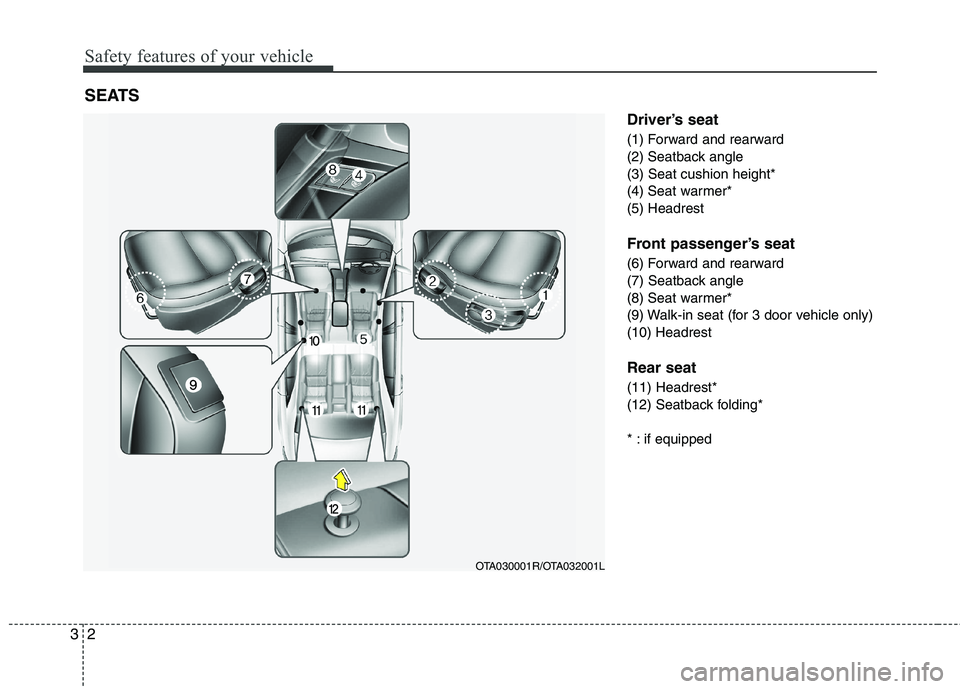
Driver’s seat
(1) Forward and rearward
(2) Seatback angle(3) Seat cushion height*
(4) Seat warmer*(5) Headrest
Front passenger’s seat
(6) Forward and rearward
(7) Seatback angle
(8) Seat warmer*
(9) Walk-in seat (for 3 door vehicle only)(10) Headrest Rear seat (11) Headrest*
(12) Seatback folding*
* : if equipped
SEATS
OTA030001R/OTA032001L
Page 436 of 1003
35
Safety features of your vehicle
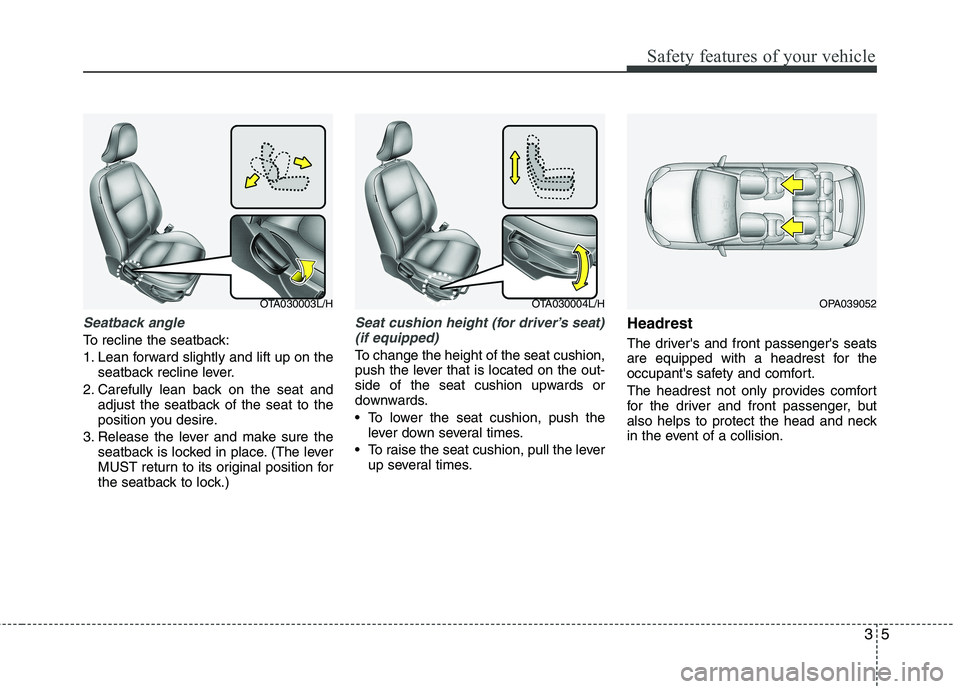
Seatback angle
To recline the seatback:
1. Lean forward slightly and lift up on theseatback recline lever.
2. Carefully lean back on the seat and adjust the seatback of the seat to the
position you desire.
3. Release the lever and make sure the seatback is locked in place. (The lever
MUST return to its original position for
the seatback to lock.)
Seat cushion height (for driver’s seat)
(if equipped)
To change the height of the seat cushion,
push the lever that is located on the out-
side of the seat cushion upwards or
downwards.
• To lower the seat cushion, push the lever down several times.
To raise the seat cushion, pull the lever up several times. Headrest
The driver's and front passenger's seats
are equipped with a headrest for the
occupant's safety and comfort.
The headrest not only provides comfort
for the driver and front passenger, but
also helps to protect the head and neck
in the event of a collision.
OPA039052OTA030003L/HOTA030004L/H
Page 437 of 1003
Safety features of your vehicle
6
3
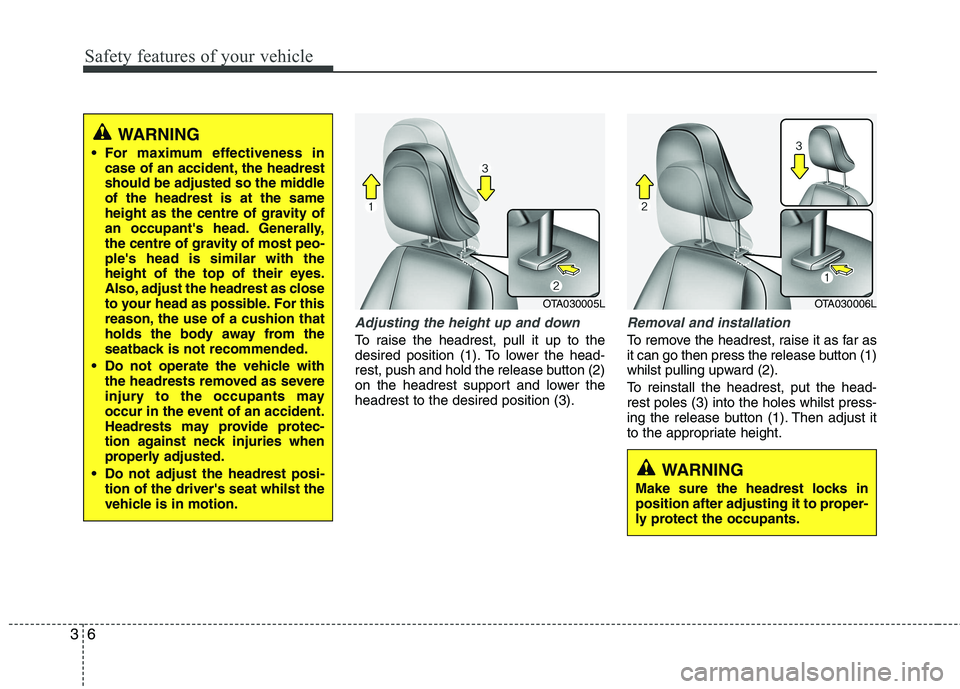
Adjusting the height up and down
To raise the headrest, pull it up to the
desired position (1). To lower the head-
rest, push and hold the release button (2)
on the headrest support and lower theheadrest to the desired position (3).
Removal and installation
To remove the headrest, raise it as far as
it can go then press the release button (1)
whilst pulling upward (2).
To reinstall the headrest, put the head- rest poles (3) into the holes whilst press-
ing the release button (1). Then adjust it
to the appropriate height.
OTA030006L
WARNING
Make sure the headrest locks in
position after adjusting it to proper-
ly protect the occupants.
WARNING
For maximum effectiveness in case of an accident, the headrest
should be adjusted so the middleof the headrest is at the same
height as the centre of gravity of
an occupant's head. Generally,
the centre of gravity of most peo-ple's head is similar with the
height of the top of their eyes.
Also, adjust the headrest as close
to your head as possible. For this
reason, the use of a cushion that
holds the body away from the
seatback is not recommended.
Do not operate the vehicle with the headrests removed as severe
injury to the occupants may
occur in the event of an accident.
Headrests may provide protec-
tion against neck injuries when
properly adjusted.
Do not adjust the headrest posi- tion of the driver's seat whilst the
vehicle is in motion.
OTA030005L
Page 441 of 1003
Safety features of your vehicle
10
3
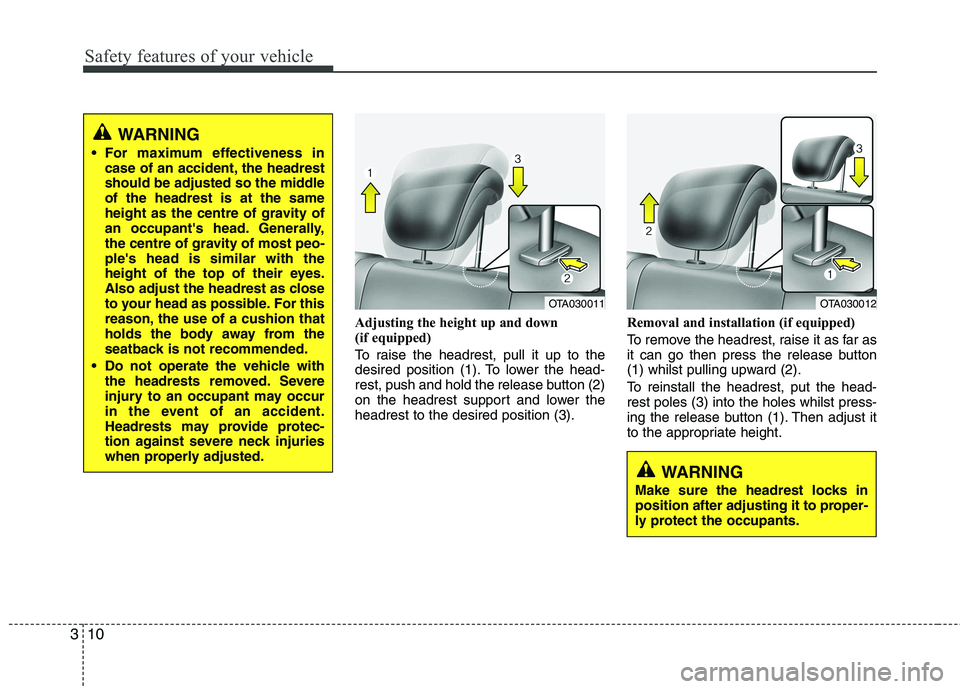
Adjusting the height up and down
(if equipped)
To raise the headrest, pull it up to the
desired position (1). To lower the head-
rest, push and hold the release button (2)
on the headrest support and lower theheadrest to the desired position (3). Removal and installation (if equipped)
To remove the headrest, raise it as far as
it can go then press the release button
(1) whilst pulling upward (2).
To reinstall the headrest, put the head- rest poles (3) into the holes whilst press-
ing the release button (1). Then adjust it
to the appropriate height.
WARNING
Make sure the headrest locks in
position after adjusting it to proper-
ly protect the occupants.
OTA030012OTA030011
WARNING
For maximum effectiveness in case of an accident, the headrest
should be adjusted so the middleof the headrest is at the same
height as the centre of gravity of
an occupant's head. Generally,
the centre of gravity of most peo-ple's head is similar with the
height of the top of their eyes.
Also adjust the headrest as close
to your head as possible. For this
reason, the use of a cushion that
holds the body away from the
seatback is not recommended.
Do not operate the vehicle with the headrests removed. Severe
injury to an occupant may occur
in the event of an accident.
Headrests may provide protec-
tion against severe neck injuries
when properly adjusted.
Page 449 of 1003
Safety features of your vehicle
18
3
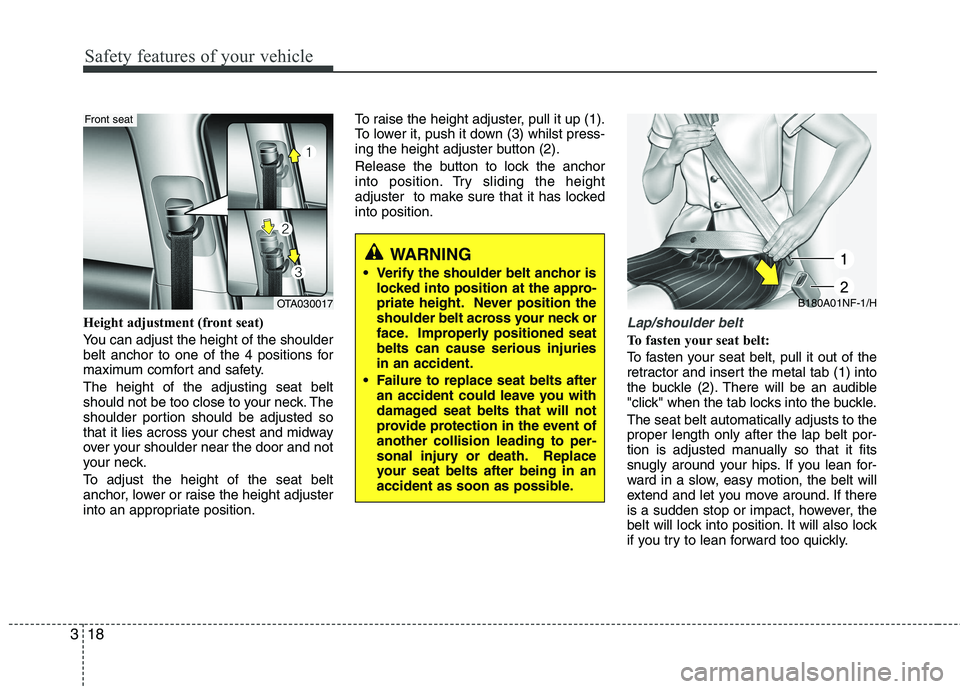
Height adjustment (front seat)
You can adjust the height of the shoulder
belt anchor to one of the 4 positions for
maximum comfort and safety. The height of the adjusting seat belt
should not be too close to your neck. The
shoulder portion should be adjusted so
that it lies across your chest and midway
over your shoulder near the door and not
your neck.
To adjust the height of the seat belt
anchor, lower or raise the height adjuster
into an appropriate position. To raise the height adjuster, pull it up (1).
To lower it, push it down (3) whilst press-
ing the height adjuster button (2).
Release the button to lock the anchor
into position. Try sliding the height
adjuster to make sure that it has lockedinto position.Lap/shoulder belt
To fasten your seat belt:
To fasten your seat belt, pull it out of the
retractor and insert the metal tab (1) into
the buckle (2). There will be an audible
"click" when the tab locks into the buckle. The seat belt automatically adjusts to the proper length only after the lap belt por-
tion is adjusted manually so that it fits
snugly around your hips. If you lean for-
ward in a slow, easy motion, the belt will
extend and let you move around. If there
is a sudden stop or impact, however, the
belt will lock into position. It will also lock
if you try to lean forward too quickly.
OTA030017
Front seat
WARNING
Verify the shoulder belt anchor is locked into position at the appro-
priate height. Never position the
shoulder belt across your neck or
face. Improperly positioned seatbelts can cause serious injuriesin an accident.
Failure to replace seat belts after an accident could leave you with
damaged seat belts that will not
provide protection in the event ofanother collision leading to per-
sonal injury or death. Replace
your seat belts after being in an
accident as soon as possible.
B180A01NF-1/H
Page 456 of 1003
325
Safety features of your vehicle
Infant or small child
You should be aware of the specific
requirements in your country. Child
and/or infant seats must be properly
placed and installed in the rear seat. For
more information about the use of these
restraints, refer to “Child restraint sys-
tem” in this section.✽✽NOTICE
Small children are best protected from
injury in an accident when properly
restrained in the rear seat by a child
restraint system that meets the require-
ments of the Safety Standards of your
country. Before buying any child
restraint system, make sure that it has a
label certifying that it meets Safety
Standards of your country. The restraint
must be appropriate for your child's
height and weight. Check the label on
the child restraint for this information.
Refer to “Child restraint system” in this
section.Larger children
Children who are too large for child
restraint systems should always occupy
the rear seat and use the available
lap/shoulder belts. The lap portion should
be fastened and snugged on the hips
and as low as possible. Check if belt fits
periodically. A child's squirming could put
the belt out of position. Children are
given the most safety in the event of an
accident when they are restrained by a
proper restraint system in the rear seat. If
a larger child (over age 12) must be seat-ed in the front seat, the child should be
securely restrained by the availablelap/shoulder belt and the seat should be
placed in the rearmost position. Children
age 12 and under should be restrained
securely in the rear seat. NEVER place achild age 12 and under in the front seat.
NEVER place a rear facing child seat in
the front seat of a vehicle.
WARNING
Every person in your vehicle needs
to be properly restrained at all
times, including infants and chil-
dren. Never hold a child in yourarms or lap when riding in a vehi-
cle. The violent forces created dur-
ing a crash will tear the child from
your arms and throw the child
against the interior. Always use a
child restraint appropriate for your
child's height and weight.