inflation pressure KIA PICANTO 2014 User Guide
[x] Cancel search | Manufacturer: KIA, Model Year: 2014, Model line: PICANTO, Model: KIA PICANTO 2014Pages: 1003, PDF Size: 44.67 MB
Page 365 of 1003
Maintenance
40
7
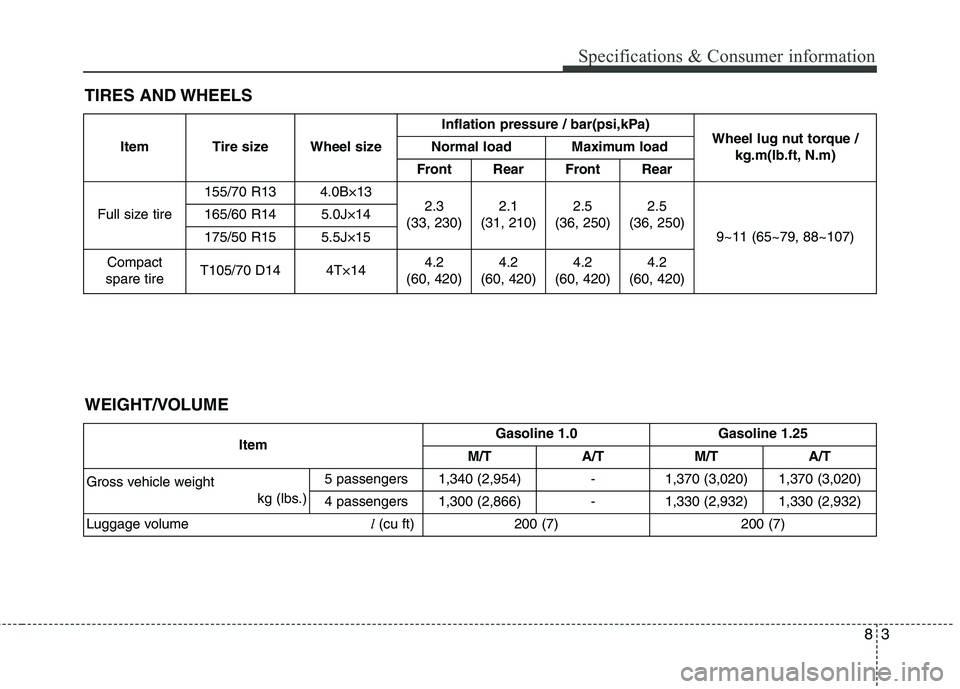
TIRES AND WHEELS
Tire care
For proper maintenance, safety, and
maximum fuel economy, you must
always maintain recommended tire
inflation pressures and stay within
the load limits and weight distribution
recommended for your vehicle. Recommended cold tire inflation pressures All tire pressures (including the
spare) should be checked when the
tires are cold. “Cold Tires” means the
vehicle has not been driven for at
least three hours or driven less than1.6 km (one mile).
Recommended pressures must be
maintained for the best ride, top vehi-
cle handling, and minimum tire wear.
For recommended inflation pressure,
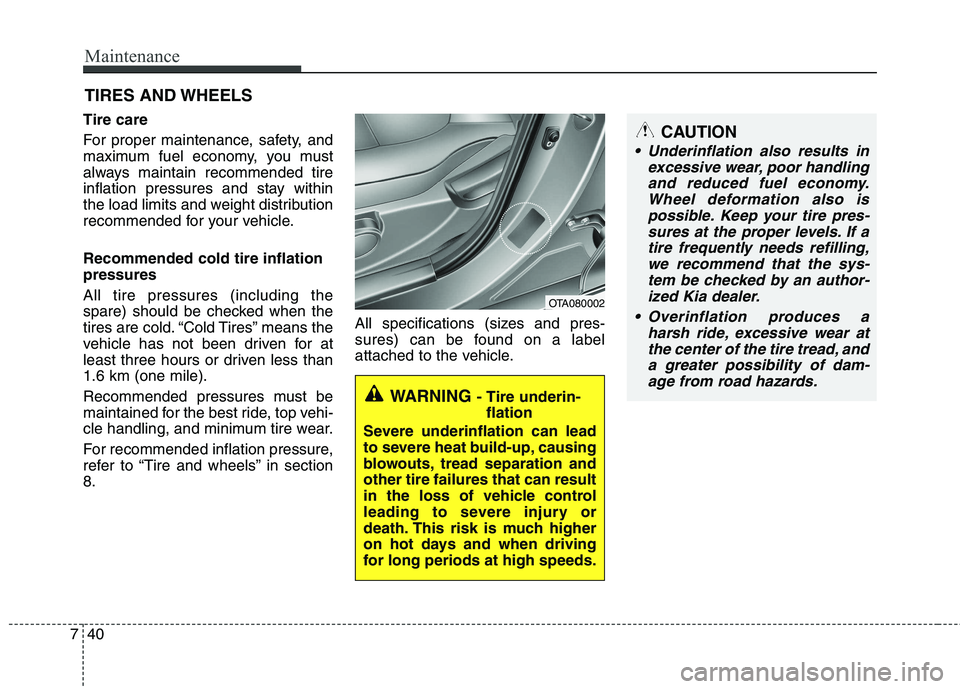
refer to “Tire and wheels” in section8. All specifications (sizes and pres-
sures) can be found on a label
attached to the vehicle.
WARNING
- Tire underin-
flation
Severe underinflation can lead
to severe heat build-up, causing
blowouts, tread separation andother tire failures that can result
in the loss of vehicle control
leading to severe injury or
death. This risk is much higher
on hot days and when driving
for long periods at high speeds.
OTA080002
CAUTION
Underinflation also results in excessive wear, poor handlingand reduced fuel economy. Wheel deformation also ispossible. Keep your tire pres-sures at the proper levels. If a tire frequently needs refilling,we recommend that the sys-tem be checked by an author- ized Kia dealer.
Overinflation produces a harsh ride, excessive wear atthe center of the tire tread, anda greater possibility of dam- age from road hazards.
Page 366 of 1003
741
Maintenance
Checking tire inflation pressure
Check your tires once a month or
more.
Also, check the tire pressure of the
spare tire.
How to check
Use a good quality gauge to check
tire pressure. You can not tell if your
tires are properly inflated simply by
looking at them. Radial tires may
look properly inflated even when
they're underinflated.
Check the tire's inflation pressure
when the tires are cold. - "Cold"
means your vehicle has been sitting
for at least three hours or driven nomore than 1.6 km (1 mile).
WARNING - Tire Inflation
Overinflation or underinflation
can reduce tire life, adversely
affect vehicle handling, and
lead to sudden tire failure. This
could result in loss of vehicle
control and potential injury.
CAUTION - Tire pressure
Always observe the following:
Check tire pressure when the tires are cold. (After vehiclehas been parked for at leastthree hours or hasn't beendriven more than 1.6 km (one mile) since startup.)
Check the pressure of your spare tire each time you checkthe pressure of other tires.
Never overload your vehicle. Be careful not to overload avehicle luggage rack if your vehicle is equipped with one.
Worn, old tires can cause acci- dents. If your tread is badlyworn, or if your tires havebeen damaged, replace them.
CAUTION
Warm tires normally exceed recommended cold tire pres-sures by 28 to 41 kPa (4 to 6psi). Do not release air fromwarm tires to adjust the pres- sure or the tires will be under-inflated.
Be sure to reinstall the tire inflation valve caps. Withoutthe valve cap, dirt or moisture could get into the valve coreand cause air leakage. If avalve cap is missing, install a new one as soon as possible.
Page 367 of 1003
Maintenance
42
7
Remove the valve cap from the tire
valve stem. Press the tire gauge firm-
ly onto the valve to get a pressure
measurement. If the cold tire inflationpressure matches the recommendedpressure on the tire and loading
information label, no further adjust-
ment is necessary. If the pressure is
low, add air until you reach the rec-ommended amount.
If you overfill the tire, release air by pushing on the metal stem in the cen-
ter of the tire valve. Recheck the tire
pressure with the tire gauge. Be sure
to put the valve caps back on the
valve stems. They help prevent leaks
by keeping out dirt and moisture. Tire rotation
To equalize tread wear, it is recom- mended that the tires be rotated
every 12,000 km (7,500 miles) or
sooner if irregular wear develops.
During rotation, check the tires for
correct balance.
When rotating tires, check for uneven
wear and damage. Abnormal wear is
usually caused by incorrect tire pres-
sure, improper wheel alignment, out-
of-balance wheels, severe braking or
severe cornering. Look for bumps or
bulges in the tread or side of tire.
Replace the tire if you find either of
these conditions. Replace the tire if
fabric or cord is visible. After rotation,
be sure to bring the front and rear tire
pressures to specification and check
lug nut tightness.
Refer to “Tire and wheels” in section 8.
WARNING
Inspect your tires frequently for proper inflation as well as
wear and damage. Always use
a tire pressure gauge.
Tires with too much or too little pressure wear unevenly caus-
ing poor handling, loss of vehi-
cle control, and sudden tirefailure leading to accidents,
injuries, and even death. Therecommended cold tire pres-
sure for your vehicle can be
found in this manual and onthe tire label located on the dri-
ver's side center pillar.
Worn tires can cause acci- dents. Replace tires that are
worn, show uneven wear, or
are damaged.
Remember to check the pres- sure of your spare tire. Kia
recommends that you check
the spare every time you
check the pressure of the
other tires on your vehicle.
Page 372 of 1003
747
Maintenance
3. Checking tire life (TIN : TireIdentification Number)
Any tires that are over 6 years old,
based on the manufacturing date,(including the spare tire) should be
replaced by new ones. You can find
the manufacturing date on the tire
sidewall (possibly on the inside of the
wheel), displaying the DOT Code.
The DOT Code is a series of num-
bers on a tire consisting of numbers
and English letters. The manufactur-
ing date is designated by the last four
digits (characters) of the DOT code. DOT : XXXX XXXX OOOO
The front part of the DOT means a
plant code number, tire size and
tread pattern and the last four num-
bers indicate week and year manu-
factured.
For example:
DOT XXXX XXXX 1613 represents
that the tire was produced in the 16th
week of 2013.
4. Tire ply composition and material
The number of layers or plies of rub-
ber-coated fabric in the tire. Tire
manufacturers also must indicate the
materials in the tire, which include
steel, nylon, polyester, and others.
The letter "R" means radial ply con-
struction; the letter "D" means diago-
nal or bias ply construction; and theletter "B" means belted-bias ply con-
struction.
5. Maximum permissible inflation
pressure
This number is the greatest amount of air pressure that should be put in the
tire. Do not exceed the maximum per-
missible inflation pressure. Refer to
the Tire and Loading Information label
for recommended inflation pressure.
6. Maximum load rating
This number indicates the maximum
load in kilograms and pounds that can
be carried by the tire. When replacing
the tires on the vehicle, always use a
tire that has the same load rating as
the factory installed tire.
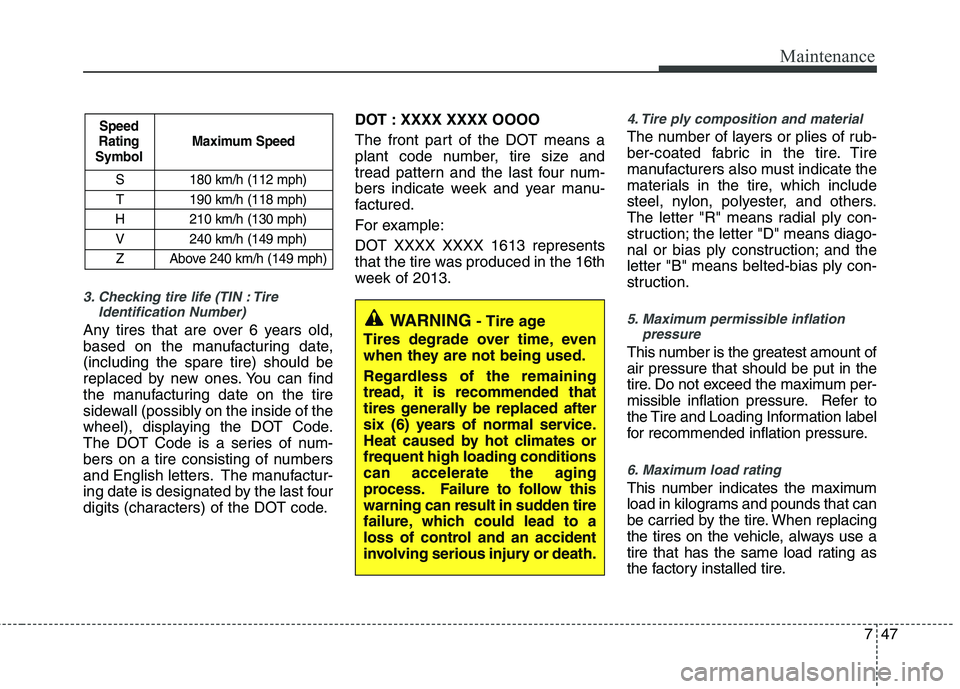
S 180 km/h (112 mph)
T 190 km/h (118 mph)
H 210 km/h (130 mph)
V 240 km/h (149 mph) Z Above 240 km/h (149 mph)
Maximum Speed
Speed
Rating
Symbol
WARNING - Tire age
Tires degrade over time, even
when they are not being used.
Regardless of the remaining
tread, it is recommended that
tires generally be replaced after
six (6) years of normal service.
Heat caused by hot climates orfrequent high loading conditions
can accelerate the aging
process. Failure to follow this
warning can result in sudden tire
failure, which could lead to a
loss of control and an accident
involving serious injury or death.
Page 405 of 1003
83
Specifications & Consumer information
TIRES AND WHEELSItem Tire size Wheel size Inflation pressure / bar(psi,kPa)
Wheel lug nut torque /
kg.m(lb.ft, N.m)
Normal load Maximum load
Front Rear Front Rear
Full size tire
155/70 R13 4.0B×13 2.3
(33, 230) 2.1
(31, 210) 2.5
(36, 250) 2.5
(36, 250) 9~11 (65~79, 88~107)
165/60 R14 5.0J×14
175/50 R15 5.5J×15
Compact
spare tire
T105/70 D14 4T×14 4.2
(60, 420) 4.2
(60, 420) 4.2
(60, 420) 4.2
(60, 420)
Item Gasoline 1.0 Gasoline 1.25
M/T A/T M/T A/T
Gross vehicle weight kg (lbs.)
5 passengers 1,340 (2,954) - 1,370 (3,020) 1,370 (3,020)
4 passengers1,300 (2,866) - 1,330 (2,932) 1,330 (2,932)
Luggage volume l(cu ft)
200 (7) 200 (7)
WEIGHT/VOLUME
Page 413 of 1003
I3
Index
Cargo weight ..................................................................5-56
Central door lock switch ................................................4-17
Changing tires ..................................................................6-9Chains
Tire chains ................................................................5-45
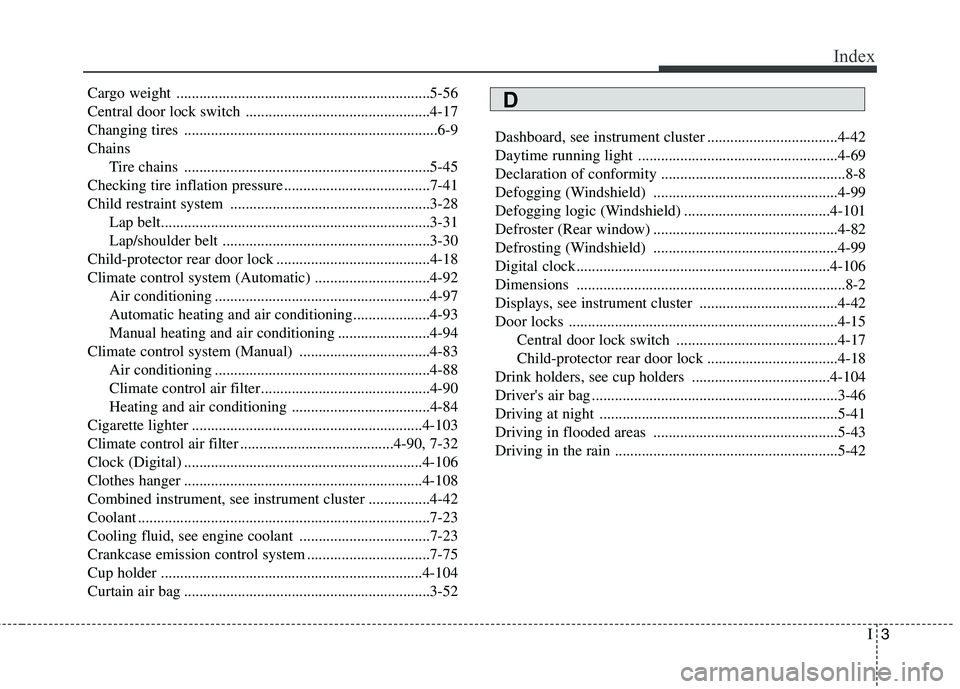
Checking tire inflation pressure ......................................7-41
Child restraint system ....................................................3-28 Lap belt......................................................................3-31
Lap/shoulder belt ......................................................3-30
Child-protector rear door lock ........................................4-18
Climate control system (Automatic) ..............................4-92 Air conditioning ........................................................4-97
Automatic heating and air conditioning....................4-93
Manual heating and air conditioning ........................4-94
Climate control system (Manual) ..................................4-83 Air conditioning ........................................................4-88
Climate control air filter............................................4-90
Heating and air conditioning ....................................4-84
Cigarette lighter ............................................................4-103
Climate control air filter ........................................4-90, 7-32
Clock (Digital) ..............................................................4-106
Clothes hanger ..............................................................4-108
Combined instrument, see instrument cluster ................4-42
Coolant ............................................................................7-23
Cooling fluid, see engine coolant ..................................7-23
Crankcase emission control system ................................7-75
Cup holder ....................................................................4-104
Curtain air bag ................................................................3-52 Dashboard, see instrument cluster ..................................4-42
Daytime running light ....................................................4-69
Declaration of conformity ................................................8-8
Defogging (Windshield) ................................................4-99
Defogging logic (Windshield) ......................................4-101
Defroster (Rear window) ................................................4-82
Defrosting (Windshield) ................................................4-99
Digital clock..................................................................4-106
Dimensions ......................................................................8-2
Displays, see instrument cluster ....................................4-42
Door locks ......................................................................4-15
Central door lock switch ..........................................4-17
Child-protector rear door lock ..................................4-18
Drink holders, see cup holders ....................................4-104
Driver's air bag ................................................................3-46
Driving at night ..............................................................5-41
Driving in flooded areas ................................................5-43
Driving in the rain ..........................................................5-42D
Page 417 of 1003
I7
Index
Parking brake ..................................................................5-27
Passenger's front air bag ................................................3-46
Power brakes ..................................................................5-26
Power outlet ..................................................................4-106
Power steering (Electronic) ............................................4-35
Power window lock button ............................................4-24
Pre-tensioner seat belt ....................................................3-22
Push starting......................................................................6-6
Rear seat............................................................................3-9
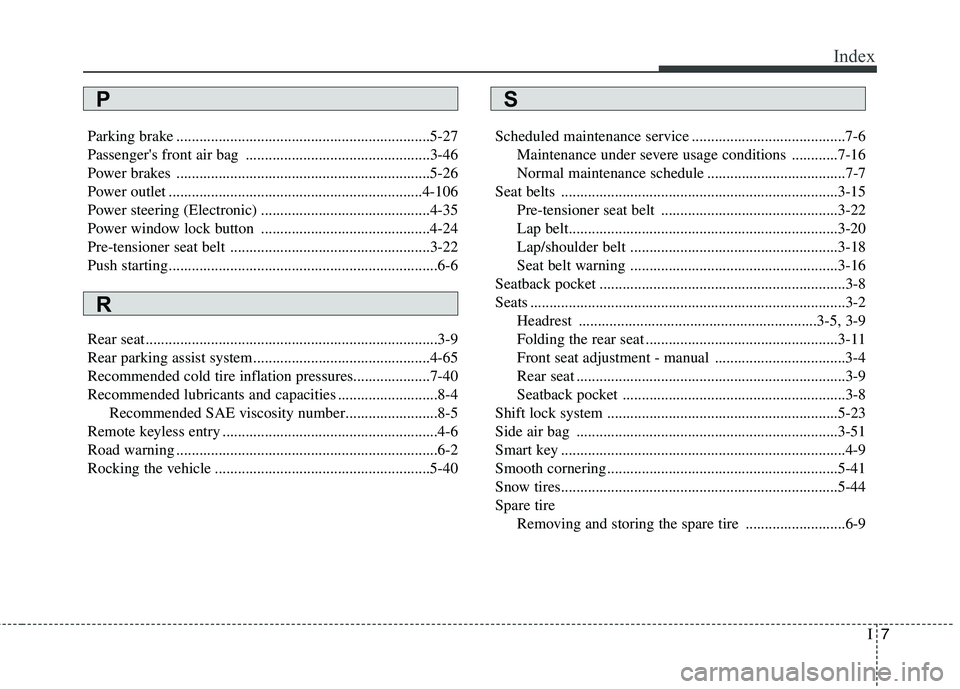
Rear parking assist system ..............................................4-65Recommended cold tire inflation pressures....................7-40
Recommended lubricants and capacities ..........................8-4
Recommended SAE viscosity number........................8-5
Remote keyless entry ........................................................4-6
Road warning ....................................................................6-2
Rocking the vehicle ........................................................5-40 Scheduled maintenance service ........................................7-6
Maintenance under severe usage conditions ............7-16Normal maintenance schedule ....................................7-7
Seat belts ........................................................................3-15 Pre-tensioner seat belt ..............................................3-22
Lap belt......................................................................3-20
Lap/shoulder belt ......................................................3-18
Seat belt warning ......................................................3-16
Seatback pocket ................................................................3-8
Seats ..................................................................................3-2 Headrest ..............................................................3-5, 3-9
Folding the rear seat ..................................................3-11
Front seat adjustment - manual ..................................3-4
Rear seat ......................................................................3-9
Seatback pocket ..........................................................3-8
Shift lock system ............................................................5-23
Side air bag ....................................................................3-51
Smart key ..........................................................................4-9
Smooth cornering............................................................5-41
Snow tires........................................................................5-44Spare tire Removing and storing the spare tire ..........................6-9
P
R
S
Page 418 of 1003
Index
8
I
Special driving conditions ..............................................5-40
Driving at night ........................................................5-41
Driving in flooded areas............................................5-43
Driving in the rain ....................................................5-42
Hazardous driving conditions ..................................5-40
Highway driving ........................................................5-43
Rocking the vehicle ..................................................5-40
Smooth cornering ......................................................5-41
Speedometer....................................................................4-43
Starting difficulties, see engine will not start ..................6-4
Starting the engine ............................................................5-9
Steering wheel ................................................................4-35 Electronic power steering..........................................4-35
Heated steering wheel ..............................................4-36
Horn ..........................................................................4-37
Tilt steering ..............................................................4-35
Steering wheel audio control ........................................4-110
Storage compartment ....................................................4-101 Glove box ................................................................4-102
Sunglass holder ......................................................4-102
Sunglass holder ............................................................4-102
Sunroof............................................................................4-31
Sunvisor ........................................................................4-105 Tachometer ......................................................................4-43
Tailgate ............................................................................4-19
Tilt steering ....................................................................4-35
Tire specification and pressure label ................................8-7
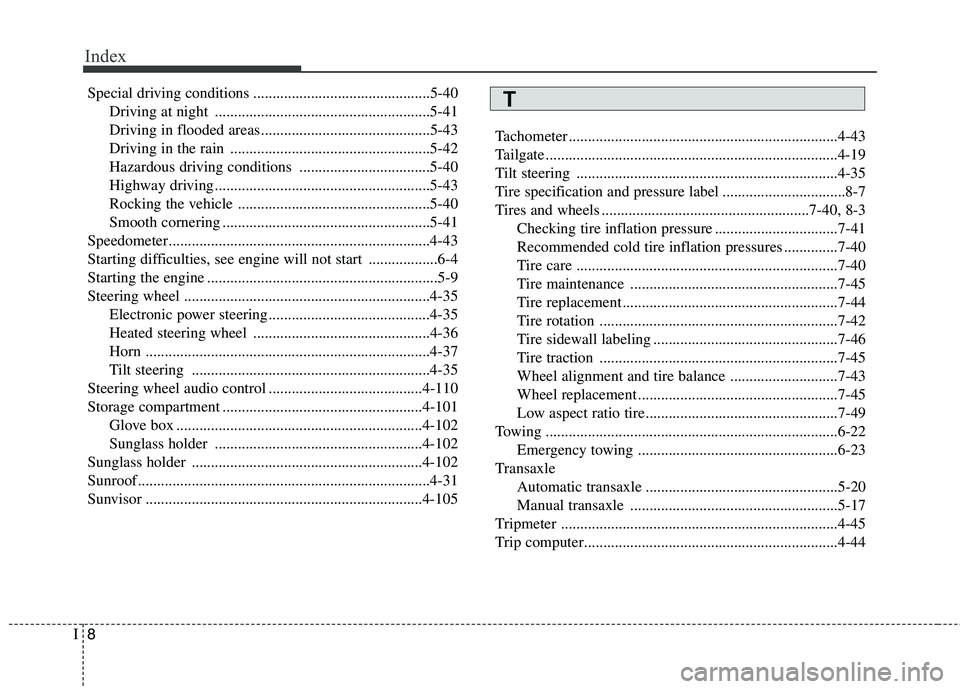
Tires and wheels ......................................................7-40, 8-3
Checking tire inflation pressure ................................7-41
Recommended cold tire inflation pressures ..............7-40
Tire care ....................................................................7-40
Tire maintenance ......................................................7-45
Tire replacement ........................................................7-44
Tire rotation ..............................................................7-42
Tire sidewall labeling ................................................7-46
Tire traction ..............................................................7-45
Wheel alignment and tire balance ............................7-43
Wheel replacement ....................................................7-45
Low aspect ratio tire..................................................7-49
Towing ............................................................................6-22 Emergency towing ....................................................6-23
Transaxle Automatic transaxle ..................................................5-20
Manual transaxle ......................................................5-17
Tripmeter ........................................................................4-45
Trip computer..................................................................4-44T
Page 475 of 1003
Safety features of your vehicle
44
3
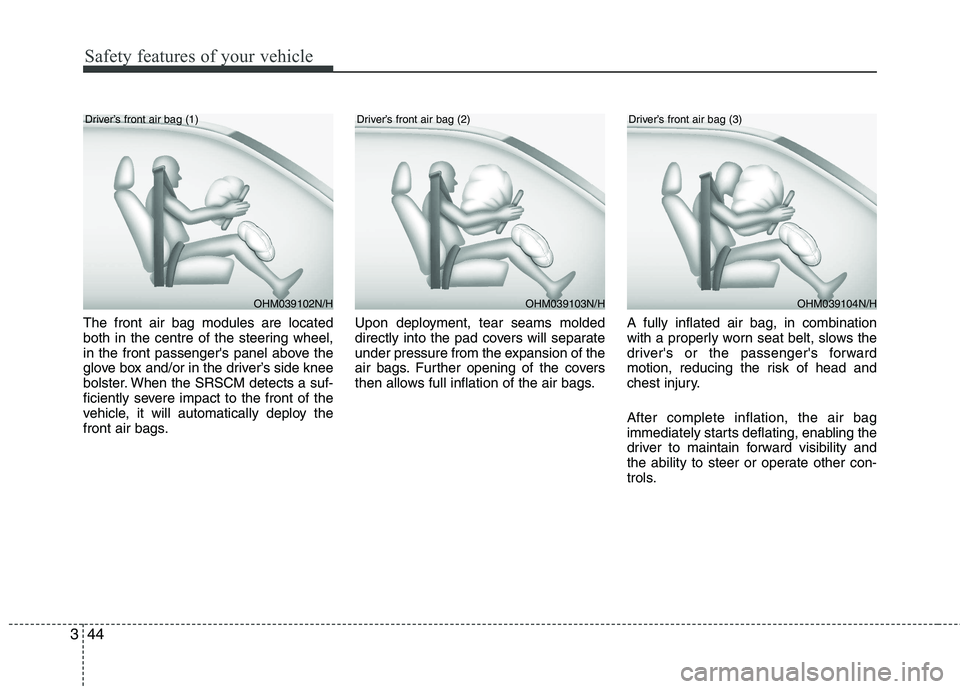
The front air bag modules are located
both in the centre of the steering wheel,
in the front passenger's panel above the
glove box and/or in the driver’s side knee
bolster. When the SRSCM detects a suf-
ficiently severe impact to the front of the
vehicle, it will automatically deploy the
front air bags. Upon deployment, tear seams molded
directly into the pad covers will separate
under pressure from the expansion of the
air bags. Further opening of the covers
then allows full inflation of the air bags.
A fully inflated air bag, in combination
with a properly worn seat belt, slows the
driver's or the passenger's forward
motion, reducing the risk of head and
chest injury. After complete inflation, the air bag
immediately starts deflating, enabling the
driver to maintain forward visibility and
the ability to steer or operate other con-
trols.
OHM039102N/H
Driver’s front air bag (1)OHM039103N/HOHM039104N/H
Driver’s front air bag (2) Driver’s front air bag (3)
Page 697 of 1003
537
Driving your vehicle
Your vehicle's fuel economy depends
mainly on your style of driving, where you
drive and when you drive.
Each of these factors affects how many
kilometers (miles) you can get from a
litre (gallon) of fuel. To operate your vehi-
cle as economically as possible, use the
following driving suggestions to help
save money in both fuel and repairs:
Drive smoothly. Accelerate at a moder-ate rate. Don't make "jack-rabbit" startsor full-throttle shifts and maintain a
steady cruising speed. Don't race
between stoplights. Try to adjust your
speed to the traffic so you don't have to
change speeds unnecessarily. Avoid
heavy traffic whenever possible.
Always maintain a safe distance from
other vehicles so you can avoid unnec-
essary braking. This also reduces
brake wear.
Drive at a moderate speed. The faster you drive, the more fuel your vehicle
uses. Driving at a moderate speed,
especially on the highway, is one of the
most effective ways to reduce fuel con-sumption. Don't "ride" the brake pedal. This can
increase fuel consumption and also
increase wear on these components.
In addition, driving with your foot rest-
ing on the brake pedal may cause the
brakes to overheat, which reduces
their effectiveness and may lead to
more serious consequences.
Take care of your tyres. Keep them inflated to the recommended pressure.
Incorrect inflation, either too much or
too little, results in unnecessary tyre
wear. Check the tyre pressures at leastonce a month.
Be sure that the wheels are aligned correctly. Improper alignment can
result from hitting kerbs or driving too
fast over irregular surfaces. Poor align-
ment causes faster tyre wear and may
also result in other problems as well as
greater fuel consumption. Keep your car in good condition. For
better fuel economy and reduced
maintenance costs, maintain your carin accordance with the maintenance
schedule in section 7. If you drive your
car in severe conditions, more frequentmaintenance is required (see section 7
for details).
Keep your car clean. For maximum service, your vehicle should be kept
clean and free of corrosive materials. It
is especially important that mud, dirt,
ice, etc. not be allowed to accumulate
on the underside of the car. This extra
weight can result in increased fuel con-
sumption and also contribute to corro-sion.
Travel lightly. Don't carry unnecessary weight in your car. Weight reduces fuel
economy.
Don't let the engine idle longer than necessary. If you are waiting (and not
in traffic), turn off your engine and
restart only when you're ready to go.
ECONOMICAL OPERATION