low KIA PICANTO 2015 Owner's Guide
[x] Cancel search | Manufacturer: KIA, Model Year: 2015, Model line: PICANTO, Model: KIA PICANTO 2015Pages: 846, PDF Size: 49.67 MB
Page 48 of 846
Safety features of your vehicle
36
3
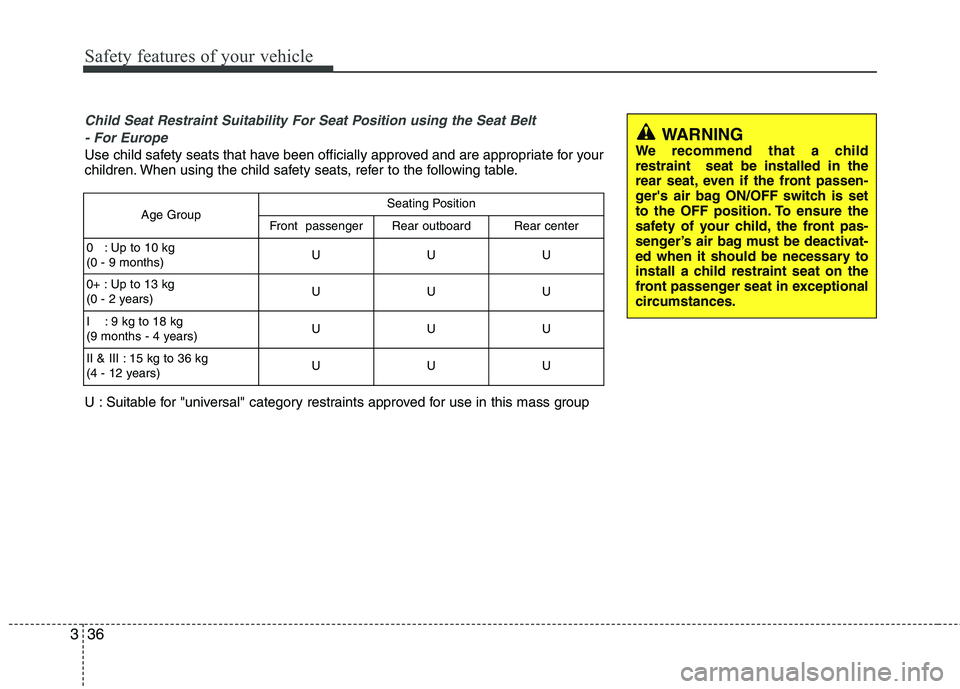
Child Seat Restraint Suitability For Seat Position using the Seat Belt
- For Europe
Use child safety seats that have been officially approved and are appropriate for your
children. When using the child safety seats, refer to the following table.
Age Group Seating Position
Front passenger Rear outboard Rear center
0 : Up to 10 kg (0 - 9 months) UUU
0+ : Up to 13 kg
(0 - 2 years) UUU
I : 9 kg to 18 kg
(9 months - 4 years) UUU
II & III : 15 kg to 36 kg
(4 - 12 years) UUU
WARNING
We recommend that a child restraint seat be installed in the
rear seat, even if the front passen-
ger's air bag ON/OFF switch is set
to the OFF position. To ensure the
safety of your child, the front pas-
senger’s air bag must be deactivat-
ed when it should be necessary to
install a child restraint seat on the
front passenger seat in exceptional
circumstances.
U : Suitable for "universal" category restraints approved for use in this mass group
Page 50 of 846
Safety features of your vehicle
38
3
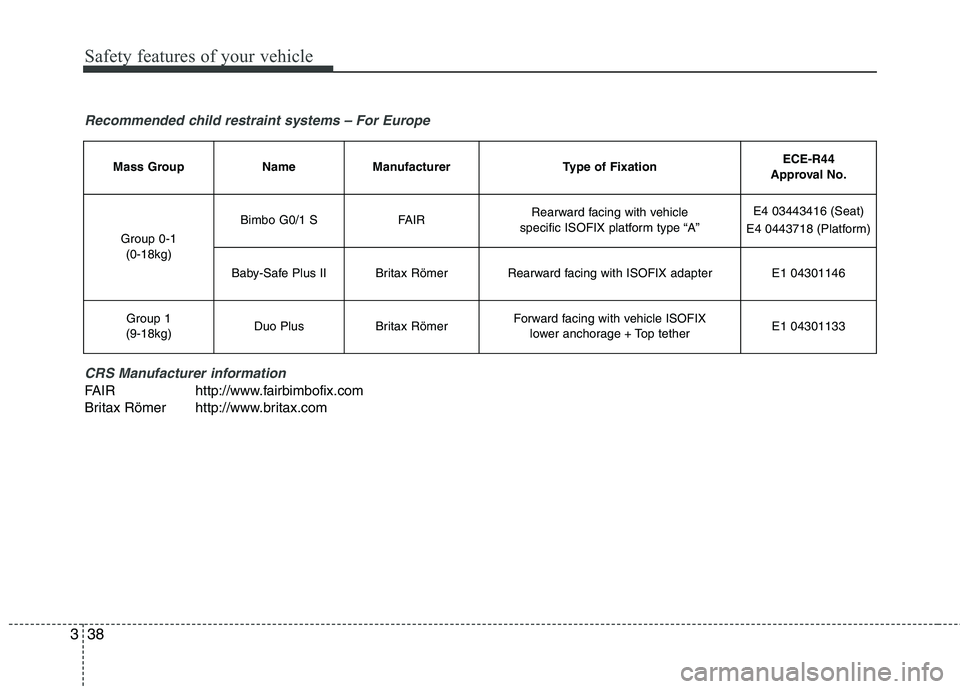
Recommended child restraint systems – For Europe
CRS Manufacturer information
FAIR http://www.fairbimbofix.com
Britax Römer http://www.britax.com
Mass GroupNameManufacturerType of FixationECE-R44
Approval No.
Group 0-1 (0-18kg)
Bimbo G0/1 SFAIRRearward facing with vehicle
specific ISOFIX platform type “A”E4 03443416 (Seat)
E4 0443718 (Platform)
Baby-Safe Plus IIBritax RömerRearward facing with ISOFIX adapterE1 04301146
Group 1
(9-18kg)Duo PlusBritax RömerForward facing with vehicle ISOFIX lower anchorage + Top tetherE1 04301133
Page 55 of 846
343
Safety features of your vehicle
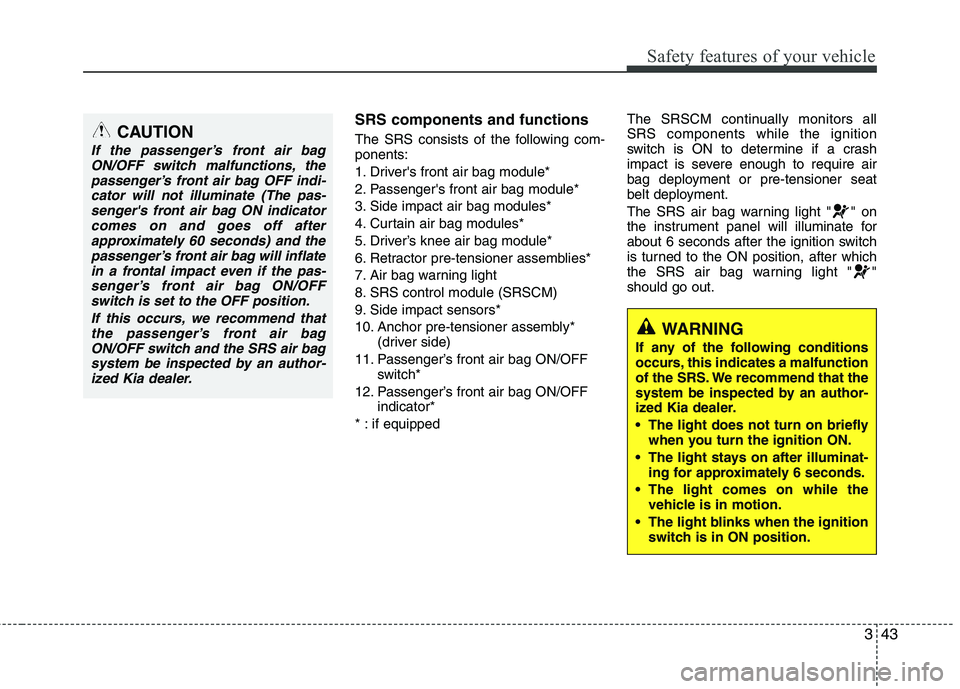
SRS components and functions
The SRS consists of the following com- ponents:
1. Driver's front air bag module*
2. Passenger's front air bag module*
3. Side impact air bag modules*
4. Curtain air bag modules*
5. Driver’s knee air bag module*
6. Retractor pre-tensioner assemblies*
7. Air bag warning light
8. SRS control module (SRSCM)
9. Side impact sensors*
10. Anchor pre-tensioner assembly* (driver side)
11. Passenger’s front air bag ON/OFF switch*
12. Passenger’s front air bag ON/OFF indicator*
* : if equipped The SRSCM continually monitors all SRS components while the ignition
switch is ON to determine if a crash
impact is severe enough to require air
bag deployment or pre-tensioner seat
belt deployment.
The SRS air bag warning light " " on
the instrument panel will illuminate for
about 6 seconds after the ignition switch
is turned to the ON position, after which
the SRS air bag warning light " "should go out.
WARNING
If any of the following conditions
occurs, this indicates a malfunction
of the SRS. We recommend that the
system be inspected by an author-
ized Kia dealer.
The light does not turn on briefly when you turn the ignition ON.
The light stays on after illuminat- ing for approximately 6 seconds.
The light comes on while the vehicle is in motion.
The light blinks when the ignition switch is in ON position.
CAUTION
If the passenger’s front air bag
ON/OFF switch malfunctions, the
passenger’s front air bag OFF indi-cator will not illuminate (The pas-senger's front air bag ON indicator comes on and goes off after
approximately 60 seconds) and thepassenger’s front air bag will inflatein a frontal impact even if the pas-
senger’s front air bag ON/OFFswitch is set to the OFF position.
If this occurs, we recommend thatthe passenger’s front air bagON/OFF switch and the SRS air bag
system be inspected by an author- ized Kia dealer.
Page 56 of 846
Safety features of your vehicle
44
3
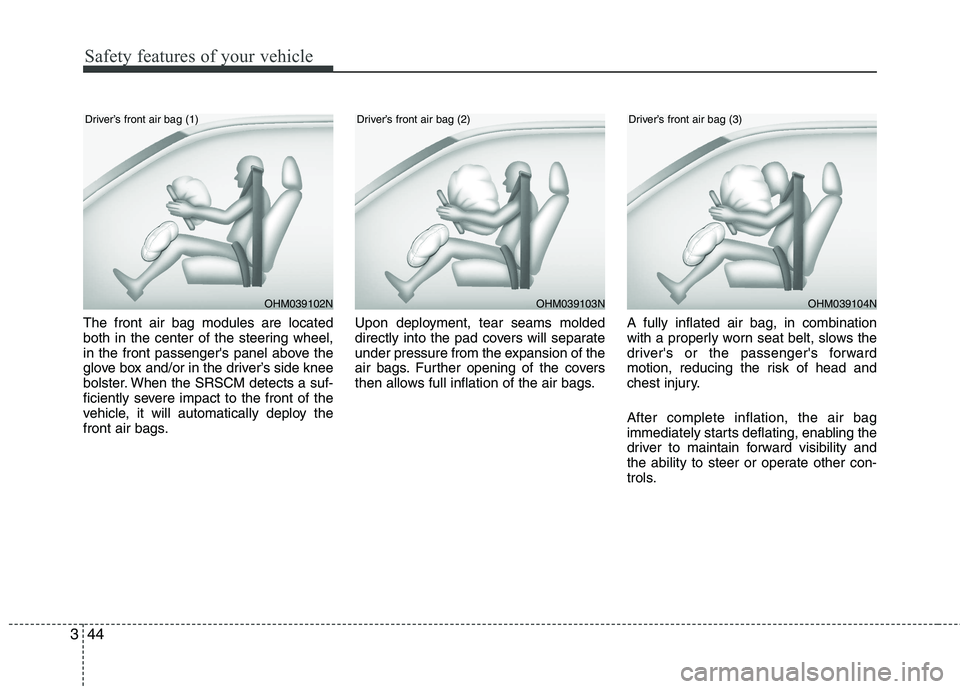
The front air bag modules are located
both in the center of the steering wheel,
in the front passenger's panel above the
glove box and/or in the driver’s side knee
bolster. When the SRSCM detects a suf-
ficiently severe impact to the front of the
vehicle, it will automatically deploy the
front air bags. Upon deployment, tear seams molded
directly into the pad covers will separate
under pressure from the expansion of the
air bags. Further opening of the covers
then allows full inflation of the air bags.
A fully inflated air bag, in combination
with a properly worn seat belt, slows the
driver's or the passenger's forward
motion, reducing the risk of head and
chest injury. After complete inflation, the air bag
immediately starts deflating, enabling the
driver to maintain forward visibility and
the ability to steer or operate other con-
trols.
OHM039102N
Driver’s front air bag (1)OHM039103NOHM039104N
Driver’s front air bag (2) Driver’s front air bag (3)
Page 57 of 846
345
Safety features of your vehicle
WARNING
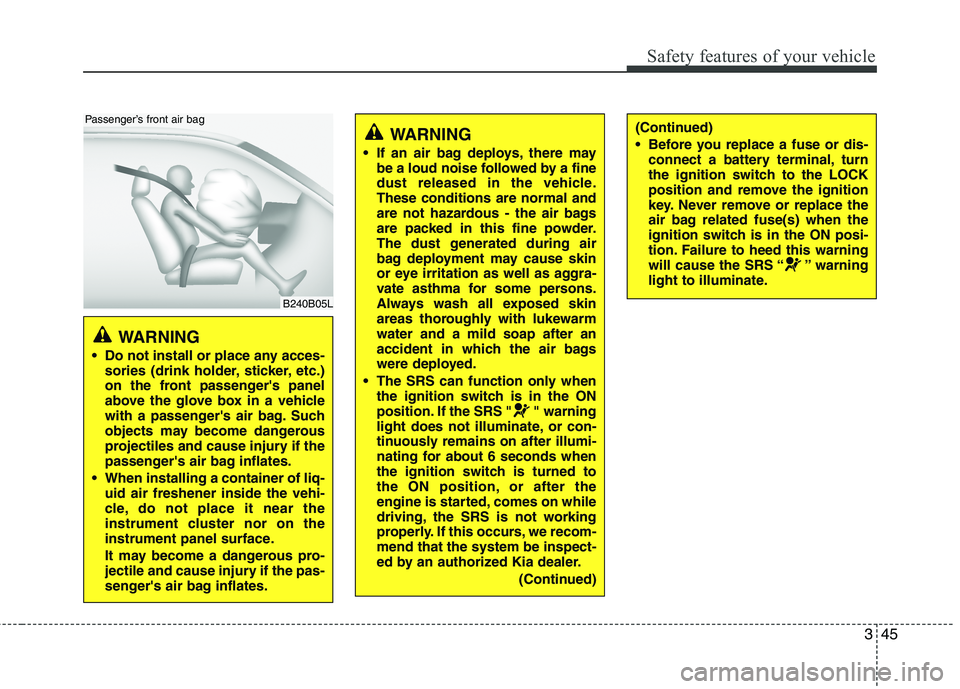
Do not install or place any acces- sories (drink holder, sticker, etc.)
on the front passenger's panel
above the glove box in a vehicle
with a passenger's air bag. Such
objects may become dangerous
projectiles and cause injury if the
passenger's air bag inflates.
When installing a container of liq- uid air freshener inside the vehi-
cle, do not place it near the
instrument cluster nor on the
instrument panel surface.
It may become a dangerous pro-
jectile and cause injury if the pas-
senger's air bag inflates.
B240B05L
Passenger’s front air bag
WARNING
If an air bag deploys, there may be a loud noise followed by a fine
dust released in the vehicle.These conditions are normal and
are not hazardous - the air bags
are packed in this fine powder.
The dust generated during air
bag deployment may cause skin
or eye irritation as well as aggra-
vate asthma for some persons.
Always wash all exposed skin
areas thoroughly with lukewarmwater and a mild soap after an
accident in which the air bags
were deployed.
The SRS can function only when the ignition switch is in the ON
position. If the SRS " " warning
light does not illuminate, or con-
tinuously remains on after illumi-
nating for about 6 seconds when
the ignition switch is turned to
the ON position, or after the
engine is started, comes on while
driving, the SRS is not working
properly. If this occurs, we recom-mend that the system be inspect-
ed by an authorized Kia dealer.
(Continued)(Continued)
Before you replace a fuse or dis-connect a battery terminal, turn
the ignition switch to the LOCK
position and remove the ignition
key. Never remove or replace the
air bag related fuse(s) when the
ignition switch is in the ON posi-
tion. Failure to heed this warning
will cause the SRS “ ” warning
light to illuminate.
Page 58 of 846
Safety features of your vehicle
46
3
Driver's and passenger's front air
bag (if equipped)
Your vehicle is equipped with a
Supplemental Restraint (Air Bag) Systemand the lap/shoulder belts at both the
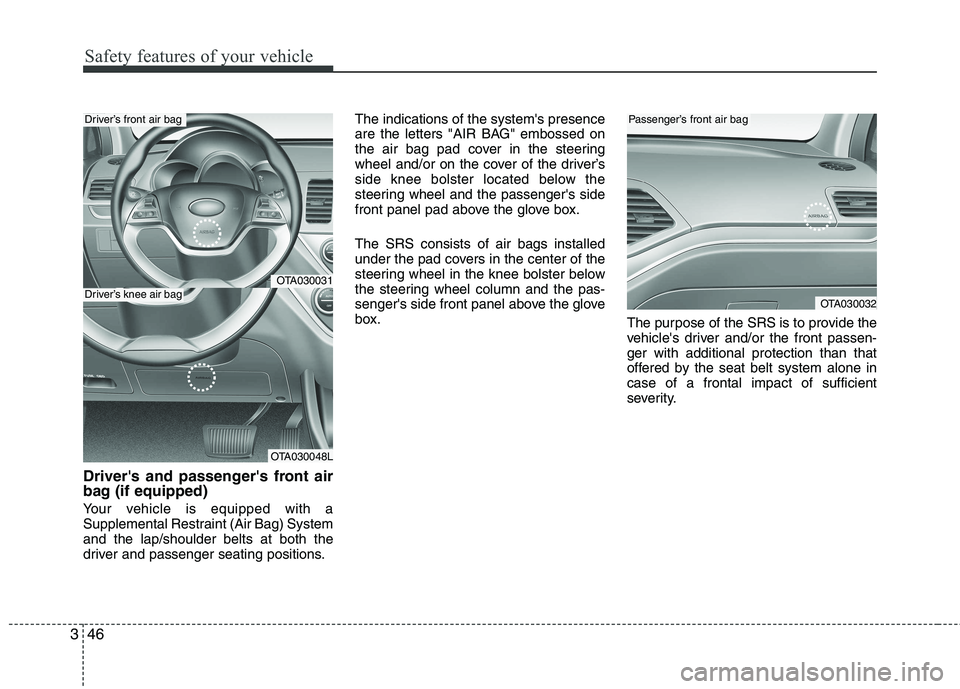
driver and passenger seating positions. The indications of the system's presence
are the letters "AIR BAG" embossed on
the air bag pad cover in the steering
wheel and/or on the cover of the driver’s
side knee bolster located below the
steering wheel and the passenger's side
front panel pad above the glove box. The SRS consists of air bags installed
under the pad covers in the center of the
steering wheel in the knee bolster below
the steering wheel column and the pas-
senger's side front panel above the glove
box.
The purpose of the SRS is to provide the
vehicle's driver and/or the front passen-ger with additional protection than that
offered by the seat belt system alone incase of a frontal impact of sufficient
severity.
OTA030032
Passenger’s front air bag
OTA030031
OTA030048L
Driver’s front air bag
Driver’s knee air bag
Page 59 of 846
347
Safety features of your vehicle
WARNING
Always use seat belts and child
restraints – every trip, every time,
everyone! Air bags inflate with con-
siderable force and in the blink of
an eye. Seat belts help keep occu-
pants in proper position to obtain
maximum benefit from the air bag.
Even with air bags, improperly belt-ed and unbelted occupants can be
severely injured when the air bag
inflates. Always follow the precau-
tions about seat belts, air bags and
occupant safety contained in this
manual.
To reduce the chance of serious or fatal injuries and receive the maxi-
mum safety benefit from yourrestraint system:
Never place a child in any child or booster seat in the front seat.
ABC – Always Buckle Children in the back seat. It is the safest place
for children of any age to ride.
Front and side air bags can injure occupants improperly positioned
in the front seats.
(Continued)(Continued)
Move your seat as far back aspractical from the front air bags,
while still maintaining control of
the vehicle.
You and your passengers should never sit or lean unnecessarily
close to the air bags. Improperly
positioned drivers and passen-
gers can be severely injured by
inflating air bags.
Never lean against the door or center console – always sit in anupright position.
Do not allow a passenger to ride in the front seat when the passen-
ger’s front air bag OFF indicator is
illuminated, because the air bag
will not deploy in the event of a
moderate or severe frontal crash.
(Continued)(Continued)
No objects should be placed overor near the air bag modules on
the steering wheel, instrument
panel, driver’s side knee bolster,
and the front passenger's panel
above the glove box, because any
such object could cause harm if
the vehicle is in a crash severe
enough to cause the air bags to
deploy.
Do not tamper with or disconnect SRS wiring or other components
of the SRS system. Doing so could
result in injury, due to accidental
deployment of the air bags or by
rendering the SRS inoperative.
If the SRS air bag warning light remains illuminated while the
vehicle is being driven, we recom-mend that the system be inspect-
ed by an authorized Kia dealer.
Air bags can only be used once – we recommend that the system
be replaced by an authorized Kia
dealer.
(Continued)
Page 60 of 846
Safety features of your vehicle
48
3
(Continued)
Children age 12 and under must
always be properly restrained in
the rear seat. Never allow chil-
dren to ride in the front passen-
ger seat. If a child over 12 must
be seated in the front seat, he or
she must be properly belted and
the seat should be moved as far
back as possible.
For maximum safety protection in all types of crashes, all occu-
pants including the driver should
always wear their seat belts
whether or not an air bag is also
provided at their seating position
to minimize the risk of severe
injury or death in the event of a
crash. Do not sit or lean unneces-
sarily close to the air bag while
the vehicle is in motion.
(Continued)(Continued)
The SRS is designed to deploythe front air bags only when an
impact is sufficiently severe andwhen the impact angle is less
than 30° from the forward longitu-
dinal axis of the vehicle.
Additionally, the air bags will only
deploy once. Seat belts must be
worn at all times.
Front air bags are not intended to deploy in side-impact, rear-
impact or rollover crashes. In
addition, front air bags will not
deploy in frontal crashes below
the deployment threshold.
A child restraint system must never be placed in the front seat.
The infant or child could be
severely injured or killed by an air
bag deployment in case of anaccident.
(Continued)(Continued)
Sitting improperly or out of posi-tion can result in serious or fatal
injury in a crash. All occupantsshould sit upright with the seat
back in an upright position, cen-tered on the seat cushion with
their seat belt on, legs comfort-
ably extended and their feet on
the floor until the vehicle is
parked and the ignition key is
removed.
The SRS air bag system must deploy very rapidly to provide
protection in a crash. If an occu-pant is out of position because of
not wearing a seat belt, the air
bag may forcefully contact theoccupant causing serious or fatalinjuries.
Page 63 of 846
351
Safety features of your vehicle
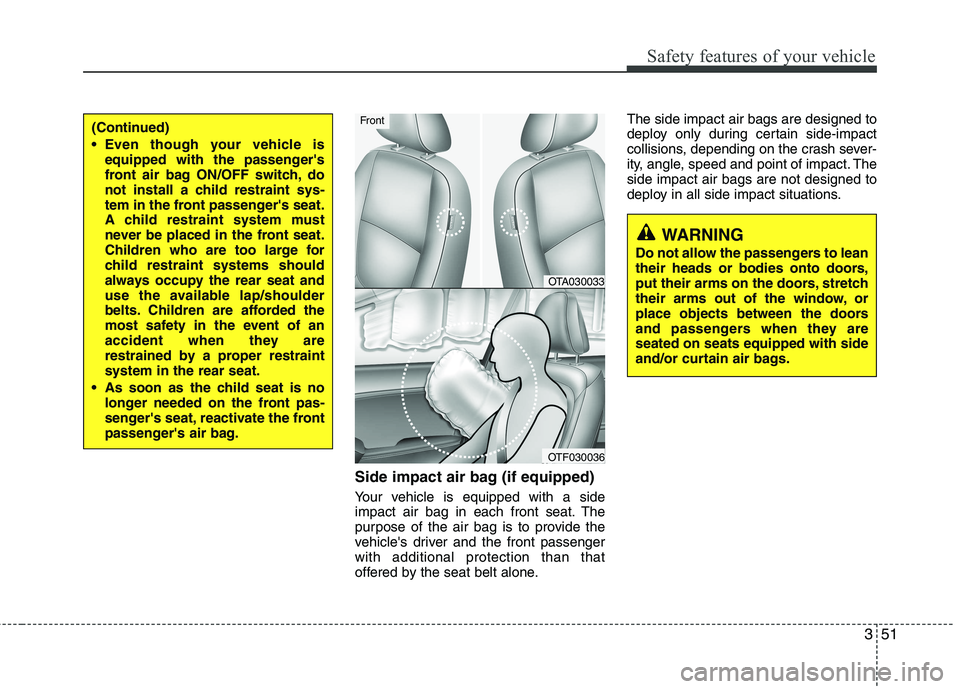
Side impact air bag (if equipped)
Your vehicle is equipped with a side
impact air bag in each front seat. The
purpose of the air bag is to provide the
vehicle's driver and the front passengerwith additional protection than that
offered by the seat belt alone.The side impact air bags are designed to
deploy only during certain side-impact
collisions, depending on the crash sever-
ity, angle, speed and point of impact. Theside impact air bags are not designed to
deploy in all side impact situations.
(Continued)
Even though your vehicle is
equipped with the passenger's
front air bag ON/OFF switch, do
not install a child restraint sys-
tem in the front passenger's seat.
A child restraint system must
never be placed in the front seat.
Children who are too large for
child restraint systems should
always occupy the rear seat and
use the available lap/shoulder
belts. Children are afforded the
most safety in the event of an
accident when they are
restrained by a proper restraintsystem in the rear seat.
As soon as the child seat is no longer needed on the front pas-
senger's seat, reactivate the front
passenger's air bag.
OTA030033
OTF030036
Front
WARNING
Do not allow the passengers to lean
their heads or bodies onto doors,
put their arms on the doors, stretch
their arms out of the window, or
place objects between the doors
and passengers when they areseated on seats equipped with side
and/or curtain air bags.
Page 65 of 846
353
Safety features of your vehicle
The curtain air bags are designed to
deploy only during certain side impact
collisions, depending on the crash sever-
ity, angle, speed and impact. The curtain
air bags are not designed to deploy in all
side impact situations, collisions from the
front or rear of the vehicle or in most
rollover situations.(Continued)
Do not allow the passengers tolean their heads or bodies onto
doors, put their arms on the
doors, stretch their arms out of
the window, or place objects
between the doors and passen-
gers when they are seated onseats equipped with side and/or
curtain air bags.
Never try to open or repair any components of the side curtain
air bag system. We recommend
that the system be serviced by an
authorized Kia dealer.
Failure to follow the above instruc-
tions can result in injury or death to
the vehicle occupants in an acci-dent.
WARNING
In order for side and curtain air bags to provide their best protec-
tion, front seat occupants and
outboard rear occupants shouldsit in an upright position with the
seat belts properly fastened.
Importantly, children should sit in
a proper child restraint system inthe rear seat.
When children are seated in the rear outboard seats, they must be
seated in the proper child
restraint system. Make sure to
position the child restraint sys-
tem as far away from the door
side as possible, and secure the
child restraint system in a lockedposition.
(Continued)