oil KIA PICANTO 2015 Service Manual
[x] Cancel search | Manufacturer: KIA, Model Year: 2015, Model line: PICANTO, Model: KIA PICANTO 2015Pages: 846, PDF Size: 49.67 MB
Page 416 of 846
87
Specifications & Consumer information
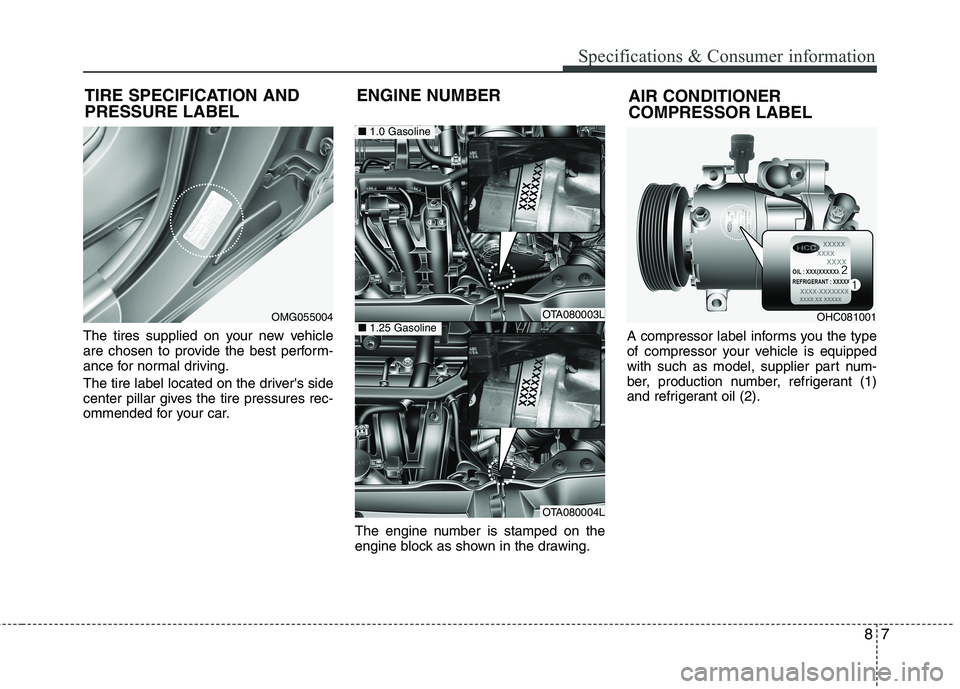
The tires supplied on your new vehicle
are chosen to provide the best perform-
ance for normal driving.
The tire label located on the driver's side
center pillar gives the tire pressures rec-
ommended for your car.The engine number is stamped on the
engine block as shown in the drawing.A compressor label informs you the type
of compressor your vehicle is equipped
with such as model, supplier part num-
ber, production number, refrigerant (1)
and refrigerant oil (2).
TIRE SPECIFICATION AND PRESSURE LABEL
OMG055004
ENGINE NUMBEROTA080003L
OTA080004L
■
1.25 Gasoline
■1.0 Gasoline
AIR CONDITIONER COMPRESSOR LABEL
OHC081001
Page 421 of 846
Index
4
I
Economical operation ....................................................5-38
Electronic power steering ..............................................4-35
Electronic stability program (ESP) ................................5-31
Emergency starting ..........................................................6-5
Jump starting ..............................................................6-5
Push starting ................................................................6-6
Emergency stop signal (ESS) ........................................5-36
Emergency towing ..........................................................6-30
Emergency while driving ..................................................6-3
Emergency commodity ..................................................6-32
Emission control system ................................................7-75 Crankcase emission control system ..........................7-75
Evaporative emission control system ........................7-75
Exhaust emission control system ..............................7-76
Engine compartment..................................................2-4, 7-2
Engine coolant ................................................................7-23
Engine number ..................................................................8-7
Engine oil ........................................................................7-21
Engine overheats ..............................................................6-7
Engine start/stop button ....................................................5-6
Engine will not start..........................................................6-4
Evaporative emission control system..............................7-75
Exhaust emission control system ....................................7-76
Explanation of scheduled maintenance items ................7-18
Exterior care....................................................................7-69 Flat tire ..............................................................................6-8
Changing tires ............................................................6-9
Jack and tools ..............................................................6-8
Removing and storing the spare tire ..........................6-9
Fluid Automatic transaxle fluid ..........................................7-27
Washer fluid ..............................................................7-29
Brake fluid ................................................................7-26
Folding the rear seat........................................................3-11
Front seat adjustment - manual ........................................3-4
Fuel filler lid ..................................................................4-28
Fuel gauge ......................................................................4-44
Fuel requirements ............................................................1-2
Fuses ..............................................................................7-50 Fuse/relay panel description......................................7-54
Instrument panel fuse ................................................7-51
Multi fuse ..................................................................7-53
Memory fuse ............................................................7-52
Gauge Fuel gauge ................................................................4-44
Glassroof, see sunroof ....................................................4-31
Glove box ......................................................................4-102
F
G
E
Page 423 of 846
Index
6
I
Label
Air bag warning label................................................3-61
Tire sidewall labeling ................................................7-46
Tire specification and pressure label ..........................8-7
Vehicle certification label............................................8-6
Light bulbs ......................................................................7-61
Lighting ..........................................................................4-69 Battery saver function ..............................................4-69
Daytime running light ..............................................4-69
Headlight escort function ..........................................4-69
Headlight welcome function ....................................4-69
Lubricants and capacities ................................................8-4 Maintenance Explanation of scheduled maintenance items ..........7-18
Maintenance services ..................................................7-3
Maintenance under severe usage conditions ............7-16 Normal maintenance schedule ....................................7-7
Owner maintenance ....................................................7-4
Scheduled maintenance service ..................................7-6
Tire maintenance ......................................................7-45
Maintenance services ........................................................7-3 Manual climate control system ......................................4-83
Air conditioning ........................................................4-88
Climate control air filter............................................4-90
Heating and air conditioning ....................................4-84
Manual heating and air conditioning ..............................4-94
Manual transaxle ............................................................5-17
Memory fuse ..................................................................7-52
Mirrors ............................................................................4-38 Day/night rearview mirror ........................................4-38
Inside rearview mirror ..............................................4-38
Outside rearview mirror ............................................4-38
Moonroof, see sunroof ....................................................4-31
Multi fuse ........................................................................7-53
Neck restraints, see headrest ....................................3-5, 3-9
Odometer ........................................................................4-45
Oil (Engine) ....................................................................7-21
Outside rearview mirror ..................................................4-38
Overheats ..........................................................................6-7
Owner maintenance ..........................................................7-4
O
M
N
L
Page 434 of 846
15
Introduction
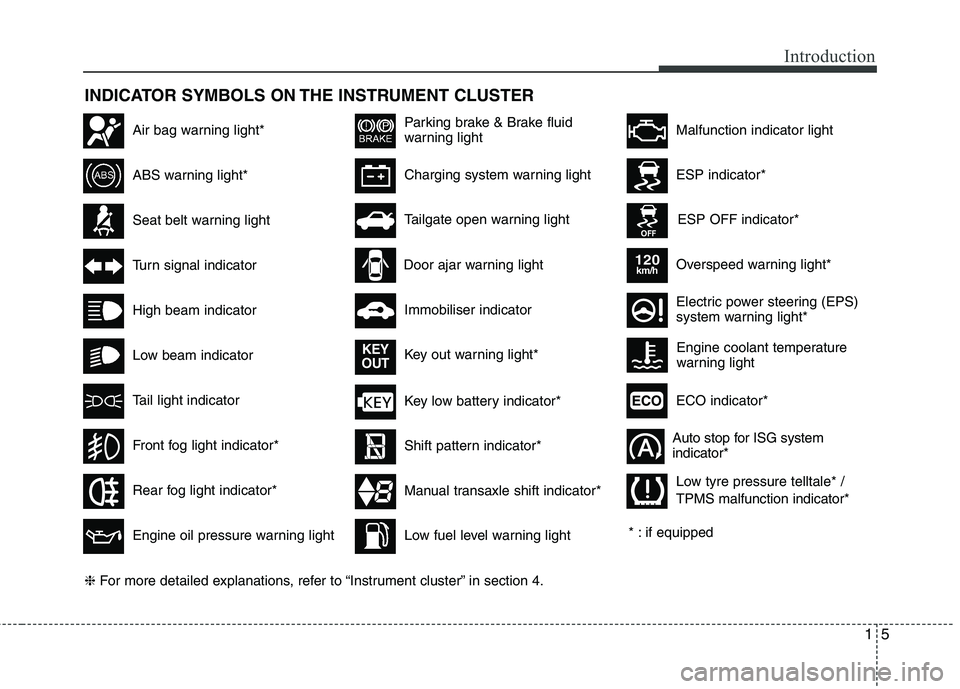
INDICATOR SYMBOLS ON THE INSTRUMENT CLUSTER
Seat belt warning light
High beam indicator
Turn signal indicator
ABS warning light*
Parking brake & Brake fluid
warning light
Engine oil pressure warning light
ESP indicator*
ESP OFF indicator*
Malfunction indicator lightAir bag warning light*
Immobiliser indicator
Low fuel level warning light* : if equipped
Charging system warning light
Overspeed warning light*
120km/h
Tail light indicator
Tailgate open warning light
Front fog light indicator*
Electric power steering (EPS)
system warning light*
Key low battery indicator*
Rear fog light indicator*
Door ajar warning light
Shift pattern indicator*
Manual transaxle shift indicator*
Key out warning light*
KEY
OUT
ECO indicator*ECO
Auto stop for ISG system indicator*
Low beam indicator Engine coolant temperature
warning light
❈
For more detailed explanations, refer to “Instrument cluster” in section 4. Low tyre pressure telltale* / TPMS malfunction indicator*
Page 438 of 846
Your vehicle at a glance
4
2
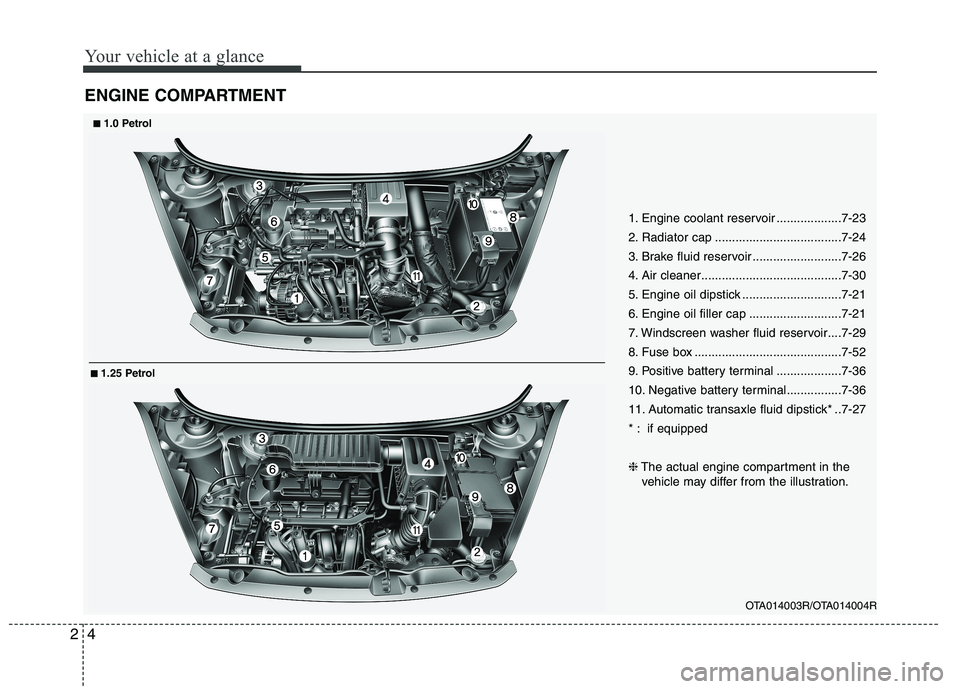
ENGINE COMPARTMENT
OTA014003R/OTA014004R
1. Engine coolant reservoir ...................7-23
2. Radiator cap .....................................7-24
3. Brake fluid reservoir ..........................7-26
4. Air cleaner.........................................7-30
5. Engine oil dipstick .............................7-21
6. Engine oil filler cap ...........................7-21
7. Windscreen washer fluid reservoir....7-29
8. Fuse box ...........................................7-52
9. Positive battery terminal ...................7-36
10. Negative battery terminal................7-36
11. Automatic transaxle fluid dipstick* ..7-27
* : if equipped
■
■
1.0 Petrol
❈The actual engine compartment in the
vehicle may differ from the illustration.
■■ 1.25 Petrol
Page 454 of 846
Safety features of your vehicle
16
3
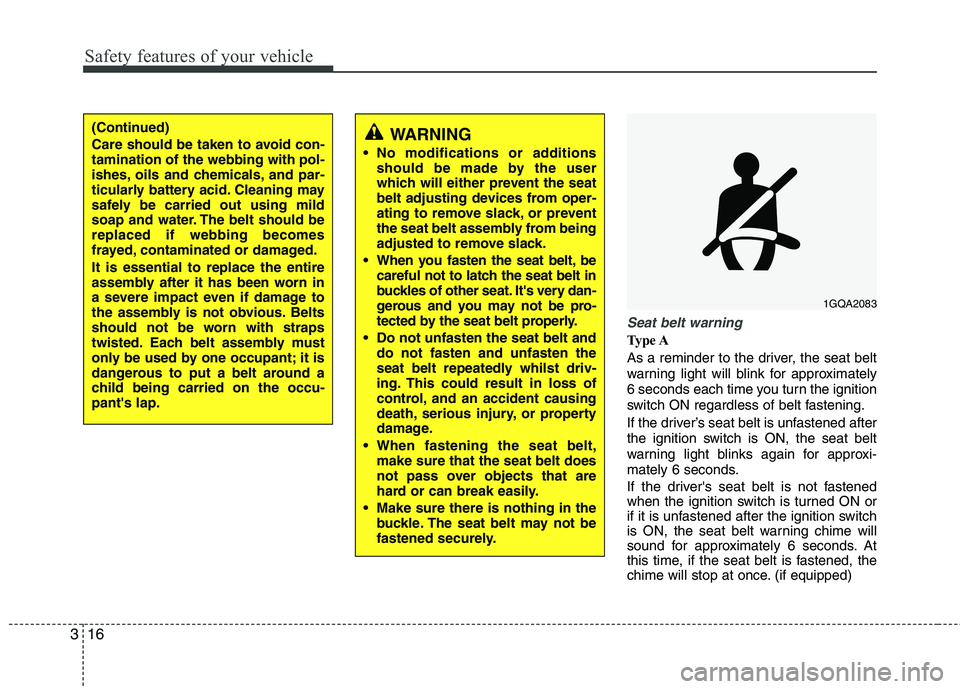
Seat belt warning
Type A
As a reminder to the driver, the seat belt
warning light will blink for approximately
6 seconds each time you turn the ignition
switch ON regardless of belt fastening.
If the driver’s seat belt is unfastened after
the ignition switch is ON, the seat belt
warning light blinks again for approxi-
mately 6 seconds.
If the driver's seat belt is not fastened
when the ignition switch is turned ON or
if it is unfastened after the ignition switch
is ON, the seat belt warning chime will
sound for approximately 6 seconds. At
this time, if the seat belt is fastened, the
chime will stop at once. (if equipped)
1GQA2083
WARNING
No modifications or additions should be made by the user
which will either prevent the seat
belt adjusting devices from oper-
ating to remove slack, or prevent
the seat belt assembly from being
adjusted to remove slack.
When you fasten the seat belt, be careful not to latch the seat belt in
buckles of other seat. It's very dan-
gerous and you may not be pro-
tected by the seat belt properly.
Do not unfasten the seat belt and do not fasten and unfasten the
seat belt repeatedly whilst driv-
ing. This could result in loss of
control, and an accident causing
death, serious injury, or property
damage.
When fastening the seat belt, make sure that the seat belt does
not pass over objects that are
hard or can break easily.
Make sure there is nothing in the buckle. The seat belt may not be
fastened securely.(Continued)
Care should be taken to avoid con- tamination of the webbing with pol-
ishes, oils and chemicals, and par-
ticularly battery acid. Cleaning may
safely be carried out using mild
soap and water. The belt should bereplaced if webbing becomes
frayed, contaminated or damaged. It is essential to replace the entire
assembly after it has been worn in
a severe impact even if damage to
the assembly is not obvious. Belts
should not be worn with straps
twisted. Each belt assembly must
only be used by one occupant; it is
dangerous to put a belt around a
child being carried on the occu-pant's lap.
Page 556 of 846
457
Features of your vehicle
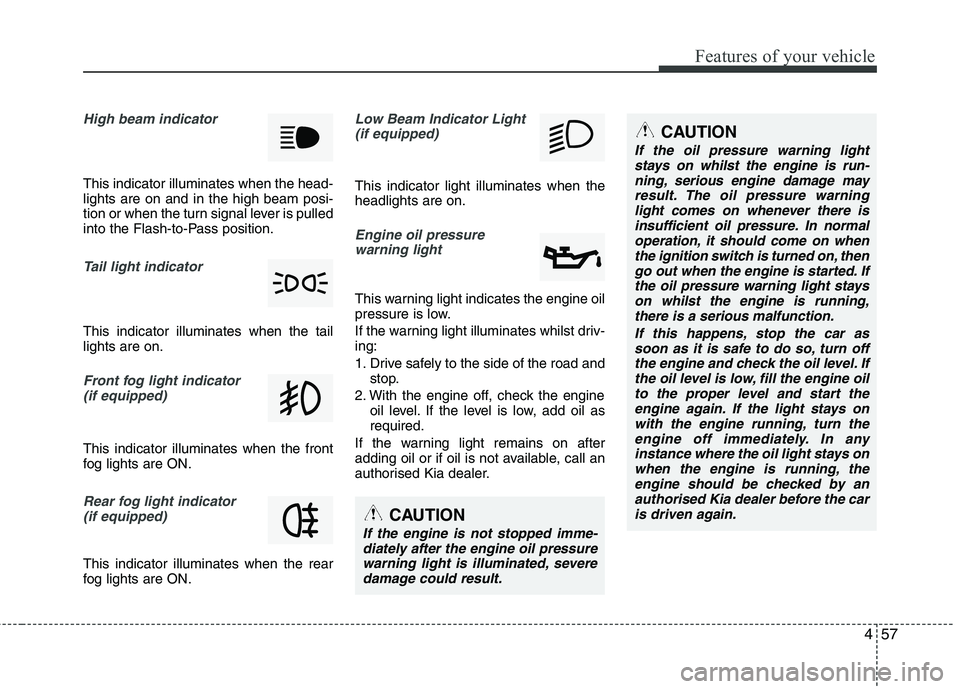
High beam indicator
This indicator illuminates when the head- lights are on and in the high beam posi-
tion or when the turn signal lever is pulled
into the Flash-to-Pass position.
Tail light indicator
This indicator illuminates when the tail lights are on.
Front fog light indicator (if equipped)
This indicator illuminates when the front
fog lights are ON.
Rear fog light indicator (if equipped)
This indicator illuminates when the rear
fog lights are ON.
Low Beam Indicator Light(if equipped)
This indicator light illuminates when the headlights are on.
Engine oil pressure warning light
This warning light indicates the engine oil
pressure is low.
If the warning light illuminates whilst driv- ing:
1. Drive safely to the side of the road and stop.
2. With the engine off, check the engine oil level. If the level is low, add oil as required.
If the warning light remains on after
adding oil or if oil is not available, call an
authorised Kia dealer.
CAUTION
If the engine is not stopped imme- diately after the engine oil pressure warning light is illuminated, severe
damage could result.
CAUTION
If the oil pressure warning light stays on whilst the engine is run-
ning, serious engine damage may result. The oil pressure warninglight comes on whenever there is insufficient oil pressure. In normal
operation, it should come on whenthe ignition switch is turned on, then go out when the engine is started. If
the oil pressure warning light stays on whilst the engine is running,there is a serious malfunction.
If this happens, stop the car assoon as it is safe to do so, turn off
the engine and check the oil level. Ifthe oil level is low, fill the engine oil to the proper level and start theengine again. If the light stays on
with the engine running, turn theengine off immediately. In anyinstance where the oil light stays on when the engine is running, the
engine should be checked by anauthorised Kia dealer before the car is driven again.
Page 588 of 846
489
Features of your vehicle
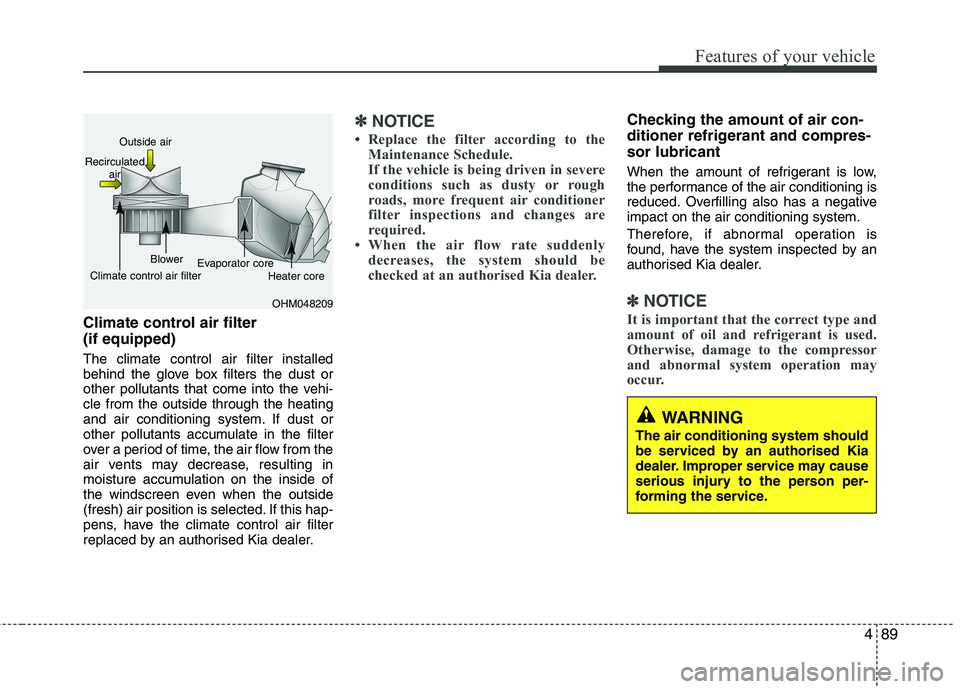
Climate control air filter (if equipped) The climate control air filter installed
behind the glove box filters the dust or
other pollutants that come into the vehi-cle from the outside through the heating
and air conditioning system. If dust or
other pollutants accumulate in the filter
over a period of time, the air flow from the
air vents may decrease, resulting in
moisture accumulation on the inside of
the windscreen even when the outside
(fresh) air position is selected. If this hap-
pens, have the climate control air filter
replaced by an authorised Kia dealer.
✽✽NOTICE
Replace the filter according to the Maintenance Schedule.
If the vehicle is being driven in severe
conditions such as dusty or rough
roads, more frequent air conditioner
filter inspections and changes are
required.
When the air flow rate suddenly
decreases, the system should be
checked at an authorised Kia dealer.Checking the amount of air con-
ditioner refrigerant and compres-sor lubricant
When the amount of refrigerant is low,
the performance of the air conditioning is
reduced. Overfilling also has a negativeimpact on the air conditioning system.
Therefore, if abnormal operation is
found, have the system inspected by an
authorised Kia dealer.
✽✽ NOTICE
It is important that the correct type and
amount of oil and refrigerant is used.
Otherwise, damage to the compressor
and abnormal system operation may
occur.
WARNING
The air conditioning system should
be serviced by an authorised Kia
dealer. Improper service may cause
serious injury to the person per-
forming the service.
OHM048209
Outside air
Recirculated air
Climate control air filter Blower
Evaporator core
Heater core
Page 669 of 846
Driving your vehicle
2
5
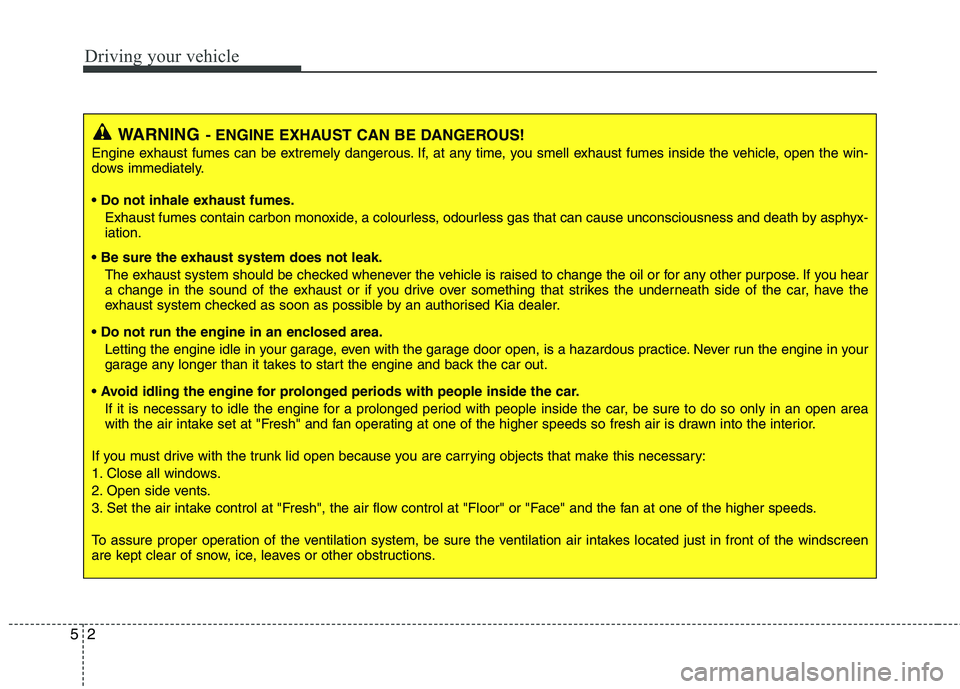
WARNING - ENGINE EXHAUST CAN BE DANGEROUS!
Engine exhaust fumes can be extremely dangerous. If, at any time, you smell exhaust fumes inside the vehicle, open the win-
dows immediately.
• Do not inhale exhaust fumes.
Exhaust fumes contain carbon monoxide, a colourless, odourless gas that can cause unconsciousness and death by asphyx- iation.
The exhaust system should be checked whenever the vehicle is raised to change the oil or for any other purpose. If you hear
a change in the sound of the exhaust or if you drive over something that strikes the underneath side of the car, have the
exhaust system checked as soon as possible by an authorised Kia dealer.
Letting the engine idle in your garage, even with the garage door open, is a hazardous practice. Never run the engine in your
garage any longer than it takes to start the engine and back the car out.
If it is necessary to idle the engine for a prolonged period with people inside the car, be sure to do so only in an open area
with the air intake set at "Fresh" and fan operating at one of the higher speeds so fresh air is drawn into the interior.
If you must drive with the trunk lid open because you are carrying objects that make this necessary:
1. Close all windows.
2. Open side vents.
3. Set the air intake control at "Fresh", the air flow control at "Floor" or "Face" and the fan at one of the higher speeds.
To assure proper operation of the ventilation system, be sure the ventilation air intakes located just in front of the windscre en
are kept clear of snow, ice, leaves or other obstructions.
Page 670 of 846
53
Driving your vehicle
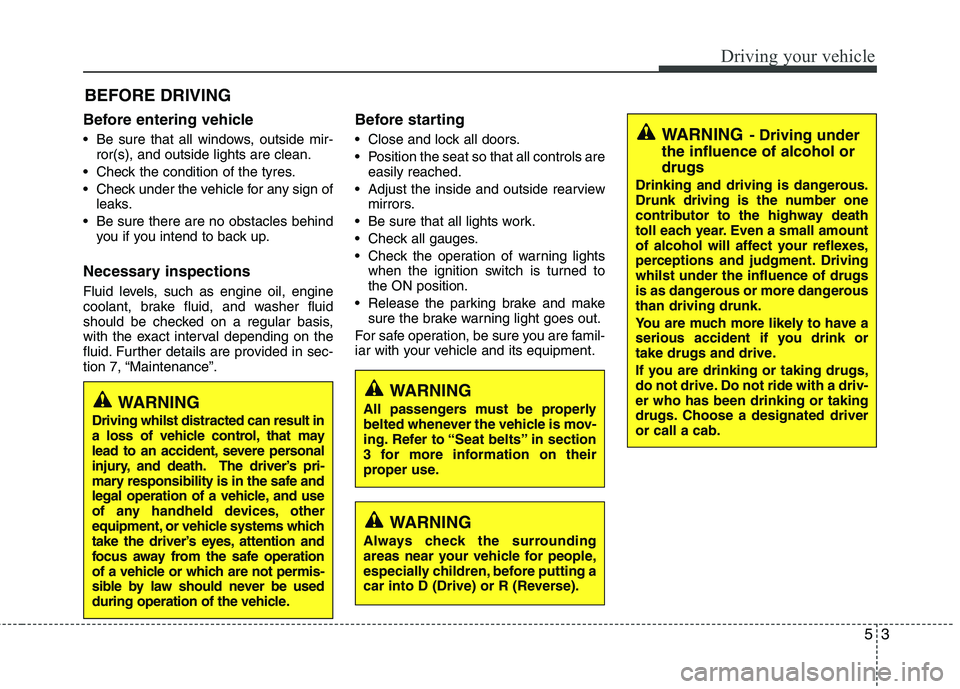
Before entering vehicle
• Be sure that all windows, outside mir-ror(s), and outside lights are clean.
Check the condition of the tyres.
Check under the vehicle for any sign of leaks.
Be sure there are no obstacles behind you if you intend to back up.
Necessary inspections
Fluid levels, such as engine oil, engine
coolant, brake fluid, and washer fluid
should be checked on a regular basis,
with the exact interval depending on the
fluid. Further details are provided in sec-
tion 7, “Maintenance”. Before starting
Close and lock all doors.
Position the seat so that all controls are
easily reached.
Adjust the inside and outside rearview mirrors.
Be sure that all lights work.
Check all gauges.
Check the operation of warning lights when the ignition switch is turned to the ON position.
Release the parking brake and make sure the brake warning light goes out.
For safe operation, be sure you are famil-
iar with your vehicle and its equipment.
BEFORE DRIVING
WARNING
All passengers must be properly
belted whenever the vehicle is mov-
ing. Refer to “Seat belts” in section
3 for more information on their
proper use.
WARNING
Always check the surrounding
areas near your vehicle for people,
especially children, before putting a
car into D (Drive) or R (Reverse).
WARNING - Driving under
the influence of alcohol or drugs
Drinking and driving is dangerous.
Drunk driving is the number one
contributor to the highway death
toll each year. Even a small amount
of alcohol will affect your reflexes,
perceptions and judgment. Drivingwhilst under the influence of drugs
is as dangerous or more dangerousthan driving drunk.
You are much more likely to have a
serious accident if you drink or
take drugs and drive.
If you are drinking or taking drugs,
do not drive. Do not ride with a driv-er who has been drinking or taking
drugs. Choose a designated driveror call a cab.
WARNING
Driving whilst distracted can result in
a loss of vehicle control, that may
lead to an accident, severe personal
injury, and death. The driver’s pri-
mary responsibility is in the safe and
legal operation of a vehicle, and use
of any handheld devices, other
equipment, or vehicle systems which
take the driver’s eyes, attention and
focus away from the safe operation
of a vehicle or which are not permis-
sible by law should never be used
during operation of the vehicle.