key KIA PICANTO 2015 Workshop Manual
[x] Cancel search | Manufacturer: KIA, Model Year: 2015, Model line: PICANTO, Model: KIA PICANTO 2015Pages: 846, PDF Size: 49.67 MB
Page 422 of 846
I5
Index
Hazard warning flasher ..................................................4-68
Hazardous driving conditions ........................................5-40
Headlight escort function................................................4-69
Headlight leveling device................................................4-75
Headlight welcome function ..........................................4-69
Headrest ....................................................................3-5, 3-9
Heating and air conditioning ..........................................4-84
Highway driving ............................................................5-43
Hill-start assist control (HAC) ........................................5-35
Hood................................................................................4-26
Horn ................................................................................4-37
How to use this manual ....................................................1-2
Idle stop and go (ISG) system ........................................5-12
Immobilizer system ..........................................................4-4
Indicators and warnings ..................................................4-55
Indicator symbols on the instrument cluster ....................1-5
Inside rearview mirror ....................................................4-38
Instrument cluster ..........................................................4-42
Fuel gauge ................................................................4-44
Odometer ..................................................................4-45
Speedometer ..............................................................4-43
Tachometer ................................................................4-43 Trip computer ............................................................4-44
Warning and indicators ............................................4-55
Instrument panel overview................................................2-3
Interior care ....................................................................7-74
Interior features ............................................................4-103 Ashtray ....................................................................4-103
Cigarette lighter ......................................................4-103
Clothes hanger ........................................................4-108
Cup holder ..............................................................4-104
Digital clock ............................................................4-106
Floor mat anchor(s) ················································4-108
Power outlet ............................................................4-106
Sunvisor ..................................................................4-105
Vanity mirror lamp ..................................................4-105
Interior light ....................................................................4-79
Interior overview ..............................................................2-2
Jack and tools....................................................................6-8
Jump starting ....................................................................6-5
Key positions ....................................................................5-4
Keys ..................................................................................4-3
H
I
K
J
Page 424 of 846
I7
Index
Parking brake ..................................................................5-27
Passenger's front air bag ................................................3-46
Power brakes ..................................................................5-26
Power outlet ..................................................................4-106
Power steering (Electronic) ............................................4-35
Power window lock button ............................................4-24
Pre-tensioner seat belt ....................................................3-22
Push starting......................................................................6-6
Rear seat..........................................................................3-10
Rear parking assist system ..............................................4-65Recommended cold tire inflation pressures....................7-40
Recommended lubricants and capacities ..........................8-4
Recommended SAE viscosity number........................8-5
Remote keyless entry ........................................................4-6
Road warning ....................................................................6-2
Rocking the vehicle ........................................................5-40 Scheduled maintenance service ........................................7-6
Maintenance under severe usage conditions ............7-16Normal maintenance schedule ....................................7-7
Seat belts ........................................................................3-15 Pre-tensioner seat belt ..............................................3-22
Lap belt......................................................................3-20
Lap/shoulder belt ......................................................3-18
Seat belt warning ......................................................3-16
Seatback pocket ................................................................3-8
Seats ..................................................................................3-2 Headrest ..............................................................3-5, 3-9
Folding the rear seat ..................................................3-11
Front seat adjustment - manual ..................................3-4
Rear seat ....................................................................3-10
Seatback pocket ..........................................................3-8
Shift lock system ............................................................5-23
Side air bag ....................................................................3-51
Smart key ..........................................................................4-9
Smooth cornering............................................................5-41
Snow tires........................................................................5-44Spare tire Removing and storing the spare tire ..........................6-9
P
R
S
Page 434 of 846
15
Introduction
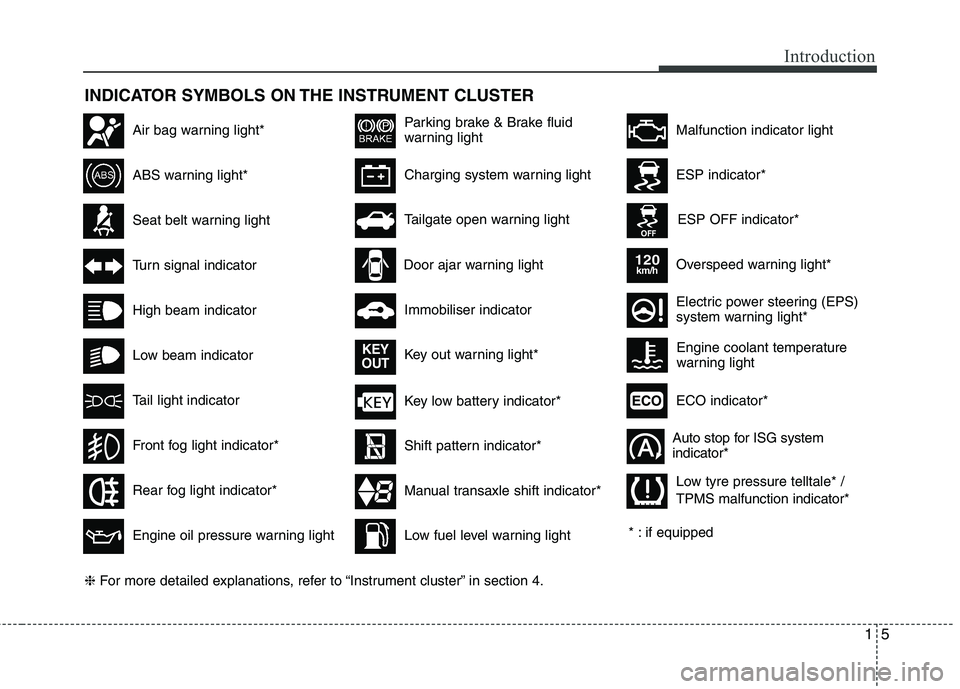
INDICATOR SYMBOLS ON THE INSTRUMENT CLUSTER
Seat belt warning light
High beam indicator
Turn signal indicator
ABS warning light*
Parking brake & Brake fluid
warning light
Engine oil pressure warning light
ESP indicator*
ESP OFF indicator*
Malfunction indicator lightAir bag warning light*
Immobiliser indicator
Low fuel level warning light* : if equipped
Charging system warning light
Overspeed warning light*
120km/h
Tail light indicator
Tailgate open warning light
Front fog light indicator*
Electric power steering (EPS)
system warning light*
Key low battery indicator*
Rear fog light indicator*
Door ajar warning light
Shift pattern indicator*
Manual transaxle shift indicator*
Key out warning light*
KEY
OUT
ECO indicator*ECO
Auto stop for ISG system indicator*
Low beam indicator Engine coolant temperature
warning light
❈
For more detailed explanations, refer to “Instrument cluster” in section 4. Low tyre pressure telltale* / TPMS malfunction indicator*
Page 483 of 846
345
Safety features of your vehicle
WARNING
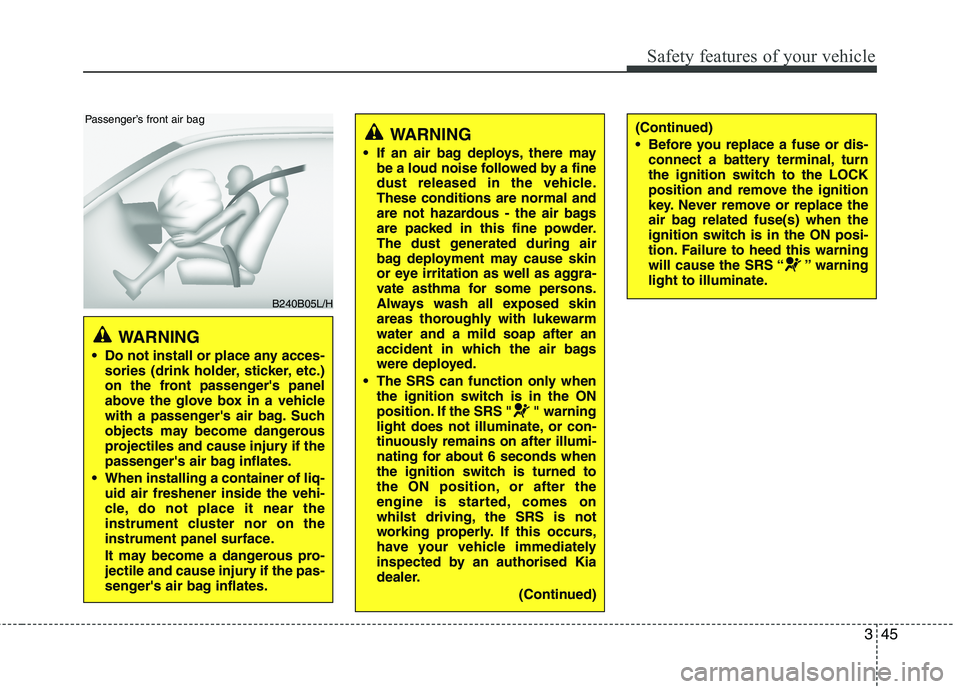
Do not install or place any acces- sories (drink holder, sticker, etc.)
on the front passenger's panel
above the glove box in a vehicle
with a passenger's air bag. Such
objects may become dangerous
projectiles and cause injury if the
passenger's air bag inflates.
When installing a container of liq- uid air freshener inside the vehi-
cle, do not place it near the
instrument cluster nor on the
instrument panel surface.
It may become a dangerous pro-
jectile and cause injury if the pas-
senger's air bag inflates.
B240B05L/H
Passenger’s front air bag
WARNING
If an air bag deploys, there may be a loud noise followed by a fine
dust released in the vehicle.These conditions are normal and
are not hazardous - the air bags
are packed in this fine powder.
The dust generated during air
bag deployment may cause skin
or eye irritation as well as aggra-
vate asthma for some persons.
Always wash all exposed skin
areas thoroughly with lukewarmwater and a mild soap after an
accident in which the air bags
were deployed.
The SRS can function only when the ignition switch is in the ON
position. If the SRS " " warning
light does not illuminate, or con-
tinuously remains on after illumi-
nating for about 6 seconds when
the ignition switch is turned to
the ON position, or after the
engine is started, comes on
whilst driving, the SRS is not
working properly. If this occurs,
have your vehicle immediately
inspected by an authorised Kia
dealer.
(Continued)(Continued)
Before you replace a fuse or dis-connect a battery terminal, turn
the ignition switch to the LOCK
position and remove the ignition
key. Never remove or replace the
air bag related fuse(s) when the
ignition switch is in the ON posi-
tion. Failure to heed this warning
will cause the SRS “ ” warning
light to illuminate.
Page 486 of 846
Safety features of your vehicle
48
3
(Continued)
Children age 12 and under must
always be properly restrained in
the rear seat. Never allow chil-
dren to ride in the front passen-
ger seat. If a child over 12 must
be seated in the front seat, he or
she must be properly belted and
the seat should be moved as far
back as possible.
For maximum safety protection in all types of crashes, all occu-
pants including the driver should
always wear their seat belts
whether or not an air bag is also
provided at their seating position
to minimise the risk of severe
injury or death in the event of a
crash. Do not sit or lean unneces-
sarily close to the air bag whilst
the vehicle is in motion.
(Continued)(Continued)
The SRS is designed to deploythe front air bags only when an
impact is sufficiently severe andwhen the impact angle is less
than 30° from the forward longitu-
dinal axis of the vehicle.
Additionally, the air bags will only
deploy once. Seat belts must be
worn at all times.
Front air bags are not intended to deploy in side-impact, rear-
impact or rollover crashes. In
addition, front air bags will not
deploy in frontal crashes below
the deployment threshold.
A child restraint system must never be placed in the front seat.
The infant or child could be
severely injured or killed by an air
bag deployment in case of anaccident.
(Continued)(Continued)
Sitting improperly or out of posi-tion can result in serious or fatal
injury in a crash. All occupantsshould sit upright with the seat
back in an upright position, cen-tred on the seat cushion with
their seat belt on, legs comfort-
ably extended and their feet on
the floor until the vehicle is
parked and the ignition key is
removed.
The SRS air bag system must deploy very rapidly to provide
protection in a crash. If an occu-pant is out of position because of
not wearing a seat belt, the air
bag may forcefully contact theoccupant causing serious or fatalinjuries.
Page 487 of 846
349
Safety features of your vehicle
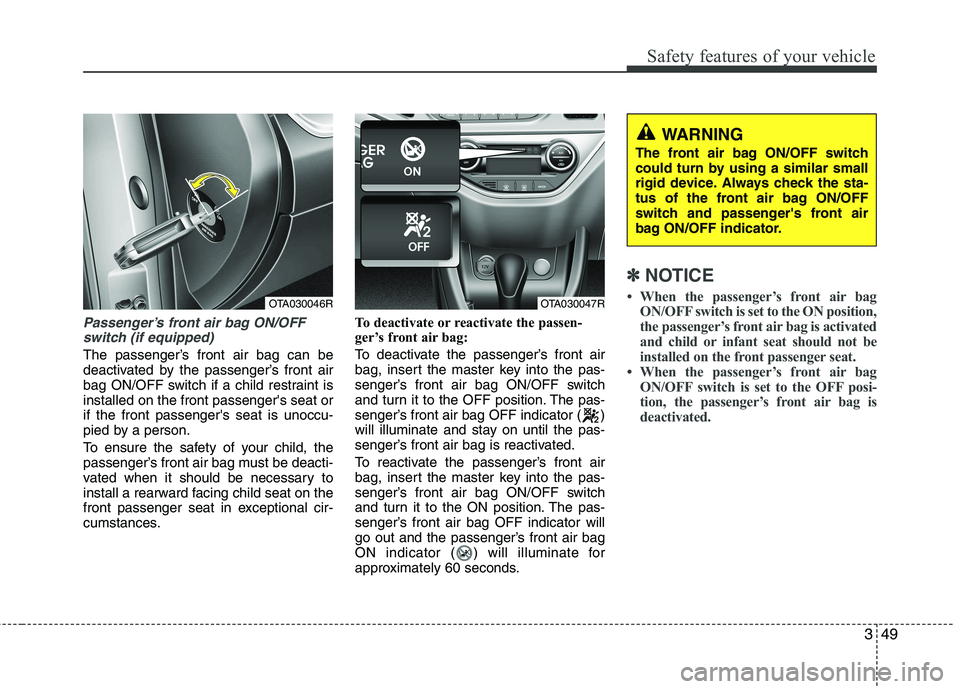
Passenger’s front air bag ON/OFFswitch (if equipped)
The passenger’s front air bag can be
deactivated by the passenger’s front air
bag ON/OFF switch if a child restraint isinstalled on the front passenger's seat orif the front passenger's seat is unoccu-
pied by a person.
To ensure the safety of your child, the
passenger’s front air bag must be deacti-
vated when it should be necessary to
install a rearward facing child seat on the
front passenger seat in exceptional cir-
cumstances. To deactivate or reactivate the passen-
ger’s front air bag:
To deactivate the passenger’s front air
bag, insert the master key into the pas-
senger’s front air bag ON/OFF switch
and turn it to the OFF position. The pas-
senger’s front air bag OFF indicator ( )
will illuminate and stay on until the pas-
senger’s front air bag is reactivated.
To reactivate the passenger’s front air
bag, insert the master key into the pas-
senger’s front air bag ON/OFF switch
and turn it to the ON position. The pas-
senger’s front air bag OFF indicator will
go out and the passenger’s front air bag
ON indicator ( ) will illuminate for
approximately 60 seconds.
✽✽
NOTICE
When the passenger’s front air bag
ON/OFF switch is set to the ON position,
the passenger’s front air bag is activated
and child or infant seat should not be
installed on the front passenger seat.
When the passenger’s front air bag
ON/OFF switch is set to the OFF posi-
tion, the passenger’s front air bag is
deactivated.OTA030046ROTA030047R
WARNING
The front air bag ON/OFF switch
could turn by using a similar small
rigid device. Always check the sta-
tus of the front air bag ON/OFF
switch and passenger's front air
bag ON/OFF indicator.
Page 500 of 846
4
Keys / 4-3
Remote keyless entry / 4-6
Smart key / 4-9
Theft-alarm system / 4-11
Door locks / 4-14
Tailgate / 4-18
Windows / 4-20
Bonnet / 4-25
Fuel filler lid / 4-27
Sunroof / 4-30
Steering wheel / 4-34
Mirrors / 4-37
Instrument cluster / 4-41
Rear parking assist system / 4-63
Hazard warning flasher / 4-66
Lighting / 4-67
Wipers and washers / 4-74
Interior light / 4-78
Defroster / 4-80
Manual climate control system / 4-81
Automatic climate control system / 4-90
Windscreen defrosting and defogging / 4-97
Features of your vehicle
Page 502 of 846
43
Features of your vehicle
Record your key numberThe key code number is
stamped on the key code
tag attached to the key
set. Should you lose your
keys, we recommend
that you contact an authorised Kia dealer.
Remove the key code tag and store it in
a safe place. Also, record the key code
number and keep it in a safe place (not in
the vehicle).
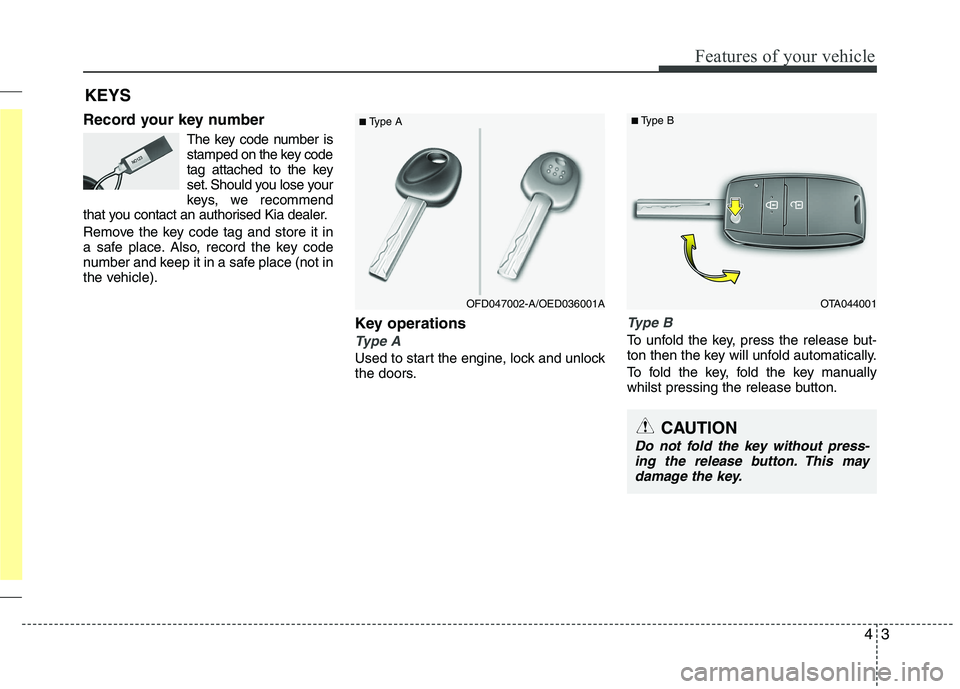
Key operations
Type A
Used to start the engine, lock and unlock
the doors.
Type B
To unfold the key, press the release but-
ton then the key will unfold automatically.
To fold the key, fold the key manually
whilst pressing the release button.
KEYS
■
Type A
CAUTION
Do not fold the key without press-
ing the release button. This may
damage the key.
OTA044001
■ Type B
OFD047002-A/OED036001A
Page 503 of 846
Features of your vehicle
4
4
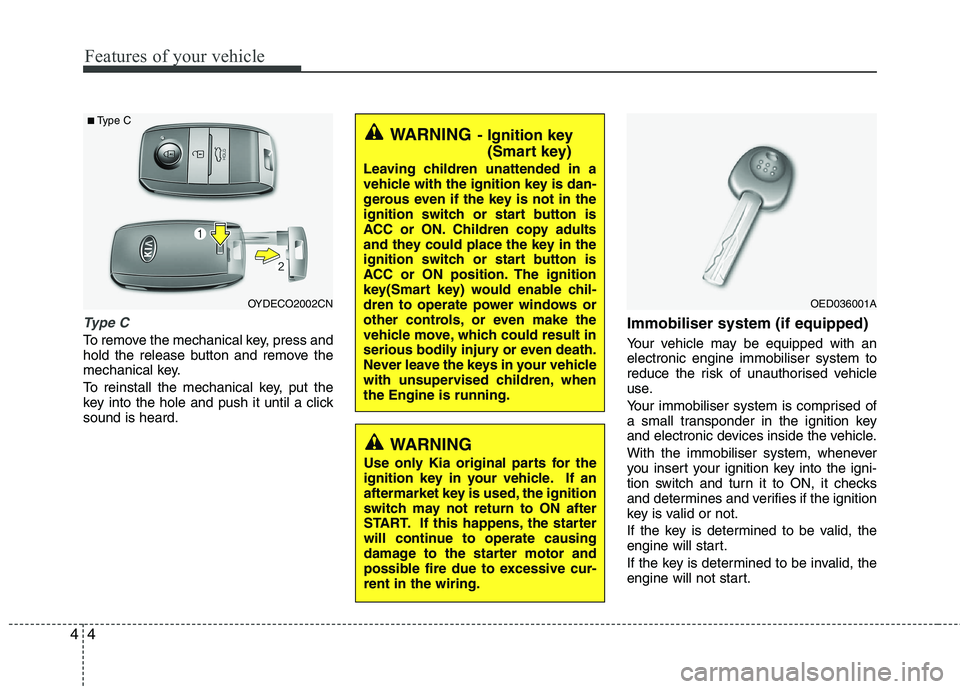
Type C
To remove the mechanical key, press and
hold the release button and remove the
mechanical key.
To reinstall the mechanical key, put the
key into the hole and push it until a clicksound is heard. Immobiliser system (if equipped)
Your vehicle may be equipped with an electronic engine immobiliser system to
reduce the risk of unauthorised vehicle
use.
Your immobiliser system is comprised of
a small transponder in the ignition key
and electronic devices inside the vehicle.
With the immobiliser system, whenever
you insert your ignition key into the igni-
tion switch and turn it to ON, it checks
and determines and verifies if the ignition
key is valid or not.
If the key is determined to be valid, the
engine will start.
If the key is determined to be invalid, the
engine will not start.
WARNING
- Ignition key
(Smart key)
Leaving children unattended in a
vehicle with the ignition key is dan-
gerous even if the key is not in the
ignition switch or start button is
ACC or ON. Children copy adults
and they could place the key in the
ignition switch or start button is
ACC or ON position. The ignition
key(Smart key) would enable chil-
dren to operate power windows or
other controls, or even make the
vehicle move, which could result in
serious bodily injury or even death.
Never leave the keys in your vehicle
with unsupervised children, whenthe Engine is running.
WARNING
Use only Kia original parts for the
ignition key in your vehicle. If an
aftermarket key is used, the ignition
switch may not return to ON after
START. If this happens, the starter
will continue to operate causing
damage to the starter motor and
possible fire due to excessive cur-rent in the wiring.
OYDECO2002CN
■ Type C
OED036001A
Page 504 of 846
45
Features of your vehicle
To activate the immobiliser system:
Turn the ignition key to the OFF position.
The immobiliser system activates auto-
matically. Without a valid ignition key for
your vehicle, the engine will not start.
To deactivate the immobiliser sys-tem:
Insert the ignition key into the key cylin-
der and turn it to the ON position.
✽✽ NOTICE
When starting the engine, do not use the
key with other immobiliser keys around.
Otherwise the engine may not start or
may stop soon after it starts. Keep each
key separate in order to avoid a starting
malfunction. ✽
✽
NOTICE
If you need additional keys or lose your
keys, consult an authorised Kia dealer.
WARNING
In order to prevent theft of your vehi-
cle, do not leave spare keys any-
where in your vehicle. Your immo-
biliser password is a customer
unique password and should be kept
confidential. Do not leave this num-
ber anywhere in your vehicle.
CAUTION
The transponder in your ignition key is an important part of theimmobiliser system. It is designedto give years of trouble-free service,
however you should avoid expo-sure to moisture, static electricity and rough handling. Immobilisersystem malfunction could occur.
CAUTION
Do not put metal accessories near the ignition switch. Metal acces-
sories may interrupt the transpon-der signal and may prevent theengine from being started.
CAUTION
Do not change, alter or adjust the immobiliser system because it
could cause the immobiliser sys- tem to malfunction and should onlybe serviced by an authorised Kiadealer.
Malfunctions caused by improperalterations, adjustments or modifi-cations to the immobiliser system are not covered by your vehicle
manufacturer warranty.