battery KIA PICANTO 2015 Repair Manual
[x] Cancel search | Manufacturer: KIA, Model Year: 2015, Model line: PICANTO, Model: KIA PICANTO 2015Pages: 846, PDF Size: 49.67 MB
Page 382 of 846
Maintenance
50
7
FUSES
A vehicle’s electrical system is protected
from electrical overload damage by fuses.
This vehicle has 2 fuse panels, one locat-
ed in the driver’s side panel bolster, oth-
ers in the engine compartment near the
battery.
If any of your vehicle’s lights, acces-
sories, or controls do not work, check the
appropriate circuit fuse. If a fuse has
blown, the element inside the fuse will bemelted.
If the electrical system does not work,
first check the driver’s side fuse panel.
Always replace a blown fuse with one of
the same rating.
Before replacing a blown fuse, move to
safe place, turn off the engine and all
electric devices, and disconnect the neg-
ative battery cable.
If the replacement fuse blows, this indi-
cates an electrical problem. Avoid using
the system involved and we recommend
that you consult an authorized Kia dealer.
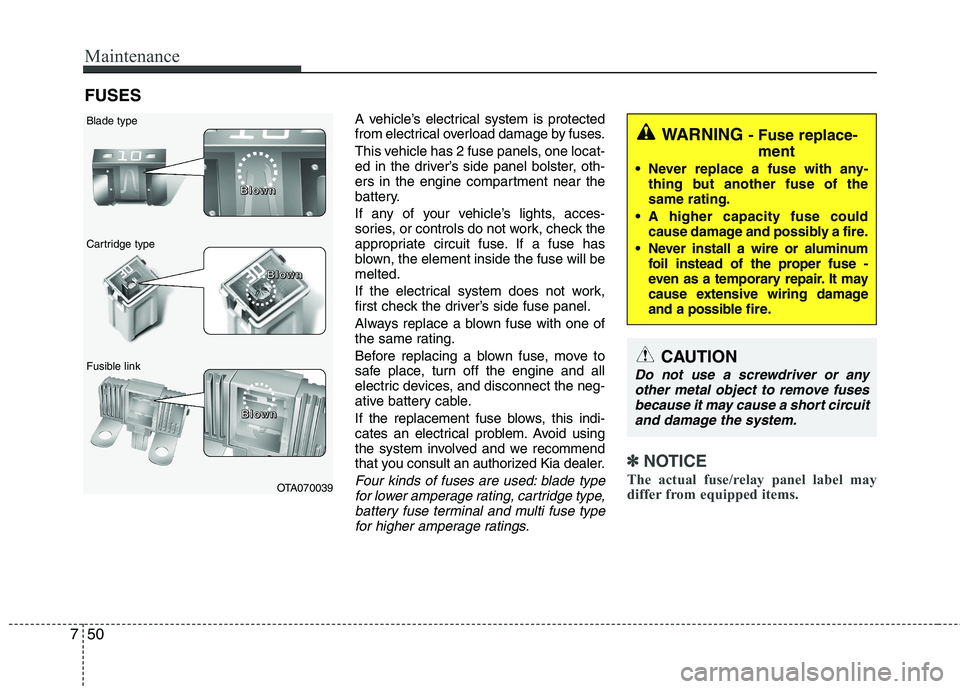
Four kinds of fuses are used: blade typefor lower amperage rating, cartridge type,battery fuse terminal and multi fuse typefor higher amperage ratings.
✽✽ NOTICE
The actual fuse/relay panel label may
differ from equipped items.
WARNING - Fuse replace-
ment
Never replace a fuse with any- thing but another fuse of the same rating.
A higher capacity fuse could cause damage and possibly a fire.
Never install a wire or aluminum foil instead of the proper fuse -
even as a temporary repair. It may
cause extensive wiring damage
and a possible fire.
CAUTION
Do not use a screwdriver or any
other metal object to remove fuses
because it may cause a short circuitand damage the system.
OTA070039
Blade type
Cartridge type
Fusible link
BBBBlllloooowwwwnnnn
BBBBlllloooowwwwnnnn
BBBBlllloooowwwwnnnn
Page 384 of 846
Maintenance
52
7
If you do not have a spare, use a fuse of
the same rating from a circuit you maynot need for operating the vehicle, suchas the cigarette lighter fuse.
If the headlights or other electrical com-
ponents do not work and the fuses are
OK, check the fuse panel in the engine
compartment. If a fuse is blown, it mustbe replaced.
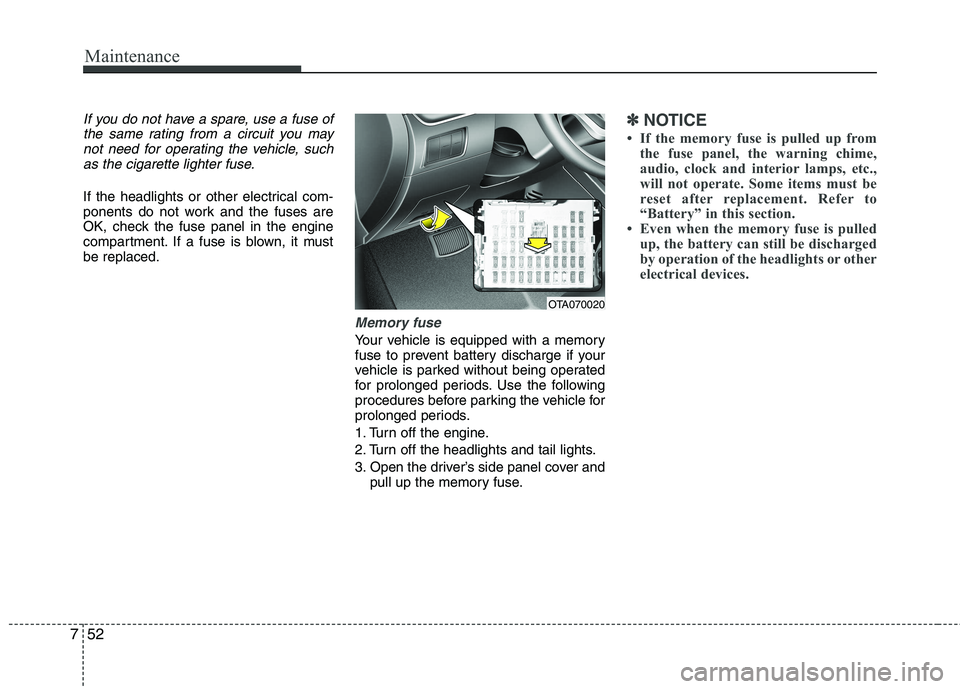
Memory fuse
Your vehicle is equipped with a memory
fuse to prevent battery discharge if your
vehicle is parked without being operated
for prolonged periods. Use the following
procedures before parking the vehicle for
prolonged periods.
1. Turn off the engine.
2. Turn off the headlights and tail lights.
3. Open the driver’s side panel cover and pull up the memory fuse.
✽✽ NOTICE
If the memory fuse is pulled up from the fuse panel, the warning chime,
audio, clock and interior lamps, etc.,
will not operate. Some items must be
reset after replacement. Refer to
“Battery” in this section.
Even when the memory fuse is pulled
up, the battery can still be discharged
by operation of the headlights or other
electrical devices.
OTA070020
Page 419 of 846
Index
2
I
Air bags..........................................................................3-39
Air bag warning label ..............................................3-61
Air bag warning light ..............................................3-42
Curtain air bag..........................................................3-52
Driver's and passenger's front air bag ......................3-46
Side air bag ..............................................................3-51
Air cleaner ....................................................................7-30
Air conditioner compressor label ....................................8-7
Antenna ........................................................................4-109
Anti-lock brake system (ABS) ......................................5-29
Appearance care ............................................................7-69 Exterior care ............................................................7-69
Interior care ..............................................................7-74
Ashtray ........................................................................4-103
Audio system ..............................................................4-109 Antenna ..................................................................4-109
Aux, USB and iPod................................................4-111
Steering wheel audio control ................................4-110
Automatic climate control system ................................4-92 Air conditioning ......................................................4-97
Automatic heating and air conditioning ..................4-93
Manual heating and air conditioning ......................4-94
Automatic transaxle ......................................................5-20 Shift lock system ......................................................5-23 Base curb weight ..........................................................5-56
Battery............................................................................7-36
Battery saver function ....................................................4-69
Before driving ..................................................................5-3
Bottle holders, see cup holders ....................................4-104
Brake system..................................................................5-26
Anti-lock brake system (ABS) ................................5-29
Electronic stability program (ESP) ..........................5-31
Hill-start assist control (HAC) ................................5-35
Emergency Stop Signal (ESS) ................................5-36
Parking brake ..........................................................5-27
Power brakes ............................................................5-26
Vehicle stability management (VSM) ......................5-35
Brake fluid ....................................................................7-26
Bulb replacement ..........................................................7-61
Bulb wattage ....................................................................8-2
Button start/stop, see engine start/stop button ................5-6
Capacities (Lubricants) ....................................................8-4 Care Exterior care ..............................................................7-69
Interior care ..............................................................7-74
Tire care ....................................................................7-40
AB
C
Page 423 of 846
Index
6
I
Label
Air bag warning label................................................3-61
Tire sidewall labeling ................................................7-46
Tire specification and pressure label ..........................8-7
Vehicle certification label............................................8-6
Light bulbs ......................................................................7-61
Lighting ..........................................................................4-69 Battery saver function ..............................................4-69
Daytime running light ..............................................4-69
Headlight escort function ..........................................4-69
Headlight welcome function ....................................4-69
Lubricants and capacities ................................................8-4 Maintenance Explanation of scheduled maintenance items ..........7-18
Maintenance services ..................................................7-3
Maintenance under severe usage conditions ............7-16 Normal maintenance schedule ....................................7-7
Owner maintenance ....................................................7-4
Scheduled maintenance service ..................................7-6
Tire maintenance ......................................................7-45
Maintenance services ........................................................7-3 Manual climate control system ......................................4-83
Air conditioning ........................................................4-88
Climate control air filter............................................4-90
Heating and air conditioning ....................................4-84
Manual heating and air conditioning ..............................4-94
Manual transaxle ............................................................5-17
Memory fuse ..................................................................7-52
Mirrors ............................................................................4-38 Day/night rearview mirror ........................................4-38
Inside rearview mirror ..............................................4-38
Outside rearview mirror ............................................4-38
Moonroof, see sunroof ....................................................4-31
Multi fuse ........................................................................7-53
Neck restraints, see headrest ....................................3-5, 3-9
Odometer ........................................................................4-45
Oil (Engine) ....................................................................7-21
Outside rearview mirror ..................................................4-38
Overheats ..........................................................................6-7
Owner maintenance ..........................................................7-4
O
M
N
L
Page 434 of 846
15
Introduction
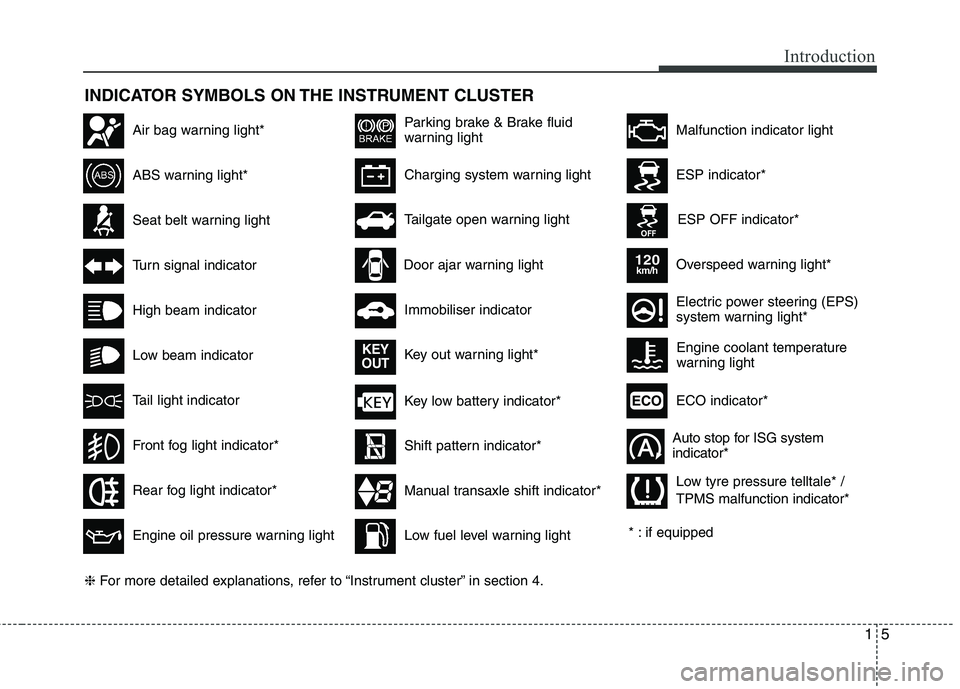
INDICATOR SYMBOLS ON THE INSTRUMENT CLUSTER
Seat belt warning light
High beam indicator
Turn signal indicator
ABS warning light*
Parking brake & Brake fluid
warning light
Engine oil pressure warning light
ESP indicator*
ESP OFF indicator*
Malfunction indicator lightAir bag warning light*
Immobiliser indicator
Low fuel level warning light* : if equipped
Charging system warning light
Overspeed warning light*
120km/h
Tail light indicator
Tailgate open warning light
Front fog light indicator*
Electric power steering (EPS)
system warning light*
Key low battery indicator*
Rear fog light indicator*
Door ajar warning light
Shift pattern indicator*
Manual transaxle shift indicator*
Key out warning light*
KEY
OUT
ECO indicator*ECO
Auto stop for ISG system indicator*
Low beam indicator Engine coolant temperature
warning light
❈
For more detailed explanations, refer to “Instrument cluster” in section 4. Low tyre pressure telltale* / TPMS malfunction indicator*
Page 438 of 846
Your vehicle at a glance
4
2
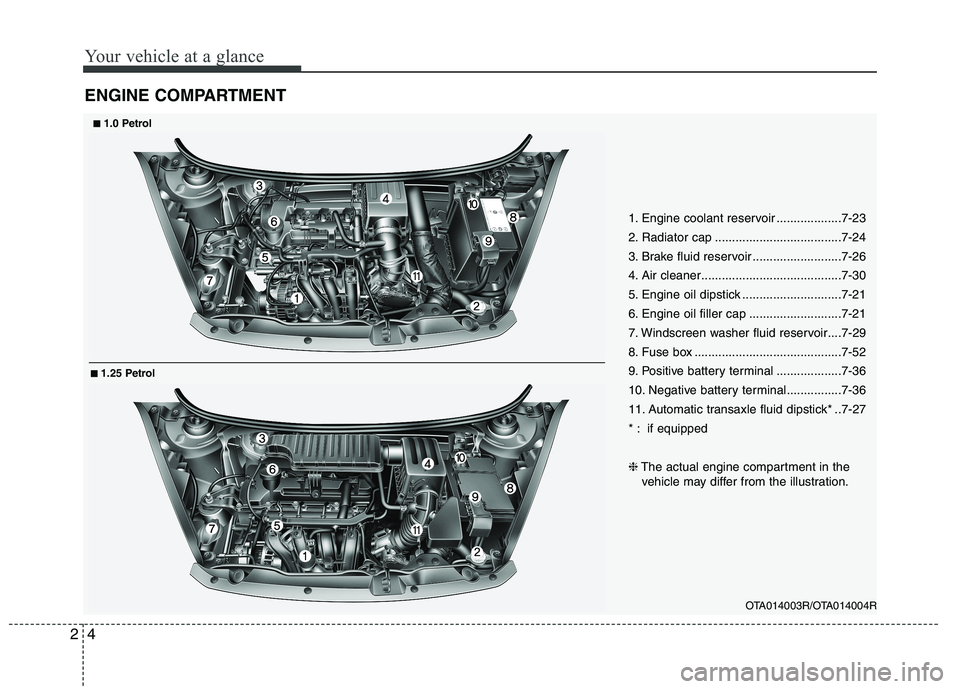
ENGINE COMPARTMENT
OTA014003R/OTA014004R
1. Engine coolant reservoir ...................7-23
2. Radiator cap .....................................7-24
3. Brake fluid reservoir ..........................7-26
4. Air cleaner.........................................7-30
5. Engine oil dipstick .............................7-21
6. Engine oil filler cap ...........................7-21
7. Windscreen washer fluid reservoir....7-29
8. Fuse box ...........................................7-52
9. Positive battery terminal ...................7-36
10. Negative battery terminal................7-36
11. Automatic transaxle fluid dipstick* ..7-27
* : if equipped
■
■
1.0 Petrol
❈The actual engine compartment in the
vehicle may differ from the illustration.
■■ 1.25 Petrol
Page 454 of 846
Safety features of your vehicle
16
3
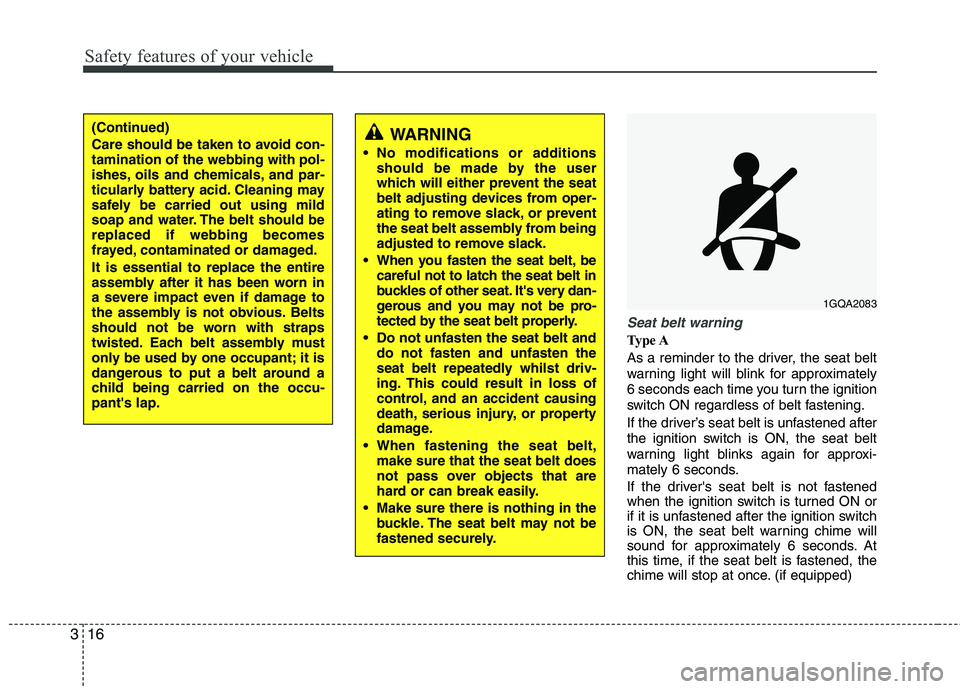
Seat belt warning
Type A
As a reminder to the driver, the seat belt
warning light will blink for approximately
6 seconds each time you turn the ignition
switch ON regardless of belt fastening.
If the driver’s seat belt is unfastened after
the ignition switch is ON, the seat belt
warning light blinks again for approxi-
mately 6 seconds.
If the driver's seat belt is not fastened
when the ignition switch is turned ON or
if it is unfastened after the ignition switch
is ON, the seat belt warning chime will
sound for approximately 6 seconds. At
this time, if the seat belt is fastened, the
chime will stop at once. (if equipped)
1GQA2083
WARNING
No modifications or additions should be made by the user
which will either prevent the seat
belt adjusting devices from oper-
ating to remove slack, or prevent
the seat belt assembly from being
adjusted to remove slack.
When you fasten the seat belt, be careful not to latch the seat belt in
buckles of other seat. It's very dan-
gerous and you may not be pro-
tected by the seat belt properly.
Do not unfasten the seat belt and do not fasten and unfasten the
seat belt repeatedly whilst driv-
ing. This could result in loss of
control, and an accident causing
death, serious injury, or property
damage.
When fastening the seat belt, make sure that the seat belt does
not pass over objects that are
hard or can break easily.
Make sure there is nothing in the buckle. The seat belt may not be
fastened securely.(Continued)
Care should be taken to avoid con- tamination of the webbing with pol-
ishes, oils and chemicals, and par-
ticularly battery acid. Cleaning may
safely be carried out using mild
soap and water. The belt should bereplaced if webbing becomes
frayed, contaminated or damaged. It is essential to replace the entire
assembly after it has been worn in
a severe impact even if damage to
the assembly is not obvious. Belts
should not be worn with straps
twisted. Each belt assembly must
only be used by one occupant; it is
dangerous to put a belt around a
child being carried on the occu-pant's lap.
Page 483 of 846
345
Safety features of your vehicle
WARNING
Do not install or place any acces- sories (drink holder, sticker, etc.)
on the front passenger's panel
above the glove box in a vehicle
with a passenger's air bag. Such
objects may become dangerous
projectiles and cause injury if the
passenger's air bag inflates.
When installing a container of liq- uid air freshener inside the vehi-
cle, do not place it near the
instrument cluster nor on the
instrument panel surface.
It may become a dangerous pro-
jectile and cause injury if the pas-
senger's air bag inflates.
B240B05L/H
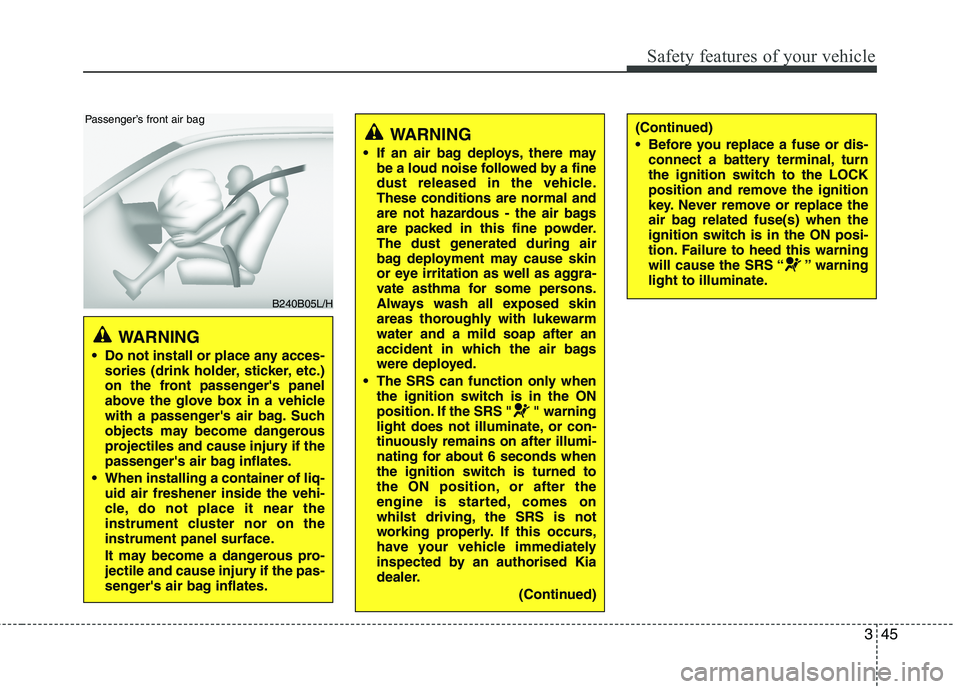
Passenger’s front air bag
WARNING
If an air bag deploys, there may be a loud noise followed by a fine
dust released in the vehicle.These conditions are normal and
are not hazardous - the air bags
are packed in this fine powder.
The dust generated during air
bag deployment may cause skin
or eye irritation as well as aggra-
vate asthma for some persons.
Always wash all exposed skin
areas thoroughly with lukewarmwater and a mild soap after an
accident in which the air bags
were deployed.
The SRS can function only when the ignition switch is in the ON
position. If the SRS " " warning
light does not illuminate, or con-
tinuously remains on after illumi-
nating for about 6 seconds when
the ignition switch is turned to
the ON position, or after the
engine is started, comes on
whilst driving, the SRS is not
working properly. If this occurs,
have your vehicle immediately
inspected by an authorised Kia
dealer.
(Continued)(Continued)
Before you replace a fuse or dis-connect a battery terminal, turn
the ignition switch to the LOCK
position and remove the ignition
key. Never remove or replace the
air bag related fuse(s) when the
ignition switch is in the ON posi-
tion. Failure to heed this warning
will cause the SRS “ ” warning
light to illuminate.
Page 506 of 846
47
Features of your vehicle
Transmitter precautions
✽✽NOTICE
The transmitter will not work if any of
following occur:
The ignition key is in ignition switch.
You exceed the operating distance limit (about 10 m [30 feet]).
The battery in the transmitter is weak.
Other vehicles or objects may be blocking the signal.
The weather is extremely cold.
The transmitter is close to a radio transmitter such as a radio station or
an airport which can interfere with
normal operation of the transmitter.
When the transmitter does not work
correctly, open and close the door with
the ignition key. If you have a problem
with the transmitter, contact an autho-
rised Kia dealer.
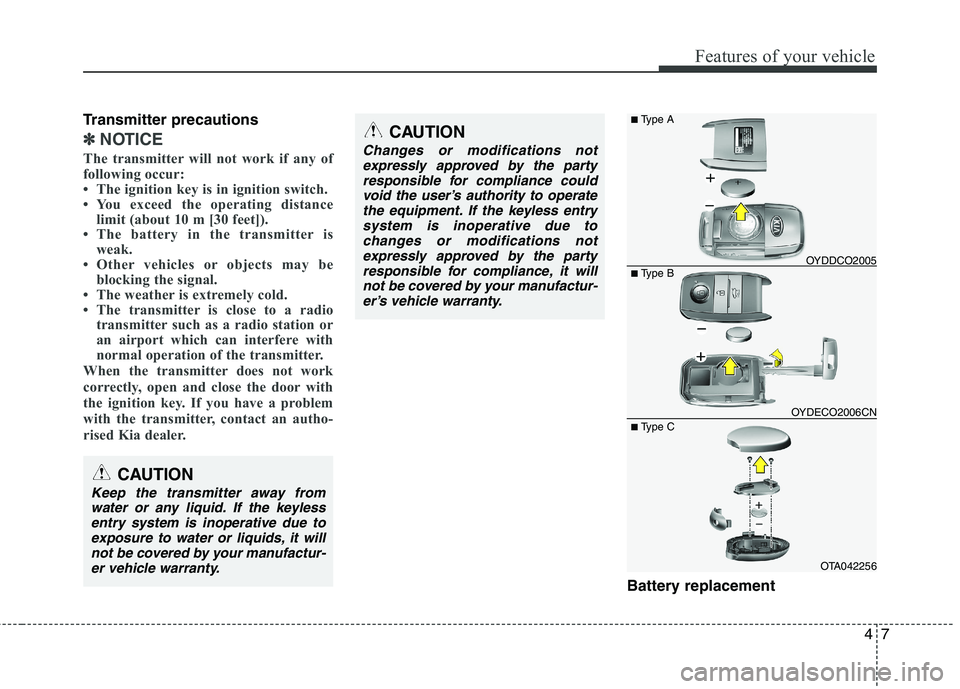
Battery replacement
CAUTION
Changes or modifications not expressly approved by the party
responsible for compliance couldvoid the user’s authority to operatethe equipment. If the keyless entry system is inoperative due to
changes or modifications notexpressly approved by the partyresponsible for compliance, it will
not be covered by your manufactur-er’s vehicle warranty.
OYDECO2006CN
■
Type A
■ Type B
OTA042256
■
Type C
CAUTION
Keep the transmitter away from
water or any liquid. If the keylessentry system is inoperative due to exposure to water or liquids, it will
not be covered by your manufactur-er vehicle warranty.
OYDDCO2005
Page 507 of 846
Features of your vehicle
8
4
The transmitter uses a 3 volt lithium bat-
tery which will normally last for several
years. When replacement is necessary,
use the following procedure.
1. Insert a slim tool into the slot and gen-
tly pry open the transmitter centre
cover.
2. Replace the battery with new one. When replacing the battery, make sure
the battery position.
3. Install the battery in the reverse order of removal.
For transmitter replacement, see an
authorised Kia dealer to reprogram the
transmitter.CAUTION
The transmitter or smart key is designed to give you years of
trouble-free use, however it canmalfunction if exposed to mois-ture or static electricity. If you are unsure how to use or replace the
battery, contact an authorised Kiadealer.
Using the wrong battery can cause the transmitter or smart
key to malfunction. Be sure to use the correct battery.
To avoid damaging the transmit- ter or smart key, don't drop it, getit wet, or expose it to heat or sun-
light.
CAUTION
An inappropriately disposed bat-tery can be harmful to the environ-
ment and human health.
Dispose the battery according toyour local law(s) or regulation.
CAUTION
Replace the battery of accessory smart key with new one per oneyear. But replace the battery as
soon as possible in case KEY lowbattery indicator illuminates.