service KIA PICANTO 2015 Manual PDF
[x] Cancel search | Manufacturer: KIA, Model Year: 2015, Model line: PICANTO, Model: KIA PICANTO 2015Pages: 846, PDF Size: 49.67 MB
Page 760 of 846
77
Maintenance
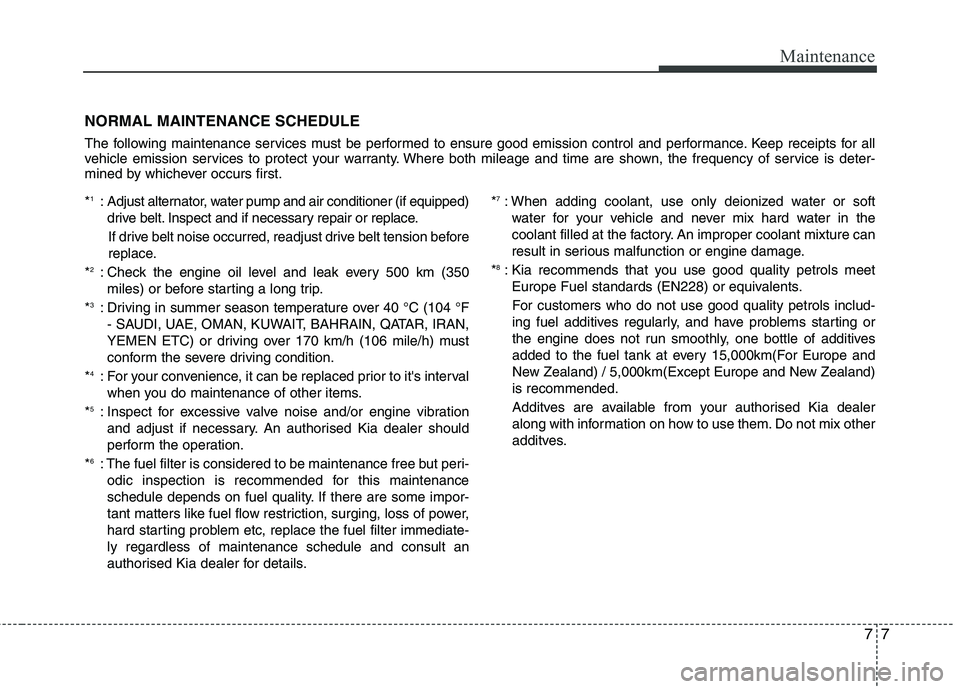
NORMAL MAINTENANCE SCHEDULE
The following maintenance services must be performed to ensure good emission control and performance. Keep receipts for all
vehicle emission services to protect your warranty. Where both mileage and time are shown, the frequency of service is deter-
mined by whichever occurs first. *1
: Adjust alternator, water pump and air conditioner (if equipped)
drive belt. Inspect and if necessary repair or replace.
If drive belt noise occurred, readjust drive belt tension before
replace.
* 2
: Check the engine oil level and leak every 500 km (350
miles) or before starting a long trip.
* 3
: Driving in summer season temperature over 40 °C (104 °F
- SAUDI, UAE, OMAN, KUWAIT, BAHRAIN, QATAR, IRAN,
YEMEN ETC) or driving over 170 km/h (106 mile/h) must
conform the severe driving condition.
* 4
: For your convenience, it can be replaced prior to it's interval
when you do maintenance of other items.
* 5
: Inspect for excessive valve noise and/or engine vibration
and adjust if necessary. An authorised Kia dealer should
perform the operation.
* 6
: The fuel filter is considered to be maintenance free but peri-
odic inspection is recommended for this maintenance
schedule depends on fuel quality. If there are some impor-
tant matters like fuel flow restriction, surging, loss of power,
hard starting problem etc, replace the fuel filter immediate-ly regardless of maintenance schedule and consult an
authorised Kia dealer for details. *
7
: When adding coolant, use only deionized water or soft
water for your vehicle and never mix hard water in the
coolant filled at the factory. An improper coolant mixture can
result in serious malfunction or engine damage.
* 8
: Kia recommends that you use good quality petrols meet
Europe Fuel standards (EN228) or equivalents.
For customers who do not use good quality petrols includ-
ing fuel additives regularly, and have problems starting or
the engine does not run smoothly, one bottle of additives
added to the fuel tank at every 15,000km(For Europe and
New Zealand) / 5,000km(Except Europe and New Zealand)is recommended.
Additves are available from your authorised Kia dealer
along with information on how to use them. Do not mix other
additves.
Page 769 of 846
Maintenance
16
7
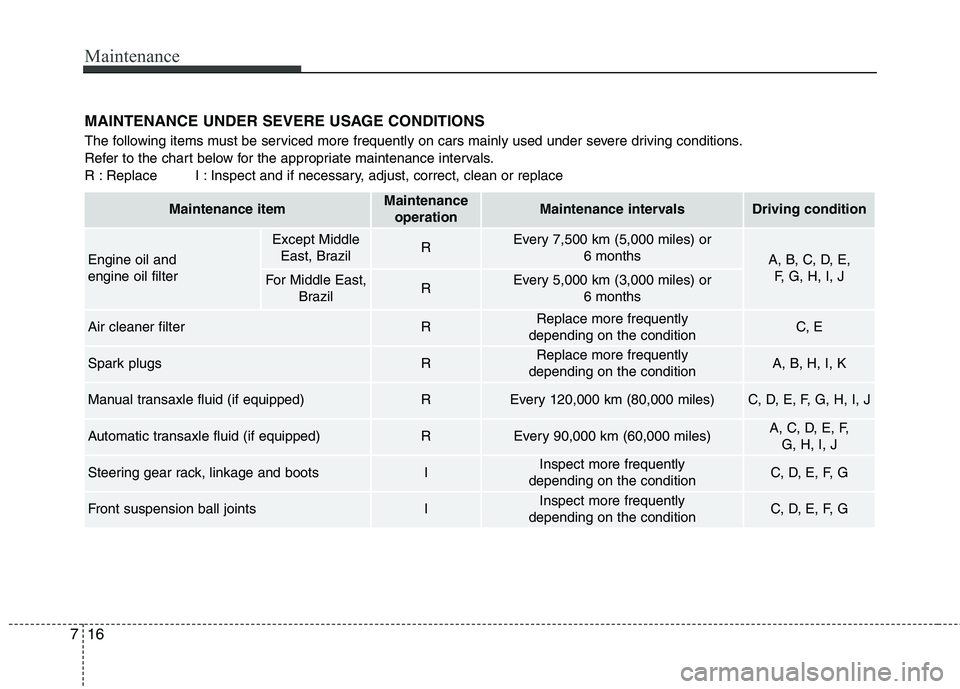
MAINTENANCE UNDER SEVERE USAGE CONDITIONS
The following items must be serviced more frequently on cars mainly used under severe driving conditions.
Refer to the chart below for the appropriate maintenance intervals.
R : Replace I : Inspect and if necessary, adjust, correct, clean or replace
Maintenance itemMaintenance
operationMaintenance intervalsDriving condition
Engine oil and engine oil filter
Except MiddleEast, Brazil REvery 7,500 km (5,000 miles) or 6 months
A, B, C, D, E, F, G, H, I, J
For Middle East, Brazil REvery 5,000 km (3,000 miles) or 6 months
Air cleaner filterRReplace more frequently
depending on the conditionC, E
Spark plugs RReplace more frequently
depending on the conditionA, B, H, I, K
Manual transaxle fluid (if equipped)REvery 120,000 km (80,000 miles)C, D, E, F, G, H, I, J
Automatic transaxle fluid (if equipped)REvery 90,000 km (60,000 miles)A, C, D, E, F, G, H, I, J
Steering gear rack, linkage and bootsIInspect more frequently
depending on the conditionC, D, E, F, G
Front suspension ball jointsIInspect more frequently
depending on the conditionC, D, E, F, G
Page 789 of 846
Maintenance
36
7
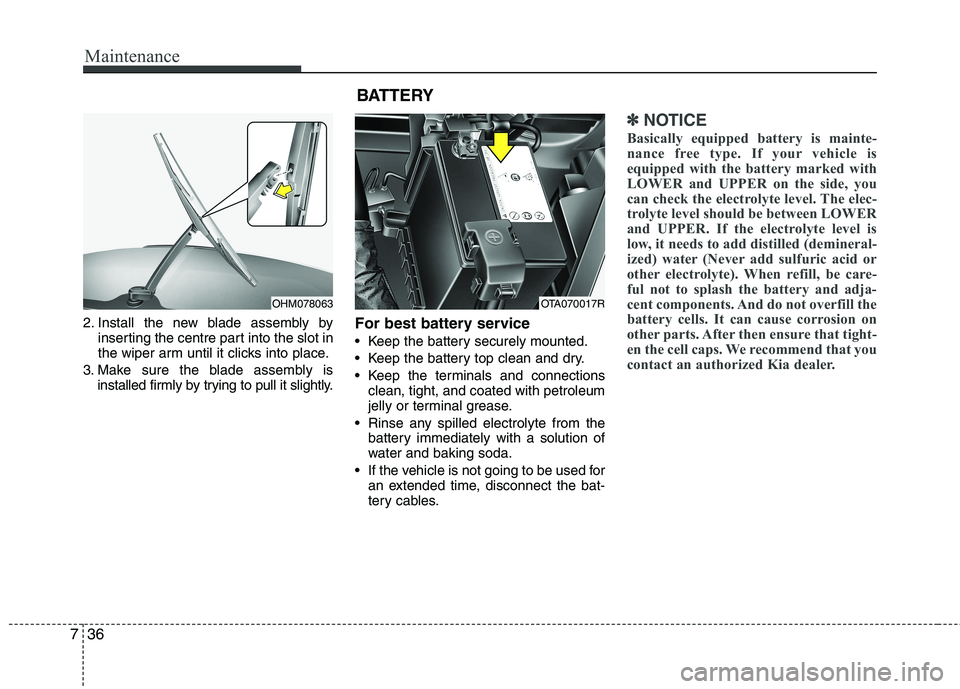
2. Install the new blade assembly by
inserting the centre part into the slot in
the wiper arm until it clicks into place.
3. Make sure the blade assembly is installed firmly by trying to pull it slightly. For best battery service
Keep the battery securely mounted.
Keep the battery top clean and dry.
Keep the terminals and connections
clean, tight, and coated with petroleum
jelly or terminal grease.
Rinse any spilled electrolyte from the battery immediately with a solution of
water and baking soda.
If the vehicle is not going to be used for an extended time, disconnect the bat-
tery cables.
✽✽ NOTICE
Basically equipped battery is mainte-
nance free type. If your vehicle is
equipped with the battery marked with
LOWER and UPPER on the side, you
can check the electrolyte level. The elec-
trolyte level should be between LOWER
and UPPER. If the electrolyte level is
low, it needs to add distilled (demineral-
ized) water (Never add sulfuric acid or
other electrolyte). When refill, be care-
ful not to splash the battery and adja-
cent components. And do not overfill the
battery cells. It can cause corrosion on
other parts. After then ensure that tight-
en the cell caps. We recommend that you
contact an authorized Kia dealer.
OHM078063 BATTERYOTA070017R
Page 800 of 846
747
Maintenance
3. Checking tyre life (TIN : TyreIdentification Number)
Any tyres that are over 6 years old,
based on the manufacturing date,(including the spare tyre) should be
replaced by new ones. You can find
the manufacturing date on the tyre
sidewall (possibly on the inside of the
wheel), displaying the DOT Code.
The DOT Code is a series of num-
bers on a tyre consisting of numbers
and English letters. The manufactur-
ing date is designated by the last four
digits (characters) of the DOT code. DOT : XXXX XXXX OOOO
The front part of the DOT means a
plant code number, tyre size and
tread pattern and the last four num-
bers indicate week and year manu-
factured.
For example:
DOT XXXX XXXX 1614 represents
that the tyre was produced in the
16th week of 2014.
4. Tyre ply composition and material
The number of layers or plies of rub-
ber-coated fabric in the tyre. Tyre
manufacturers also must indicate the
materials in the tyre, which include
steel, nylon, polyester, and others.
The letter "R" means radial ply con-
struction; the letter "D" means diago-
nal or bias ply construction; and theletter "B" means belted-bias ply con-
struction.
5. Maximum permissible inflation
pressure
This number is the greatest amount of air pressure that should be put in
the tyre. Do not exceed the maximum
permissible inflation pressure. Refer
to the Tyre and Loading Information
label for recommended inflation
pressure.
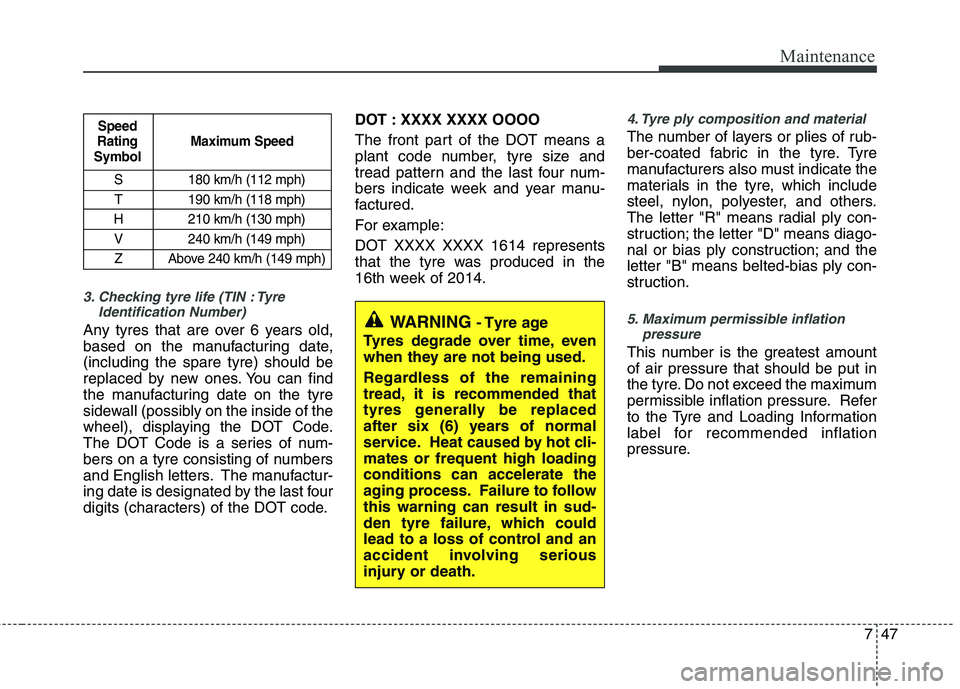
S 180 km/h (112 mph)
T 190 km/h (118 mph)
H 210 km/h (130 mph)
V 240 km/h (149 mph) Z Above 240 km/h (149 mph)
Maximum Speed
Speed
Rating
Symbol
WARNING - Tyre age
Tyres degrade over time, even
when they are not being used.
Regardless of the remaining
tread, it is recommended that
tyres generally be replaced
after six (6) years of normal
service. Heat caused by hot cli-mates or frequent high loadingconditions can accelerate the
aging process. Failure to followthis warning can result in sud-
den tyre failure, which could
lead to a loss of control and an
accident involving serious
injury or death.
Page 801 of 846
Maintenance
48
7
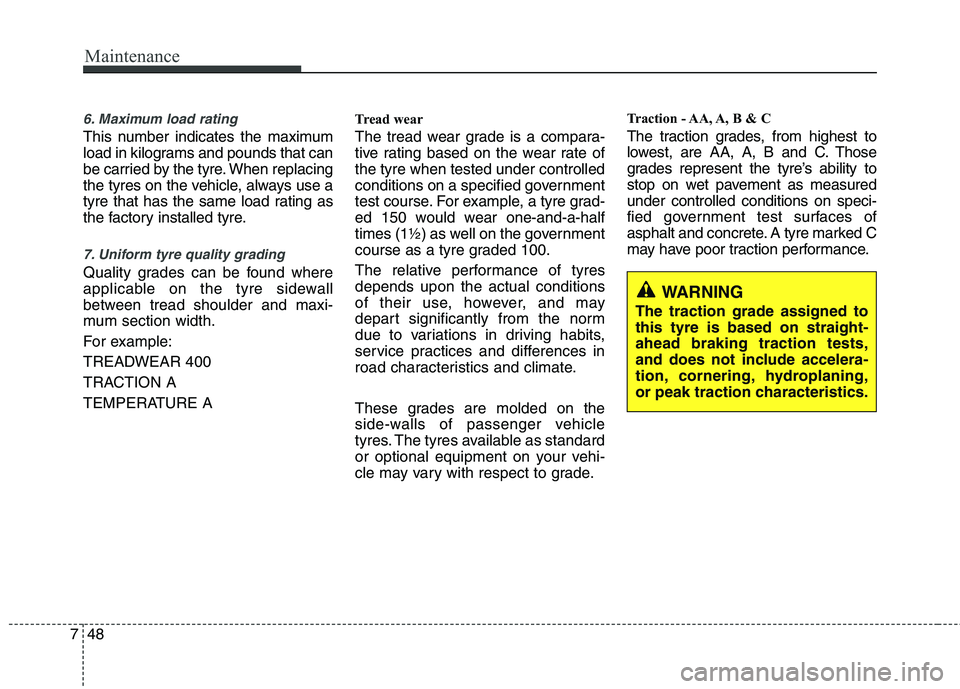
6. Maximum load rating
This number indicates the maximum
load in kilograms and pounds that can
be carried by the tyre. When replacing
the tyres on the vehicle, always use a
tyre that has the same load rating as
the factory installed tyre.
7. Uniform tyre quality grading
Quality grades can be found where
applicable on the tyre sidewall
between tread shoulder and maxi-
mum section width.
For example:
TREADWEAR 400
TRACTION A
TEMPERATURE A Tread wear
The tread wear grade is a compara-
tive rating based on the wear rate ofthe tyre when tested under controlled
conditions on a specified government
test course. For example, a tyre grad-
ed 150 would wear one-and-a-half
times (1½) as well on the government
course as a tyre graded 100.
The relative performance of tyres depends upon the actual conditions
of their use, however, and may
depart significantly from the norm
due to variations in driving habits,
service practices and differences in
road characteristics and climate.
These grades are molded on the
side-walls of passenger vehicle
tyres. The tyres available as standard
or optional equipment on your vehi-
cle may vary with respect to grade.Traction - AA, A, B & C
The traction grades, from highest to
lowest, are AA, A, B and C. Those
grades represent the tyre’s ability to
stop on wet pavement as measuredunder controlled conditions on speci-
fied government test surfaces of
asphalt and concrete. A tyre marked C
may have poor traction performance.
WARNING
The traction grade assigned to this tyre is based on straight-ahead braking traction tests,
and does not include accelera-
tion, cornering, hydroplaning,
or peak traction characteristics.
Page 828 of 846
775
Maintenance
EMISSION CONTROL SYSTEM (IF EQUIPPED)
The emission control system of your
vehicle is covered by a written limited
warranty. Please see the warranty infor-
mation contained in the Service Passport
in your vehicle.
Your vehicle is equipped with an emis-
sion control system to meet all applicable
emission regulations. There are three emission control sys-
tems, as follows.
(1) Crankcase emission control system
(2) Evaporative emission control system(3) Exhaust emission control system In order to assure the proper function of
the emission control systems, it is recom-
mended that you have your car inspected
and maintained by an authorised Kiadealer in accordance with the mainte-
nance schedule in this manual. Caution for the Inspection and
Maintenance Test (With Electronic
Stability Control (ESC) system)
To prevent the vehicle from misfir-
ing during dynamometer testing,
turn the Electronic Stability Control
(ESC) system off by pressing the
ESC switch.
After dynamometer testing is com- pleted, turn the ESC system back on
by pressing the ESC switch again. 1. Crankcase emission control
system
The positive crankcase ventilation sys-
tem is employed to prevent air pollution
caused by blow-by gases being emitted
from the crankcase. This system supplies
fresh filtered air to the crankcase through
the air intake hose. Inside the crankcase,
the fresh air mixes with blow-by gases,
which then pass through the PCV valveinto the induction system.
2. Evaporative emission control system
The Evaporative Emission Control
System is designed to prevent fuel
vapors from escaping into the atmos-
phere.
Page 834 of 846
Specifications & Consumer information
4
8
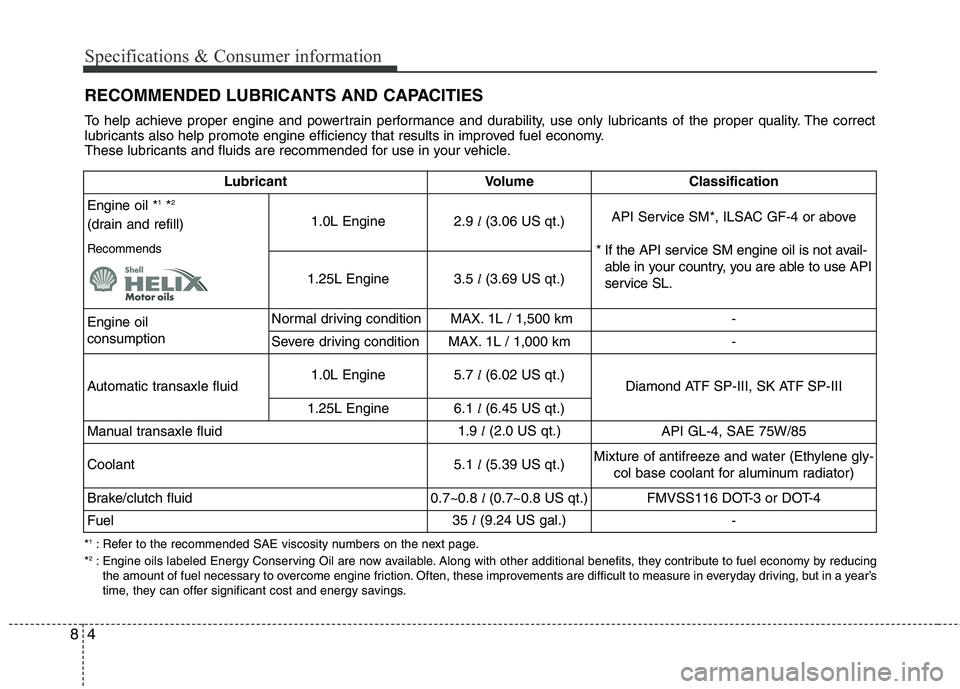
RECOMMENDED LUBRICANTS AND CAPACITIES
* 1
: Refer to the recommended SAE viscosity numbers on the next page.
* 2
: Engine oils labeled Energy Conserving Oil are now available. Along with other additional benefits, they contribute to fuel economy by reducing
the amount of fuel necessary to overcome engine friction. Often, these improvements are difficult to measure in everyday driving, but in a year’s
time, they can offer significant cost and energy savings.
To help achieve proper engine and powertrain performance and durability, use only lubricants of the proper quality. The correct
lubricants also help promote engine efficiency that results in improved fuel economy.
These lubricants and fluids are recommended for use in your vehicle.
Lubricant Volume Classification
Engine oil * 1
*2
(drain and refill) Recommends 1.0L Engine
2.9
l(3.06 US qt.) API Service SM*, ILSAC GF-4 or above
* If the API service SM engine oil is not avail- able in your country, you are able to use API
service SL.
1.25L Engine3.5 l(3.69 US qt.)
Engine oil consumption Normal driving condition MAX. 1L / 1,500 km -
Severe driving condition MAX. 1L / 1,000 km -
Automatic transaxle fluid 1.0L Engine
5.7
l(6.02 US qt.)
Diamond ATF SP-III, SK ATF SP-III
1.25L Engine 6.1
l(6.45 US qt.)
Manual transaxle fluid 1.9
l(2.0 US qt.)
API GL-4, SAE 75W/85
Coolant 5.1
l(5.39 US qt.) Mixture of antifreeze and water (Ethylene gly-
col base coolant for aluminum radiator)
Brake/clutch fluid 0.7~0.8
l (0.7~0.8 US qt.)
FMVSS116 DOT-3 or DOT-4
Fuel 35
l(9.24 US gal.)
-
Page 843 of 846
Index
6
I
Label
Air bag warning label................................................3-61
Tyre sidewall labeling ..............................................7-46
Tyre specification and pressure label ..........................8-7
Vehicle certification label............................................8-6
Light bulbs ......................................................................7-61
Lighting ..........................................................................4-67 Battery saver function ..............................................4-67
Daytime running light ..............................................4-67
Headlight escort function ..........................................4-67
Headlight welcome function ....................................4-67
Lubricants and capacities ..................................................8-4 Maintenance Explanation of scheduled maintenance items ..........7-18
Maintenance services ..................................................7-3
Maintenance under severe usage conditions ............7-16 Normal maintenance schedule ....................................7-7
Owner maintenance ....................................................7-4
Scheduled maintenance service ..................................7-6
Tyre maintenance ......................................................7-45
Maintenance services ........................................................7-3 Manual climate control system ......................................4-81
Air conditioning ........................................................4-86
Climate control air filter............................................4-88
Heating and air conditioning ....................................4-82
Manual heating and air conditioning ..............................4-92
Manual transaxle ............................................................5-16
Memory fuse ..................................................................7-52
Mirrors ............................................................................4-37 Day/night rearview mirror ........................................4-37
Inside rearview mirror ..............................................4-37
Outside rearview mirror ............................................4-37
Moonroof, see sunroof ....................................................4-30
Multi fuse ........................................................................7-53
Neck restraints, see headrest ....................................3-5, 3-9
Odometer ........................................................................4-44
Oil (Engine) ....................................................................7-21
Outside rearview mirror ..................................................4-37
Overheats ..........................................................................6-7
Owner maintenance ..........................................................7-4
O
M
N
L
Page 844 of 846
I7
Index
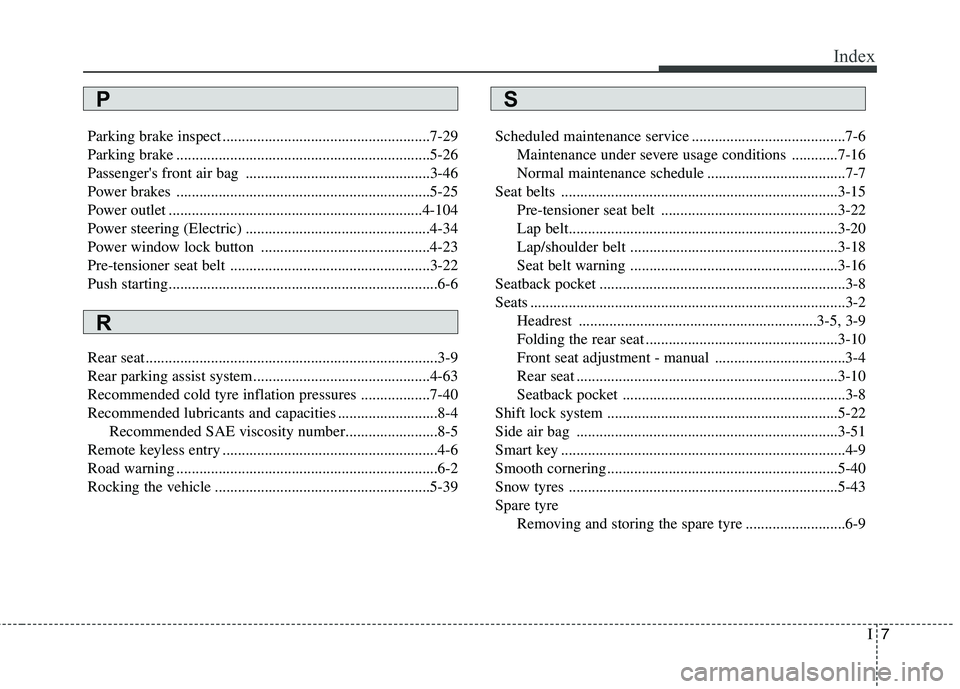
Parking brake inspect ......................................................7-29
Parking brake ..................................................................5-26
Passenger's front air bag ................................................3-46
Power brakes ..................................................................5-25
Power outlet ..................................................................4-104
Power steering (Electric) ................................................4-34
Power window lock button ............................................4-23
Pre-tensioner seat belt ....................................................3-22
Push starting......................................................................6-6
Rear seat............................................................................3-9
Rear parking assist system ..............................................4-63
Recommended cold tyre inflation pressures ..................7-40
Recommended lubricants and capacities ..........................8-4
Recommended SAE viscosity number........................8-5
Remote keyless entry ........................................................4-6
Road warning ....................................................................6-2
Rocking the vehicle ........................................................5-39 Scheduled maintenance service ........................................7-6
Maintenance under severe usage conditions ............7-16Normal maintenance schedule ....................................7-7
Seat belts ........................................................................3-15 Pre-tensioner seat belt ..............................................3-22
Lap belt......................................................................3-20
Lap/shoulder belt ......................................................3-18
Seat belt warning ......................................................3-16
Seatback pocket ................................................................3-8
Seats ..................................................................................3-2 Headrest ..............................................................3-5, 3-9
Folding the rear seat ..................................................3-10
Front seat adjustment - manual ..................................3-4
Rear seat ....................................................................3-10
Seatback pocket ..........................................................3-8
Shift lock system ............................................................5-22
Side air bag ....................................................................3-51
Smart key ..........................................................................4-9
Smooth cornering............................................................5-40
Snow tyres ......................................................................5-43Spare tyre Removing and storing the spare tyre ..........................6-9
P
R
S