seats KIA QUORIS 2013 Owner's Manual
[x] Cancel search | Manufacturer: KIA, Model Year: 2013, Model line: QUORIS, Model: KIA QUORIS 2013Pages: 485, PDF Size: 31.55 MB
Page 78 of 485
363
Safety features of your vehicle
Additional safety precautions
All occupants should sit upright,fully back in their seats with their
seat belts on and their feet on the
floor.
Passengers should not move
out of or change seats while the
vehicle is moving. A passenger
who is not wearing a seat belt dur-
ing a crash or emergency stop can
be thrown against the inside of the
vehicle, against other occupants,
or out of the vehicle.
Each seat belt is designed torestrain one occupant. If more
than one person uses the same
seat belt, they could be seriouslyinjured or killed in a collision.
Do not use any accessories onseat belts. Devices claiming to
improve occupant comfort or repo-sition the seat belt can reduce the
protection provided by the seat belt
and increase the chance of serious
injury in a crash.
Passengers should not place
hard or sharp objects between
themselves and the air bags.
Carrying hard or sharp objects on
your lap or in your mouth can result
in injuries if an air bag inflates.
Keep occupants away from the
air bag covers. All occupants
should sit upright, fully back in theirseats with their seat belts on and
their feet on the floor. If occupants
are too close to the air bag covers,
they could be injured if the air bags
inflate.
Do not attach or place objects
on or near the air bag covers.
Any object attached to or placed
on the front or side air bag covers
could interfere with the proper
operation of the air bags.
Do not modify the front seats.Modification of the front seats
could interfere with the operation of
the supplemental restraint systemsensing components or side air
bags.
Do not place items under the
front seats. Placing items under
the front seats could interfere with
the operation of the supplemental
restraint system sensing compo-
nents and wiring harnesses.
Never hold an infant or child on
your lap. The infant or child could
be seriously injured or killed in the
event of a crash. All infants and
children should be properly
restrained in appropriate child
safety seats or seat belts in therear seat.
Page 140 of 485
461
Features of your vehicle
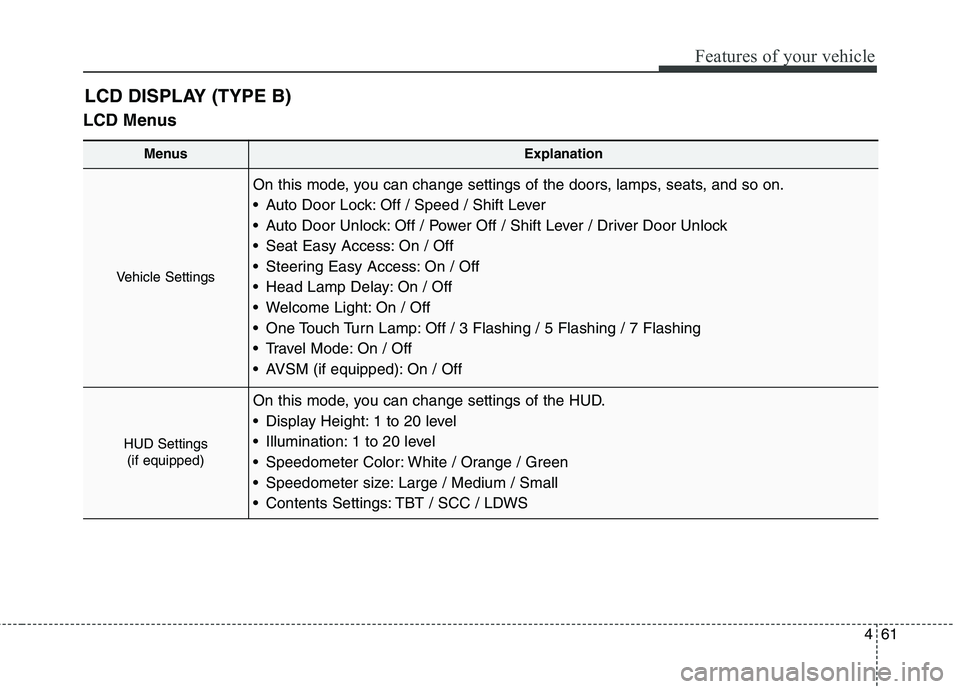
LCD MenusLCD DISPLAY (TYPE B)
MenusExplanation
Vehicle Settings
On this mode, you can change settings of the doors, lamps, seats, and so on.
Auto Door Lock: Off / Speed / Shift Lever
Auto Door Unlock: Off / Power Off / Shift Lever / Driver Door Unlock
Seat Easy Access: On / Off
Steering Easy Access: On / Off
Head Lamp Delay: On / Off
Welcome Light: On / Off
One Touch Turn Lamp: Off / 3 Flashing / 5 Flashing / 7 Flashing
Travel Mode: On / Off
AVSM (if equipped): On / Off
HUD Settings
(if equipped)
On this mode, you can change settings of the HUD.
Display Height: 1 to 20 level
Illumination: 1 to 20 level
Speedometer Color: White / Orange / Green
Speedometer size: Large / Medium / Small
Contents Settings: TBT / SCC / LDWS
Page 232 of 485
4153
Features of your vehicle
Seat warmerWARNING
Do not put a finger or a foreign
element (pin, etc.) into a power
outlet and do not touch with a
wet hand. You may get an elec-
tric shock.
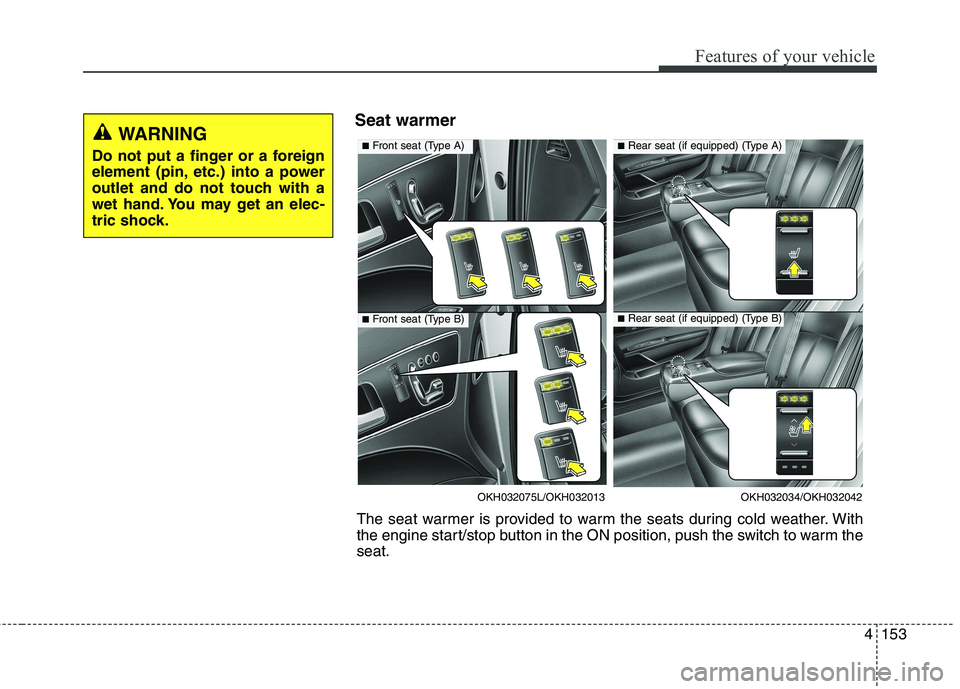
OKH032034/OKH032042
■ Rear seat (if equipped) (Type A)
■Rear seat (if equipped) (Type B)
OKH032075L/OKH032013
■Front seat (Type A)
■Front seat (Type B)
The seat warmer is provided to warm the seats during cold weather. With
the engine start/stop button in the ON position, push the switch to warm theseat.
Page 233 of 485
Features of your vehicle
154
4
During mild weather or under condi-
tions where the operation of the seat
warmer is not needed, keep the
switches in the "OFF" position.
Each time you press the switch,
the temperature setting of the seat
will change as follows :
When pressing the switch for more than 1.5 seconds with the seat
warmer operating, the seat warmer
will turn OFF.
The seat warmer defaults to the OFF position whenever the engine
start/stop button is turned on. You can activate or deactivate the
rear seat warmer button by using the
REAR LOCK button on the rear arm-
rest or “System Settings” in
AVN(Audio, Video, and Navigation).
Detailed information for “System
Settings” is described in a separate-
ly supplied manual. If the rear seat
warmer button has deactivated
through AVN, you can reactivate the
rear seat warmer button only through
AVN.
✽✽ NOTICE
With the seat warmer switch in ON
position, the heating system in the
seat turns off or on automatically
depending on the seat temperature.
CAUTION - Seat damage
When cleaning the seats, do
not use an organic solventsuch as paint thinner, ben- zene, alcohol and gasoline.Doing so may damage the sur-face of the heater or seats.
To prevent overheating the seat warmer, do not place any-thing on the seats that insu-lates against heat, such asblankets, cushions or seat covers on the seats while theseat warmer is in operation.
Do not place heavy or sharp objects on the seat. Thosethings may damage the seat warmer system.
Be careful not to spill liquid such as water or beverages onthe seat. If you spill some liq-uid, wipe the seat with a dry towel. Before using the seatwarmer, dry the seat com-pletely.
OFF HIGH( ) MIDDLE( ) LOW( )
Page 234 of 485
4155
Features of your vehicle
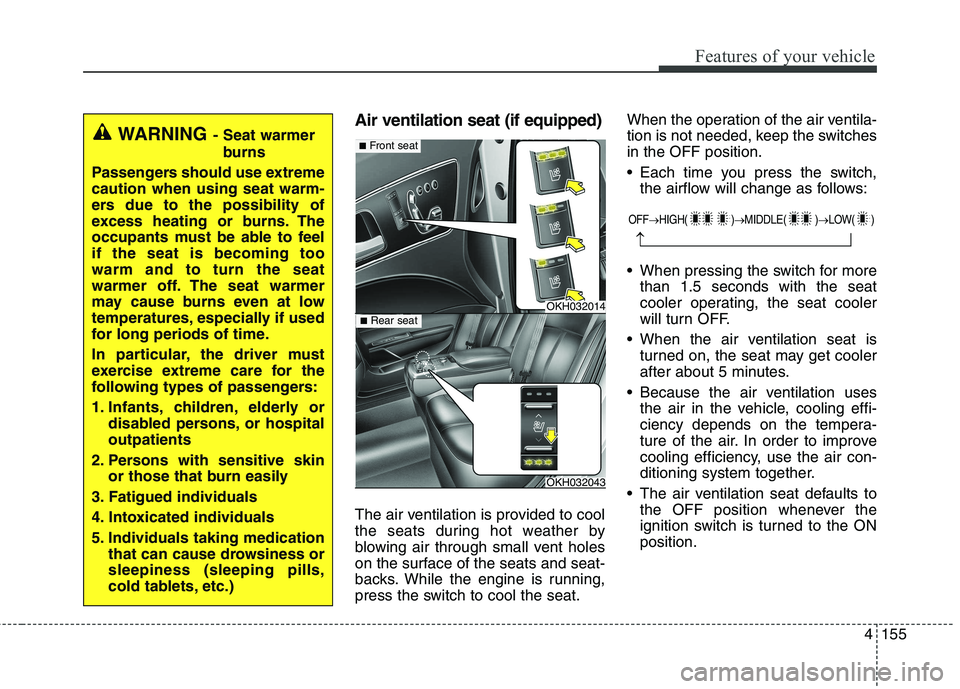
Air ventilation seat (if equipped)
The air ventilation is provided to cool
the seats during hot weather by
blowing air through small vent holes
on the surface of the seats and seat-
backs. While the engine is running,
press the switch to cool the seat.When the operation of the air ventila-
tion is not needed, keep the switchesin the OFF position.
Each time you press the switch,
the airflow will change as follows:
When pressing the switch for more than 1.5 seconds with the seat
cooler operating, the seat cooler
will turn OFF.
When the air ventilation seat is turned on, the seat may get cooler
after about 5 minutes.
Because the air ventilation uses the air in the vehicle, cooling effi-
ciency depends on the tempera-
ture of the air. In order to improve
cooling efficiency, use the air con-
ditioning system together.
The air ventilation seat defaults to the OFF position whenever the
ignition switch is turned to the ONposition.
OFF HIGH( ) MIDDLE( ) LOW( )
OKH032014
OKH032043
■Front seat
■Rear seat
WARNING - Seat warmer
burns
Passengers should use extreme caution when using seat warm-
ers due to the possibility of
excess heating or burns. The
occupants must be able to feelif the seat is becoming toowarm and to turn the seat
warmer off. The seat warmer
may cause burns even at low
temperatures, especially if used
for long periods of time.
In particular, the driver must
exercise extreme care for the
following types of passengers:
1. Infants, children, elderly or disabled persons, or hospital outpatients
2. Persons with sensitive skin or those that burn easily
3. Fatigued individuals
4. Intoxicated individuals
5. Individuals taking medication that can cause drowsiness or sleepiness (sleeping pills,
cold tablets, etc.)
Page 235 of 485
Features of your vehicle
156
4
You can activate or deactivate the
rear air ventilation button by using
the REAR LOCK button on the rear
armrest or “System Settings” in
AVN(Audio, Video, and Navigation).
Detailed information for “System
Settings” is described in a sepa-
rately supplied manual. If the rear
air ventilation button has deactivat-
ed through AVN, you can reactivate
the rear air ventilation button only
through AVN.CAUTION - Seat damage
When cleaning the seats, do
not use an organic solventsuch as paint thinner, ben- zene, alcohol and gasoline.Doing so may damage the airventilation seat.
Do not place heavy or sharp objects on the seat. Thosethings may damage the airventilation seat.
Be careful not to spill liquid such as water or beverages onthe seat. If you spill some liquid, wipe the seat with a dry towel.Before using the air ventilationseat, dry the seat completely.
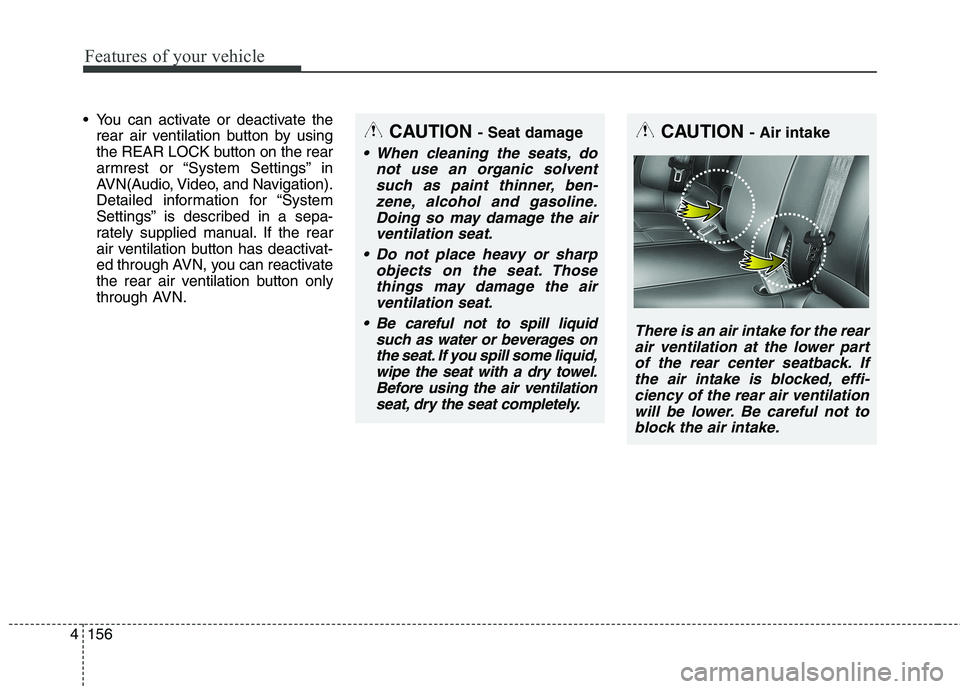
CAUTION - Air intake
There is an air intake for the rear
air ventilation at the lower partof the rear center seatback. If the air intake is blocked, effi-ciency of the rear air ventilationwill be lower. Be careful not toblock the air intake.
Page 459 of 485
783
Maintenance
Keep paint and trim in good con- dition
Scratches or chips in the finish
should be covered with "touch-up"
paint as soon as possible to reduce
the possibility of corrosion. If bare
metal is showing through, the atten-tion of a qualified body and paintshop is recommended.
Bird droppings : Bird droppings are
highly corrosive and may damage
painted surfaces in just a few hours.
Always remove bird droppings as
soon as possible. Don't neglect the interior Moisture can collect under the floor
mats and carpeting to cause corro-
sion. Check under the mats periodi-
cally to be sure the carpeting is dry.
Use particular care if you carry fertil-
izers, cleaning materials or chemi-
cals in the car.
These should be carried only in
proper containers and any spills or
leaks should be cleaned up, flushed
with clean water and thoroughly
dried.Interior care
Interior general precautions
Prevent chemicals such as perfume, cosmetic oil, sun cream, hand cleanerand air freshener from contacting the
interior parts because they may
cause damage or discoloration. If they
do contact the interior parts, wipe
them off immediately. If necessary,
use a vinyle cleaner, see instructions
for corrrect usage.
CAUTION
Never allow water or other liq-
uids to come in contact withelectrical/electronic compo- nents inside the vehicle as thismay damage them.
CAUTION
When cleaning leather products(steering wheel, seats etc.), useneutral detergents or low alco- hol content solutions. If you usehigh alcohol content solutionsor acid/alkaline detergents, thecolor of the leather may fade or the surface may get stripped off.
Page 483 of 485
I9
Index
Road warning . . . . . . . . . . . . . . . . . . . . . . . . . . . . . . . . . 6-2
Rocking the vehicle . . . . . . . . . . . . . . . . . . . . . . . . . . . 5-96
Rotation (Tire) . . . . . . . . . . . . . . . . . . . . . . . . . . . . . . . 7-45
Scheduled maintenance service . . . . . . . . . . . . . . . . . . . 7-8
Seat belt warning . . . . . . . . . . . . . . . . . . . . . . . . . . . . . 3-21
Seat belts . . . . . . . . . . . . . . . . . . . . . . . . . . . . . . . . . . . . 3-19
Care. . . . . . . . . . . . . . . . . . . . . . . . . . . . . . . . . . . . . . . 3-29
Height adjustment(front seat) . . . . . . . . . . . . . . . . . . . 3-22
Lap/shoulder belt . . . . . . . . . . . . . . . . . . . . . . . . . . . . 3-21
Precautions . . . . . . . . . . . . . . . . . . . . . . . . . . . . . . . . . 3-29
Pre-Safe Seat belt (PSB) . . . . . . . . . . . . . . . . . . . . . . 3-28
Pre-tensioner seat belt . . . . . . . . . . . . . . . . . . . . . . . . 3-25
Seat belt warning . . . . . . . . . . . . . . . . . . . . . . . . . . . . 3-21
Seat belts Care . . . . . . . . . . . . . . . . . . . . . . . . . . . . . . . 3-29
Seat belts Precautions . . . . . . . . . . . . . . . . . . . . . . . . . . 3-29
Seat warmer . . . . . . . . . . . . . . . . . . . . . . . . . . . . . . . . 4-153
Seatback pocket . . . . . . . . . . . . . . . . . . . . . . . . . . . . . 4-148
Seats . . . . . . . . . . . . . . . . . . . . . . . . . . . . . . . . . . . . . . . . 3-2 Driver position memory system . . . . . . . . . . . . . . . . . . 3-7
Front seat adjustment . . . . . . . . . . . . . . . . . . . . . . . . . . 3-4
Headrest(front) . . . . . . . . . . . . . . . . . . . . . . . . . . . . . . . 3-8
Headrest(rear) . . . . . . . . . . . . . . . . . . . . . . . . . . . . . . . 3-16
Rear seat adjustment. . . . . . . . . . . . . . . . . . . . . . . . . . 3-12
Shift lock system (shift by cable) . . . . . . . . . . . . . . . . . 5-15 Shift lock system (shift by wire) . . . . . . . . . . . . . . . . . 5-24
Side air bag . . . . . . . . . . . . . . . . . . . . . . . . . . . . . . . . . . 3-54
Side curtain . . . . . . . . . . . . . . . . . . . . . . . . . . . . . . . . . 4-160
Smart key . . . . . . . . . . . . . . . . . . . . . . . . . . . . . . . . . . . . 4-4
Battery replacement . . . . . . . . . . . . . . . . . . . . . . . . . . 4-10
Buttons on the smart key . . . . . . . . . . . . . . . . . . . . . . . 4-6
Immobilizer system . . . . . . . . . . . . . . . . . . . . . . . . . . . 4-9
Restrictions in handling keys . . . . . . . . . . . . . . . . . . . . 4-7
Smart key function . . . . . . . . . . . . . . . . . . . . . . . . . . . . 4-4
Smart key precautions . . . . . . . . . . . . . . . . . . . . . . . . . 4-8
Smooth cornering . . . . . . . . . . . . . . . . . . . . . . . . . . . . . 5-97
Snow tires . . . . . . . . . . . . . . . . . . . . . . . . . . . . . . . . . . 5-101
Spare tire Changing tires. . . . . . . . . . . . . . . . . . . . . . . . . . . . . . . 6-16
Removing and storing the spare tire . . . . . . . . . . . . . 6-16
Special driving conditions . . . . . . . . . . . . . . . . . . . . . . 5-96 Driving at night . . . . . . . . . . . . . . . . . . . . . . . . . . . . . 5-98
Driving in flooded areas . . . . . . . . . . . . . . . . . . . . . . . 5-99
Driving in the rain . . . . . . . . . . . . . . . . . . . . . . . . . . . 5-98
Hazardous driving conditions. . . . . . . . . . . . . . . . . . . 5-96
Highway driving . . . . . . . . . . . . . . . . . . . . . . . . . . . . . 5-99
Rocking the vehicle . . . . . . . . . . . . . . . . . . . . . . . . . . 5-96
Smooth cornering . . . . . . . . . . . . . . . . . . . . . . . . . . . . 5-97
Speedometer . . . . . . . . . . . . . . . . . . . . . . . . . . . . . . . . . 4-52
SRS components and functions . . . . . . . . . . . . . . . . . . 3-47
Starting difficulties, see engine will not start . . . . . . . . . 6-4
S