tow KIA QUORIS 2013 Owner's Manual
[x] Cancel search | Manufacturer: KIA, Model Year: 2013, Model line: QUORIS, Model: KIA QUORIS 2013Pages: 485, PDF Size: 31.55 MB
Page 339 of 485
Driving your vehicle
96
5
Hazardous driving conditions
When hazardous driving conditions
are encountered such as water,
snow, ice, mud, sand, or similar haz-
ards, follow these suggestions:
Drive cautiously and allow extra
distance for braking.
Avoid sudden braking or steering.
If stalled in snow, mud, or sand, use second gear. Accelerate slow-
ly to avoid spinning the drive
wheels.
Use sand, rock salt, tire chains, or other non-slip material under the
drive wheels to provide traction
when stalled in ice, snow, or mud. Rocking the vehicle
If it is necessary to rock the vehicle
to free it from snow, sand, or mud,
first turn the steering wheel right and
left to clear the area around your
front wheels. Then, shift back and
forth between R (Reverse) and any
forward gear in vehicles equipped
with an automatic transaxle. Do not
race the engine, and spin the wheels
as little as possible. If you are still
stuck after a few tries, have the vehi-
cle pulled out by a tow vehicle to
avoid engine overheating and possi-
ble damage to the transaxle.
SPECIAL DRIVING CONDITIONS WARNING
- Downshifting
Downshifting with an automatic
transaxle, while driving on slip-
pery surfaces can cause an
accident. The sudden change intire speed could cause the tires
to skid. Be careful when down-
shifting on slippery surfaces.
WARNING - ABS
Do not pump the brake pedal on
a vehicle equipped with ABS.
CAUTION
Prolonged rocking may cause engine over-heating, transaxledamage or failure, and tire dam- age.
Page 347 of 485
Driving your vehicle
104
5
To keep locks from freezing
To keep the locks from freezing,
squirt an approved de-icer fluid or
glycerine into the key opening. If a
lock is covered with ice, squirt it with
an approved de-icing fluid to remove
the ice. If the lock is frozen internally,
you may be able to thaw it out by
using a heated key. Handle the heat-
ed key with care to avoid injury.
Use approved window washer
anti-freeze in system
To keep the water in the window
washer system from freezing, add an
approved window washer anti-freeze
solution in accordance with instruc-
tions on the container. Window wash-
er anti-freeze is available from an
authorized Kia dealer and most auto
parts outlets. Do not use engine
coolant or other types of anti-freeze
as these may damage the paint fin-ish. Don't let your parking brake
freeze
Under some conditions your parking
brake can freeze in the engaged
position. This is most likely to hap-
pen when there is an accumulation
of snow or ice around or near the
rear brakes or if the brakes are wet.
If there is a risk the parking brake
may freeze, apply it only temporarily
while you put the shift lever in P and
block the rear wheels so the vehicle
cannot roll. Then release the parking
brake.
Don't let ice and snow accu-
mulate underneath
Under some conditions, snow and
ice can build up under the fenders
and interfere with the steering. When
driving in severe winter conditions
where this may happen, you should
periodically check underneath the
vehicle to be sure the movement of
the front wheels and the steering
components is not obstructed.Carry emergency equipment
Depending on the severity of the
weather, you should carry appropri-
ate emergency equipment. Some of
the items you may want to carry
include tire chains, tow straps or
chains, flashlight, emergency flares,
sand, shovel, jumper cables, window
scraper, gloves, ground cloth, cover-
alls, blanket, etc.
Page 349 of 485
What to do in an emergency
Road warning . . . . . . . . . . . . . . . . . . . . . . . . . . . . . 6-2• Hazard warning flasher . . . . . . . . . . . . . . . . . . . . . . . 6-2
In case of an emergency while driving . . . . . . . . . . 6-3
. . . . . . . . . . . . . . . 6-3
. . . . . . . . . . . . . . . . . . . . 6-3
If the engine will not start . . . . . . . . . . . . . . . . . . . . 6-4 . . . . 6-4
. . . . 6-4
Emergency starting . . . . . . . . . . . . . . . . . . . . . . . . . 6-5
. . . . . . . . . . . . . . . . . . . . . . . . . . . . . . . . 6-7
If the engine overheats . . . . . . . . . . . . . . . . . . . . . . . 6-8
Tire Pressure Monitoring System (TPMS) . . . . . . 6-9 . . . . . . . . . . . . . . . . . . . . . . 6-10
. . . . . . . . . . . . . . . 6-10
malfunction indicator . . . . . . . . . . . . . . . . . . . . . . . . 6-11
. . . . . . . . . . . . . . . . . . . . 6-11
If you have a flat tire (with spare tire) . . . . . . . . . 6-15 . . . . . . . . . . . . . . . . . . . . . . . . . . . . . . . 6-15
. . . . . . . . . . . . 6-16
Towing . . . . . . . . . . . . . . . . . . . . . . . . . . . . . . . . . . . 6-22
. . . . . . . . . . . . . . . . . . . . . . . . . . . . . . . 6-22
. . . . . . . . . . . . . . . . . . . . . . . 6-24
. . . . . . . . . . . . . . . . . . . . . . . . . . . . 6-25
Emergency commodity . . . . . . . . . . . . . . . . . . . . . 6-28 . . . . . . . . . . . . . . . . . . . . . . . . . . . . . 6-28
. . . . . . . . . . . . . . . . . . . . . . . . . . . . . . . . . 6-28
. . . . . . . . . . . . . . . . . . . . . . . . . . . . 6-28
. . . . . . . . . . . . . . . . . . . . . . . . . . . 6-28
6
Page 350 of 485
What to do in an emergency
2
6
ROAD WARNING
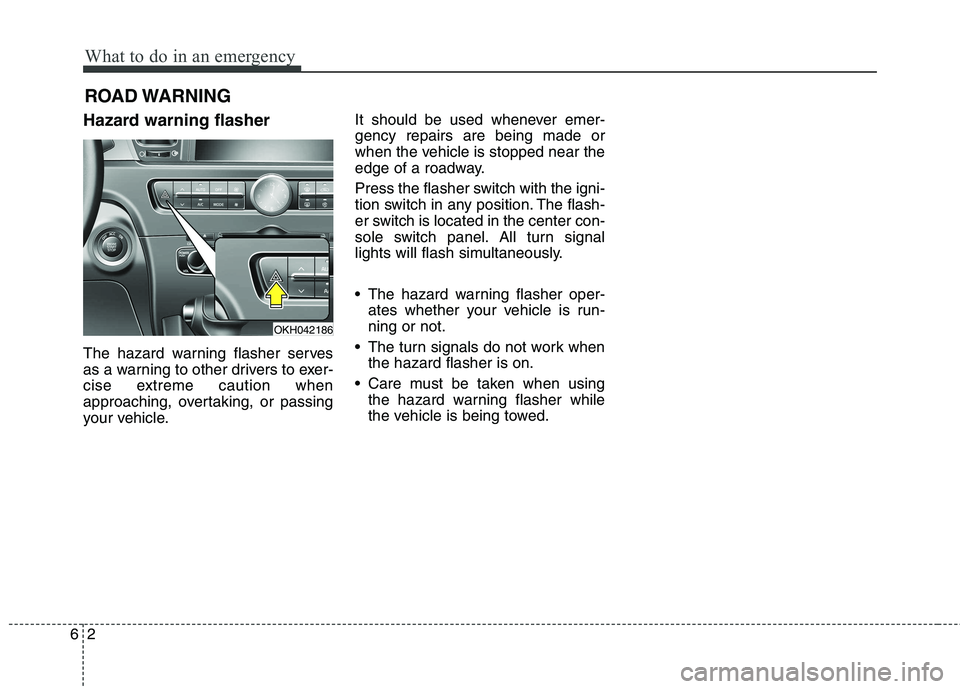
Hazard warning flasher
The hazard warning flasher serves
as a warning to other drivers to exer-
cise extreme caution when
approaching, overtaking, or passing
your vehicle. It should be used whenever emer-gency repairs are being made or
when the vehicle is stopped near the
edge of a roadway.
Press the flasher switch with the igni-
tion switch in any position. The flash-
er switch is located in the center con-
sole switch panel. All turn signal
lights will flash simultaneously.
• The hazard warning flasher oper-
ates whether your vehicle is run- ning or not.
The turn signals do not work when the hazard flasher is on.
Care must be taken when using the hazard warning flasher while
the vehicle is being towed.
OKH042186
Page 353 of 485
65
What to do in an emergency
EMERGENCY STARTING
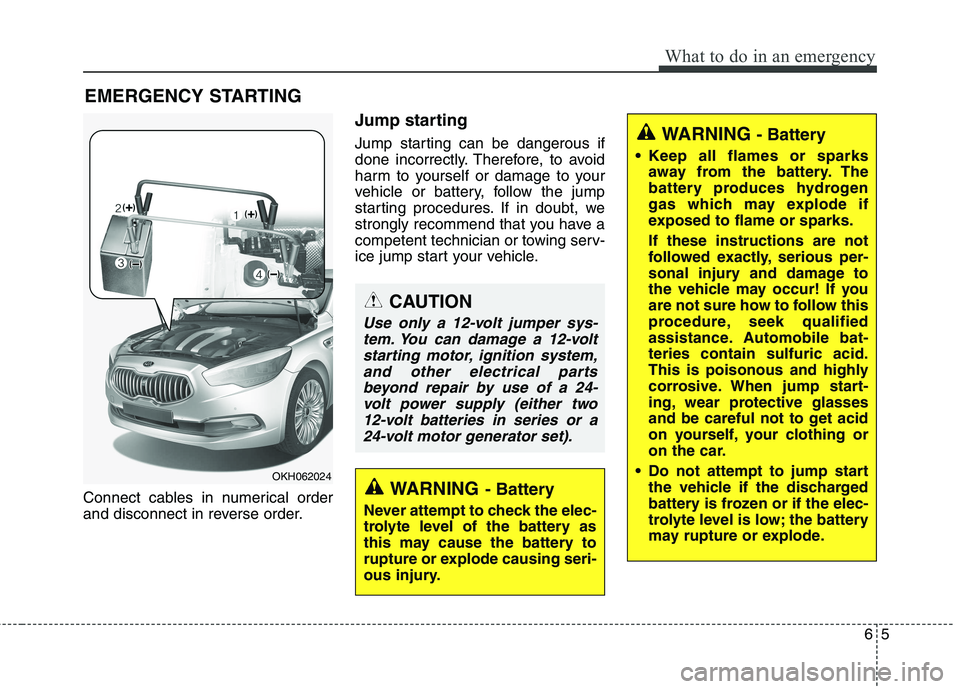
Connect cables in numerical order
and disconnect in reverse order. Jump starting
Jump starting can be dangerous if
done incorrectly. Therefore, to avoid
harm to yourself or damage to your
vehicle or battery, follow the jump
starting procedures. If in doubt, we
strongly recommend that you have a
competent technician or towing serv-
ice jump start your vehicle.
CAUTION
Use only a 12-volt jumper sys-
tem. You can damage a 12-voltstarting motor, ignition system,and other electrical partsbeyond repair by use of a 24- volt power supply (either two12-volt batteries in series or a24-volt motor generator set).
WARNING - Battery
• Keep all flames or sparks away from the battery. The
battery produces hydrogen
gas which may explode if
exposed to flame or sparks. If these instructions are not
followed exactly, serious per-
sonal injury and damage to
the vehicle may occur! If you
are not sure how to follow this
procedure, seek qualified
assistance. Automobile bat-teries contain sulfuric acid.
This is poisonous and highly
corrosive. When jump start-
ing, wear protective glasses
and be careful not to get acid
on yourself, your clothing or
on the car.
Do not attempt to jump start the vehicle if the discharged
battery is frozen or if the elec-
trolyte level is low; the battery
may rupture or explode.
WARNING - Battery
Never attempt to check the elec-
trolyte level of the battery as
this may cause the battery to
rupture or explode causing seri-
ous injury.OKH062024
Page 354 of 485
What to do in an emergency
6
6
Jump starting procedure
✽✽
NOTICE
Your vehicle has a battery in the
trunk room, but when you jump
start your vehicle, use the jumper
terminal in the engine room.
1.Make sure the booster battery is 12-volt and that its negative termi-
nal is grounded.
2.If the booster battery is in another vehicle, do not allow the vehicles totouch.
3.Turn off all unnecessary electrical loads.
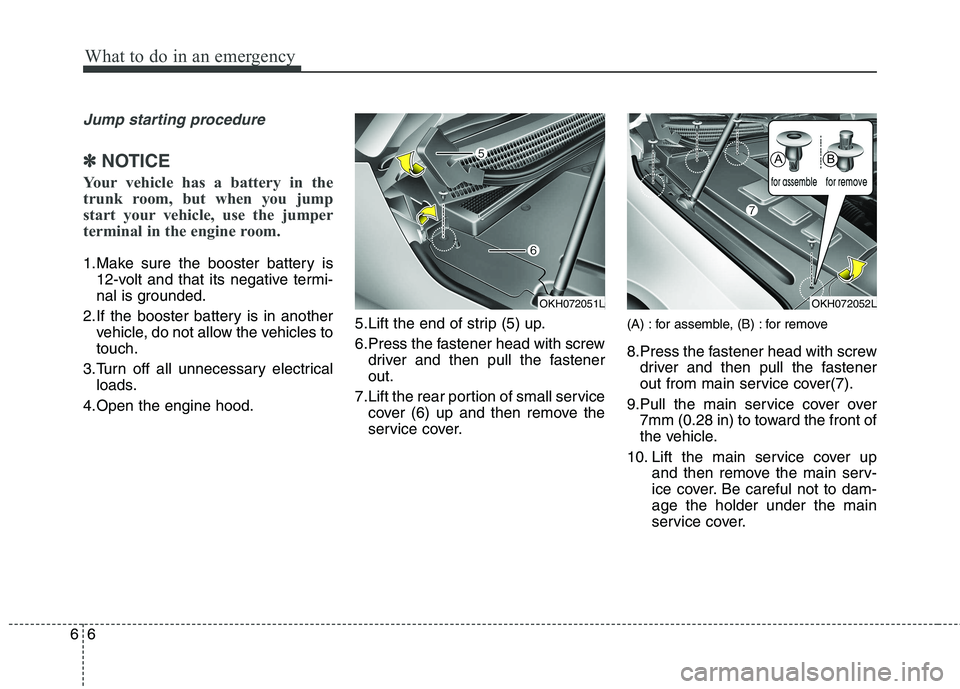
4.Open the engine hood. 5.Lift the end of strip (5) up.
6.Press the fastener head with screw
driver and then pull the fastener out.
7.Lift the rear portion of small service cover (6) up and then remove the
service cover. (A) : for assemble, (B) : for remove
8.Press the fastener head with screw
driver and then pull the fastener
out from main service cover(7).
9.Pull the main service cover over 7mm (0.28 in) to toward the front of
the vehicle.
10. Lift the main service cover up and then remove the main serv-
ice cover. Be careful not to dam-age the holder under the main
service cover.
OKH072051LOKH072052L
AB
Page 355 of 485
67
What to do in an emergency
11. Connect the jumper cables in theexact sequence shown in the
illustration. First connect one end
of a jumper cable to the positive
terminal of the jump start con-nector (1), then connect the other
end to the positive terminal on
the booster battery (2).
Proceed to connect one end of
the other jumper cable to the
negative terminal of the booster
battery (3), then the other end to
the negative terminal of the jump
start connector (4). Do not con-
nect it to or near any part that
moves when the engine is
cranked.
Do not allow the jumper cables to
contact anything except the cor-
rect battery terminals or the cor-
rect ground. Do not lean over the
battery when making connec-
tions. 12. Start the engine of the vehicle
with the booster battery and let it
run at 2,000 rpm, then start the
engine of the vehicle with the dis-
charged battery.
If the cause of your battery discharg-
ing is not apparent, we recommendthat the system be checked by anauthorized Kia dealer.
Push-starting
Vehicles equipped with automatic
transaxle cannot be push-started.
Follow the directions in this section
for jump-starting.CAUTION - Battery
cables
Do not connect the jumpercable from the negative terminalof the booster battery to thenegative terminal of the dis-charged battery. This can cause the discharged battery to over-heat and crack, releasing bat-tery acid.
WARNING
Never tow a vehicle to start it
because the sudden surge for-
ward when the engine startscould cause a collision with the
tow vehicle.
Page 360 of 485
What to do in an emergency
12
6
Changing a tire with TPMS
If you have a flat tire, the low Tire
Pressure and Position telltales will
come on. We recommend that the
system be checked by an authorized
Kia dealer. Each wheel is equipped with a tire pressure sensor mounted inside the
tire behind the valve stem. You must
use TPMS specific wheels. It is rec-
ommended that you have your tires
serviced by an authorized Kia dealer.CAUTION
The TPMS malfunction indica-
tor may blink for approximate-ly 1 minute and then remaincontinuously illuminated if thevehicle is moving around elec-tric power supply cables or radios transmitter such as atpolice stations, governmentand public offices, broadcast-ing stations, military installa-tions, airports, or transmitting towers, etc. This can interferewith normal operation of theTire Pressure MonitoringSystem (TPMS).
The TPMS malfunction indica- tor may blink for approximate-ly 1 minute and then remain continuously illuminated ifsnow chains are used or someseparate electronic devicessuch as notebook computer,mobile charger, remote starter or navigation etc., are used inthe vehicle.
(Continued)
(Continued)This can interfere with normaloperation of the Tire PressureMonitoring System (TPMS).
CAUTION
If you use a puncture-repairing agent to repair and/or inflate alow pressure tire. The tiresealant may damage the tirepressure sensor. We recom- mend that you use the sealantapproved by Kia. If used, we rec-ommend that the TPMS bechecked by an authorized Kia dealer.
Page 363 of 485
615
What to do in an emergency
(Continued)
Be sure to use the correctfront and rear jacking posi-
tions on the vehicle; never
use the bumpers or any other
part of the vehicle for jacking
support.
The vehicle can easily roll off the jack causing serious
injury or death.
Do not get under a vehicle that is supported by a jack.
Do not start or run the engine while the vehicle is on the
jack.
Do not allow anyone to remain in the vehicle while it is on the
jack.
Make sure any children pres- ent are in a secure place away
from the road and from the
vehicle to be raised with the
jack.
IF YOU HAVE A FLAT TIRE
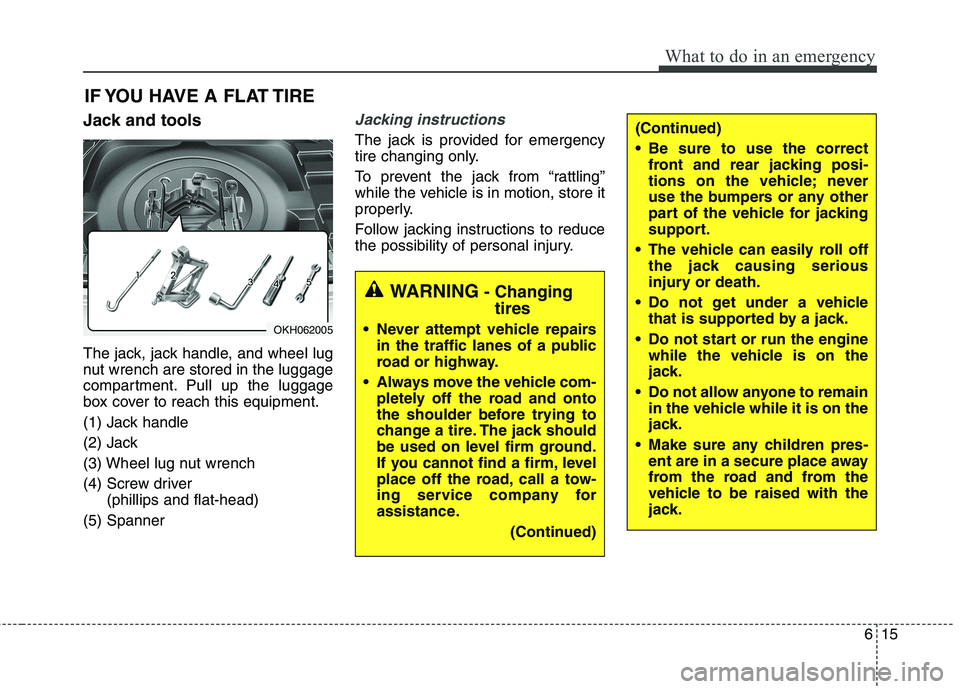
Jack and tools
The jack, jack handle, and wheel lug
nut wrench are stored in the luggage
compartment. Pull up the luggage
box cover to reach this equipment.
(1) Jack handle
(2) Jack
(3) Wheel lug nut wrench
(4) Screw driver (phillips and flat-head)
(5) Spanner
Jacking instructions
The jack is provided for emergency
tire changing only.
To prevent the jack from “rattling”
while the vehicle is in motion, store it
properly.
Follow jacking instructions to reduce
the possibility of personal injury.
WARNING - Changing
tires
Never attempt vehicle repairs in the traffic lanes of a public
road or highway.
Always move the vehicle com- pletely off the road and onto
the shoulder before trying to
change a tire. The jack should
be used on level firm ground.
If you cannot find a firm, level
place off the road, call a tow-
ing service company for
assistance.
(Continued)
OKH062005
Page 370 of 485
What to do in an emergency
22
6
TOWING
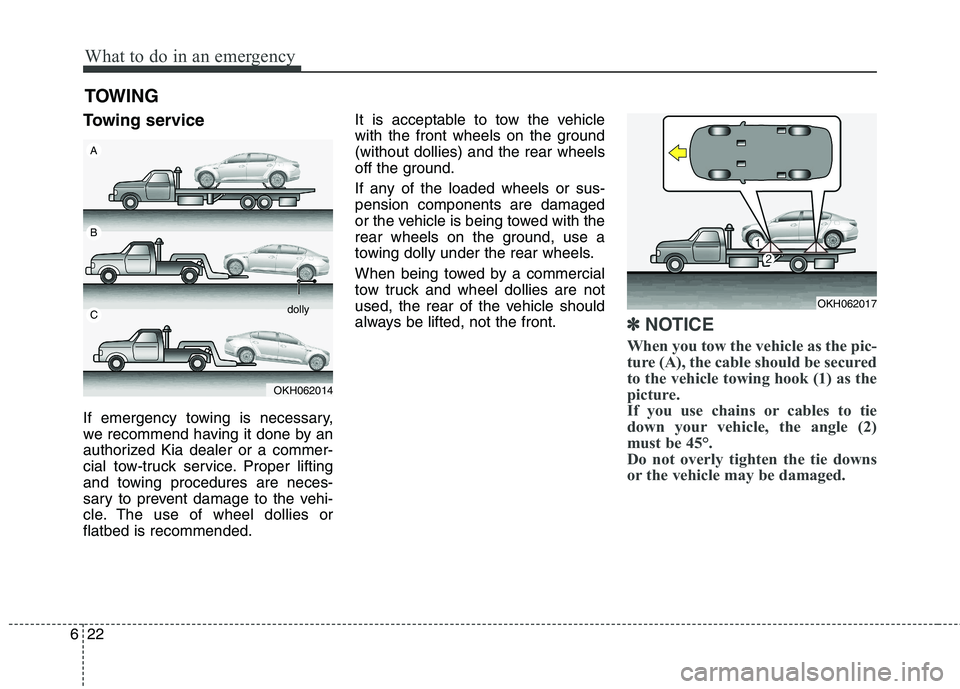
Towing service
If emergency towing is necessary,
we recommend having it done by an
authorized Kia dealer or a commer-
cial tow-truck service. Proper lifting
and towing procedures are neces-
sary to prevent damage to the vehi-
cle. The use of wheel dollies orflatbed is recommended. It is acceptable to tow the vehicle
with the front wheels on the ground(without dollies) and the rear wheels
off the ground.
If any of the loaded wheels or sus- pension components are damaged
or the vehicle is being towed with the
rear wheels on the ground, use a
towing dolly under the rear wheels.
When being towed by a commercial
tow truck and wheel dollies are not
used, the rear of the vehicle should
always be lifted, not the front.
✽✽
NOTICE
When you tow the vehicle as the pic-
ture (A), the cable should be secured
to the vehicle towing hook (1) as the
picture.
If you use chains or cables to tie
down your vehicle, the angle (2)
must be 45°.
Do not overly tighten the tie downs
or the vehicle may be damaged.
OKH062014
A
B
C dollyOKH062017