fuel KIA QUORIS 2014 Service Manual
[x] Cancel search | Manufacturer: KIA, Model Year: 2014, Model line: QUORIS, Model: KIA QUORIS 2014Pages: 486, PDF Size: 31.74 MB
Page 390 of 486
Maintenance
14
7
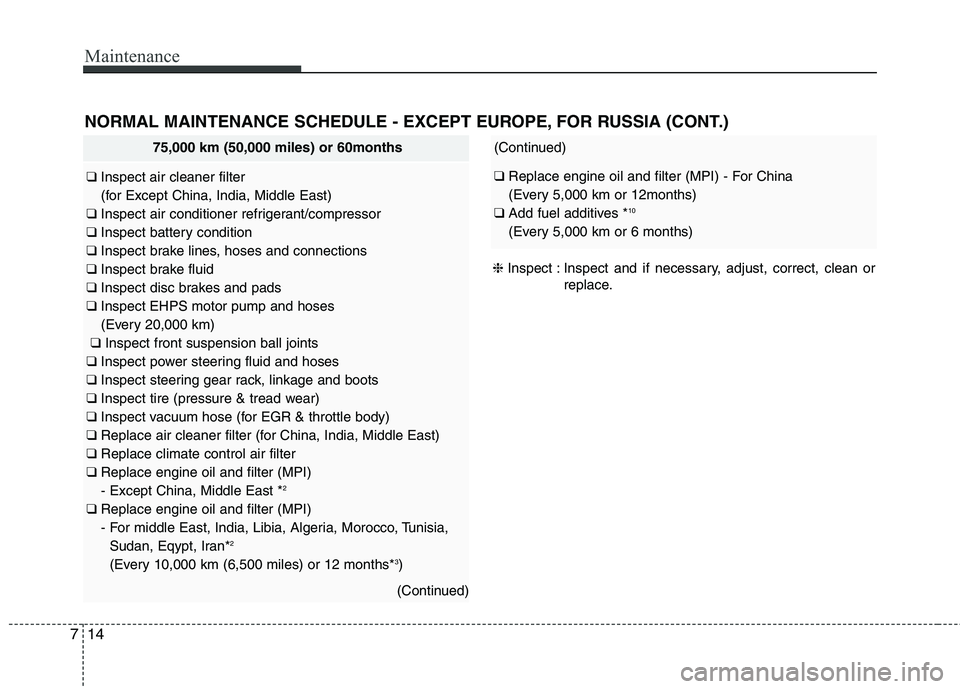
NORMAL MAINTENANCE SCHEDULE - EXCEPT EUROPE, FOR RUSSIA (CONT.)
75,000 km (50,000 miles) or 60months
❑ Inspect air cleaner filter
(for Except China, India, Middle East)
❑ Inspect air conditioner refrigerant/compressor
❑ Inspect battery condition
❑ Inspect brake lines, hoses and connections
❑ Inspect brake fluid
❑ Inspect disc brakes and pads
❑ Inspect EHPS motor pump and hoses
(Every 20,000 km)
❑ Inspect front suspension ball joints
❑ Inspect power steering fluid and hoses
❑ Inspect steering gear rack, linkage and boots
❑ Inspect tire (pressure & tread wear)
❑ Inspect vacuum hose (for EGR & throttle body)
❑ Replace air cleaner filter (for China, India, Middle East)
❑ Replace climate control air filter
❑ Replace engine oil and filter (MPI) - Except China, Middle East * 2
❑ Replace engine oil and filter (MPI)
- For middle East, India, Libia, Algeria, Morocco, Tunisia,
Sudan, Eqypt, Iran* 2
(Every 10,000 km (6,500 miles) or 12 months* 3
)
(Continued)
(Continued)
❑ Replace engine oil and filter (MPI) - For China
(Every 5,000 km or 12months)
❑ Add fuel additives * 10
(Every 5,000 km or 6 months)
❈ Inspect : Inspect and if necessary, adjust, correct, clean or
replace.
Page 391 of 486
715
Maintenance
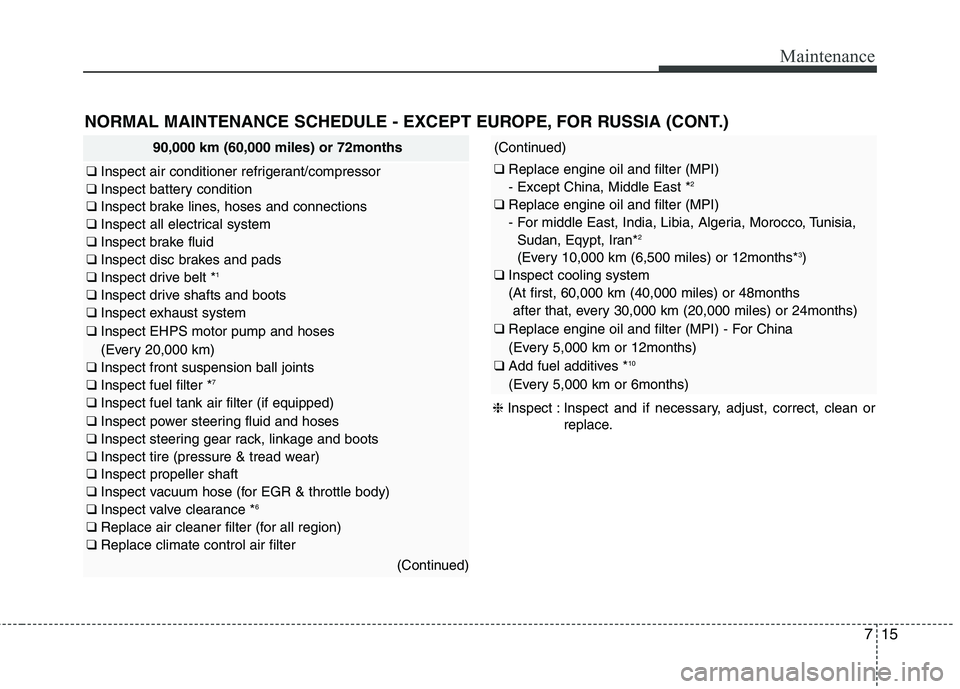
NORMAL MAINTENANCE SCHEDULE - EXCEPT EUROPE, FOR RUSSIA (CONT.)
90,000 km (60,000 miles) or 72months
❑ Inspect air conditioner refrigerant/compressor
❑ Inspect battery condition
❑ Inspect brake lines, hoses and connections
❑ Inspect all electrical system
❑ Inspect brake fluid
❑ Inspect disc brakes and pads
❑ Inspect drive belt * 1
❑ Inspect drive shafts and boots
❑ Inspect exhaust system
❑ Inspect EHPS motor pump and hoses
(Every 20,000 km)
❑ Inspect front suspension ball joints
❑ Inspect fuel filter * 7
❑ Inspect fuel tank air filter (if equipped)
❑ Inspect power steering fluid and hoses
❑ Inspect steering gear rack, linkage and boots
❑ Inspect tire (pressure & tread wear)
❑ Inspect propeller shaft
❑ Inspect vacuum hose (for EGR & throttle body)
❑ Inspect valve clearance * 6
❑ Replace air cleaner filter (for all region)
❑ Replace climate control air filter
(Continued)
(Continued)
❑ Replace engine oil and filter (MPI) - Except China, Middle East * 2
❑ Replace engine oil and filter (MPI)
- For middle East, India, Libia, Algeria, Morocco, Tunisia,
Sudan, Eqypt, Iran* 2
(Every 10,000 km (6,500 miles) or 12months* 3
)
❑ Inspect cooling system
(At first, 60,000 km (40,000 miles) or 48months
after that, every 30,000 km (20,000 miles) or 24months)
❑ Replace engine oil and filter (MPI) - For China
(Every 5,000 km or 12months)
❑ Add fuel additives * 10
(Every 5,000 km or 6months)
❈ Inspect : Inspect and if necessary, adjust, correct, clean or
replace.
Page 392 of 486
Maintenance
16
7
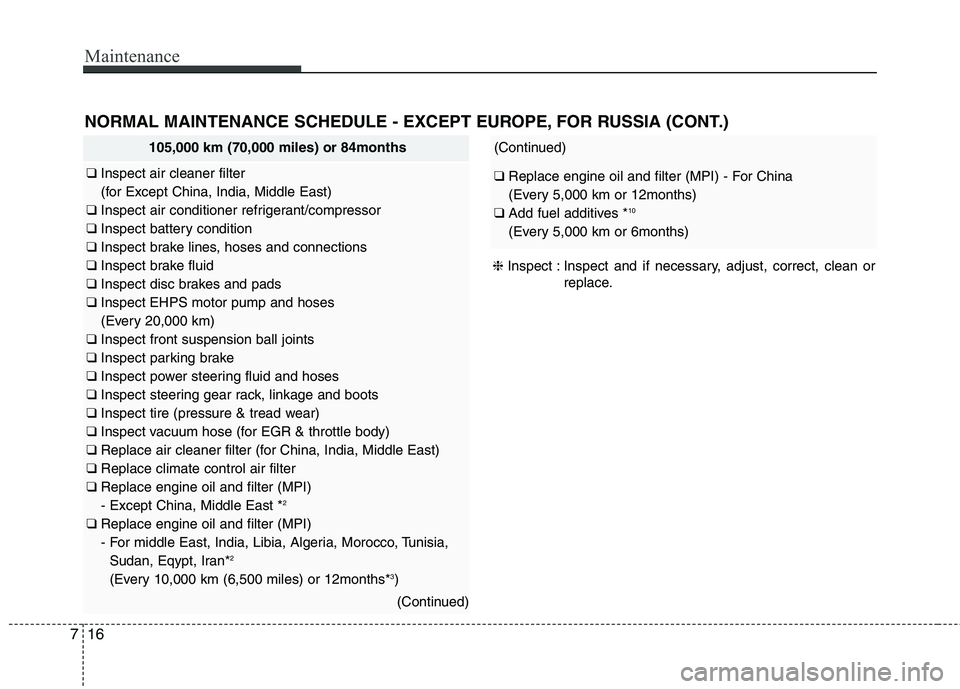
NORMAL MAINTENANCE SCHEDULE - EXCEPT EUROPE, FOR RUSSIA (CONT.)
105,000 km (70,000 miles) or 84months
❑ Inspect air cleaner filter
(for Except China, India, Middle East)
❑ Inspect air conditioner refrigerant/compressor
❑ Inspect battery condition
❑ Inspect brake lines, hoses and connections
❑ Inspect brake fluid
❑ Inspect disc brakes and pads
❑ Inspect EHPS motor pump and hoses
(Every 20,000 km)
❑ Inspect front suspension ball joints
❑ Inspect parking brake
❑ Inspect power steering fluid and hoses
❑ Inspect steering gear rack, linkage and boots
❑ Inspect tire (pressure & tread wear)
❑ Inspect vacuum hose (for EGR & throttle body)
❑ Replace air cleaner filter (for China, India, Middle East)
❑ Replace climate control air filter
❑ Replace engine oil and filter (MPI) - Except China, Middle East * 2
❑ Replace engine oil and filter (MPI)
- For middle East, India, Libia, Algeria, Morocco, Tunisia,
Sudan, Eqypt, Iran* 2
(Every 10,000 km (6,500 miles) or 12months* 3
)
(Continued)
(Continued)
❑ Replace engine oil and filter (MPI) - For China
(Every 5,000 km or 12months)
❑ Add fuel additives * 10
(Every 5,000 km or 6months)
❈ Inspect : Inspect and if necessary, adjust, correct, clean or
replace.
Page 393 of 486
717
Maintenance
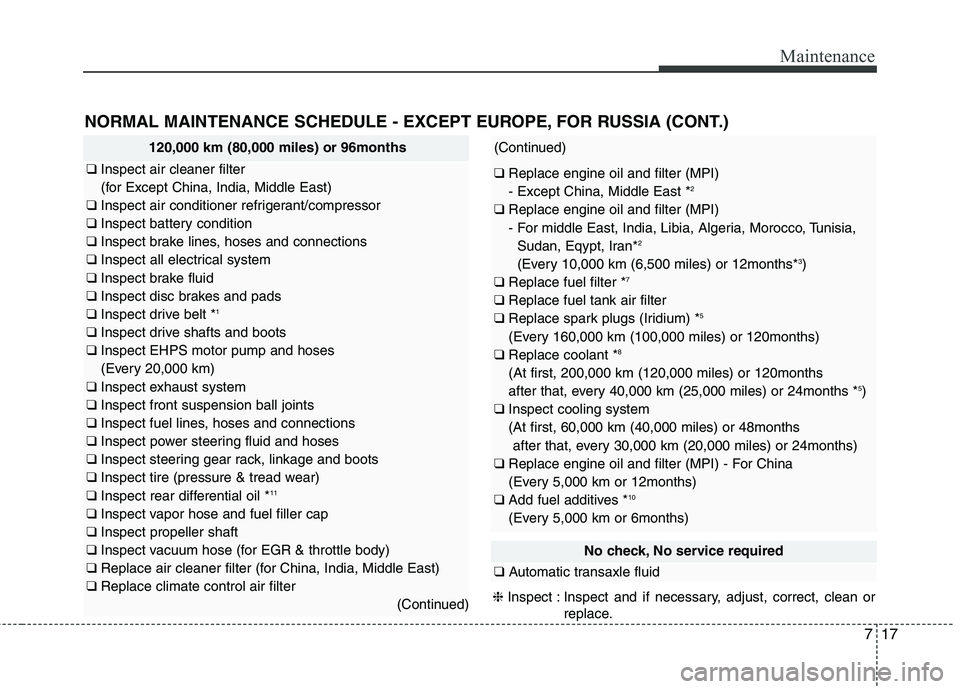
NORMAL MAINTENANCE SCHEDULE - EXCEPT EUROPE, FOR RUSSIA (CONT.)
120,000 km (80,000 miles) or 96months
❑ Inspect air cleaner filter
(for Except China, India, Middle East)
❑ Inspect air conditioner refrigerant/compressor
❑ Inspect battery condition
❑ Inspect brake lines, hoses and connections
❑ Inspect all electrical system
❑ Inspect brake fluid
❑ Inspect disc brakes and pads
❑ Inspect drive belt * 1
❑ Inspect drive shafts and boots
❑ Inspect EHPS motor pump and hoses
(Every 20,000 km)
❑ Inspect exhaust system
❑ Inspect front suspension ball joints
❑ Inspect fuel lines, hoses and connections
❑ Inspect power steering fluid and hoses
❑ Inspect steering gear rack, linkage and boots
❑ Inspect tire (pressure & tread wear)
❑ Inspect rear differential oil * 11
❑ Inspect vapor hose and fuel filler cap
❑ Inspect propeller shaft
❑ Inspect vacuum hose (for EGR & throttle body)
❑ Replace air cleaner filter (for China, India, Middle East)
❑ Replace climate control air filter
(Continued)
(Continued)
❑ Replace engine oil and filter (MPI) - Except China, Middle East * 2
❑ Replace engine oil and filter (MPI)
- For middle East, India, Libia, Algeria, Morocco, Tunisia,
Sudan, Eqypt, Iran* 2
(Every 10,000 km (6,500 miles) or 12months* 3
)
❑ Replace fuel filter * 7
❑ Replace fuel tank air filter
❑ Replace spark plugs (Iridium) * 5
(Every 160,000 km (100,000 miles) or 120months)
❑ Replace coolant * 8
(At first, 200,000 km (120,000 miles) or 120months
after that, every 40,000 km (25,000 miles) or 24months * 5
)
❑ Inspect cooling system
(At first, 60,000 km (40,000 miles) or 48months
after that, every 30,000 km (20,000 miles) or 24months)
❑ Replace engine oil and filter (MPI) - For China
(Every 5,000 km or 12months)
❑ Add fuel additives * 10
(Every 5,000 km or 6months)
No check, No service required
❑ Automatic transaxle fluid
❈ Inspect : Inspect and if necessary, adjust, correct, clean or
replace.
Page 396 of 486

Maintenance
20
7
EXPLANATION OF SCHEDULED MAINTENANCE ITEMS
Engine oil and filter The engine oil and filter should be
changed at the intervals specified in
the maintenance schedule. If the car
is being driven in severe conditions,more frequent oil and filter changesare required. Drive belts
Inspect all drive belts for evidence of
cuts, cracks, excessive wear or oil
saturation and replace if necessary.
Drive belts should be checked peri-
odically for proper tension and
adjusted as necessary. Fuel filter A clogged filter can limit the speed at
which the vehicle may be driven,damage the emission system and
cause multiple issues such as hard
starting. If an excessive amount of
foreign matter accumulates in the
fuel tank, the filter may require
replacement more frequently.
After installing a new filter, run the
engine for several minutes, and
check for leaks at the connections.
We recommend that the fuel lines,fuel hoses and connectionsr be
replaced by an authoized Kia dealer.
Fuel lines, fuel hoses and con- nections
Check the fuel lines, fuel hoses and
connections for leakage and dam-
age. We recommend that the fuel
lines, fuel hoses and connectionsr be
replaced by an authoized Kia dealer.
Vapor hose and fuel filler cap
The vapor hose and fuel filler cap should be inspected at those inter-
vals specified in the maintenance
schedule. Make sure that a new
vapor hose or fuel filler cap is cor-rectly replaced.
CAUTION
When you are inspecting the
belt, place the ignition
switch in the LOCK/OFF or ACCposition.
Page 419 of 486
743
Maintenance
TIRES AND WHEELS
Tire care
For proper maintenance, safety, and
maximum fuel economy, you must
always maintain recommended tire
inflation pressures and stay within
the load limits and weight distribution
recommended for your vehicle. Recommended cold tire infla- tion pressures All tire pressures (including the
spare) should be checked when the
tires are cold. “Cold Tires” means the
vehicle has not been driven for at
least three hours or driven less than1.6 km (one mile).
Recommended pressures must be
maintained for the best ride, top vehi-
cle handling, and minimum tire wear.
For recommended inflation pressure,
refer to “Tire and wheels” in section 8. All specifications (sizes and pres-
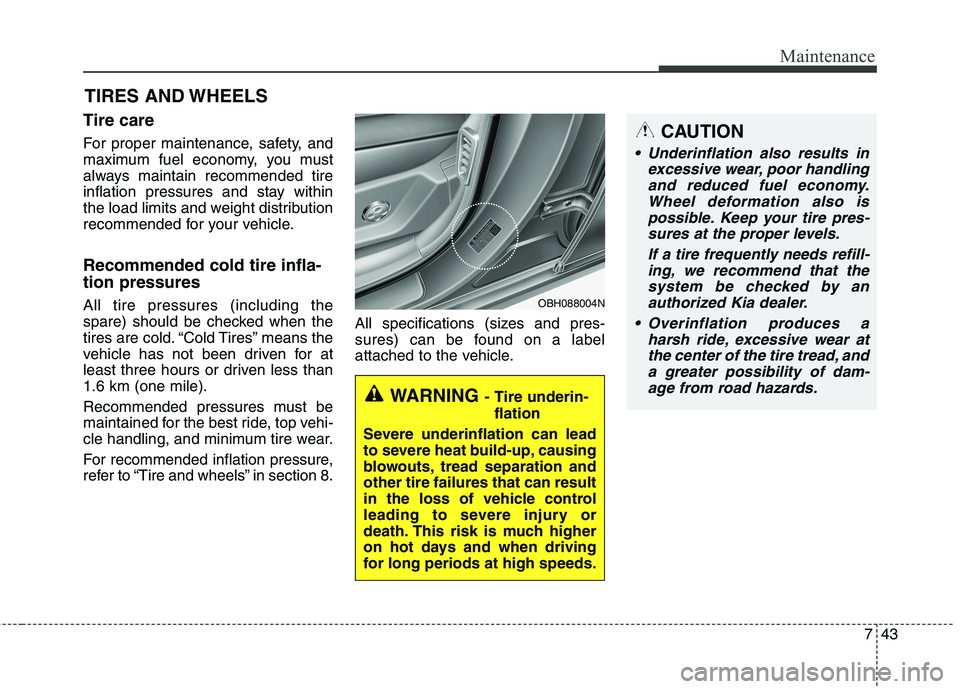
sures) can be found on a label
attached to the vehicle.
WARNING
- Tire underin-
flation
Severe underinflation can lead
to severe heat build-up, causing
blowouts, tread separation andother tire failures that can result
in the loss of vehicle control
leading to severe injury or
death. This risk is much higher
on hot days and when driving
for long periods at high speeds.
OBH088004N
CAUTION
Underinflation also results in excessive wear, poor handlingand reduced fuel economy. Wheel deformation also ispossible. Keep your tire pres-sures at the proper levels.
If a tire frequently needs refill-ing, we recommend that thesystem be checked by anauthorized Kia dealer.
Overinflation produces a harsh ride, excessive wear atthe center of the tire tread, anda greater possibility of dam-age from road hazards.
Page 444 of 486

Maintenance
68
7
FuseFuse NameSymbolFuse rastingCircuit Protected
METAL
CORE
BLOCK
(PCB #1)
Sensor 310ARear Smart Junction Box (Fuel Pump Relay)
P/Door PASS15APassenger Door Latch
SPARE15ASpare
Deicer15AMetal Core Block (PCB #1) (Front Deicer Relay)
Ignition20AIgnition Coil #1~6, Condenser #1, #2
Horn15AMetal Core Block (PCB #1) (Horn Relay)
Sensor 210AMass Air Flow Sensor, Oxygen Sensor #1~4, E/R Fuse & Relay Box LH (RLY.6)
SPARE15ASpare
Wiper 330AWiper Motor
ECU 330AMetal Core Block (PCB #1) (ECU Main Relay)
ECS 240AMetal Core Block (PCB #1) (Air ECS Relay)
METAL CORE
BLOCK
(PCB #2)
Sensor 115APurge Control Solenoid Valve, ECM, Variable Intake Solenoid Valve,
Oil Control Valve #1~4
Injector 22 INJECTOR15AInjector #1~6
SPARE10ASpare
SPARE20ASpare
SPARE10ASpare
Page 447 of 486

771
Maintenance
Fuse NameSymbolFuse rastingCircuit Protected
Rear HTD40ARear Defogger Relay
P/WDW RH30APassenger Power Window Module, Rear Power Window Module RH
P/Trunk30APower Trunk Module
F/Pump20AFuel Pump Relay
Rear P/Seat 120ARear Seat Relay Box
ECS 11ECS20AECS Unit
PASS P/Seat15APassenger IMS Control Module
P/Door RR RH15ARear Door Latch RH
Spare15ASpare
Trunk10ATrunk Lid Relay, Power Trunk Module Buzzer
Rear Fog Lamp10ARear Fog Lamp Relay
Spare40ASpare
AMP30AAMP
Spare20ASpare
Rear P/Seat 210ARear Seat Relay Box LH, Rear Seat Relay RH, Rear Seat Massage Control Module LH, Rear Seat Massage Control Module RH
Spare10ASpare
Trunk fuse panel
Page 457 of 486
781
Maintenance
Bright-metal maintenance
To remove road tar and insects,use a tar remover, not a scraper or
other sharp object.
To protect the surfaces of bright- metal parts from corrosion, apply a
coating of wax or chrome preser-
vative and rub to a high luster.
During winter weather or in coastal areas, cover the bright metal parts
with a heavier coating of wax or
preservative. If necessary, coat the
parts with non-corrosive petroleum
jelly or other protective compound.
Underbody maintenance
Corrosive materials used for ice and
snow removal and dust control may
collect on the underbody. If these
materials are not removed, acceler-
ated rusting can occur on underbody
parts such as the fuel lines, frame,
floor pan and exhaust system, even
though they have been treated with
rust protection.
Thoroughly flush the vehicle under-
body and wheel openings with luke-
warm or cold water once a month,
after off-road driving and at the end of
each winter. Pay special attention tothese areas because it is difficult to
see all the mud and dirt. It will do
more harm than good to wet down the
road grime without removing it. The
lower edges of doors, rocker panels,
and frame members have drain holes
that should not be allowed to clog with
dirt; trapped water in these areas can
cause rusting.WARNING
After washing the vehicle, test
the brakes while driving slowly
to see if they have been affected
by water. If braking performance
is impaired, dry the brakes by
applying them lightly while
maintaining a slow forwardspeed.
Page 462 of 486
Maintenance
86
7
EMISSION CONTROL SYSTEM (IF EQUIPPED)
The emission control system of your
vehicle is covered by a written limited
warranty. Please see the warranty
information contained in the Service
Passport in your vehicle.
Your vehicle is equipped with an emission control system to meet all
applicable emission regulations. There are three emission control
systems, as follows.
(1) Crankcase emission control sys- tem
(2) Evaporative emission control sys- tem
(3) Exhaust emission control systemIn order to assure the proper function
of the emission control systems, it is
recommended that you have your
car inspected and maintained by an
authorized Kia dealer in accordancewith the maintenance schedule in
this manual. Caution for the Inspection and
Maintenance Test (With Electronic
Stability Control (ESC) system)
To prevent the vehicle from mis-
firing during dynamometer test-
ing, turn the Electronic Stability
Control (ESC) system off by
pressing the ESC switch.
After dynamometer testing is completed, turn the ESC system
back on by pressing the ESC
switch again. 1. Crankcase emission control
system
The positive crankcase ventilation
system is employed to prevent air
pollution caused by blow-by gases
being emitted from the crankcase.This system supplies fresh filtered air
to the crankcase through the air
intake hose. Inside the crankcase,
the fresh air mixes with blow-by
gases, which then pass through the
PCV valve into the induction system.
2. Evaporative emission con- trol system
The Evaporative Emission Control
System is designed to prevent fuel
vapors from escaping into the atmos-
phere.