warning KIA QUORIS 2015 Owners Manual
[x] Cancel search | Manufacturer: KIA, Model Year: 2015, Model line: QUORIS, Model: KIA QUORIS 2015Pages: 486, PDF Size: 35.55 MB
Page 338 of 486
Driving your vehicle
94
5
Hazardous driving conditions
When hazardous driving conditions
are encountered such as water,
snow, ice, mud, sand, or similar haz-
ards, follow these suggestions:
Drive cautiously and allow extra
distance for braking.
Avoid sudden braking or steering.
If stalled in snow, mud, or sand, use second gear. Accelerate slowly to
avoid spinning the drive wheels.
Use sand, rock salt, tire chains, or other non-slip material under the
drive wheels to provide traction
when stalled in ice, snow, or mud. Rocking the vehicle
If it is necessary to rock the vehicle
to free it from snow, sand, or mud,
first turn the steering wheel right and
left to clear the area around your
front wheels. Then, shift back and
forth between R (Reverse) and any
forward gear in vehicles equipped
with an automatic transaxle. Do not
race the engine, and spin the wheels
as little as possible. If you are still
stuck after a few tries, have the vehi-
cle pulled out by a tow vehicle to
avoid engine overheating and possi-
ble damage to the transaxle.
SPECIAL DRIVING CONDITIONS WARNING
- Downshifting
Downshifting with an automatic
transaxle, while driving on slip-
pery surfaces can cause an
accident. The sudden change intire speed could cause the tires
to skid. Be careful when down-
shifting on slippery surfaces.
WARNING - ABS
Do not pump the brake pedal on
a vehicle equipped with ABS.
CAUTION
Prolonged rocking may cause engine over-heating, transaxledamage or failure, and tire dam-age.
Page 339 of 486
595
Driving your vehicle
✽✽NOTICE
The ESC system should be turned
OFF prior to rocking the vehicle.
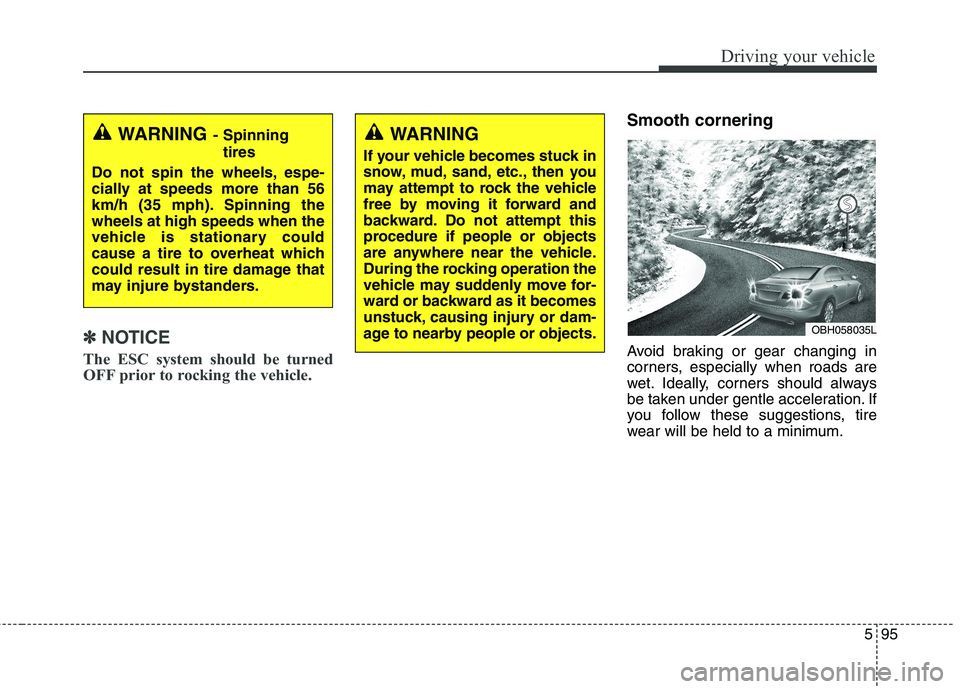
Smooth cornering
Avoid braking or gear changing in
corners, especially when roads are
wet. Ideally, corners should always
be taken under gentle acceleration. If
you follow these suggestions, tire
wear will be held to a minimum.WARNING - Spinning
tires
Do not spin the wheels, espe-
cially at speeds more than 56
km/h (35 mph). Spinning thewheels at high speeds when the
vehicle is stationary could
cause a tire to overheat which
could result in tire damage that
may injure bystanders.WARNING
If your vehicle becomes stuck in
snow, mud, sand, etc., then you
may attempt to rock the vehicle
free by moving it forward and
backward. Do not attempt this
procedure if people or objects
are anywhere near the vehicle.
During the rocking operation the
vehicle may suddenly move for-
ward or backward as it becomes
unstuck, causing injury or dam-
age to nearby people or objects.
OBH058035L
Page 342 of 486
Driving your vehicle
98
5
Fuel, engine coolant and engine
oil
High speed travel consumes more
fuel than urban motoring. Do not for-
get to check both engine coolant andengine oil.
Drive belt
A loose or damaged drive belt may
result in overheating of the engine.
WARNING
Underinflated or overinflated tires can cause poor handling,
loss of vehicle control, and
sudden tire failure leading to
accidents, injuries, and even
death. Always check the tires
for proper inflation before
driving. For proper tire pres-
sures, refer to section 8,“Tires and wheels”.
Driving on tires with no or insufficient tread is danger-
ous. Worn-out tires can result
in loss of vehicle control, col-
lisions, injury, and even death.
Worn-out tires should be
replaced as soon as possible
and should never be used for
driving. Always check the tire
tread before driving your vehi-
cle. For further information
and tread limits, refer to sec-
tion 7, “Tires and wheels”.
Page 343 of 486
599
Driving your vehicle
WINTER DRIVING
Severe weather conditions in the
winter result in greater wear and
other problems. To minimize the
problems of winter driving, you
should follow these suggestions: Snowy or Icy conditions
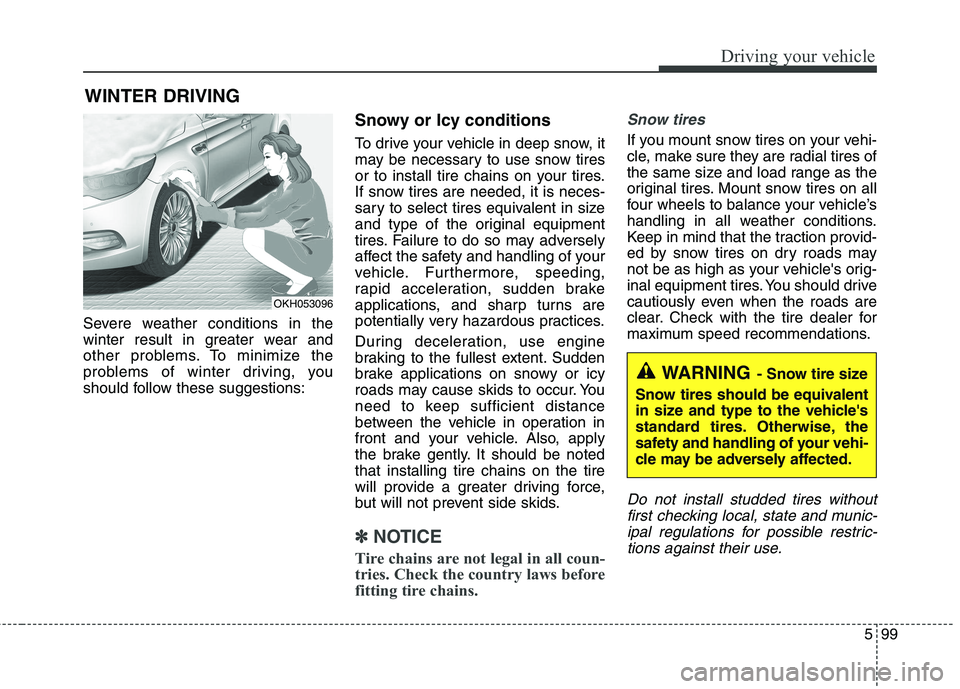
To drive your vehicle in deep snow, it
may be necessary to use snow tires
or to install tire chains on your tires.
If snow tires are needed, it is neces-
sary to select tires equivalent in size
and type of the original equipment
tires. Failure to do so may adversely
affect the safety and handling of your
vehicle. Furthermore, speeding,
rapid acceleration, sudden brake
applications, and sharp turns are
potentially very hazardous practices.
During deceleration, use engine
braking to the fullest extent. Sudden
brake applications on snowy or icy
roads may cause skids to occur. You
need to keep sufficient distance
between the vehicle in operation in
front and your vehicle. Also, apply
the brake gently. It should be notedthat installing tire chains on the tire
will provide a greater driving force,
but will not prevent side skids.
✽✽
NOTICE
Tire chains are not legal in all coun-
tries. Check the country laws before
fitting tire chains.
Snow tires
If you mount snow tires on your vehi-
cle, make sure they are radial tires of
the same size and load range as the
original tires. Mount snow tires on all
four wheels to balance your vehicle’s
handling in all weather conditions.
Keep in mind that the traction provid-
ed by snow tires on dry roads may
not be as high as your vehicle's orig-
inal equipment tires. You should drive
cautiously even when the roads are
clear. Check with the tire dealer for
maximum speed recommendations.
Do not install studded tires without first checking local, state and munic-ipal regulations for possible restric-tions against their use.
WARNING - Snow tire size
Snow tires should be equivalent
in size and type to the vehicle's
standard tires. Otherwise, the
safety and handling of your vehi-
cle may be adversely affected.
OKH053096
Page 344 of 486
Driving your vehicle
100
5
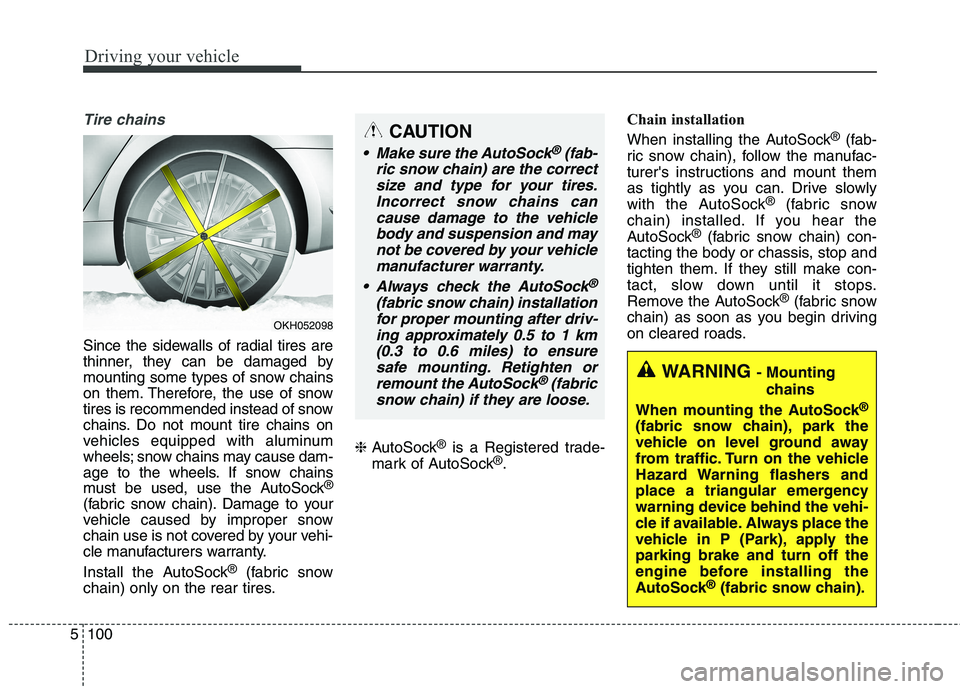
Tire chains
Since the sidewalls of radial tires are
thinner, they can be damaged by
mounting some types of snow chains
on them. Therefore, the use of snow
tires is recommended instead of snow
chains. Do not mount tire chains on
vehicles equipped with aluminum
wheels; snow chains may cause dam-
age to the wheels. If snow chains
must be used, use the AutoSock ®
(fabric snow chain). Damage to your
vehicle caused by improper snow
chain use is not covered by your vehi-
cle manufacturers warranty.
Install the AutoSock ®
(fabric snow
chain) only on the rear tires. ❈
AutoSock ®
is a Registered trade-
mark of AutoSock ®
. Chain installation
When installing the AutoSock
®
(fab-
ric snow chain), follow the manufac-
turer's instructions and mount them
as tightly as you can. Drive slowly
with the AutoSock ®
(fabric snow
chain) installed. If you hear the
AutoSock ®
(fabric snow chain) con-
tacting the body or chassis, stop and
tighten them. If they still make con-
tact, slow down until it stops.
Remove the AutoSock ®
(fabric snow
chain) as soon as you begin driving
on cleared roads.
CAUTION
Make sure the AutoSock®(fab-
ric snow chain) are the correct size and type for your tires.Incorrect snow chains cancause damage to the vehiclebody and suspension and may not be covered by your vehiclemanufacturer warranty.
Always check the AutoSock
®
(fabric snow chain) installation for proper mounting after driv- ing approximately 0.5 to 1 km(0.3 to 0.6 miles) to ensuresafe mounting. Retighten orremount the AutoSock
®(fabric
snow chain) if they are loose.
OKH052098
WARNING - Mounting
chains
When mounting the AutoSock ®
(fabric snow chain), park the
vehicle on level ground away
from traffic. Turn on the vehicle
Hazard Warning flashers and
place a triangular emergency
warning device behind the vehi-
cle if available. Always place the
vehicle in P (Park), apply theparking brake and turn off the
engine before installing the
AutoSock ®
(fabric snow chain).
Page 345 of 486
5101
Driving your vehicle
❈AutoSock ®
is a Registered trade-
mark of AutoSock ®
. Use high quality ethylene gly- col coolant
Your vehicle is delivered with high
quality ethylene glycol coolant in the
cooling system. It is the only type ofcoolant that should be used because
it helps prevent corrosion in the cool-
ing system, lubricates the water
pump and prevents freezing. Be sure
to replace or replenish your coolantin accordance with the maintenance
schedule in section 7. Before winter,
have your coolant tested to assure
that its freezing point is sufficient for
the temperatures anticipated during
the winter.
Check battery and cables
Winter puts additional burdens on
the battery system. Visually inspect
the battery and cables as described
in section 7. We recommend that the
level of charge in your battery be
checked by an authorized Kia dealer.
CAUTION
The AutoSock®(fabric snow
chain) that are the wrong size or improperly installed can damage your vehicle's brakelines, suspension, body andwheels.
Stop driving and retighten the AutoSock
®(fabric snow
chain) any time you hear them hitting the vehicle.
WARNING - Tire chains
The use of the AutoSock ®
(fab-
ric snow chain) may adversely
affect vehicle handling.
Do not exceed 30 km/h (20 mph) or the AutoSock ®
(fabric
snow chain) manufacturer’srecommended speed limit,
whichever is lower.
Drive carefully and avoid bumps, holes, sharp turns, and
other road hazards, which may
cause the vehicle to bounce.
Avoid sharp turns or locked- wheel braking.
Page 347 of 486
5103
Driving your vehicle
VEHICLE WEIGHT
This section will guide you in the
proper loading of your vehicle and/or
trailer, to keep your loaded vehicle
weight within its design rating capa-
bility, with or without a trailer. Properly
loading your vehicle will provide max-
imum return of the vehicle design
performance. Before loading your
vehicle, familiarize yourself with the
following terms for determining your
vehicle's weight ratings, with or with-
out a trailer, from the vehicle's speci-
fications and the certification label: Base curb weight
This is the weight of the vehicle including a full tank of fuel and all
standard equipment. It does not
include passengers, cargo, or option-al equipment.
Vehicle curb weight
This is the weight of your new vehicle
when you picked it up from your deal-
er plus any aftermarket equipment. Cargo weight
This figure includes all weight added
to the Base Curb Weight, includingcargo and optional equipment.
GAW (Gross axle weight)
This is the total weight placed on each axle (front and rear) - including
vehicle curb weight and all payload.
GAWR
(Gross axle weight rating)
This is the maximum allowable
weight that can be carried by a single
axle (front or rear). These numbers
are shown on the certification label.
The total load on each axle must
never exceed its GAWR.
GVW (Gross vehicle weight)
This is the Base Curb Weight plus
actual Cargo Weight plus passengers.
GVWR
(Gross vehicle weight rating)
This is the maximum allowable
weight of the fully loaded vehicle
(including all options, equipment,
passengers and cargo). The GVWR
is shown on the certification label. Overloading
WARNING
- Vehicle
weight
The gross axle weight rating
(GAWR) and the gross vehicle
weight rating (GVWR) for your
vehicle are on the certification
label attached to the driver's (or
front passenger’s) door.Exceeding these ratings can
cause an accident or vehicle
damage. You can calculate the
weight of your load by weighing
the items (and people) before
putting them in the vehicle. Be
careful not to overload your
vehicle.
Page 348 of 486
What to do in an emergency
Road warning . . . . . . . . . . . . . . . . . . . . . . . . . . . . . . 6-2• Hazard warning flasher . . . . . . . . . . . . . . . . . . . . . . . 6-2
In case of an emergency while driving . . . . . . . . . . 6-3
. . . . . . . . . . . . . . . 6-3
. . . . . . . . . . . . . . . . . . . . 6-3
If the engine will not start . . . . . . . . . . . . . . . . . . . . 6-4 . . . . 6-4
. . . . 6-4
Emergency starting . . . . . . . . . . . . . . . . . . . . . . . . . 6-5
. . . . . . . . . . . . . . . . . . . . . . . . . . . . . . . . 6-7
If the engine overheats . . . . . . . . . . . . . . . . . . . . . . . 6-8
Tire Pressure Monitoring System (TPMS) . . . . . 6-10 . . . . . . . . . . . . . . . . . . . . . . 6-11
. . . . . . . . . . . . . . . 6-11
malfunction indicator . . . . . . . . . . . . . . . . . . . . . . . . 6-13
. . . . . . . . . . . . . . . . . . . . 6-14
If you have a flat tire . . . . . . . . . . . . . . . . . . . . . . . 6-16 . . . . . . . . . . . . . . . . . . . . . . . . . . . . . . . 6-16
. . . . . . . . . . . . 6-17
. . . . . . . . . . . . . . . . . . . . . . . . . . . . . . . 6-17 Towing . . . . . . . . . . . . . . . . . . . . . . . . . . . . . . . . . . . 6-24
. . . . . . . . . . . . . . . . . . . . . . . . . . . . . . . 6-24
. . . . . . . . . . . . . . . . . . . . . . . 6-26
. . . . . . . . . . . . . . . . . . . . . . . . . . . . 6-27
Emergency commodity . . . . . . . . . . . . . . . . . . . . . 6-30 . . . . . . . . . . . . . . . . . . . . . . . . . . . . . 6-30
. . . . . . . . . . . . . . . . . . . . . . . . . . . . . . . . . 6-30
. . . . . . . . . . . . . . . . . . . . . . . . . . . . 6-30
. . . . . . . . . . . . . . . . . . . . . . . . . . . 6-30
6
Page 349 of 486
What to do in an emergency
2
6
ROAD WARNING
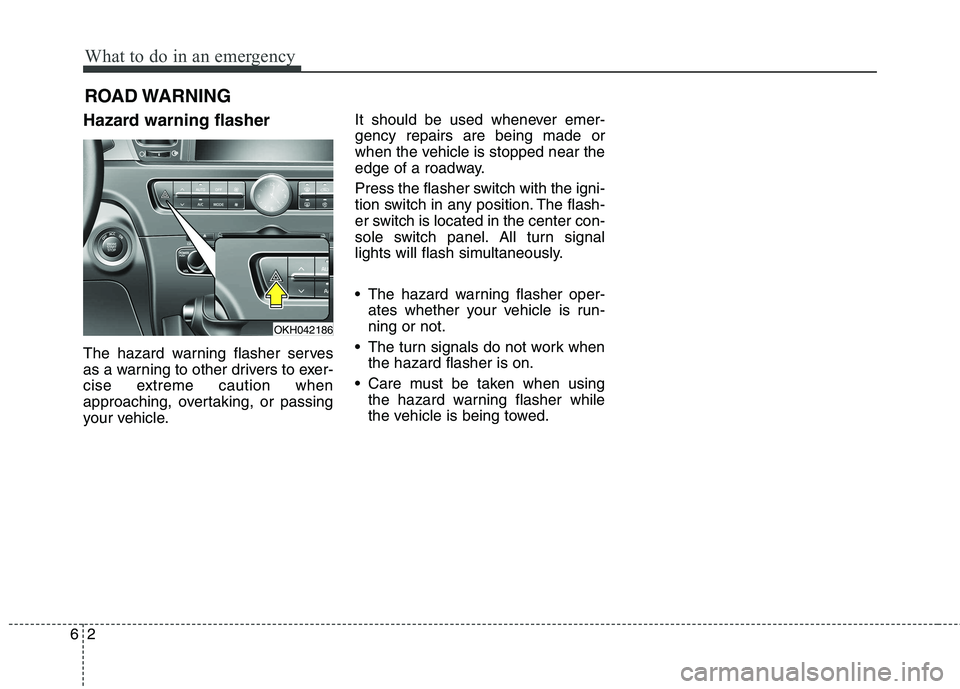
Hazard warning flasher
The hazard warning flasher serves
as a warning to other drivers to exer-
cise extreme caution when
approaching, overtaking, or passing
your vehicle. It should be used whenever emer-gency repairs are being made or
when the vehicle is stopped near the
edge of a roadway.
Press the flasher switch with the igni-
tion switch in any position. The flash-
er switch is located in the center con-
sole switch panel. All turn signal
lights will flash simultaneously.
• The hazard warning flasher oper-
ates whether your vehicle is run- ning or not.
The turn signals do not work when the hazard flasher is on.
Care must be taken when using the hazard warning flasher while
the vehicle is being towed.
OKH042186
Page 351 of 486
What to do in an emergency
4
6
IF THE ENGINE WILL NOT START
If engine doesn't turn over or
turns over slowly
1. If your vehicle has an automatic transaxle, be sure the shift lever is
in N (Neutral) or P (Park) and the
emergency brake is set.
2. Check the battery connections to be sure they are clean and tight.
3. Turn on the interior light. If the light dims or goes out when you oper-
ate the starter, the battery is dis-charged.
4. Check the starter connections to be sure they are securely tight-ened.
5. Do not push or pull the vehicle to start it. See instructions for "Jump
starting". If engine turns over normally
but does not start
1. Check fuel level.
2. With the ignition switch in the
LOCK /OFF position, check all connectors at the ignition coils and
spark plugs. Reconnect any that
may be disconnected or loose.
3. If the engine still does not start, we recommend that you call an
authorized Kia dealer.
WARNING
If the engine will not start, do
not push or pull the car to start
it. This could result in a collision
or cause other damage.