engine oil KIA QUORIS 2015 Owner's Manual
[x] Cancel search | Manufacturer: KIA, Model Year: 2015, Model line: QUORIS, Model: KIA QUORIS 2015Pages: 486, PDF Size: 35.55 MB
Page 394 of 486
717
Maintenance
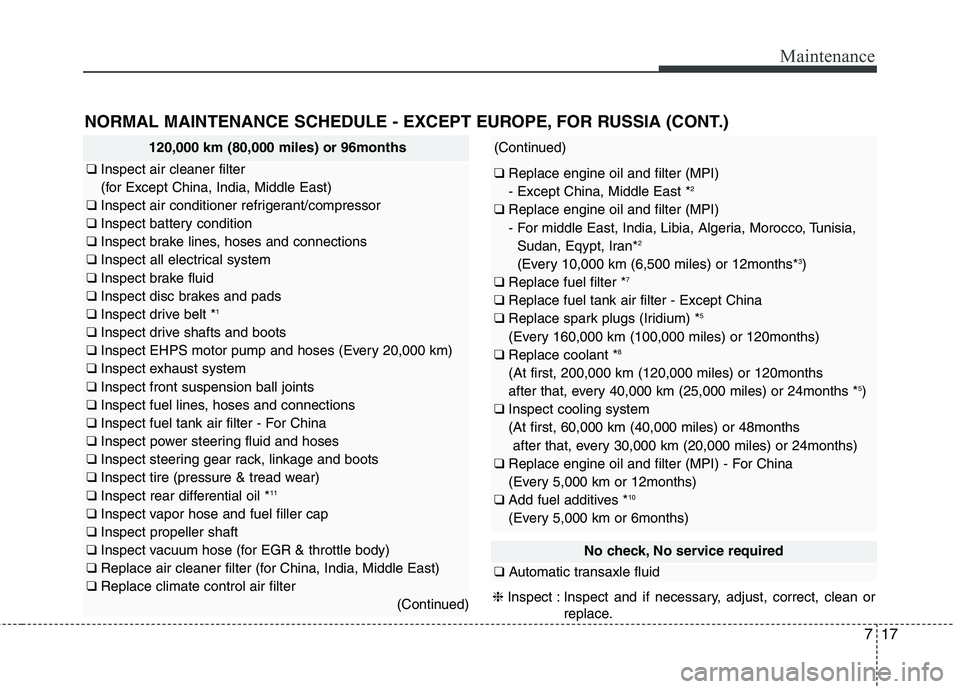
NORMAL MAINTENANCE SCHEDULE - EXCEPT EUROPE, FOR RUSSIA (CONT.)
120,000 km (80,000 miles) or 96months
❑ Inspect air cleaner filter
(for Except China, India, Middle East)
❑ Inspect air conditioner refrigerant/compressor
❑ Inspect battery condition
❑ Inspect brake lines, hoses and connections
❑ Inspect all electrical system
❑ Inspect brake fluid
❑ Inspect disc brakes and pads
❑ Inspect drive belt * 1
❑ Inspect drive shafts and boots
❑ Inspect EHPS motor pump and hoses (Every 20,000 km)
❑ Inspect exhaust system
❑ Inspect front suspension ball joints
❑ Inspect fuel lines, hoses and connections
❑ Inspect fuel tank air filter - For China
❑ Inspect power steering fluid and hoses
❑ Inspect steering gear rack, linkage and boots
❑ Inspect tire (pressure & tread wear)
❑ Inspect rear differential oil * 11
❑ Inspect vapor hose and fuel filler cap
❑ Inspect propeller shaft
❑ Inspect vacuum hose (for EGR & throttle body)
❑ Replace air cleaner filter (for China, India, Middle East)
❑ Replace climate control air filter
(Continued)
(Continued)
❑ Replace engine oil and filter (MPI) - Except China, Middle East * 2
❑ Replace engine oil and filter (MPI)
- For middle East, India, Libia, Algeria, Morocco, Tunisia,
Sudan, Eqypt, Iran* 2
(Every 10,000 km (6,500 miles) or 12months* 3
)
❑ Replace fuel filter * 7
❑ Replace fuel tank air filter - Except China
❑ Replace spark plugs (Iridium) * 5
(Every 160,000 km (100,000 miles) or 120months)
❑ Replace coolant * 8
(At first, 200,000 km (120,000 miles) or 120months
after that, every 40,000 km (25,000 miles) or 24months * 5
)
❑ Inspect cooling system
(At first, 60,000 km (40,000 miles) or 48months
after that, every 30,000 km (20,000 miles) or 24months)
❑ Replace engine oil and filter (MPI) - For China
(Every 5,000 km or 12months)
❑ Add fuel additives * 10
(Every 5,000 km or 6months)
No check, No service required
❑ Automatic transaxle fluid
❈ Inspect : Inspect and if necessary, adjust, correct, clean or
replace.
Page 395 of 486
Maintenance
18
7
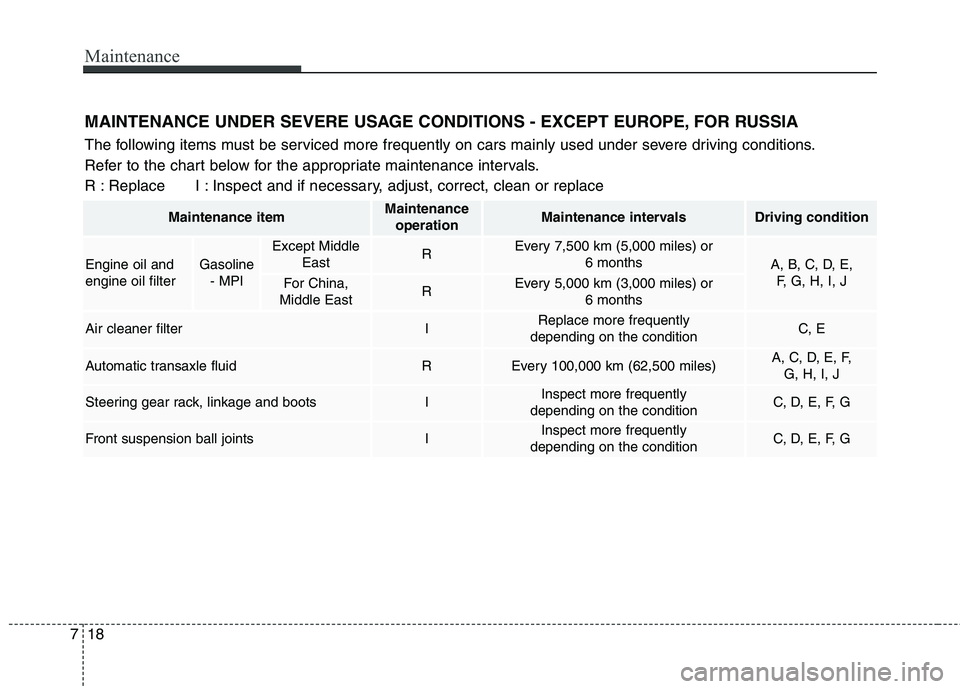
MAINTENANCE UNDER SEVERE USAGE CONDITIONS - EXCEPT EUROPE, FOR RUSSIA
The following items must be serviced more frequently on cars mainly used under severe driving conditions.
Refer to the chart below for the appropriate maintenance intervals.
R : Replace I : Inspect and if necessary, adjust, correct, clean or replace
Maintenance itemMaintenance
operationMaintenance intervalsDriving condition
Engine oil and engine oil filterGasoline - MPI
Except Middle EastREvery 7,500 km (5,000 miles) or 6 months
A, B, C, D, E, F, G, H, I, J
For China,
Middle EastREvery 5,000 km (3,000 miles) or 6 months
Air cleaner filterIReplace more frequently
depending on the conditionC, E
Automatic transaxle fluid REvery 100,000 km (62,500 miles)A, C, D, E, F, G, H, I, J
Steering gear rack, linkage and bootsIInspect more frequently
depending on the conditionC, D, E, F, G
Front suspension ball jointsIInspect more frequently
depending on the conditionC, D, E, F, G
Page 397 of 486
Maintenance
20
7
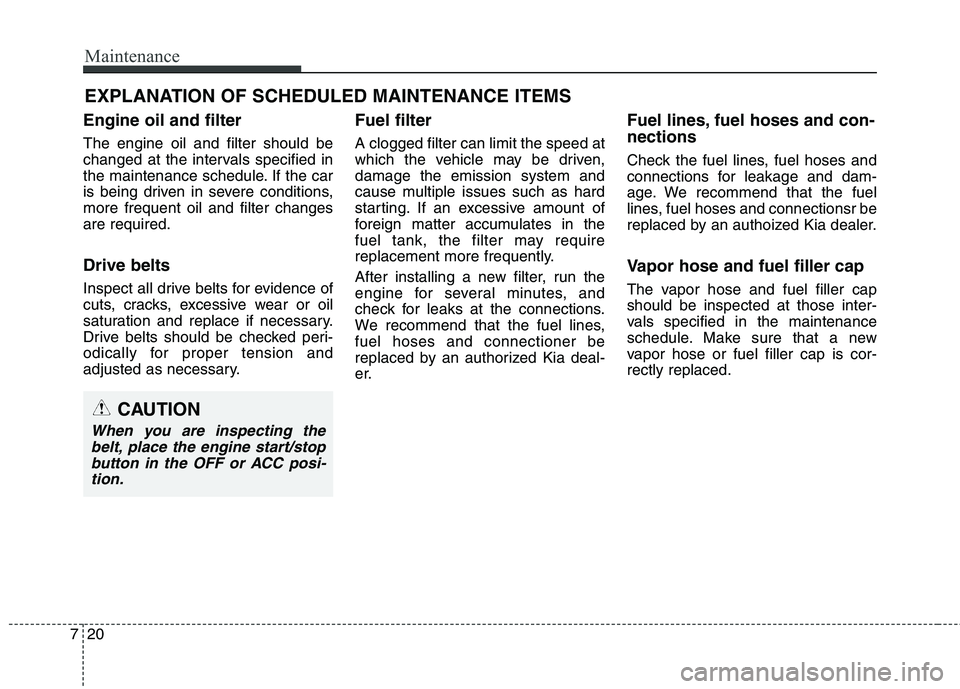
EXPLANATION OF SCHEDULED MAINTENANCE ITEMS
Engine oil and filter The engine oil and filter should be
changed at the intervals specified in
the maintenance schedule. If the car
is being driven in severe conditions,more frequent oil and filter changesare required. Drive belts
Inspect all drive belts for evidence of
cuts, cracks, excessive wear or oil
saturation and replace if necessary.
Drive belts should be checked peri-
odically for proper tension and
adjusted as necessary. Fuel filter A clogged filter can limit the speed at
which the vehicle may be driven,damage the emission system and
cause multiple issues such as hard
starting. If an excessive amount of
foreign matter accumulates in the
fuel tank, the filter may require
replacement more frequently.
After installing a new filter, run the
engine for several minutes, and
check for leaks at the connections.
We recommend that the fuel lines,fuel hoses and connectioner be
replaced by an authorized Kia deal-
er.Fuel lines, fuel hoses and con- nections
Check the fuel lines, fuel hoses and
connections for leakage and dam-
age. We recommend that the fuel
lines, fuel hoses and connectionsr be
replaced by an authoized Kia dealer.
Vapor hose and fuel filler cap
The vapor hose and fuel filler cap should be inspected at those inter-
vals specified in the maintenance
schedule. Make sure that a new
vapor hose or fuel filler cap is cor-rectly replaced.
CAUTION
When you are inspecting the
belt, place the engine start/stopbutton in the OFF or ACC posi- tion.
Page 401 of 486
Maintenance
24
7
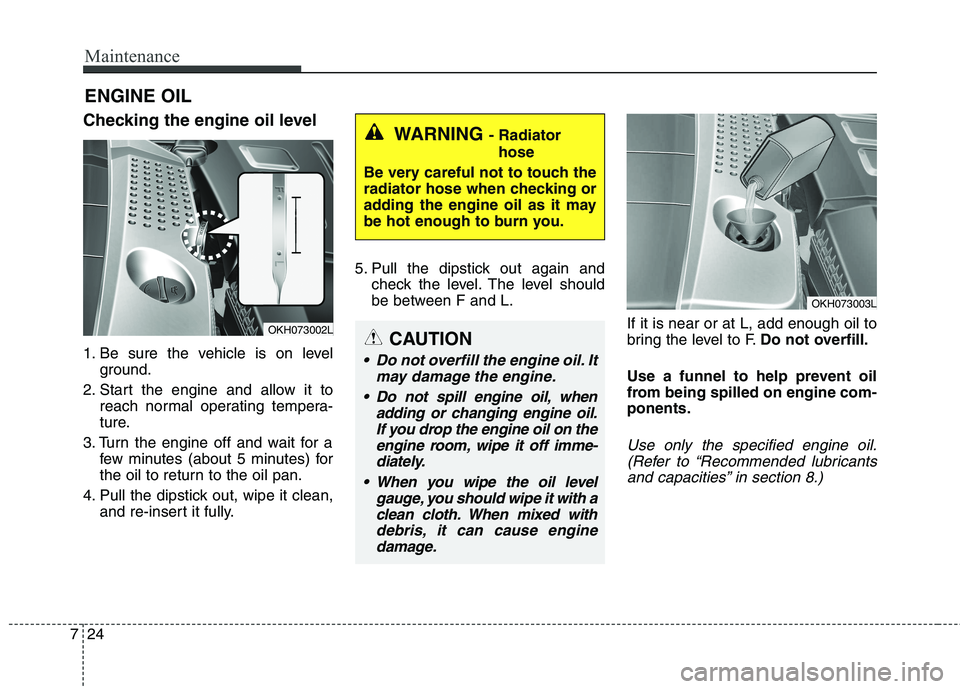
ENGINE OIL
Checking the engine oil level
1. Be sure the vehicle is on level ground.
2. Start the engine and allow it to reach normal operating tempera-
ture.
3. Turn the engine off and wait for a few minutes (about 5 minutes) for
the oil to return to the oil pan.
4. Pull the dipstick out, wipe it clean, and re-insert it fully. 5. Pull the dipstick out again and
check the level. The level should
be between F and L.
If it is near or at L, add enough oil to
bring the level to F.Do not overfill.
Use a funnel to help prevent oil
from being spilled on engine com-ponents.
Use only the specified engine oil. (Refer to “Recommended lubricantsand capacities” in section 8.)
WARNING - Radiator
hose
Be very careful not to touch the
radiator hose when checking or
adding the engine oil as it may
be hot enough to burn you.
CAUTION
Do not overfill the engine oil. It may damage the engine.
Do not spill engine oil, when adding or changing engine oil.If you drop the engine oil on theengine room, wipe it off imme-diately.
When you wipe the oil level gauge, you should wipe it with aclean cloth. When mixed withdebris, it can cause enginedamage.
OKH073002L
OKH073003L
Page 402 of 486
725
Maintenance
Changing the engine oil and filter
We recommend that the engine oil
and filter be replaced by an author-
ized Kia dealer.
WARNING
Used engine oil may cause irri- tation or cancer of the skin if
left in contact with the skin for
prolonged periods of time. Used
engine oil contains chemicals
that have caused cancer in lab-
oratory animals. Always protect
your skin by washing your
hands thoroughly with soapand warm water as soon as pos-
sible after handling used oil.
Page 406 of 486
729
Maintenance
BRAKE FLUID
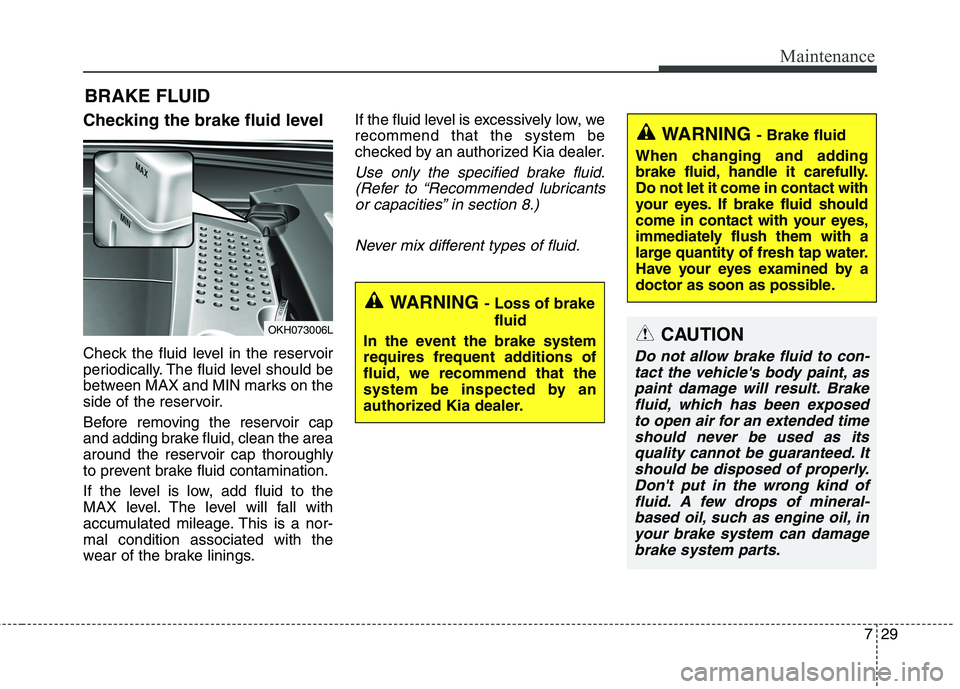
Checking the brake fluid level
Check the fluid level in the reservoir
periodically. The fluid level should be
between MAX and MIN marks on the
side of the reservoir.
Before removing the reservoir cap
and adding brake fluid, clean the area
around the reservoir cap thoroughly
to prevent brake fluid contamination.
If the level is low, add fluid to the
MAX level. The level will fall with
accumulated mileage. This is a nor-mal condition associated with the
wear of the brake linings. If the fluid level is excessively low, werecommend that the system be
checked by an authorized Kia dealer.
Use only the specified brake fluid.
(Refer to “Recommended lubricantsor capacities” in section 8.)
Never mix different types of fluid.
WARNING - Brake fluid
When changing and adding
brake fluid, handle it carefully.Do not let it come in contact with
your eyes. If brake fluid should
come in contact with your eyes,
immediately flush them with a
large quantity of fresh tap water.
Have your eyes examined by a
doctor as soon as possible.
WARNING - Loss of brake
fluid
In the event the brake system
requires frequent additions of
fluid, we recommend that the
system be inspected by an
authorized Kia dealer.
CAUTION
Do not allow brake fluid to con- tact the vehicle's body paint, aspaint damage will result. Brake fluid, which has been exposedto open air for an extended timeshould never be used as itsquality cannot be guaranteed. It should be disposed of properly.Don't put in the wrong kind offluid. A few drops of mineral- based oil, such as engine oil, inyour brake system can damagebrake system parts.
OKH073006L
Page 407 of 486
Maintenance
30
7
POWER STEERING FLUID
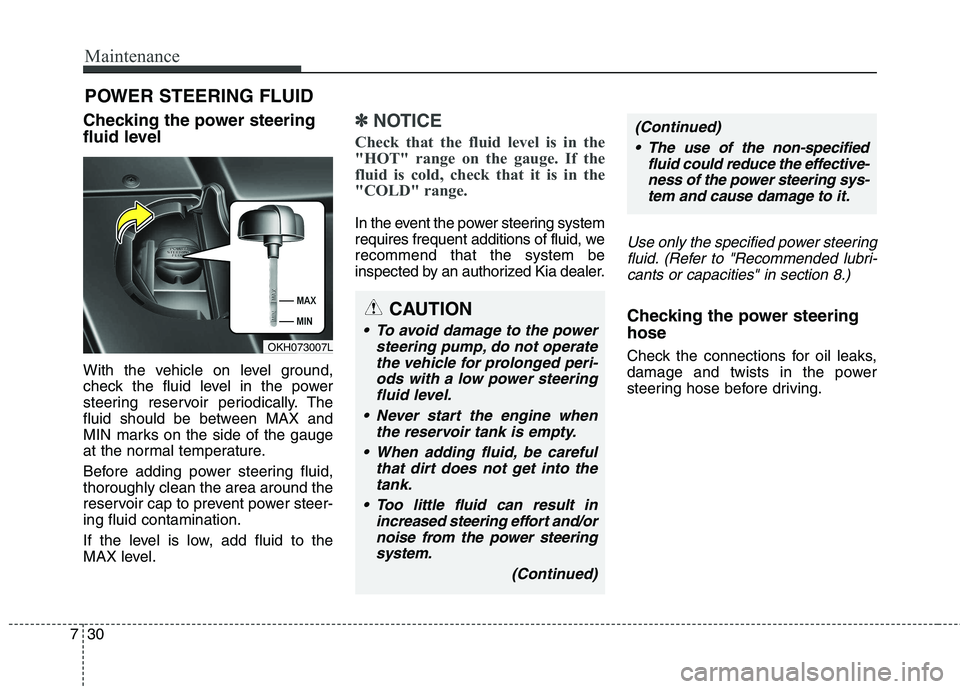
Checking the power steering
fluid level
With the vehicle on level ground,
check the fluid level in the power
steering reservoir periodically. The
fluid should be between MAX and
MIN marks on the side of the gauge
at the normal temperature.
Before adding power steering fluid, thoroughly clean the area around the
reservoir cap to prevent power steer-ing fluid contamination.
If the level is low, add fluid to the
MAX level.
✽✽ NOTICE
Check that the fluid level is in the
"HOT" range on the gauge. If the
fluid is cold, check that it is in the
"COLD" range.
In the event the power steering system
requires frequent additions of fluid, werecommend that the system be
inspected by an authorized Kia dealer.
Use only the specified power steering fluid. (Refer to "Recommended lubri-cants or capacities" in section 8.)
Checking the power steering hose
Check the connections for oil leaks,
damage and twists in the power
steering hose before driving.
OKH073007L
CAUTION
To avoid damage to the power steering pump, do not operatethe vehicle for prolonged peri- ods with a low power steeringfluid level.
Never start the engine when the reservoir tank is empty.
When adding fluid, be careful that dirt does not get into thetank.
Too little fluid can result in increased steering effort and/ornoise from the power steeringsystem.
(Continued)
(Continued) The use of the non-specified fluid could reduce the effective-ness of the power steering sys-tem and cause damage to it.
Page 431 of 486
Maintenance
54
7
FUSES
A vehicle’s electrical system is pro-
tected from electrical overload dam-
age by fuses.
This vehicle has 2 fuse panels, one
located in the driver’s side panel bol-
ster, another is in the engine com-
partment.
If any of your vehicle’s lights, acces-
sories, or controls do not work, check
the appropriate circuit fuse. If a fuse
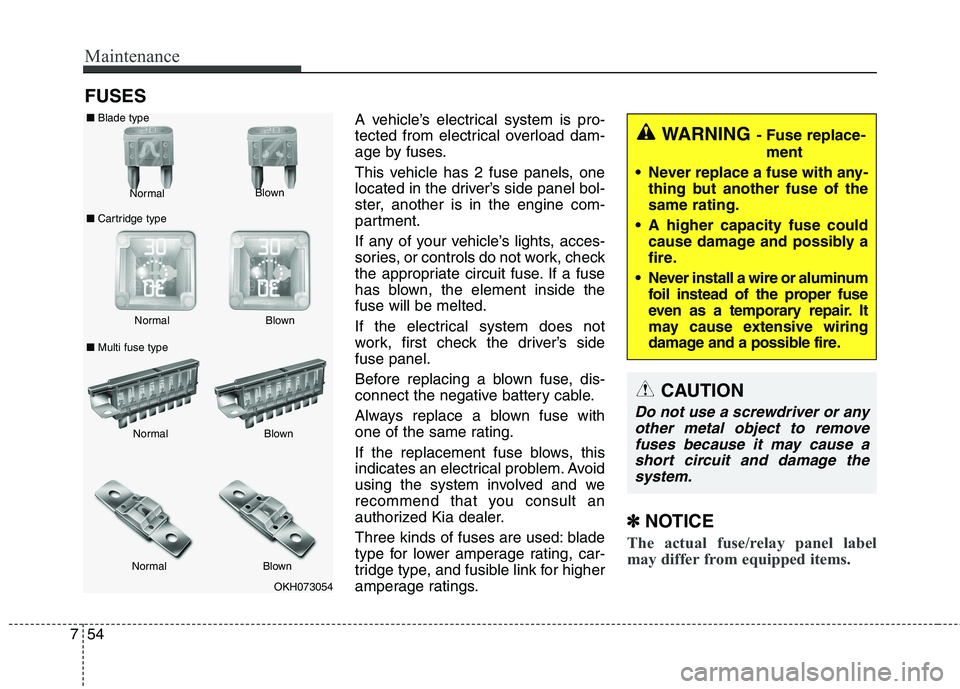
has blown, the element inside thefuse will be melted.
If the electrical system does not
work, first check the driver’s sidefuse panel.
Before replacing a blown fuse, dis-
connect the negative battery cable.
Always replace a blown fuse with
one of the same rating.
If the replacement fuse blows, this
indicates an electrical problem. Avoid
using the system involved and we
recommend that you consult an
authorized Kia dealer.
Three kinds of fuses are used: blade
type for lower amperage rating, car-
tridge type, and fusible link for higher
amperage ratings. ✽
✽
NOTICE
The actual fuse/relay panel label
may differ from equipped items.
WARNING - Fuse replace-
ment
Never replace a fuse with any- thing but another fuse of the same rating.
A higher capacity fuse could cause damage and possibly a
fire.
Never install a wire or aluminum foil instead of the proper fuse
even as a temporary repair. It
may cause extensive wiring
damage and a possible fire.
CAUTION
Do not use a screwdriver or any
other metal object to removefuses because it may cause ashort circuit and damage the system.
OKH073054
Normal
Normal
■
Blade type
■ Cartridge type
■ Multi fuse type Blown
Blown
Normal Blown
Normal Blown
Page 456 of 486
779
Maintenance
Waxing
Wax the vehicle when water will no longer bead on the paint.
Always wash and dry the vehicle
before waxing. Use a good quality
liquid or paste wax, and follow the
manufacturer’s instructions. Wax all
metal trim to protect it and to main-
tain its luster.
Removing oil, tar, and similar materi-
als with a spot remover will usually
strip the wax from the finish. Be sure to
re-wax these areas even if the rest of
the vehicle does not yet need waxing.Finish damage repair
Deep scratches or stone chips in the
painted surface must be repaired
promptly. Exposed metal will quickly
rust and may develop into a major
repair expense.
✽✽NOTICE
If your vehicle is damaged and
requires any metal repair or
replacement, be sure the body shop
applies anti-corrosion materials to
the parts repaired or replaced.
CAUTION
Wiping dust or dirt off the body with a dry cloth willscratch the finish.
Do not use steel wool, abra- sive cleaners, or strong deter-gents containing high alkalineor caustic agents on chrome- plated or anodized aluminumparts. This may result in dam-age to the protective coating and cause discoloration orpaint deterioration.
CAUTION
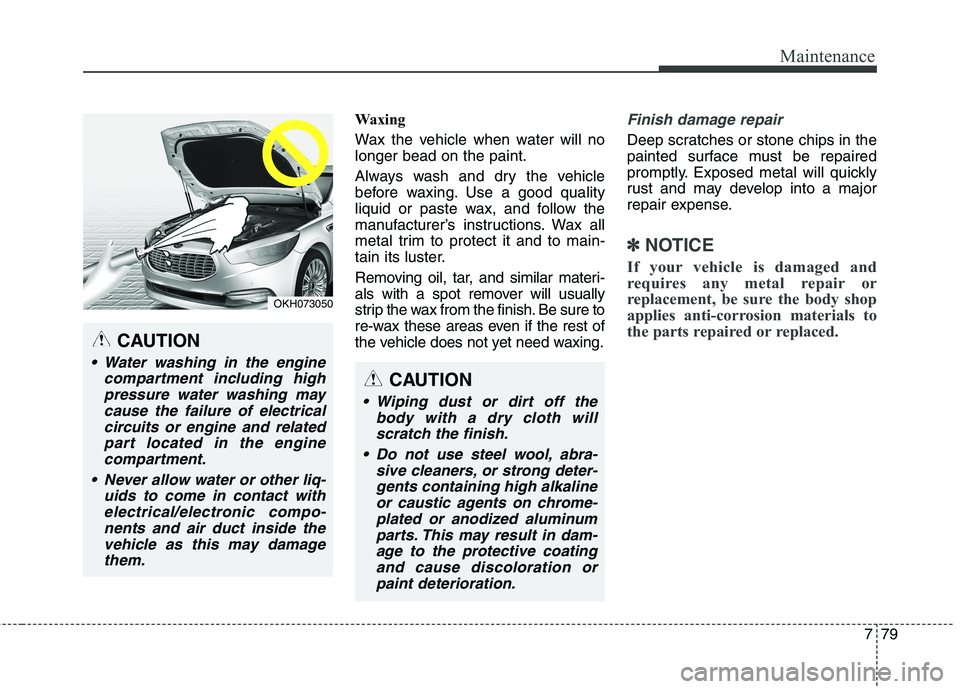
Water washing in the engine compartment including highpressure water washing maycause the failure of electricalcircuits or engine and related part located in the enginecompartment.
Never allow water or other liq- uids to come in contact withelectrical/electronic compo- nents and air duct inside thevehicle as this may damagethem.
OKH073050
Page 471 of 486
Specifications & Consumer information
6
8
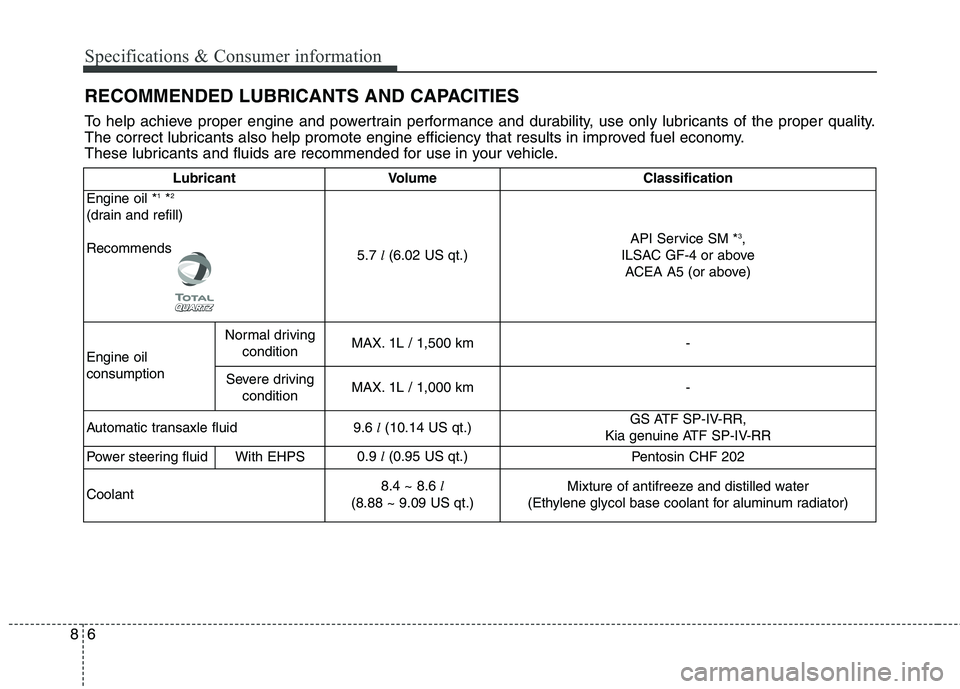
RECOMMENDED LUBRICANTS AND CAPACITIES
To help achieve proper engine and powertrain performance and durability, use only lubricants of the proper quality.
The correct lubricants also help promote engine efficiency that results in improved fuel economy.
These lubricants and fluids are recommended for use in your vehicle.
Lubricant Volume Classification
Engine oil * 1
*2
(drain and refill) Recommends 5.7 l(6.02 US qt.) API Service SM *
3
,
ILSAC GF-4 or above ACEA A5 (or above)
Engine oil consumption Normal driving
condition MAX. 1L / 1,500 km -
Severe driving condition MAX. 1L / 1,000 km -
Automatic transaxle fluid 9.6
l(10.14 US qt.) GS ATF SP-IV-RR,
Kia genuine ATF SP-IV-RR
Power steering fluid With EHPS 0.9
l(0.95 US qt.)
Pentosin CHF 202
Coolant 8.4 ~ 8.6
l
(8.88 ~ 9.09 US qt.) Mixture of antifreeze and distilled water
(Ethylene glycol base coolant for aluminum radiator)