brake KIA QUORIS 2017 Repair Manual
[x] Cancel search | Manufacturer: KIA, Model Year: 2017, Model line: QUORIS, Model: KIA QUORIS 2017Pages: 514, PDF Size: 35.2 MB
Page 309 of 514

Driving your vehicle
48
5
Hill-start assist control (HAC)
A vehicle has the tendency to slip
back on a steep hill when it starts to
go after stopping. The Hill-start Assist
Control (HAC) prevents the vehicle
from slipping back by operating the
brakes automatically for about 2 sec-
onds. The brakes are released when
the accelerator pedal is depressed or
after about 2 seconds.
✽✽
NOTICE
The HAC does not operate when the transaxle shift lever is in the P
(Park) or N (Neutral) position.
The HAC activates even though the ESC is off but it does not acti-
vate when the ESC has malfunc-
tioned.
Good braking practices After parking the vehicle, check to
be sure the parking brake is not
engaged and that the parking
brake indicator light is out before
driving away.
Driving through water may get the brakes wet. They can also get wet
when the car is washed. Wet
brakes can be dangerous! Your car
will not stop as quickly if the brakes
are wet. Wet brakes may cause the
car to pull to one side.
To dry the brakes, apply the brakes
lightly until the braking action
returns to normal, taking care to
keep the car under control at all
times. If the braking action does not
return to normal, stop as soon as it
is safe to do so and call an author-
ized Kia dealer for assistance.
Do not coast down hills with the car out of gear. This is extremely haz-
ardous. Keep the car in gear at all
times, use the brakes to slow
down, then shift to a lower gear so
that engine braking will help you
maintain a safe speed.
WARNING
The HAC is activated only for
about 2 seconds, so when the
vehicle is starting off alwaysdepress the accelerator pedal.
WARNING
Whenever leaving vehicle or parking, always set the park-
ing brake as far as possible
and fully engage the vehicle'stransmission into the park
position. Vehicles not fully
engaged in park with the park-
ing brake set are at risk for
moving inadvertently and
injuring yourself or others.
All vehicles should always have the parking brake fully
engaged when parking to
avoid inadvertent movement
of the car which can injureoccupants or pedestrians.
Page 310 of 514

549
Driving your vehicle
Do not "ride" the brake pedal.Resting your foot on the brake
pedal while driving can be danger-ous because it can result in the
brakes overheating and losing their
effectiveness. It also increases the
wear of the brake components.
If a tire goes flat while you are driv- ing, apply the brakes gently and
keep the car pointed straight
ahead while you slow down. When
you are moving slowly enough for it
to be safe to do so, pull off the road
and stop in a safe place.
If your car is equipped with an automatic transmission, don't let
your car creep forward. To avoid
creeping forward, keep your foot
firmly on the brake pedal when thecar is stopped. Be cautious when parking on a hill.
Firmly engage the parking brake
and place the shift lever in P (Park).
If your car is facing downhill, turnthe front wheels into the curb to
help keep the car from rolling. If
your car is facing uphill, turn the
front wheels away from the curb to
help keep the car from rolling. If
there is no curb or if it is required by
other conditions to keep the car
from rolling, block the wheels.
Under some conditions your park- ing brake can freeze in the
engaged position. This is most like-ly to happen when there is an accu-
mulation of snow or ice around or
near the rear brakes or if the brakes
are wet. If there is a risk that the
parking brake may freeze, apply it
only temporarily while you put the
shift lever in P (P ark) and block the
rear wheels so the car cannot roll.
Then release the parking brake. Do not hold the vehicle on the
upgrade with the accelerator
pedal. This can cause the trans-
mission to overheat. Always use
the brake pedal or parking brake.
Page 311 of 514

Driving your vehicle
50
5
AVSM detects the distance from the
vehicle ahead with the sensor, to
warn you before collision and protect
you in certain hazardous situations
by using warning message, warning
sound and seat belt vibration. ❈ The seat belt vibration is a option-
al function.
If the AVSM senses the objectahead too near the vehicle and if dri-
ver's operating of the brake pedal or
the steering wheel should be need-
ed, the warning light illuminates.
Immediately reduce your speed.
If the AVSM senses more danger- ous, the warning sound also oper-
ates and the seat belt vibrates.
Immediately reduce your speed.
❈ The seat belt vibration is a option-
al function.
ADVANCED VEHICLE SAFTY MANAGMENT (AVSM) (IF EQUIPPED)CAUTION
Always check the road condi-
tions to prevent danger even ifthe warning light does not illu-minate, the warning sound does not operate or the acceleratorpedal/seat belt does not vibrate.
OKH053049L
■ Type A■Type B
Page 312 of 514
551
Driving your vehicle
Brake operating
If the AVSM senses the collision,the brake system comes to stan- dard mode to react promptly when
the driver operates the brake pedal.
If the driver releases the accelera- tor after warning in hazardous situ-
ations, the AVSM automatically
brakes the vehicle gently.
If the driver hits the brake to reduce vehicle speed, the brake assistant
system operates to raise efficiency
of braking.
If danger disappears, if the driver depresses the accelerator or if the
driver releases the brake pedal,
the brake operating stop.
Seat belt operating (if equipped)
The seat belt tightens when the vehi- cle senses a collision.
User setting mode
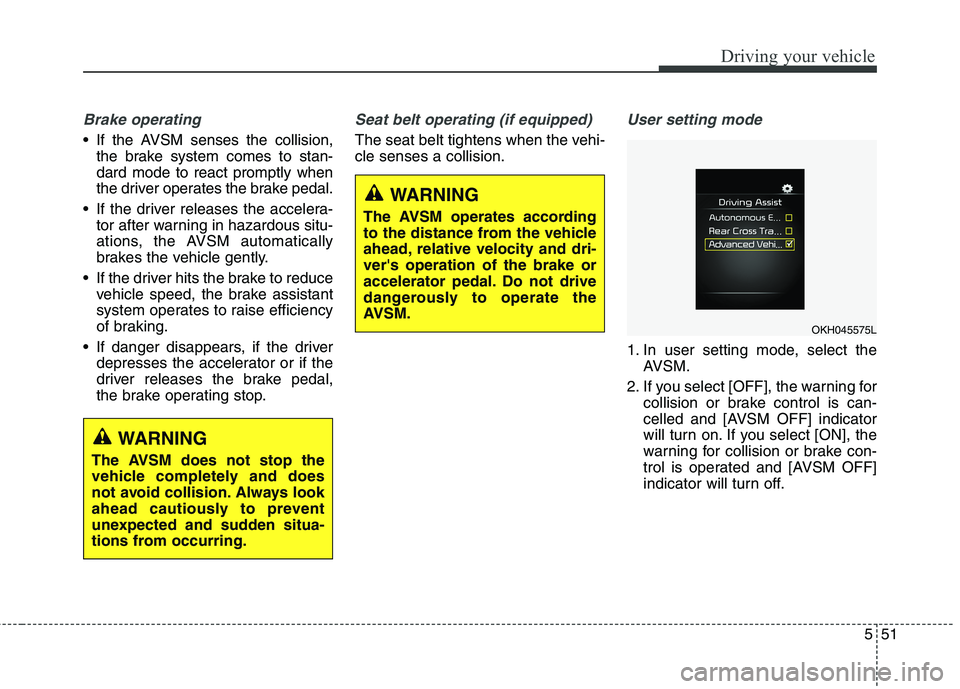
1. In user setting mode, select the AVSM.
2. If you select [OFF], the warning for collision or brake control is can-
celled and [AVSM OFF] indicator
will turn on. If you select [ON], the
warning for collision or brake con-
trol is operated and [AVSM OFF]
indicator will turn off.
WARNING
The AVSM does not stop the
vehicle completely and does
not avoid collision. Always look
ahead cautiously to prevent
unexpected and sudden situa-
tions from occurring.
WARNING
The AVSM operates according
to the distance from the vehicle
ahead, relative velocity and dri-ver's operation of the brake or
accelerator pedal. Do not drive
dangerously to operate the
AVSM.
OKH045575L
Page 313 of 514

Driving your vehicle
52
5
Malfunction indicator
The AVSM OFF indicator will illumi-
nate when the engine start/stop but-
ton is turned ON, but should go off
after approximately 3 seconds. If theindicator does not come on, or con-
tinuously remains on after coming
on for about 3 seconds when you
turn the engine start/stop button tothe ON position, or if the indicator
comes on while driving, the AVSM is
not working properly. We recom-
mend have the system checked by
an authorized Kia dealer. The AVSM OFF indicator may illu-
minate when the ESC indicator or
SCC indicator comes on, but itdoes not indicate malfunction of
the AVSM.
OKH053118
WARNING
The AVSM is not a substitute for
safe driving practices but a sup-
plementary function only. It isthe responsibility of the driver to
always check the speed and the
distance to the vehicle ahead.
WARNING
Even if there is a malfunction to the brake operating of the
AVSM, when you depress the
brake pedal, the brake is oper-
ating normally. But, the AVSMbrake operating does not
operate even in certain haz-
ardous situations.
The AVSM is designed to function above approximately
15 km/h (9.3 mph) and below
approximately 180 km/h (111.8mph).
The AVSM does not react to
- Persons or animals.
- Oncoming vehicles in theopposite lane or the vehicle
in the intersection.
- Stopped objects.
The AVSM can not detect the objects certainly, when:
- The sensors are stained withdirt or covered.
(Continued)■Type A■ Type B
Page 314 of 514

553
Driving your vehicle
(Continued)- There is heavy rain or heavysnow.
- There is interference by elec- tromagnetic waves.
- There are strong radar reflections.
- Driving in curve.
- Driving uphill or downhill.
- Driving in areas under con- struction.
- The object ahead is very nar- row such as motorcycles or
bicycles.
- The vehicle cuts in suddenly.
The AVSM brake operating does not operates, if the driv-er does not release the accel-erator pedal or does not oper-ate the brake pedal.
Page 315 of 514

Driving your vehicle
54
5
The Autonomous Emergency
Braking (AEB) helps avoid accidents
by identifying critical situations early
and warning the driver.
AUTONOMOUS EMERGENCY BRAKING (AEB) (IF EQUIPPED)
WARNING
Take the following precautions
when using the Autonomous
Emergency Braking (AEB):
This system is only a supple- mental system and it is not
intended to, nor does it replace
the need for extreme care and
attention of the driver. The
sensing range and objects
detectable by the sensors are
limited. Pay attention to the
road conditions at all times.
NEVER drive too fast for the road conditions or too quicklywhen cornering.
Always drive cautiously to pre- vent unexpected and sudden
situations from occurring. AEB
does not stop the vehicle com-
pletely and does not avoid col-lisions.
(Continued)(Continued)
AEB operates according tothe distance from the vehicle
ahead, relative velocity, anddriver's operation of the brake
or accelerator pedal. Do not
drive dangerously to inten-
tionally operate the AEB.
ALWAYS check the speed and the distance to the vehicle
ahead. The AEB is not a substi-
tute for safe driving practices.
Page 316 of 514

555
Driving your vehicle
AEB Operation
Warning message
A warning message and chime will
sound when you need to use the
brake pedal or steering wheel due to a
sudden stop or lack of distance with
the vehicle ahead. The warning mes-
sages will vary according to the sever-
ity of the situation. Immediately reduce
your speed to prevent a collision.Brake operation
In a critical situation:
The brake assist system enters
standby mode to react promptly
when the driver operates the brakepedal.
The vehicle automatically reduces speed according to the severity ofthe situation.
- Rapidly reduces speed whenvehicle speed is under 80km/h
- Slowly reduces speed when vehi- cle speed is over 80km/h
If the driver uses the brake pedal to reduce vehicle speed, the brake
assist system operates to increase
braking efficiency.
If the driver presses down hard on the accelerator pedal or sharply
turns the steering wheel, the brakeassist system is canceled.
OKH055049L
OKH055140L
OKH055141L
■Type A■ Type B
■Type A■ Type B
■Type A■ Type B
Page 318 of 514

557
Driving your vehicle
Malfunction indicator
When the AEB system is turnedoff, the AEB warning light turns on.
(Warning message does not comeon.) If the sensor or cover is dirty or
obscured with foreign matter such
as snow, the AEB warning light
and message comes on. In this
case, the AEB system may not
function temporarily, but it does notindicate a malfunction of the AEB
system. Clean the sensor or cover
by using a soft cloth.
If there is a malfunction with the AEB system, the AEB warning light and
message will come on. We recom-
mend that the vehicle be checked by
an authorized Kia dealer.
When the ESC (Electronic Stability Control) or SCC (Smart CruiseControl) message comes on the
AEB warning message may come
on but it does not indicate a mal-function of the AEB system.
OKH045518L
■Warning light TTTTyyyyppppeeee AAAA TTTTyyyyppppeeee BBBB
TTTTyyyyppppeeee AAAA TTTTyyyyppppeeee BBBB■Warning messageOKH055151/OKH055152
WARNING
Even if there is a malfunction to the brake operation of the
AEB, when you depress the
brake pedal, the brake oper-
ates normally. AEB brakeoperation does not operate in
certain hazardous situations.
The AEB is designed to func- tion above approximately 8
km/h and below approximate-
ly 180 km/h.
The AEB does not detect:
- Persons or animals.
- Oncoming vehicles in theopposite lane or a vehicle in
an intersection.
- Stopped objects.
(Continued)
Page 326 of 514
565
Driving your vehicle
Attributes of SMART MODE.
If the accelerator pedal is pressedgently, your vehicle will recognize it
as a economic driving style. After
some time, the system will automat-
ically shift to SMART ECO MODE.
If you press the accelerator pedal frequently and heavily in SMARTECO MODE, the system will auto-
matically shift to SMART NORMALMODE.
Even when driving style has not changed from SMART ECO
MODE, if your vehicle is driven
uphill considerably, the system will
detect the gradient. Then, the
SMART system will automatically
change the setting to the SMART
NORMAL MODE temporarily.
Once your vehicle is out of the hilly
ground, your vehicle will automati-
cally return to the SMART ECOMODE. The SMART system will recognize
sudden and repetitive acceleration or
steering as aggressive driving and
automatically turn to the SMART
SPORT MODE. Your vehicle will run
at a lower gear in SMART SPORTMODE compared to those in
SMART NORMAL MODE.
The vehicle's start and stop
response rate will become faster.
When the SMART SPORT MODE is activated, and you take your feet
off the accelerator pedal, the vehi-
cle will remain in low gear and you
may sense engine brake. This is
due to necessary preparatory time
for the next acceleration and is
only normal.
The SMART SPORT MODE is acti- vated only when very aggressiveand high speed is detected.
Therefore, in average driving
styles, the SMART system will
select either SMART ECO or
SMART NORMAL MODE. The artificial intelligence algorithm
will instantly calculate each driver's
style of driving. So if the driver is
changed to a different person, the
algorithm will measure accordingly.