glove box KIA QUORIS 2017 Owners Manual
[x] Cancel search | Manufacturer: KIA, Model Year: 2017, Model line: QUORIS, Model: KIA QUORIS 2017Pages: 514, PDF Size: 35.2 MB
Page 14 of 514
25
Your vehicle at a glance
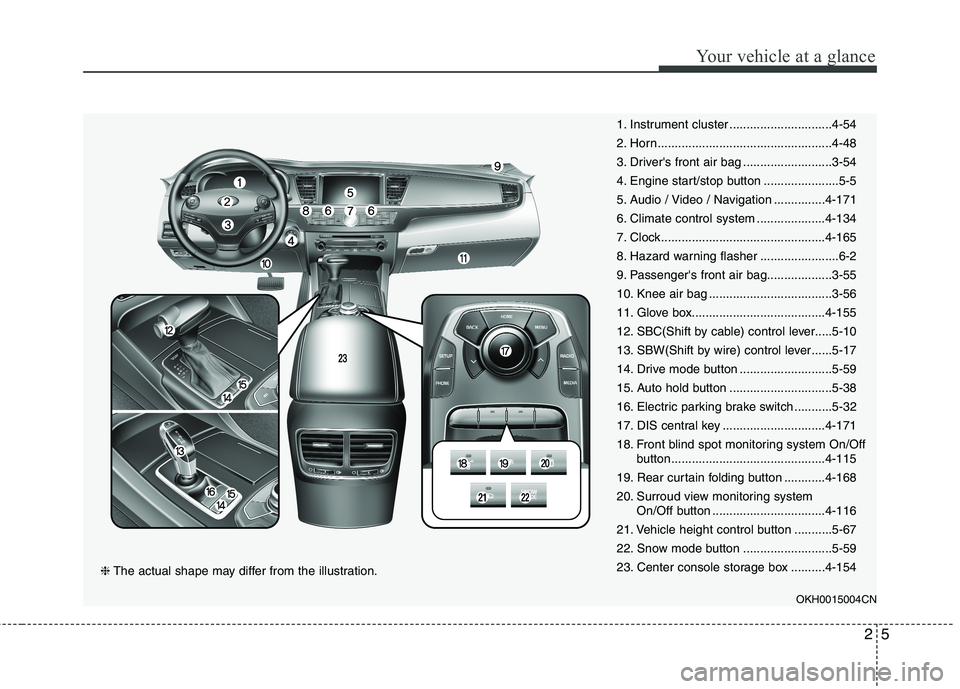
1. Instrument cluster ..............................4-54
2. Horn...................................................4-48
3. Driver's front air bag ..........................3-54
4. Engine start/stop button ......................5-5
5. Audio / Video / Navigation ...............4-171
6. Climate control system ....................4-134
7. Clock................................................4-165
8. Hazard warning flasher .......................6-2
9. Passenger's front air bag...................3-55
10. Knee air bag ....................................3-56
11. Glove box.......................................4-155
12. SBC(Shift by cable) control lever.....5-10
13. SBW(Shift by wire) control lever......5-17
14. Drive mode button ...........................5-59
15. Auto hold button ..............................5-38
16. Electric parking brake switch ...........5-32
17. DIS central key ..............................4-171
18. Front blind spot monitoring system On/Offbutton.............................................4-115
19. Rear curtain folding button ............4-168
20. Surroud view monitoring system On/Off button .................................4-116
21. Vehicle height control button ...........5-67
22. Snow mode button ..........................5-59
23. Center console storage box ..........4-154
OKH0015004CN
❈The actual shape may differ from the illustration.
Page 71 of 514

Safety features of your vehicle
54
3
The front air bag modules are locat-
ed in the center of the steeringwheel, in the front passenger's panel
above the glove box and/or in the dri-
ver’s side knee bolster. When the
SRSCM detects a sufficiently severe
impact to the front of the vehicle, it
will automatically deploy the front air
bags. Upon deployment, tear seams mold-
ed directly into the pad covers will
separate under pressure from the
expansion of the air bags. Further
opening of the covers then allows full
inflation of the air bags.
A fully inflated air bag, in combina-
tion with a properly worn seat belt,
slows the driver's or the passenger's
forward motion, reducing the risk of
head and chest injury. After complete inflation, the air bag
immediately starts deflating,
enabling the driver to maintain for-
ward visibility and the ability to steer
or operate other controls.
OHM039103N
■
Driver’s front air bag (2)
OHM039104N
■Driver’s front air bag (3)
OHM039102N
■Driver’s front air bag (1)
Page 72 of 514

355
Safety features of your vehicle
(Continued)
When installing a container ofliquid air freshener inside the
vehicle, do not place it near
the instrument cluster nor on
the instrument panel surface.
It may become a dangerous
projectile and cause injury if the
passenger's air bag inflates.
WARNING
Do not install or place any accessories (drink holder,
cassette holder, sticker, etc.)
on the front passenger's
panel above the glove box in a
vehicle with a passenger's air
bag. Such objects may
become dangerous projec-
tiles and cause injury if the
passenger's air bag inflates.
(Continued)
B240B05L
■Passenger’s front air bag
WARNING
If an air bag deploys, there may be a loud noise followed by a fine dust released in the vehi-
cle. These conditions are nor-
mal and are not hazardous - the
air bags are packed in this fine
powder. The dust generated
during air bag deployment may
cause skin or eye irritation as
well as aggravate asthma for
some persons. Always wash all
exposed skin areas thoroughlywith cold water and a mild
soap after an accident in which
the air bags were deployed.
(Continued)
(Continued)
The SRS can function onlywhen the Engine Start/Stop
button is in the ON position. If
the SRS air bag warning light
does not illuminate, or continu-
ously remains on after illumi-
nating for about 6 seconds
when the Engine Start/Stop
button is turned to the ON posi-
tion, or after the engine is start-
ed, comes on while driving, the
SRS is not working properly.
If this occurs, we recommend that the system be inspected
by an authorized Kia dealer.
Before you replace a fuse or disconnect a battery terminal,
turn the engine start/stop but-
ton to the OFF position. Never
remove or replace the air bagrelated fuse(s) when the
engine start/stop button is in
the ON position. Failure toheed this warning will cause
the SRS “ ” warning light to
illuminate.
Page 73 of 514

Safety features of your vehicle
56
3
Driver's and passenger's front
air bag
Your vehicle is equipped with a
Supplemental Restraint (Air Bag)System and the lap/shoulder belts at
both the driver and passenger seat-
ing positions. The indications of the system's pres-
ence are the letters "SRS AIR BAG"
embossed on the air bag pad cover
in the steering wheel and/or on the
cover of the driver's side knee bolster
located below the steering wheel andthe passenger's side front panel pad
above the glove box.
The SRS consists of air bags
installed under the pad covers in the
center of the steering wheel , in the
knee bolster below the steeringwheel column and the passenger's
side front panel above the glove box.
The purpose of the SRS is to provide
the vehicle's driver and/or the frontpassenger with additional protection
than that offered by the seat belt sys-tem alone in case of a frontal impact
of sufficient severity. The SRS uses
sensors to gather information about
the driver's seat position, the driver'sand front passenger's seat belt usage
and impact severity.
OKH032053
OKH032054
■Driver’s knee air bag
■Driver’s front air bag
OKH032055
■Passenger’s front air bag
Page 74 of 514

357
Safety features of your vehicle
The seat belt buckle sensors (if
equipped) determine if the driver and
front passenger's seat belts are fas-
tened. These sensors provide the
ability to control the SRS deploymentbased on whether or not the seat
belts are fastened, and how severe
the impact is.
WARNING
Always use seat belts and child
restraints – every trip, every
time, everyone! Air bags inflate
with considerable force and in
the blink of an eye. Seat belts
help keep occupants in proper
position to obtain maximum
benefit from the air bag. Even
with air bags, improperly andunbelted occupants can be
severely injured when the air
bag inflates. Always follow the
precautions about seat belts, air
bags and occupant safety con-
tained in this manual. (Continued)
(Continued)
To reduce the chance of serious or fatal injuries and receive the
maximum safety benefit from
your restraint system:
Never place a child in anychild or booster seat in the
front seat.
ABC – Always Buckle Children in the back seat. It is
the safest place for children of
any age to ride.
Front and side air bags can injure occupants improperly
positioned in the front seats.
Move your seat as far back as practical from the front air
bags, while still maintaining
control of the vehicle.
You and your passengers should never sit or lean
unnecessarily close to the air
bags. Improperly positioned
drivers and passengers can
be severely injured by inflat-
ing air bags.
(Continued)(Continued)
Never lean against the door orcenter console – always sit in an upright position.
No objects should be placed over or near the air bag mod-ules on the steering wheel,
instrument panel or the front
passenger's panel above the
glove box, because any suchobject could cause harm if the
vehicle is in a crash severe
enough to cause the air bags
to deploy.
Do not tamper with or discon- nect SRS wiring or other com-ponents of the SRS system.
Doing so could result in injury,
due to accidental deployment
of the air bags or by rendering
the SRS inoperative.
If the SRS air bag warning light remains illuminated
while the vehicle is being driv-
en, we recommend that the
system be inspected by an
authorized Kia dealer.
(Continued)
Page 76 of 514

359
Safety features of your vehicle
Side air bag Your vehicle is equipped with a side air bag in each front and outboard rear
seat. The purpose of the air bag is to
provide the vehicle's driver and/or thefront and outboard rear passengerswith additional protection than that
offered by the seat belt alone.
The side air bags are designed to
deploy during certain side-impact
collisions, depending on the crash
severity, angle, speed and point ofimpact.
The side air bags are not designed to deploy in all side impact.
OKH032056
OKH032081
OKH032089
■Front
■Rear
❈ The actual air bags in the vehicle may dif-
fer from the illustration.
WARNING - No attaching objects
No objects (such as crash pad
cover, cellular phone holder,
cup holder, perfume or stickers)
should be placed over or near
the air bag modules on the
steering wheel, instrument
panel, windshield glass, and the
front passenger's panel above
the glove box. Such objects
could cause harm if the vehicle
is in a crash severe enough to
cause the air bags to deploy. Do
not place any objects over the
air bag or between the air bag
and yourself.
Page 85 of 514

Safety features of your vehicle
68
3
SRS Care
The SRS is virtually maintenance-free
and so there are no parts you can
safely service by yourself. If the SRS
air bag warning light does not illumi-
nate, or continuously remains on, werecommend that the system be
inspected by an authorized Kia dealer.(Continued)
No objects should be placed
over or near the air bag mod- ules on the steering wheel,
instrument panel, and the
front passenger's panel above
the glove box, because any
such object could cause harm
if the vehicle is in a crash
severe enough to cause the
air bags to inflate.
If the air bags inflate, we rec- ommend that the system be
replaced by an authorized Kia
dealer.
Do not tamper with or discon- nect SRS wiring, or othercomponents of the SRS sys-
tem. Doing so could result in
injury, due to accidental infla-
tion of the air bags or by ren-
dering the SRS inoperative.
(Continued)
WARNING
Modification to SRS compo- nents or wiring, including the
addition of any kind of badges
to the pad covers or modifica-
tions to the body structure,
can adversely affect SRS per-
formance and lead to possible
injury.
For cleaning the air bag pad covers, use only a soft, dry
cloth or one which has been
moistened with plain water.
Solvents or cleaners could
adversely affect the air bag
covers and proper deploy-ment of the system.
(Continued)
(Continued)
If components of the air bagsystem must be discarded, or
if the vehicle must be
scrapped, certain safety pre-
cautions must be observed.
An authorized Kia dealer
knows these precautions and
can give you the necessary
information. Failure to follow
these precautions and proce-dures could increase the risk
of personal injury.
If your car was flooded and has soaked carpeting or water
on flooring, you shouldn't try
to start the engine; we recom-
mend that you contact an
authorized Kia dealer.
Page 94 of 514

47
Features of your vehicle
Trunk unlock (3)
Non-powered trunk.
1. Press the trunk unlock button formore than 1 second.
2. The hazard warning light will blink twice to indicate that the trunk is
unlocked.
✽✽ NOTICE
After unlocking the trunk, the trunk will lock automatically unless
it is opened within 30 seconds.
Once the trunk is opened and then closed, the trunk will lock auto-
matically.
The word "HOLD" is written on the button to inform you that you
must press and hold the button.
Power trunk
1. Press the trunk unlock button for more than 1 second.
2. The hazard warning light will blink and chime will sound twice to indi-
cate the trunk is unlocked andopened.
✽✽ NOTICE
Once the trunk is opened and then closed, the trunk will lock auto-
matically.
The word "HOLD" is written on the button to inform you that you
must press and hold the button.
Restrictions in handling keys
When leaving keys with parking lot
and valet attendants, the following
procedures will ensure that your
vehicle’s trunk and glove box com-
partment can not be opened in your
absence.
To activate the trunk lock system so
that the trunk can only be opened
with the mechanical key, perform the
following:
1. Press and hold the release button and remove the mechanical key
from the smart key.
OKH042010
Page 95 of 514

Features of your vehicle
8
4
2. Unlock the glove box by using the
mechanical key then open it.
3. Set the trunk lid control button to OFF position (unpressed).
4. Close and lock the glove box using the mechanical key.
When leaving your keys with a park-
ing lot attendant or valet, perform
steps 1 to 4 above, remove the
mechanical key from the smart key
and leave the smart key with the
attendant. In this manner the smart
key can only be used to start the
engine and operate door locks.
Lock release
To release the trunk lock feature,
open the glove box with the mechan-
ical key and set the trunk lid control
button to ON position (pressed). In
this position the trunk will open with
the trunk lid button or smart key. Smart key precautions
✽✽
NOTICE
If, for some reason, you happen to lose your smart key, you will not
be able to start the engine. Tow
the vehicle, if necessary, we recom-
mend that you contact an author-
ized Kia dealer.
A maximum of 2 smart keys can be registered to a single vehicle. If
you lose a smart key, we recom-
mend that you contact an author-
ized Kia dealer.
The smart key will not work if any of the following occurs:
- The smart key is close to a radiotransmitter such as a radio sta-
tion or an airport which can
interfere with normal operation
of the smart key.
- The smart key is near a mobile two-way radio system or a cellu-
lar phone.
- Another vehicle’s smart key is being operated close to your
vehicle. (Continued)(Continued)
When the smart key does not work
properly, open and close the door
with the mechanical key. If you
have a problem with the smart key,
we recommend that you contact an
authorized Kia dealer.
If the smart key is in close proxim- ity to your cell phone or smart
phone, the signal from the smart
key could be blocked by normal
operation of your cell phone or
smart phone. This is especially
important when the phone is
active such as making call, receiv-
ing calls, text messaging, and/or
sending/receiving emails. Avoid
placing the smart key and your
cell phone or smart phone in the
same pants or jacket pocket and
maintain adequate distance
between the two devices.
Page 218 of 514

4131
Features of your vehicle
Glove box lamp
The glove box lamp comes on when
the glove box is opened.Vanity mirror lamp
Opening the lid of the vanity mirror
will automatically turn on the mirrorlight.
CAUTION
- Vanity mirror
lamp (if equipped)
Always have the switch in the off position when the vanity mir-ror lamp is not in use. If the sun- visor is closed without the lampoff, it may discharge the batteryor damage the sunvisor.
OKH042204
CAUTION
To prevent unnecessary charg-ing system drain, close theglove box securely after using the glove box.
OKH042205