wheel KIA Rio 2005 2.G User Guide
[x] Cancel search | Manufacturer: KIA, Model Year: 2005, Model line: Rio, Model: KIA Rio 2005 2.GPages: 238, PDF Size: 2.6 MB
Page 92 of 238
4-11
Transaxle Ranges
O/D (OVERDRIVE) SYSTEM
Pressing the O/D system button cancels and engages
the overdrive system. When the O/D system is can-
celled (button is depressed), the O/D OFF indicator
illuminates and the transaxle gear range is limited to
1st through 3rd. The transaxle will not shift to 4th gear
until the O/D system button is again depressed.
When the ignition is switched OFF, the O/D OFF mode
is automatically cancelled.
WARNING - Automatic
Transaxle
Before leaving the driver’s seat, always
make sure the shift lever is in the P (PARK)
position; then set the parking brake fully
and shut the engine off. Unexpected and
sudden vehicle movement can occur if these
precautions are not followed in the order
identified.
O/D OFF indicator
This indicator light illuminates in the instrument panel
when the O/D mode is cancelled.
NORMAL OPERATION
P (Park)
This position locks the transaxle and prevents the front
wheels from rotating. Always come to a complete stop
before shifting into this position.
✽
NOTICE
If the O/D OFF indicator flashes, it indicates an
electrical problem with the transaxle. Should this
occur, have the vehicle checked by an Authorized
Kia Dealer as soon as possible.
WARNING
Shifting into P (Park) while the vehicle is in
motion will cause the front wheels to lock and
you will lose driving control of the vehicle.
RIO ENG CNA 4.qxd 7/29/05 5:06 PM Page 11
Page 93 of 238
Driving Your Vehicle4-12
R (Reverse)
Use this position to drive the vehicle backward.
N (Neutral)
In this position, the wheels and transaxle are not
locked. The vehicle will roll freely even on the slight-
est incline unless the parking brake or service brakes
are applied.
D (Drive)
This is the normal forward driving position. The
transaxle will automatically shift through a four-gear
sequence, providing the best fuel economy and power.
For extra power when passing another vehicle or
climbing steep grades, depress the accelerator fully, at
which time the transaxle will automatically downshift
into the next lower gear.
CAUTION
Always come to a complete stop before shifting
into or out of R (Reverse). You may damage the
transaxle if you shift into R while the vehicle is in
motion, except as explained in “Rocking the
Ve h i c l e .’’
✽
NOTICE
The transaxle may be damaged if you shift into
P (Park) while the vehicle is in motion.
WARNING
Do not use the P (Park) position in place of
the parking brake when leaving the vehicle.
Always make sure the shift lever is latched
in the P (Park) position so that it cannot be
moved unless the lock release button is
pushed in AND the parking brake is fully
set.
Turn the ignition switch OFF whenever you
leave the vehicle unattended. Never leave the
vehicle unattended while the engine is run-
ning. Unexpected and sudden vehicle move-
ment may occur if these precautions are not
taken.
Never leave a child unattended in a vehicle.
RIO ENG CNA 4.qxd 7/29/05 5:06 PM Page 12
Page 94 of 238
4-13
For improved engine performance, the transaxle will
not shift into 4th gear until the engine coolant reaches
normal operation temperature.
2 (2nd)
Move shift lever to this position for driving in heavy,
slow-moving traffic or when climbing hills. This posi-
tion also provides engine braking when going down
hills and helps reduce wheel spin on slippery surfaces.
1 (1st)
Move the shift lever to this position in hard pulling sit-
uations and for climbing or descending steep grades.
Moving Up a Steep Grade from a Standing
Start
To move up a steep grade from a standing start,
depress the brake pedal, shift the shift lever to
D (Drive), 2 (2nd), or 1 (1st). Select the appropriate
gear depending on load weight and steepness of the
grade, and release the parking brake. Depress the
accelerator gradually while releasing the service
brakes.Shift Lock System
For your safety, the Automatic Transaxle has a shift
lock system which prevents shifting the transaxle out
of P (Park) unless the brake pedal is depressed.
To shift the transaxle out of P (Park):
1. Depress and hold the brake pedal.
2. Start the engine or turn the ignition key to the ON
position.
3. Depress the lock release button and move the shift
lever.
When the ignition switch is in the ACC or LOCK posi-
tion, the transaxle cannot be shifted from P (Park).
If the brake pedal is repeatedly depressed and released
with the shift lever in the P (Park) position, a chatter-
ing noise near the shift lever may be heard.
This is a normal condition.
Also, the ignition key cannot be removed unless the
shift lever is in the P (Park) position. If the ignition
switch is in any other position, the key cannot be
removed.
RIO ENG CNA 4.qxd 7/29/05 5:06 PM Page 13
Page 96 of 238
4-15
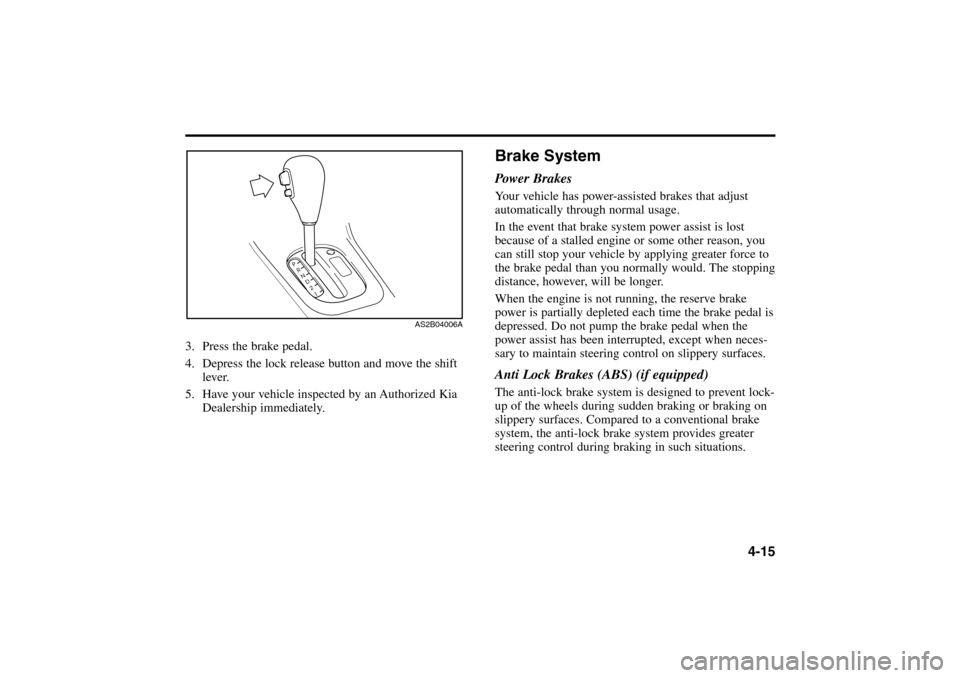
3. Press the brake pedal.
4. Depress the lock release button and move the shift
lever.
5. Have your vehicle inspected by an Authorized Kia
Dealership immediately.
AS2B04006A
Brake SystemPower BrakesYour vehicle has power-assisted brakes that adjust
automatically through normal usage.
In the event that brake system power assist is lost
because of a stalled engine or some other reason, you
can still stop your vehicle by applying greater force to
the brake pedal than you normally would. The stopping
distance, however, will be longer.
When the engine is not running, the reserve brake
power is partially depleted each time the brake pedal is
depressed. Do not pump the brake pedal when the
power assist has been interrupted, except when neces-
sary to maintain steering control on slippery surfaces.Anti Lock Brakes (ABS) (if equipped)The anti-lock brake system is designed to prevent lock-
up of the wheels during sudden braking or braking on
slippery surfaces. Compared to a conventional brake
system, the anti-lock brake system provides greater
steering control during braking in such situations.
RIO ENG CNA 4.qxd 7/29/05 5:06 PM Page 15
Page 102 of 238
Parking on Curbed Streets When parking your vehicle on an uphill grade, park
as close to the curb as possible and turn the front
wheels away from the curb so that the front wheels
will contact the curb if the vehicle moves backward.
When parking your vehicle on a downhill grade,
park as close to the curb as possible and turn the
front wheels toward the curb so that the front wheels
will contact the curb if the vehicle moves forward.
4-21
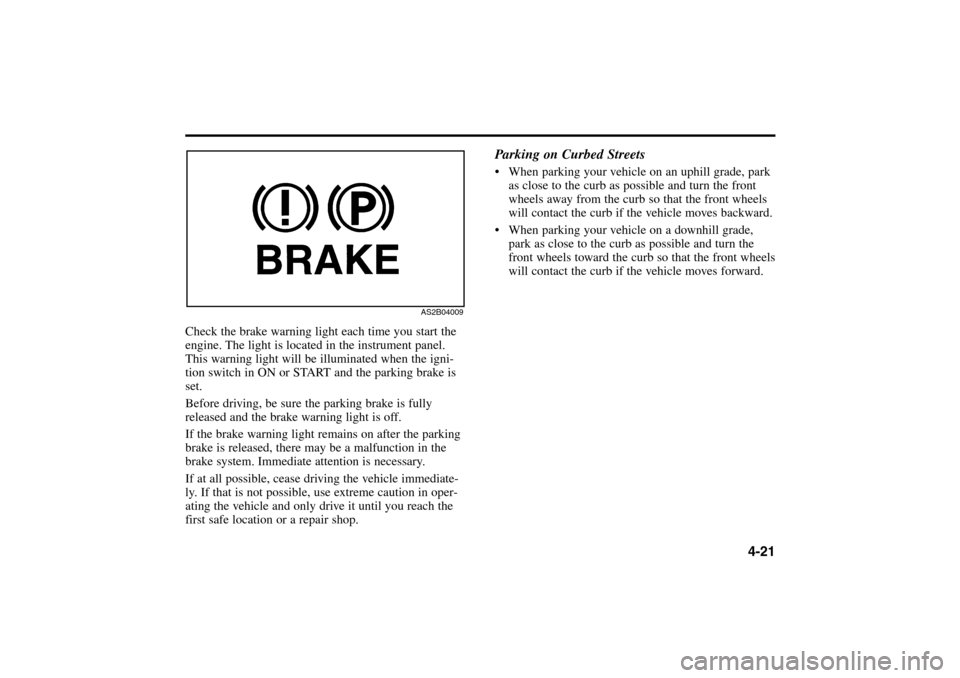
Check the brake warning light each time you start the
engine. The light is located in the instrument panel.
This warning light will be illuminated when the igni-
tion switch in ON or START and the parking brake is
set.
Before driving, be sure the parking brake is fully
released and the brake warning light is off.
If the brake warning light remains on after the parking
brake is released, there may be a malfunction in the
brake system. Immediate attention is necessary.
If at all possible, cease driving the vehicle immediate-
ly. If that is not possible, use extreme caution in oper-
ating the vehicle and only drive it until you reach the
first safe location or a repair shop.
AS2B04009
RIO ENG CNA 4.qxd 7/29/05 5:06 PM Page 21
Page 103 of 238
Driving Your Vehicle4-22Power Steering (If Equipped)Power steering uses energy from the engine to assist
you in steering the vehicle. If the engine is off or if the
power steering system becomes inoperative, the vehi-
cle may still be steered, but it will require increased
steering effort.
Should you notice any change in the effort required to
steer during normal vehicle operation, have the power
steering system checked by an Authorized Kia Dealer.
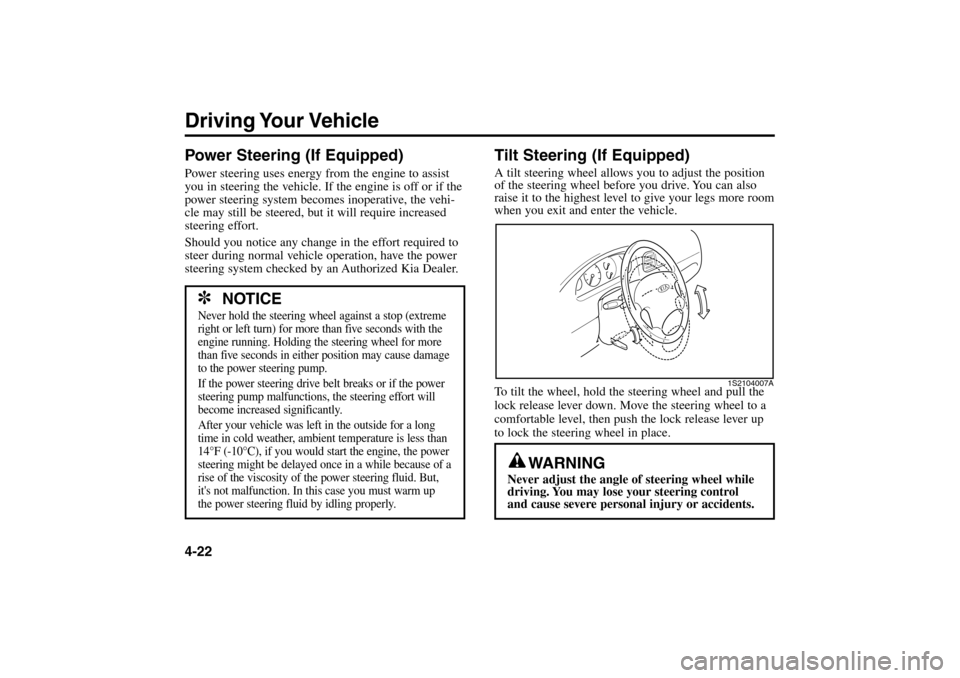
Tilt Steering (If Equipped)A tilt steering wheel allows you to adjust the position
of the steering wheel before you drive. You can also
raise it to the highest level to give your legs more room
when you exit and enter the vehicle.
To tilt the wheel, hold the steering wheel and pull the
lock release lever down. Move the steering wheel to a
comfortable level, then push the lock release lever up
to lock the steering wheel in place.
✽
NOTICE
Never hold the steering wheel against a stop (extreme
right or left turn) for more than five seconds with the
engine running. Holding the steering wheel for more
than five seconds in either position may cause damage
to the power steering pump.
If the power steering drive belt breaks or if the power
steering pump malfunctions, the steering effort will
become increased significantly.
After your vehicle was left in the outside for a long
time in cold weather, ambient temperature is less than
14°F (-10°C), if you would start the engine, the power
steering might be delayed once in a while because of a
rise of the viscosity of the power steering fluid. But,
it's not malfunction. In this case you must warm up
the power steering fluid by idling properly.
WARNING
Never adjust the angle of steering wheel while
driving. You may lose your steering control
and cause severe personal injury or accidents.
1S2104007A
RIO ENG CNA 4.qxd 7/29/05 5:06 PM Page 22
Page 114 of 238
4-33 Door Ajar Warning
This warning light comes on when a door is not closed
securely with the ignition switch in any position.Anti-Lock Brake System (ABS)
Warning Light (if equipped)This light illuminates when you start the engine. The
light will go off if the ABS system is operating nor-
mally. Also, this light comes on if the key is turned to
ON, and then goes off in 2-3 seconds if the system is
operating normally.
If this warning light illuminates while the vehicle is
being driven, have the vehicle checked by an autho-
rized Kia Dealer as soon as possible.Rear Window Defroster Indicator This light comes on when the rear defroster is ON.Rear Hatch Warning Light
(5 door-if equipped)This warning light comes on when a rear hatch is not
closed securely with the ignition switch in any posi-
tion.
AS2B04020
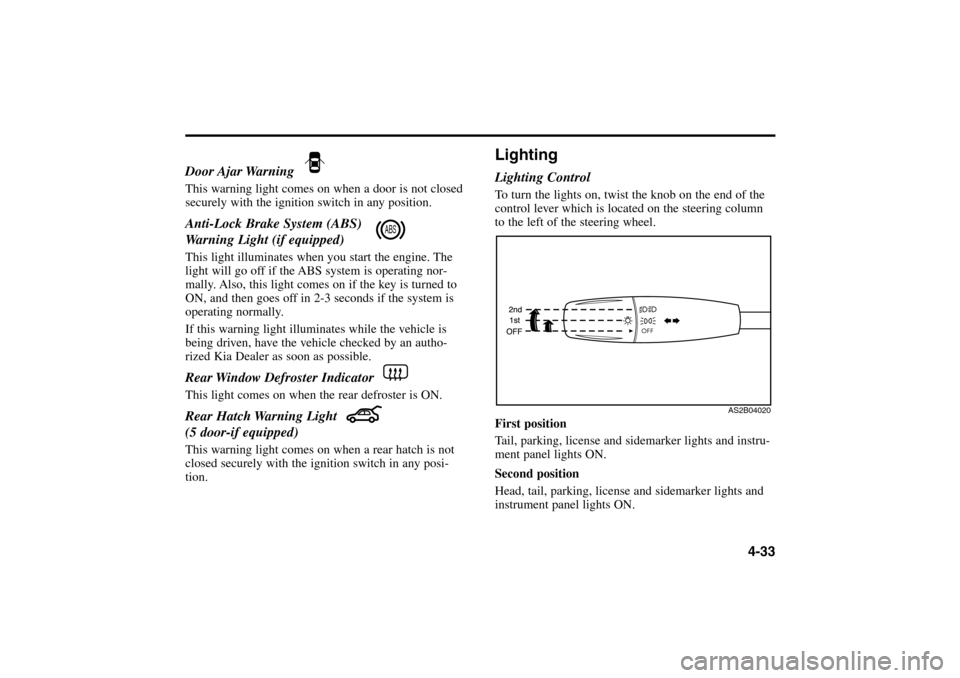
LightingLighting ControlTo turn the lights on, twist the knob on the end of the
control lever which is located on the steering column
to the left of the steering wheel.
First position
Tail, parking, license and sidemarker lights and instru-
ment panel lights ON.
Second position
Head, tail, parking, license and sidemarker lights and
instrument panel lights ON.
ABS
RIO ENG CNA 4.qxd 7/29/05 5:06 PM Page 33
Page 140 of 238
Suggestions for Economical
OperationYour vehicle’s fuel economy is mainly dependent on
your style of driving, how you drive, where you drive
and when you drive.
Each of these factors has an effect on how many miles
(kilometers) you can get from a gallon (liter) of fuel.
To operate your vehicle as economically as possible,
use the following driving suggestions to help save
money in both fuel and repairs:
Avoid lengthy warm-up idling. Once the engine
is running smoothly, begin driving. Remember,
though, that on cold days, engine warm-up may take
a little longer.
Save fuel by accelerating slowly after stopping.
Keep the engine in tune and follow the
recommended periodic maintenance schedule.
This will increase the life of all parts and lower your
operating costs.
Do not use the air conditioner unnecessarily.
Slow down when driving on rough roads. For longer tire life and better fuel economy, always
keep the tires inflated to the recommended
pressures.
Maintain a safe distance from other vehicles to
avoid sudden stops. This will reduce wear on brake
linings and pads and save fuel because extra fuel is
required to accelerate back to driving speed.
Do not carry unnecessary weight in the vehicle.
Do not rest your foot on the brake pedal while
driving. This can cause needless wear, possible
damage to the brakes, and poor fuel economy.
Improper wheel alignment causes the tires to roll
at excessive angles, which results in faster tire wear.
It takes more power to overcome this improper
alignment, which wastes fuel.
Open windows at high speeds can reduce fuel
economy.
Crosswinds and headwinds reduce fuel economy. To
help offset some of this loss, slow down when
driving in these conditions.Driving Tips5-6
RIO ENG CNA 5.qxd 7/29/05 5:07 PM Page 6
Page 142 of 238
Driving Tips5-8Rocking the Vehicle
If it is necessary to rock the vehicle to free it from
snow, sand, or mud, move the shift lever of an
automatic transaxle from D (Drive) to R (Reverse) in a
repeat pattern while depressing the accelerator gently.
With a manual transaxle, move the shift lever back and
forth from 1 (First) to R (Reverse).
Do not race the engine. If you are still stuck after a
couple minutes of rocking, have the vehicle pulled out
by a tow vehicle to avoid engine overheating and
possible damage to the transaxle.
✽
NOTICE
Prolonged rocking may cause engine overheating,
transaxle damage or failure, and tire damage.
WARNING - Spinning Tires
Do not spin the wheels especially at speeds
more than 56 km/h (35 mph). Spinning the
wheels at high speeds when the vehicle is
stationary could cause a tire to overheat,
explode and injure bystanders.
When starting from a stop in snow, mud, or sand,
use second gear and accelerate slowly to avoid
spinning the front wheels. Low gear may be used, if
necessary.
Use sand, rock salt, tire chains, or other non-slip
material under the front wheels to provide traction
when stalled on ice, snow, or mud.
WARNING - Downshifting
Downshifting into first gear with a manual
transaxle or into low with an automatic
transaxle while driving on slippery surfaces
can cause an accident. The sudden change in
tire speed could cause the tires to skid. Be
careful when downshifting on slippery
surfaces.
RIO ENG CNA 5.qxd 7/29/05 5:07 PM Page 8
Page 144 of 238
Driving Tips5-10
Snow Tires
When snow tires are used, select the size and
construction specified on the Tire Pressure Label. It is
strongly recommended that snow tires be used on all
four wheels, or poor handling may result. Snow tires
should not be operated at speeds exceeding 75 mph
(120 km/h).
These tires should be inflated 4 psi (28 kPa,
0.3 kg/cm
2) above the recommended pressures shown
on the Tire Specification/Pressure Label, but inflation
should never exceed the maximum cold-tire pressure
shown on the tire sidewalls.
Do not install studded tires without first checking
local, provincial and municipal regulations for
possible restrictions against their use.
WARNING - Snow Tire Size
Snow tires should be equivalent in size and
type to the vehicle’s standard tires. Otherwise,
the safety and handling of your vehicle may be
adversely affected.
Winter Driving We recommend that you carry emergency
equipment. Some things you might include are tire
chains, a window scraper, windshield de-icer, a bag
of sand or salt, flares, a small shovel and jumper
cables.
Make sure you have sufficient ethylene glycol
coolant in the radiator.
Check the battery condition and cables. Cold
temperatures reduce the capacity of any battery, so it
must be in top shape to provide enough winter
starting power.
Make sure the engine oil viscosity is suitable for
cold weather.
Check the ignition system for loose connections and
damage.
Use antifreeze-formulated windshield washer fluid
and make sure you have sufficient fluid for your
trip. (Do not use engine coolant antifreeze.)
Do not use the parking brake if it might freeze. This
is most likely to happen after driving in slushy or
wet conditions and temperatures drop into the
freezing range. When parking, shift to P (Park) with
automatic transaxle, or to 1 (First) or R (Reverse)
with a manual transaxle and block the rear wheels.
RIO ENG CNA 5.qxd 7/29/05 5:07 PM Page 10