warning KIA Rio 2005 2.G Service Manual
[x] Cancel search | Manufacturer: KIA, Model Year: 2005, Model line: Rio, Model: KIA Rio 2005 2.GPages: 238, PDF Size: 2.6 MB
Page 69 of 238

3-59
Fuel Filler DoorOpening the Fuel Filler DoorRemote Fuel Filler Door
Release(Type A)
Pull up on the release lever(located on the floor) at the
left front corner of the driver’s seat to open the filler
door.
Manual Fuel Filler Door
Release(Type B)
Open the fuel filler door by hand outside the vehicle.
1B3104004F
WARNING - Fuel Filling
Fuel may be under pressure. Always remove the
fuel cap carefully and slowly. If the cap is venting
fuel or if a hissing sound is heard, wait until the
condition stops before completely removing the
cap. If these precautions are not followed, fuel
may spray out and cause serious personal injury.
WARNING
Automotive fuels are flammable/explosive
materials. When refueling, please note the fol-
lowing guidelines carefully. Failure to follow
these guidelines may result in severe personal
injury, severe burns or death by fire or explo-
sion.
Before refueling always note the location of
the Emergency Gasoline Shut-Off, if avail-
able, at the gas station facility.
Before touching the fuel nozzle or fuel filler
cap, you should eliminate potentially dan-
gerous static electricity discharge by touch-
ing another metal part of the front of the
vehicle, a safe distance away from the fuel
filler neck, nozzle, or other gas source.
(Continued)
RIO ENG CNA 3.qxd 7/29/05 5:13 PM Page 59
Page 77 of 238
3-67
WARNING
Do not place uncovered cups of hot liquid in
the cup holder while the vehicle is in motion.
If the hot liquid spills, you could be burned
and lose control of the vehicle. Moreover,
the spilled liquid could cause the failure of
the automatic transaxle change lever.
To reduce the risk of personal injury in the
event of a sudden stop or collision, do not
place bottles, drinking glasses, cans, etc., in
the cup holder while the vehicle is in motion.
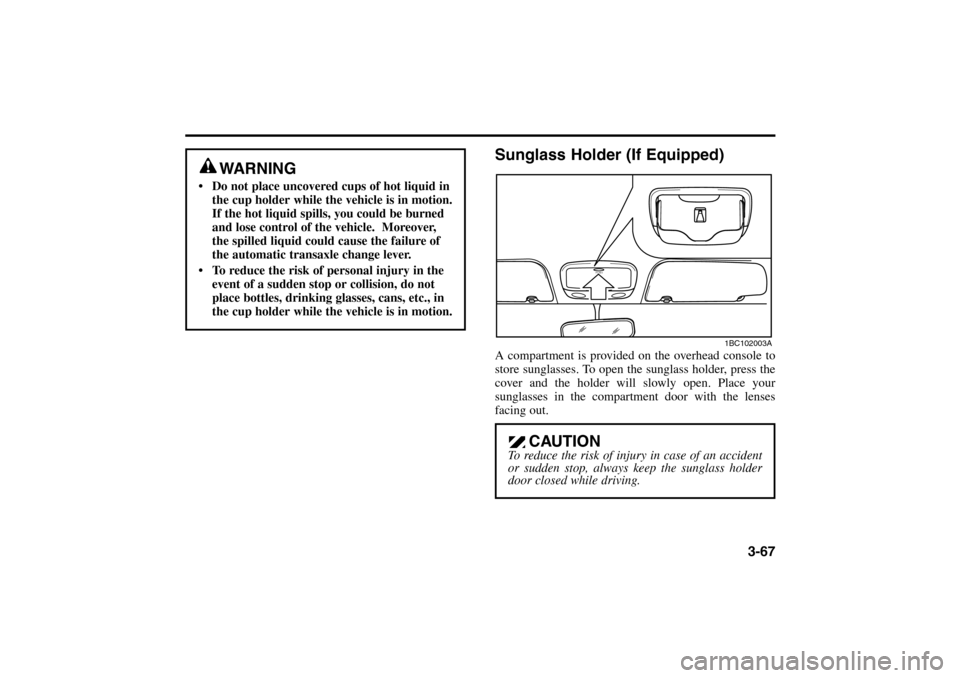
Sunglass Holder (If Equipped)A compartment is provided on the overhead console to
store sunglasses. To open the sunglass holder, press the
cover and the holder will slowly open. Place your
sunglasses in the compartment door with the lenses
facing out.
PUSH
1BC102003A
CAUTION
To reduce the risk of injury in case of an accident
or sudden stop, always keep the sunglass holder
door closed while driving.
RIO ENG CNA 3.qxd 7/29/05 5:13 PM Page 67
Page 78 of 238
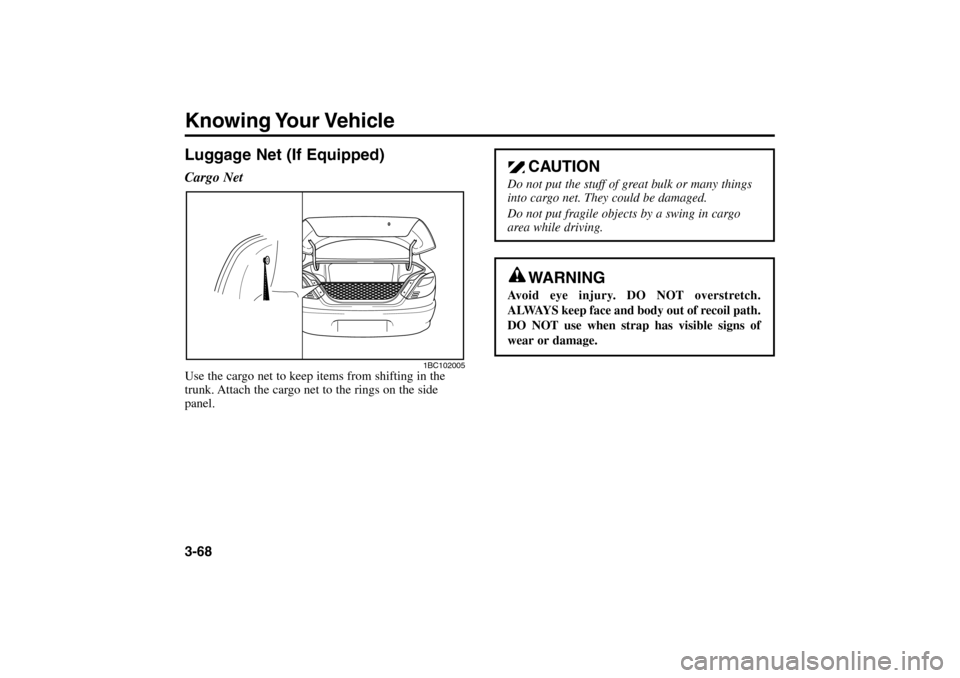
Knowing Your Vehicle3-68Luggage Net (If Equipped)Cargo NetUse the cargo net to keep items from shifting in the
trunk. Attach the cargo net to the rings on the side
panel.
1BC102005
CAUTION
Do not put the stuff of great bulk or many things
into cargo net. They could be damaged.
Do not put fragile objects by a swing in cargo
area while driving.
WARNING
Avoid eye injury. DO NOT overstretch.
ALWAYS keep face and body out of recoil path.
DO NOT use when strap has visible signs of
wear or damage.
RIO ENG CNA 3.qxd 7/29/05 5:13 PM Page 68
Page 82 of 238
4-1
DRIVING YOUR VEHICLEIgnition Switch . . . . . . . . . . . . . . . . . . . . . . . . . . . . . . .4-2
Starting the Engine . . . . . . . . . . . . . . . . . . . . . . . . . . . .4-4
Manual Transaxle . . . . . . . . . . . . . . . . . . . . . . . . . . . . .4-7
Automatic Transaxle . . . . . . . . . . . . . . . . . . . . . . . . . . .4-9
Brake System . . . . . . . . . . . . . . . . . . . . . . . . . . . . . . .4-15
Power Steering . . . . . . . . . . . . . . . . . . . . . . . . . . . . . .4-22
Tilt Steering . . . . . . . . . . . . . . . . . . . . . . . . . . . . . . . . .4-22
Instrument Cluster . . . . . . . . . . . . . . . . . . . . . . . . . . .4-23
Gauges . . . . . . . . . . . . . . . . . . . . . . . . . . . . . . . . . . . .4-25
Warnings and Indicators . . . . . . . . . . . . . . . . . . . . . .4-27
Lighting . . . . . . . . . . . . . . . . . . . . . . . . . . . . . . . . . . . .4-33
Daytime Running Lights(DRL) . . . . . . . . . . . . . . . . . .4-35
Wipers and Washers . . . . . . . . . . . . . . . . . . . . . . . . . .4-36
Rear Window Defroster . . . . . . . . . . . . . . . . . . . . . . . .4-38
Interior Features . . . . . . . . . . . . . . . . . . . . . . . . . . . . .4-40
Climate Control System . . . . . . . . . . . . . . . . . . . . . . .4-44
Windshield Defrosting and Defogging . . . . . . . . . . . .4-50
4
RIO ENG CNA 4.qxd 7/29/05 5:06 PM Page 1
Page 83 of 238
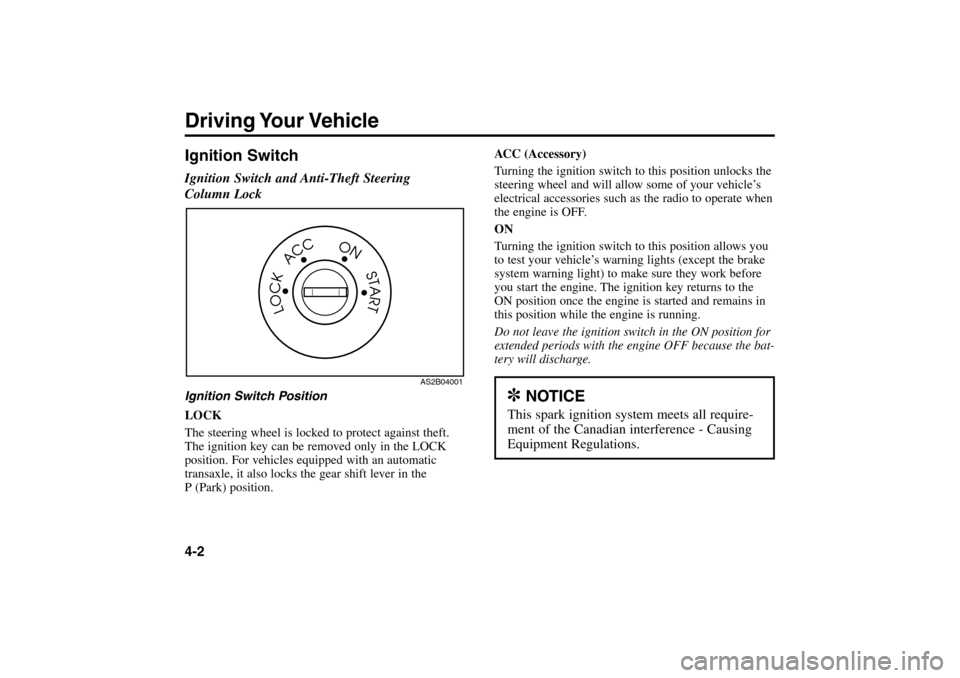
Ignition SwitchIgnition Switch and Anti-Theft Steering
Column LockIgnition Switch Position
LOCK
The steering wheel is locked to protect against theft.
The ignition key can be removed only in the LOCK
position. For vehicles equipped with an automatic
transaxle, it also locks the gear shift lever in the
P (Park) position.
ACC (Accessory)
Turning the ignition switch to this position unlocks the
steering wheel and will allow some of your vehicle’s
electrical accessories such as the radio to operate when
the engine is OFF.
ON
Turning the ignition switch to this position allows you
to test your vehicle’s warning lights (except the brake
system warning light) to make sure they work before
you start the engine. The ignition key returns to the
ON position once the engine is started and remains in
this position while the engine is running.
Do not leave the ignition switch in the ON position for
extended periods with the engine OFF because the bat-
tery will discharge.
Driving Your Vehicle4-2
AS2B04001
✽
NOTICE
This spark ignition system meets all require-
ment of the Canadian interference - Causing
Equipment Regulations.
RIO ENG CNA 4.qxd 7/29/05 5:06 PM Page 2
Page 84 of 238
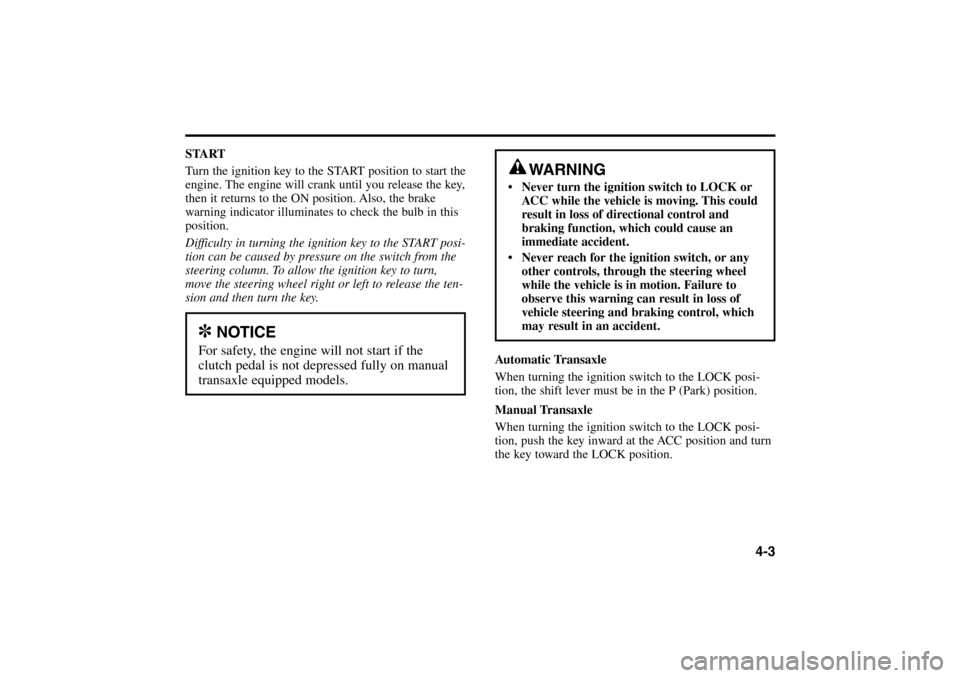
START
Turn the ignition key to the START position to start the
engine. The engine will crank until you release the key,
then it returns to the ON position. Also, the brake
warning indicator illuminates to check the bulb in this
position.
Difficulty in turning the ignition key to the START posi-
tion can be caused by pressure on the switch from the
steering column. To allow the ignition key to turn,
move the steering wheel right or left to release the ten-
sion and then turn the key.
Automatic Transaxle
When turning the ignition switch to the LOCK posi-
tion, the shift lever must be in the P (Park) position.
Manual Transaxle
When turning the ignition switch to the LOCK posi-
tion, push the key inward at the ACC position and turn
the key toward the LOCK position.
4-3
WARNING
• Never turn the ignition switch to LOCK or
ACC while the vehicle is moving. This could
result in loss of directional control and
braking function, which could cause an
immediate accident.
Never reach for the ignition switch, or any
other controls, through the steering wheel
while the vehicle is in motion. Failure to
observe this warning can result in loss of
vehicle steering and braking control, which
may result in an accident.
✽
NOTICE
For safety, the engine will not start if the
clutch pedal is not depressed fully on manual
transaxle equipped models.
RIO ENG CNA 4.qxd 7/29/05 5:06 PM Page 3
Page 88 of 238
4-7
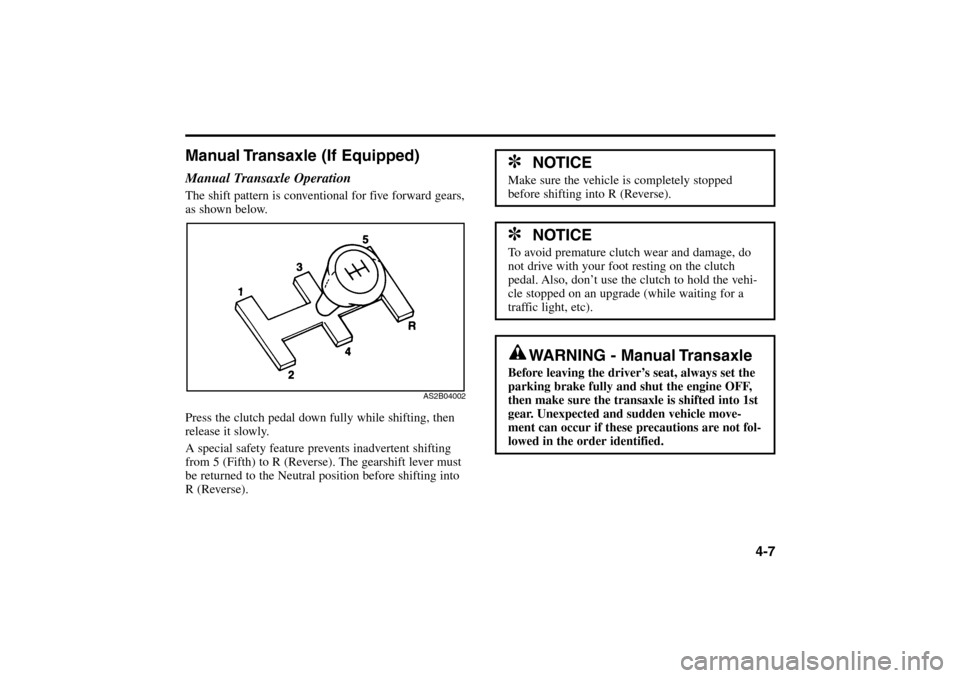
Manual Transaxle (If Equipped)Manual Transaxle OperationThe shift pattern is conventional for five forward gears,
as shown below.
Press the clutch pedal down fully while shifting, then
release it slowly.
A special safety feature prevents inadvertent shifting
from 5 (Fifth) to R (Reverse). The gearshift lever must
be returned to the Neutral position before shifting into
R (Reverse).
✽
NOTICE
To avoid premature clutch wear and damage, do
not drive with your foot resting on the clutch
pedal. Also, don’t use the clutch to hold the vehi-
cle stopped on an upgrade (while waiting for a
traffic light, etc).✽
NOTICE
Make sure the vehicle is completely stopped
before shifting into R (Reverse).
WARNING - Manual Transaxle
Before leaving the driver’s seat, always set the
parking brake fully and shut the engine OFF,
then make sure the transaxle is shifted into 1st
gear. Unexpected and sudden vehicle move-
ment can occur if these precautions are not fol-
lowed in the order identified.
AS2B04002
RIO ENG CNA 4.qxd 7/29/05 5:06 PM Page 7
Page 92 of 238
4-11
Transaxle Ranges
O/D (OVERDRIVE) SYSTEM
Pressing the O/D system button cancels and engages
the overdrive system. When the O/D system is can-
celled (button is depressed), the O/D OFF indicator
illuminates and the transaxle gear range is limited to
1st through 3rd. The transaxle will not shift to 4th gear
until the O/D system button is again depressed.
When the ignition is switched OFF, the O/D OFF mode
is automatically cancelled.
WARNING - Automatic
Transaxle
Before leaving the driver’s seat, always
make sure the shift lever is in the P (PARK)
position; then set the parking brake fully
and shut the engine off. Unexpected and
sudden vehicle movement can occur if these
precautions are not followed in the order
identified.
O/D OFF indicator
This indicator light illuminates in the instrument panel
when the O/D mode is cancelled.
NORMAL OPERATION
P (Park)
This position locks the transaxle and prevents the front
wheels from rotating. Always come to a complete stop
before shifting into this position.
✽
NOTICE
If the O/D OFF indicator flashes, it indicates an
electrical problem with the transaxle. Should this
occur, have the vehicle checked by an Authorized
Kia Dealer as soon as possible.
WARNING
Shifting into P (Park) while the vehicle is in
motion will cause the front wheels to lock and
you will lose driving control of the vehicle.
RIO ENG CNA 4.qxd 7/29/05 5:06 PM Page 11
Page 93 of 238
Driving Your Vehicle4-12
R (Reverse)
Use this position to drive the vehicle backward.
N (Neutral)
In this position, the wheels and transaxle are not
locked. The vehicle will roll freely even on the slight-
est incline unless the parking brake or service brakes
are applied.
D (Drive)
This is the normal forward driving position. The
transaxle will automatically shift through a four-gear
sequence, providing the best fuel economy and power.
For extra power when passing another vehicle or
climbing steep grades, depress the accelerator fully, at
which time the transaxle will automatically downshift
into the next lower gear.
CAUTION
Always come to a complete stop before shifting
into or out of R (Reverse). You may damage the
transaxle if you shift into R while the vehicle is in
motion, except as explained in “Rocking the
Ve h i c l e .’’
✽
NOTICE
The transaxle may be damaged if you shift into
P (Park) while the vehicle is in motion.
WARNING
Do not use the P (Park) position in place of
the parking brake when leaving the vehicle.
Always make sure the shift lever is latched
in the P (Park) position so that it cannot be
moved unless the lock release button is
pushed in AND the parking brake is fully
set.
Turn the ignition switch OFF whenever you
leave the vehicle unattended. Never leave the
vehicle unattended while the engine is run-
ning. Unexpected and sudden vehicle move-
ment may occur if these precautions are not
taken.
Never leave a child unattended in a vehicle.
RIO ENG CNA 4.qxd 7/29/05 5:06 PM Page 12
Page 97 of 238
Driving Your Vehicle4-16
When driving a vehicle equipped with anti-lock brakes,
adjust your driving according to the road and traffic
conditions and keep the following in mind.
Do not pump the brakes as you would when driving
a vehicle not equipped with an anti-lock brake sys-
tem (ABS). In order for the ABS to function nor-
mally, press the brake pedal firmly, without pump-
ing the pedal.
Even with the anti-lock brake system, your vehicle
still requires a sufficient stopping distance. Always
maintain a safe distance from the vehicle in front of
you.
Always slow down when cornering. The anti-lock
brake system cannot prevent accidents resulting
from excessive speeds.
On loose or uneven road surfaces, operation of the
anti-lock brake system may result in a longer stop-
ping distance than for vehicles equipped with a con-
ventional brake system.
Avoid high speeds on wet roads. The anti-lock brake
system cannot eliminate the risk of hydroplaning.
If the anti-lock brake system should fail, the brake sys-
tem will function as a conventional brake system. Have
your vehicle checked by an authorized Kia dealer as
soon as possible. During normal driving conditions, the anti-lock brake
system operates the same as a conventional brake sys-
tem. When the anti-lock brake system is engaged due
to imminent loss of traction, a pulsation of the brake
pedal will result and you may hear or feel “chattering”.
This is a normal condition and indicates the system is
functioning properly.
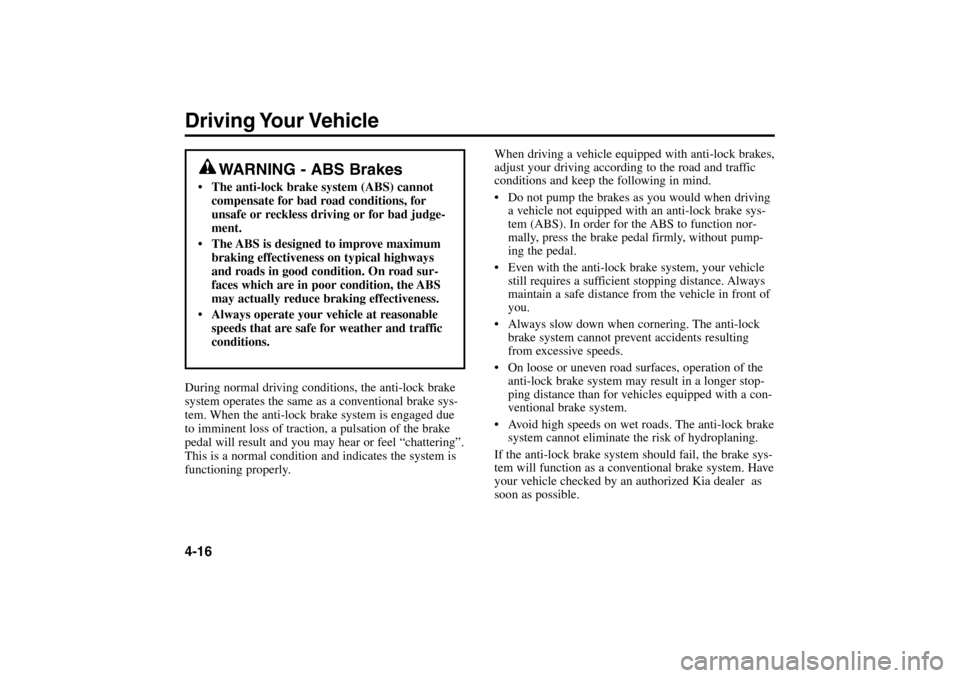
WARNING - ABS Brakes
The anti-lock brake system (ABS) cannot
compensate for bad road conditions, for
unsafe or reckless driving or for bad judge-
ment.
The ABS is designed to improve maximum
braking effectiveness on typical highways
and roads in good condition. On road sur-
faces which are in poor condition, the ABS
may actually reduce braking effectiveness.
Always operate your vehicle at reasonable
speeds that are safe for weather and traffic
conditions.
RIO ENG CNA 4.qxd 7/29/05 5:06 PM Page 16