heating KIA Rio 2005 2.G Owner's Manual
[x] Cancel search | Manufacturer: KIA, Model Year: 2005, Model line: Rio, Model: KIA Rio 2005 2.GPages: 238, PDF Size: 2.6 MB
Page 26 of 238
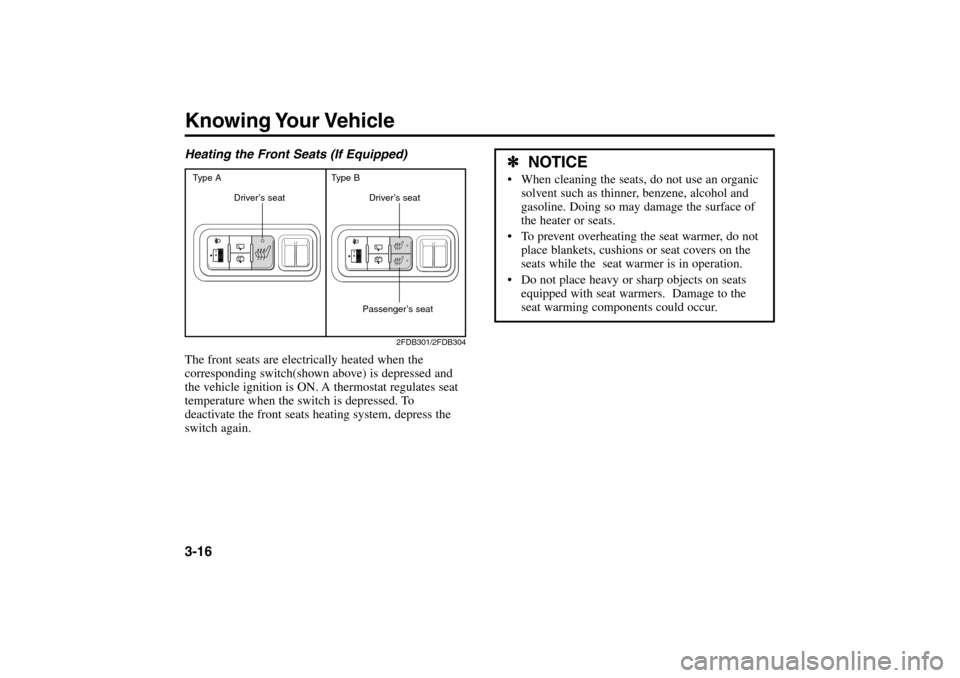
Knowing Your Vehicle3-16Heating the Front Seats (If Equipped)
The front seats are electrically heated when the
corresponding switch(shown above) is depressed and
the vehicle ignition is ON. A thermostat regulates seat
temperature when the switch is depressed. To
deactivate the front seats heating system, depress the
switch again.
2FDB301/2FDB304
Type A
Driver’s seatType B
Driver’s seatPassenger’s seat
✽ ✽
NOTICE When cleaning the seats, do not use an organic
solvent such as thinner, benzene, alcohol and
gasoline. Doing so may damage the surface of
the heater or seats.
To prevent overheating the seat warmer, do not
place blankets, cushions or seat covers on the
seats while the seat warmer is in operation.
Do not place heavy or sharp objects on seats
equipped with seat warmers. Damage to the
seat warming components could occur.
RIO ENG CNA 3.qxd 7/29/05 5:13 PM Page 16
Page 27 of 238
3-17
Rear Seat
WARNING - Rear Seatback
The rear seatback must be securely latched.
If not passengers and objects could be
thrown forward and suffer serious injury or
death in the event of a sudden stop or colli-
sion.
Luggage and other cargo should be laid flat
in the cargo area. If objects are large, heavy
or must be piled, they must be secured.
Under no circumstances should cargo be
piled higher than the seatbacks. Failure to
follow what warnings could result in serious
injury or death in the event of a sudden
stop, collision or rollover.
(Continued)
WARNING
Passengers should use extreme caution when
using seat warmers due to the possibility of
excess heating or burns. In particular, the fol-
lowing types of passengers should exercise
extreme care:
1. Infants, children, elderly or handicapped
persons, or hospital outpatients
2. Persons with sensitive skin or those that
burn easily
3. Fatigued individuals
4. Intoxicated individuals
5. Individuals taking medication that can cause
drowsiness or sleepiness (sleeping pills, cold
tablets, etc.)
RIO ENG CNA 3.qxd 7/29/05 5:13 PM Page 17
Page 107 of 238
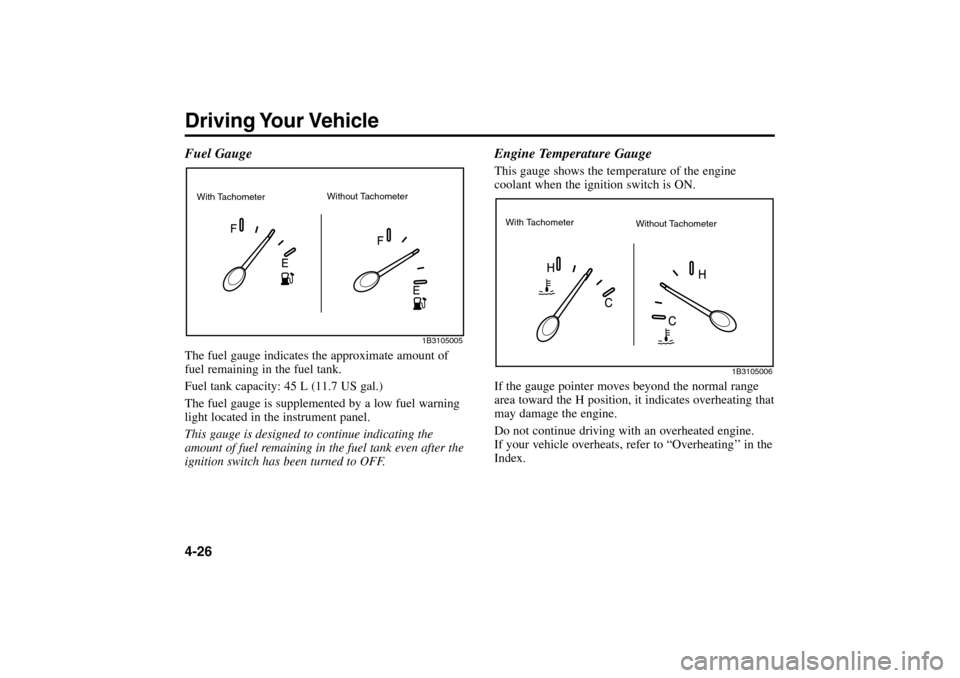
Driving Your Vehicle4-26 Fuel GaugeThe fuel gauge indicates the approximate amount of
fuel remaining in the fuel tank.
Fuel tank capacity: 45 L (11.7 US gal.)
The fuel gauge is supplemented by a low fuel warning
light located in the instrument panel.
This gauge is designed to continue indicating the
amount of fuel remaining in the fuel tank even after the
ignition switch has been turned to OFF.
Engine Temperature GaugeThis gauge shows the temperature of the engine
coolant when the ignition switch is ON.
If the gauge pointer moves beyond the normal range
area toward the H position, it indicates overheating that
may damage the engine.
Do not continue driving with an overheated engine.
If your vehicle overheats, refer to “Overheating’’ in the
Index.
1B3105005
1B3105006
With Tachometer
Without Tachometer
With Tachometer
Without Tachometer
RIO ENG CNA 4.qxd 7/29/05 5:06 PM Page 26
Page 110 of 238
4-29
If the warning light illuminates while driving:
1. Drive to the nearest safe location and carefully stop
your vehicle.
2. With the engine OFF, check the generator drive belt
for looseness or breakage.
3. If the belt is adjusted properly, a problem exists
somewhere in the electrical charging system. Have
an Authorized Kia Dealer locate and correct the
problem as soon as possible.Engine Oil Pressure Warning This warning light indicates the engine oil pressure is
low.
If the warning light comes ON while driving:
1. Drive safely to the side of the road and stop.
2. With the engine OFF, check the engine oil level. If
the level is low, add oil as required.
If the warning light remains ON after adding oil or if
oil is not available, call an Authorized Kia Dealer.Low Fuel Level Warning This warning light indicates the fuel tank is near
empty. The warning light will come on when the fuel
level has dropped to about 9 liters (2.4 US gal.).
Refuel as soon as possible.
✽
NOTICE
Do not drive the vehicle with a loose or broken
generator belt; the engine could be damaged by
overheating because this belt also drives the water
pump.
✽
NOTICE
If the engine is not stopped as soon as possible,
severe engine damage could result.
Do not drive the vehicle when the Engine Oil
Pressure Warning Light is ON.
RIO ENG CNA 4.qxd 7/29/05 5:06 PM Page 29
Page 112 of 238
4-31 Flashing ON and OFF :
If the CHECK ENGINE light begins to flash ON and
OFF, a more serious problem with the ECS or exhaust
system component has been detected. If this happens,
and there is no degradation to performance, the vehicle
is still driveable (avoid high speeds) but should be
checked by an authorized Kia dealer at your earliest
possible convenience. If the flashing CHECK
ENGINE light is accompanied by a decrease in power
or poor running conditions, safely stop the vehicle and
immediately contact Kia Roadside Assistance.
Note that the CHECK ENGINE light will illuminate
for a problem like a loose or missing gas cap, but will
not illuminate as a result of low engine oil or coolant,
low automatic transaxle fluid or engine overheating.
The driver will be alerted to these conditions by other
indicators on the instrument panel.
CAUTION
Prolonged driving with the On Board
Diagnostic System Malfunction Indicator Light
()illuminated may cause damage to the
emission control systems which could effect
driveability and/or fuel economy.
If the On Board Diagnostic System
Malfunction Indicator Light () begins to
flash ON and OFF, potential catalytic convert-
er damage is possible which could result in
loss of engine power. Have the On Board
Diagnostic System inspected as soon as possi-
ble by an authorized Kia dealer.
CHECK
CHECK
CHECK
CHECK
RIO ENG CNA 4.qxd 7/29/05 5:06 PM Page 31
Page 122 of 238
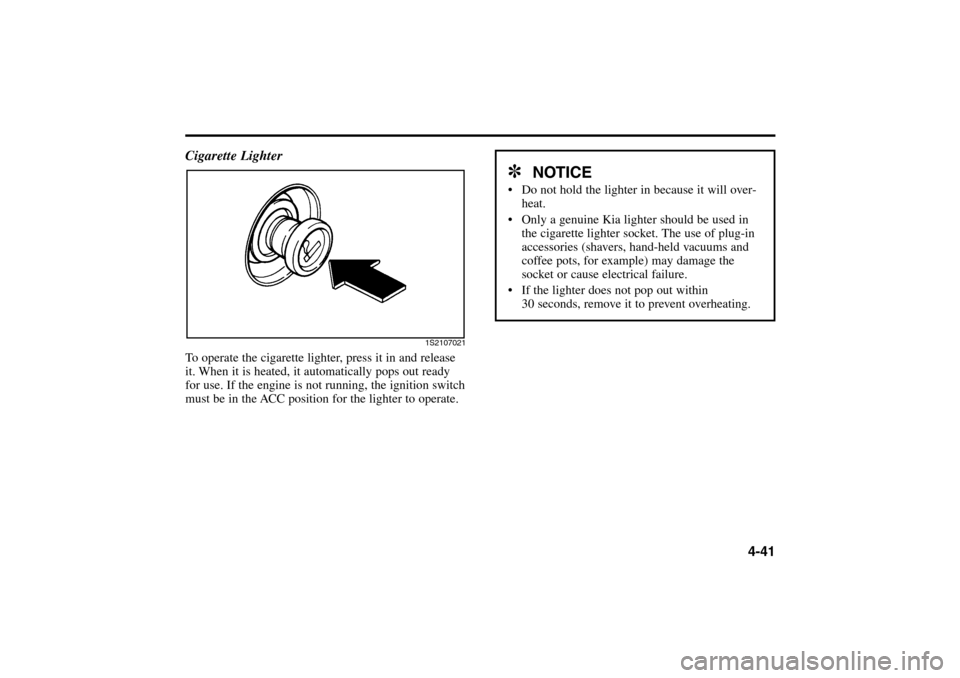
4-41 Cigarette Lighter
To operate the cigarette lighter, press it in and release
it. When it is heated, it automatically pops out ready
for use. If the engine is not running, the ignition switch
must be in the ACC position for the lighter to operate.
1S2107021
✽
NOTICE
Do not hold the lighter in because it will over-
heat.
Only a genuine Kia lighter should be used in
the cigarette lighter socket. The use of plug-in
accessories (shavers, hand-held vacuums and
coffee pots, for example) may damage the
socket or cause electrical failure.
If the lighter does not pop out within
30 seconds, remove it to prevent overheating.
RIO ENG CNA 4.qxd 7/29/05 5:06 PM Page 41
Page 127 of 238
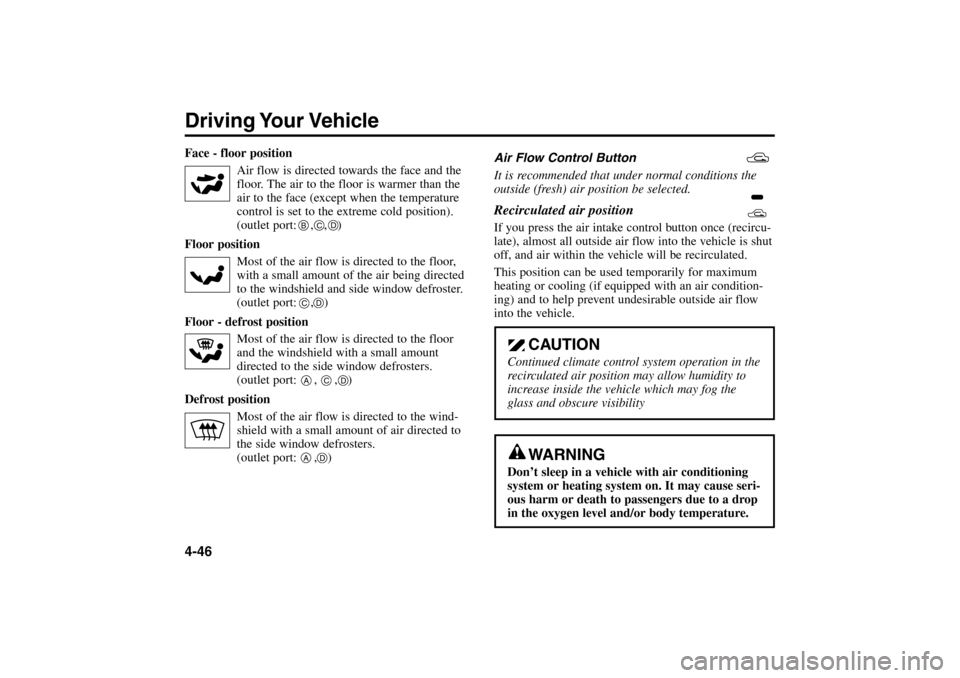
Driving Your Vehicle4-46Face - floor position
Air flow is directed towards the face and the
floor. The air to the floor is warmer than the
air to the face (except when the temperature
control is set to the extreme cold position).
(outlet port: , , )
Floor position
Most of the air flow is directed to the floor,
with a small amount of the air being directed
to the windshield and side window defroster.
(outlet port: , )
Floor - defrost position
Most of the air flow is directed to the floor
and the windshield with a small amount
directed to the side window defrosters.
(outlet port: , , )
Defrost position
Most of the air flow is directed to the wind-
shield with a small amount of air directed to
the side window defrosters.
(outlet port: , )Air Flow Control Button
It is recommended that under normal conditions the
outside (fresh) air position be selected.
Recirculated air position If you press the air intake control button once (recircu-
late), almost all outside air flow into the vehicle is shut
off, and air within the vehicle will be recirculated.
This position can be used temporarily for maximum
heating or cooling (if equipped with an air condition-
ing) and to help prevent undesirable outside air flow
into the vehicle.
BC
C
D
D
A
C
D
A
D
CAUTION
Continued climate control system operation in the
recirculated air position may allow humidity to
increase inside the vehicle which may fog the
glass and obscure visibility
WARNING
Don’t sleep in a vehicle with air conditioning
system or heating system on. It may cause seri-
ous harm or death to passengers due to a drop
in the oxygen level and/or body temperature.
RIO ENG CNA 4.qxd 7/29/05 5:06 PM Page 46
Page 129 of 238
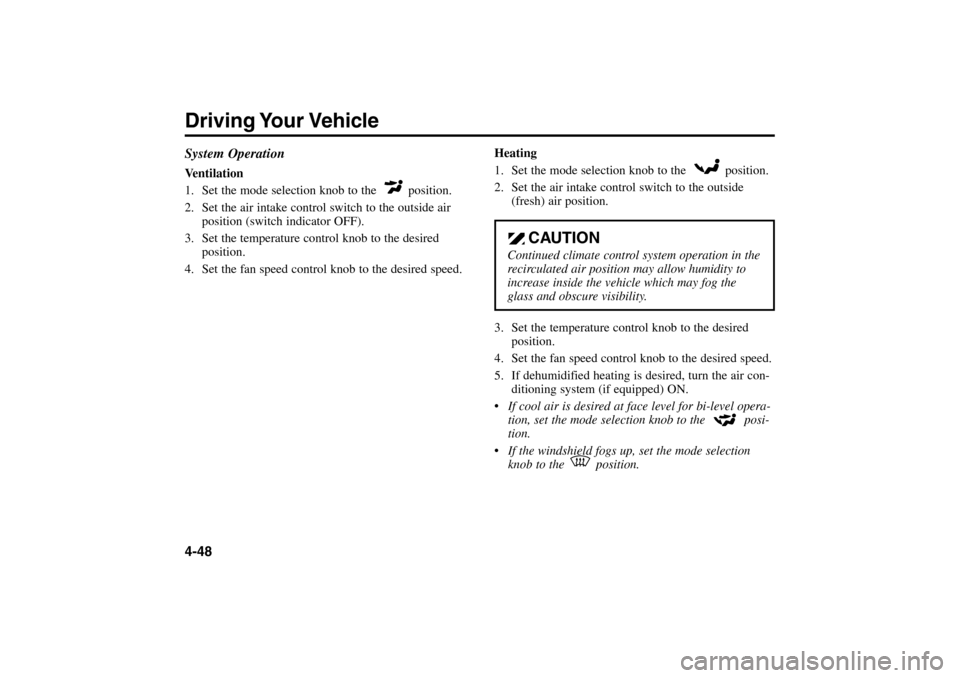
Driving Your Vehicle4-48 System OperationVentilation
1. Set the mode selection knob to the position.
2. Set the air intake control switch to the outside air
position (switch indicator OFF).
3. Set the temperature control knob to the desired
position.
4. Set the fan speed control knob to the desired speed.
Heating
1. Set the mode selection knob to the position.
2. Set the air intake control switch to the outside
(fresh) air position.
3. Set the temperature control knob to the desired
position.
4. Set the fan speed control knob to the desired speed.
5. If dehumidified heating is desired, turn the air con-
ditioning system (if equipped) ON.
If cool air is desired at face level for bi-level opera-
tion, set the mode selection knob to the posi-
tion.
If the windshield fogs up, set the mode selection
knob to the position.
CAUTION
Continued climate control system operation in the
recirculated air position may allow humidity to
increase inside the vehicle which may fog the
glass and obscure visibility.
RIO ENG CNA 4.qxd 7/29/05 5:06 PM Page 48
Page 130 of 238
4-49
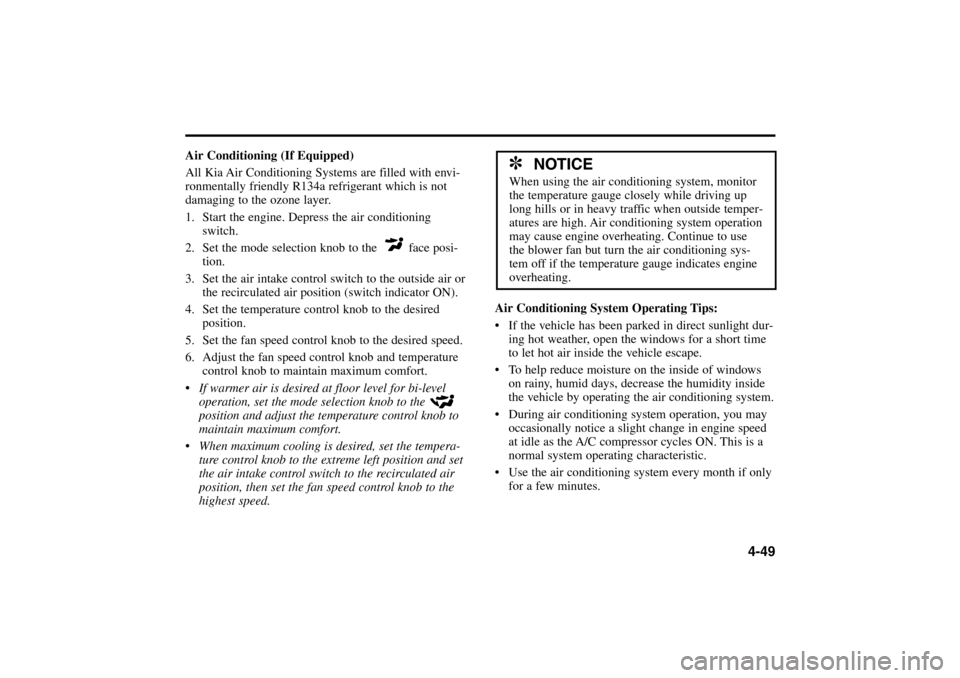
Air Conditioning (If Equipped)
All Kia Air Conditioning Systems are filled with envi-
ronmentally friendly R134a refrigerant which is not
damaging to the ozone layer.
1. Start the engine. Depress the air conditioning
switch.
2. Set the mode selection knob to the face posi-
tion.
3. Set the air intake control switch to the outside air or
the recirculated air position (switch indicator ON).
4. Set the temperature control knob to the desired
position.
5. Set the fan speed control knob to the desired speed.
6. Adjust the fan speed control knob and temperature
control knob to maintain maximum comfort.
If warmer air is desired at floor level for bi-level
operation, set the mode selection knob to the
position and adjust the temperature control knob to
maintain maximum comfort.
When maximum cooling is desired, set the tempera-
ture control knob to the extreme left position and set
the air intake control switch to the recirculated air
position, then set the fan speed control knob to the
highest speed.
Air Conditioning System Operating Tips:
If the vehicle has been parked in direct sunlight dur-
ing hot weather, open the windows for a short time
to let hot air inside the vehicle escape.
To help reduce moisture on the inside of windows
on rainy, humid days, decrease the humidity inside
the vehicle by operating the air conditioning system.
During air conditioning system operation, you may
occasionally notice a slight change in engine speed
at idle as the A/C compressor cycles ON. This is a
normal system operating characteristic.
Use the air conditioning system every month if only
for a few minutes.
✽
NOTICE
When using the air conditioning system, monitor
the temperature gauge closely while driving up
long hills or in heavy traffic when outside temper-
atures are high. Air conditioning system operation
may cause engine overheating. Continue to use
the blower fan but turn the air conditioning sys-
tem off if the temperature gauge indicates engine
overheating.
RIO ENG CNA 4.qxd 7/29/05 5:06 PM Page 49
Page 142 of 238
Driving Tips5-8Rocking the Vehicle
If it is necessary to rock the vehicle to free it from
snow, sand, or mud, move the shift lever of an
automatic transaxle from D (Drive) to R (Reverse) in a
repeat pattern while depressing the accelerator gently.
With a manual transaxle, move the shift lever back and
forth from 1 (First) to R (Reverse).
Do not race the engine. If you are still stuck after a
couple minutes of rocking, have the vehicle pulled out
by a tow vehicle to avoid engine overheating and
possible damage to the transaxle.
✽
NOTICE
Prolonged rocking may cause engine overheating,
transaxle damage or failure, and tire damage.
WARNING - Spinning Tires
Do not spin the wheels especially at speeds
more than 56 km/h (35 mph). Spinning the
wheels at high speeds when the vehicle is
stationary could cause a tire to overheat,
explode and injure bystanders.
When starting from a stop in snow, mud, or sand,
use second gear and accelerate slowly to avoid
spinning the front wheels. Low gear may be used, if
necessary.
Use sand, rock salt, tire chains, or other non-slip
material under the front wheels to provide traction
when stalled on ice, snow, or mud.
WARNING - Downshifting
Downshifting into first gear with a manual
transaxle or into low with an automatic
transaxle while driving on slippery surfaces
can cause an accident. The sudden change in
tire speed could cause the tires to skid. Be
careful when downshifting on slippery
surfaces.
RIO ENG CNA 5.qxd 7/29/05 5:07 PM Page 8