Rear light KIA Rio 2008 2.G Owner's Manual
[x] Cancel search | Manufacturer: KIA, Model Year: 2008, Model line: Rio, Model: KIA Rio 2008 2.GPages: 219, PDF Size: 5.17 MB
Page 7 of 219
Your vehicle at a glance
2 2
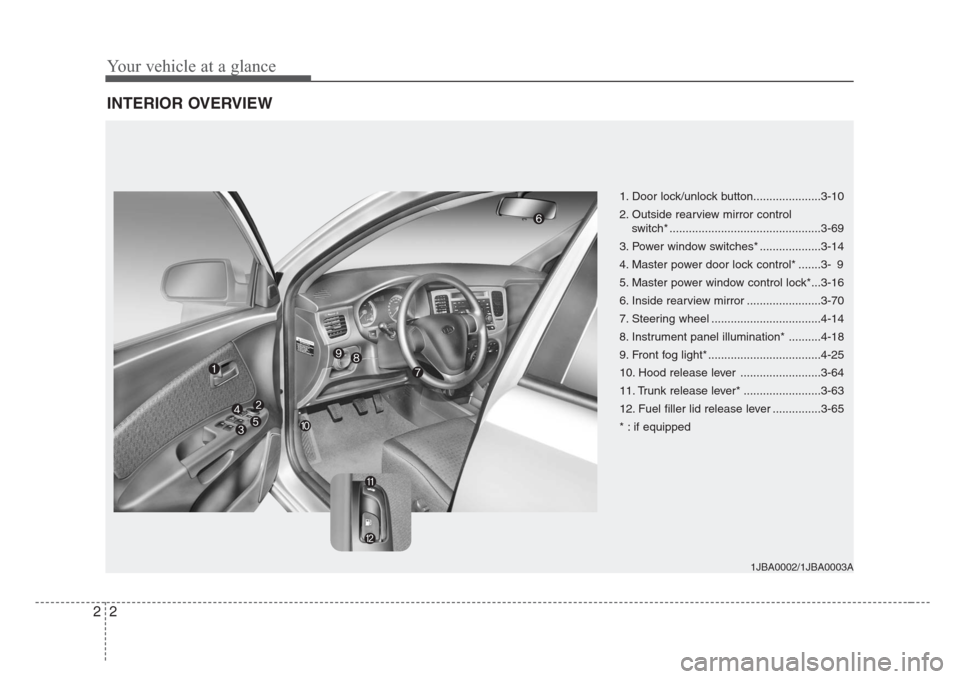
INTERIOR OVERVIEW
1. Door lock/unlock button.....................3-10
2. Outside rearview mirror control
switch* ...............................................3-69
3. Power window switches* ...................3-14
4. Master power door lock control* .......3- 9
5. Master power window control lock*...3-16
6. Inside rearview mirror .......................3-70
7. Steering wheel ..................................4-14
8. Instrument panel illumination* ..........4-18
9. Front fog light* ...................................4-25
10. Hood release lever .........................3-64
11. Trunk release lever* ........................3-63
12. Fuel filler lid release lever ...............3-65
* : if equipped
1JBA0002/1JBA0003A
Page 8 of 219
23
Your vehicle at a glance
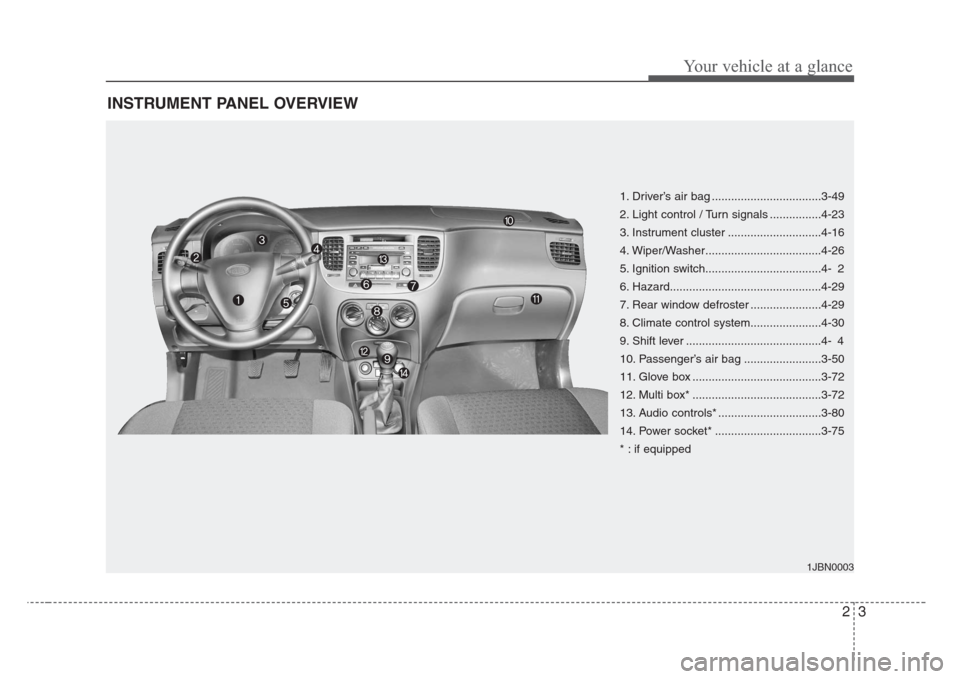
INSTRUMENT PANEL OVERVIEW
1. Driver’s air bag ..................................3-49
2. Light control / Turn signals ................4-23
3. Instrument cluster .............................4-16
4. Wiper/Washer....................................4-26
5. Ignition switch....................................4- 2
6. Hazard...............................................4-29
7. Rear window defroster ......................4-29
8. Climate control system......................4-30
9. Shift lever ..........................................4- 4
10. Passenger’s air bag ........................3-50
11. Glove box ........................................3-72
12. Multi box* ........................................3-72
13. Audio controls* ................................3-80
14. Power socket* .................................3-75
* : if equipped
1JBN0003
Page 14 of 219
35
Knowing your vehicle
Theft alarm system will not operate when
the ignition key is in the ignition switch.
If the lock button on the transmitter is
pressed when the key is not in the igni-
tion and any vehicle door or the trunk (if
equipped) is open, then, the doors will
lock but the theft alarm system will not
activate. However, the theft alarm system
will automatically activate when the open
door(s) or trunk (if equipped) is closed
and locked.
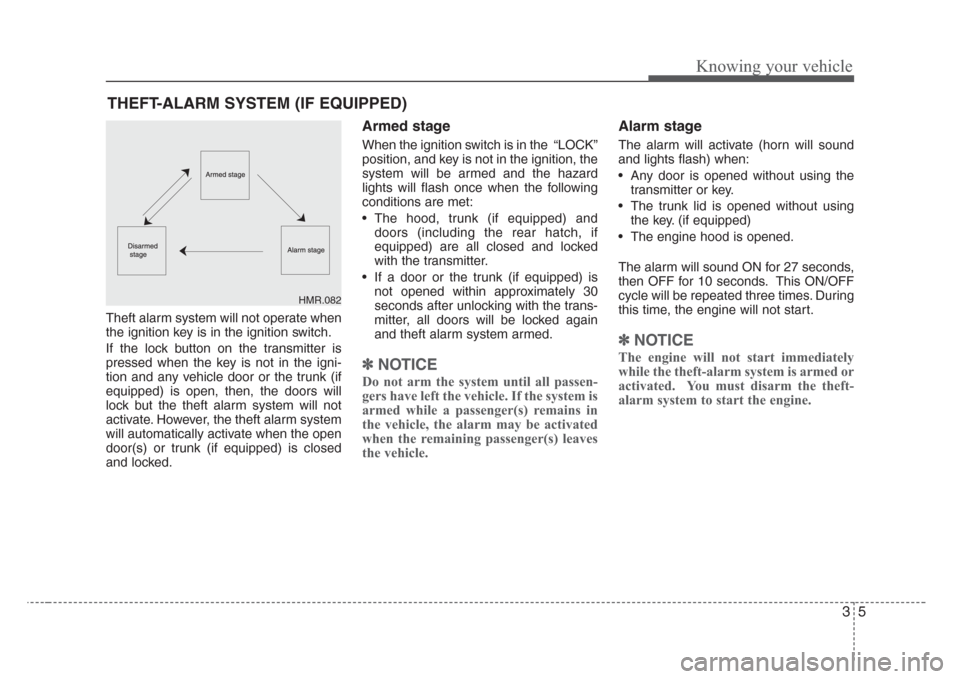
Armed stage
When the ignition switch is in the “LOCK”
position, and key is not in the ignition, the
system will be armed and the hazard
lights will flash once when the following
conditions are met:
• The hood, trunk (if equipped) and
doors (including the rear hatch, if
equipped) are all closed and locked
with the transmitter.
• If a door or the trunk (if equipped) is
not opened within approximately 30
seconds after unlocking with the trans-
mitter, all doors will be locked again
and theft alarm system armed.
✽
NOTICE
Do not arm the system until all passen-
gers have left the vehicle. If the system is
armed while a passenger(s) remains in
the vehicle, the alarm may be activated
when the remaining passenger(s) leaves
the vehicle.
Alarm stage
The alarm will activate (horn will sound
and lights flash) when:
• Any door is opened without using the
transmitter or key.
• The trunk lid is opened without using
the key. (if equipped)
• The engine hood is opened.
The alarm will sound ON for 27 seconds,
then OFF for 10 seconds. This ON/OFF
cycle will be repeated three times. During
this time, the engine will not start.
✽
NOTICE
The engine will not start immediately
while the theft-alarm system is armed or
activated. You must disarm the theft-
alarm system to start the engine.
THEFT-ALARM SYSTEM (IF EQUIPPED)
HMR.082
Page 15 of 219
Knowing your vehicle
6 3
Opening the trunk with the alarm
armed (if equipped)
When the alarm is armed, the alarm will
not sound if the trunk lid is opened with
the key.
However, if the trunk lid is not opened
completely within two seconds after
unlocking with the key, the alarm will
sound.
Also, if any of the doors or hood is
opened while the trunk lid is open and
the alarm armed, the alarm will sound.
Disarmed stage
The system will be disarmed when the
doors are unlocked by depressing the
unlock button on the transmitter. After
depressing unlock button, the hazard
flasher light will flash twice to indicate the
system is disarmed.
After depressing unlock button, if any
door is not opened within 30 seconds,
the system will be rearmed.CAUTION
Only the transmitter can disarm the
armed stage. If the transmitter does
not disarm the system, it is neces-
sary to take the following steps:
Without immobilizer system:
1. Unlock and open the door with
the key, which will cause the
alarm to be activated.
2. Insert the key in the ignition
switch and turn the ignition key
to "ON" position.
3. Wait for 30 seconds.
With immobilizer system:
1. Unlock and open the door with
the key, which will cause the
alarm to be activated.
2. Insert the key in the ignition
switch and turn the ignition key
to "START" position.
After completing the steps above,
the system will be disarmed.
Page 28 of 219
319
Knowing your vehicle
Adjusting height of the driver’s seat
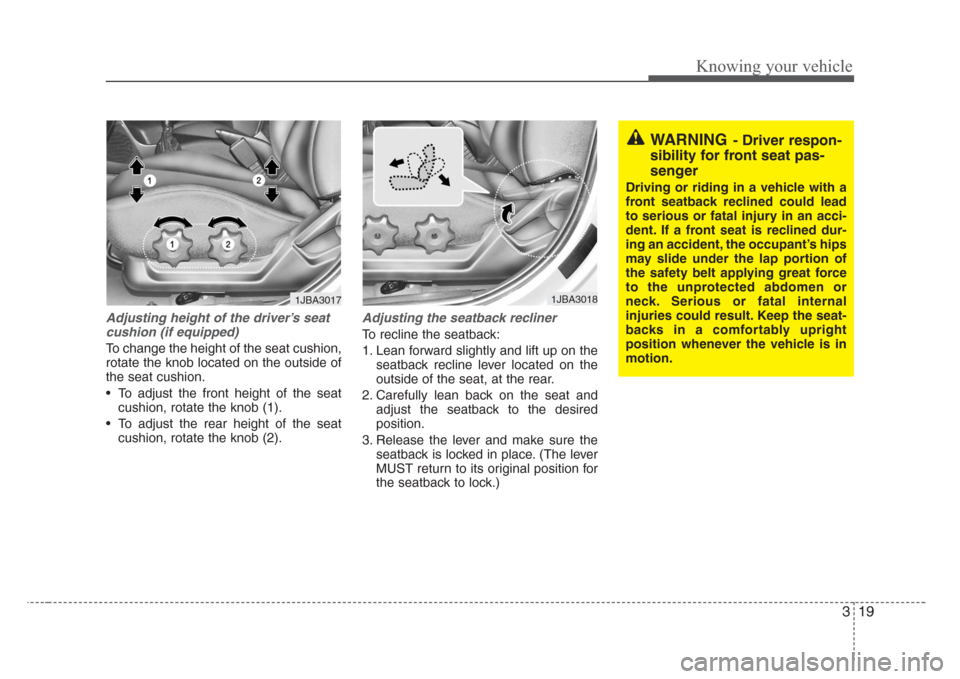
cushion (if equipped)
To change the height of the seat cushion,
rotate the knob located on the outside of
the seat cushion.
• To adjust the front height of the seat
cushion, rotate the knob (1).
• To adjust the rear height of the seat
cushion, rotate the knob (2).
Adjusting the seatback recliner
To recline the seatback:
1. Lean forward slightly and lift up on the
seatback recline lever located on the
outside of the seat, at the rear.
2. Carefully lean back on the seat and
adjust the seatback to the desired
position.
3. Release the lever and make sure the
seatback is locked in place. (The lever
MUST return to its original position for
the seatback to lock.)
1JBA30171JBA3018
WARNING- Driver respon-
sibility for front seat pas-
senger
Driving or riding in a vehicle with a
front seatback reclined could lead
to serious or fatal injury in an acci-
dent. If a front seat is reclined dur-
ing an accident, the occupant’s hips
may slide under the lap portion of
the safety belt applying great force
to the unprotected abdomen or
neck. Serious or fatal internal
injuries could result. Keep the seat-
backs in a comfortably upright
position whenever the vehicle is in
motion.
Page 48 of 219
339
Knowing your vehicle
Restraint of larger children
As children grow, they may need to use
new child-restraint systems, including
larger child seats or booster seats, which
are appropriate for their increased size.
A child who has outgrown available child-
restraint systems should use the belts
provided in the vehicle. When seated in
the rear outboard seats, the child should
be restrained by the lap/shoulder belt.
If the shoulder belt portion slightly touch-
es the child’s neck or face, try placing the
child closer to the center of the vehicle. If
the shoulder belt still touches their face
or neck they need to be returned to a
child restraint system. In addition, after-
market devices are available from inde-
pendent manufacturers which help pull
the shoulder belt down and away from
the child’s face or neck.WARNING- Infants and
young children
• Infants and young children are at
much greater risk of serious
injury or death in an accident or
sudden stop if they are unre-
strained or restrained improperly.
Follow all instructions in this sec-
tion and the instructions that
came with an approved child
safety system. The child restraint
must be correctly installed in the
vehicle, and the child must be
correctly placed in the child
restraint.
• All children under 12 are safest in
the back seat.
• Never install a rear facing infant
seat in the front passenger posi-
tion. The baby will be injured or
killed by the air bag if it deploys.
• Never allow a child to stand or
kneel on the seat of a moving
vehicle.
WARNING- Children on
laps
Never hold a child on your lap or in
your arms in a moving vehicle.
Even a very strong person cannot
hold onto a child in the event of
even a minor collision.
CAUTION- Hot metal parts
Safety belts and seats can become
hot in a vehicle that has been
closed during warm/hot weather;
they could burn a child. Check
seats,seatbelt webbing and buck-
les before you place a child any-
where near them.
WARNING- Shoulder belts
on small children
• Never allow a shoulder belt to be
in contact with a child’s neck or
face while the vehicle is in motion.
• If safety belts are not properly
worn and adjusted, there is a risk
of death or serious injury to such
a child.
Page 57 of 219
Knowing your vehicle
48 3
What your air bag system does
Driver’s air bag and front passenger’s air
bag are designed to supplement the pro-
tection offered by the safety belt in cer-
tain frontal collisions. Likewise, side air
bag and curtain air bags are designed to
supplement the protection offered by the
safety belt in side collisions. Safety belts
are designed to reduce the injury of the
driver or passengers in case of light
impact or collision. No safety belt or air
bag system can completely eliminate
injuries that may cause in collisions or
impacts. To help reduce impact on driver
or passengers in any collision, safety
belts must be correctly worn.
What your air bag system does
not do
The air bag system is designed to sup-
plement the protection offered by the
safety belt system. IT IS NOT A SUBSTI-
TUTE FOR THE SAFETY BELT.
The importance of using
safety belts
There are four very important reasons to
use safety belts even with an air bag sup-
plemental restraint system. They:
• help keep you in the proper position
(away from the air bag) when it inflates.
• reduce the risk of harm in rollover, side
impact (vehicles not equipped with
side and curtain air bags) or rear
impact collisions, because an air bag is
not designed to inflate in such situa-
tions and even a side curtain air bag is
designed to inflate only in certain side
impact collisions.
• reduce the risk of harm in frontal or
side collisions which are not severe
enough to actuate the air bag supple-
mental restraint system.
• reduce the risk of being ejected from
your vehicle.Your vehicle’s Supplemental Restraint
System Control Module is equipped
with a recording device that may
record the use or status of the safety
belt restraint system by the driver and
front passenger in certain collisions.
WARNING- Air bags &
safety belts
• Even in vehicles with air bags,
you and your passengers must
always wear the safety belts pro-
vided in order to minimize the risk
and severity of injury in the event
of a collision or rollover.
•Always wear your safety belt. It
can help keep you away from the
air bags during heavy braking
just before a collision. It may also
reduce the risk of occupant ejec-
tion.
• If occupants are not wearing safe-
ty belts or correctly seated, they
cannot be fully protected, and
thus face a greater risk of serious
injury or death.
(Continued)
Page 58 of 219
349
Knowing your vehicle
Air bag system components
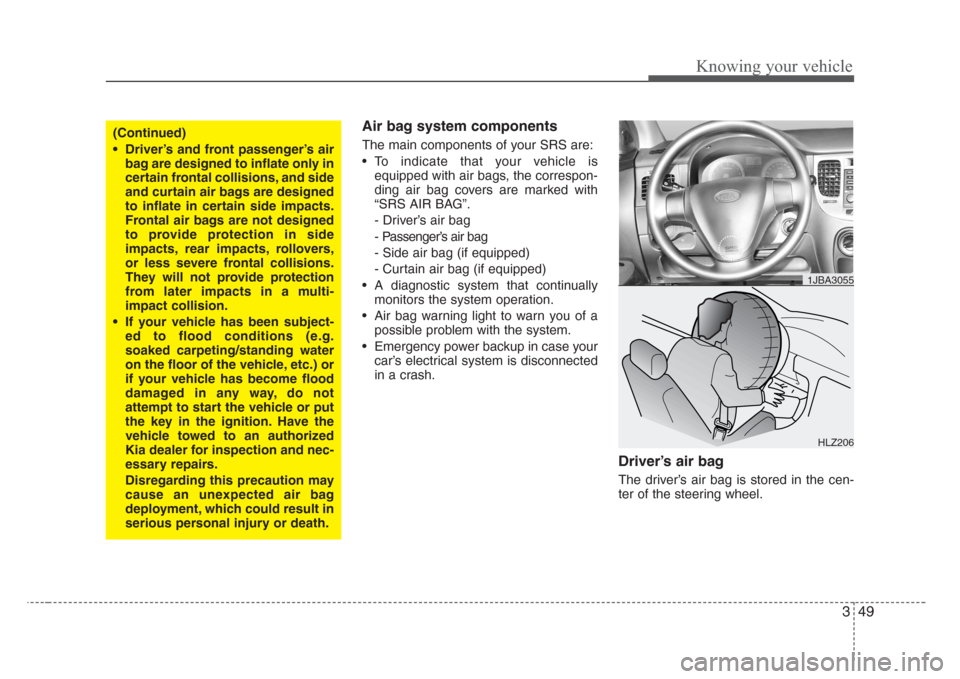
The main components of your SRS are:
• To indicate that your vehicle is
equipped with air bags, the correspon-
ding air bag covers are marked with
“SRS AIR BAG”.
- Driver’s air bag
- Passenger’s air bag
- Side air bag (if equipped)
- Curtain air bag (if equipped)
• A diagnostic system that continually
monitors the system operation.
• Air bag warning light to warn you of a
possible problem with the system.
• Emergency power backup in case your
car’s electrical system is disconnected
in a crash.
Driver’s air bag
The driver’s air bag is stored in the cen-
ter of the steering wheel.
(Continued)
• Driver’s and front passenger’s air
bag are designed to inflate only in
certain frontal collisions, and side
and curtain air bags are designed
to inflate in certain side impacts.
Frontal air bags are not designed
to provide protection in side
impacts, rear impacts, rollovers,
or less severe frontal collisions.
They will not provide protection
from later impacts in a multi-
impact collision.
• If your vehicle has been subject-
ed to flood conditions (e.g.
soaked carpeting/standing water
on the floor of the vehicle, etc.) or
if your vehicle has become flood
damaged in any way, do not
attempt to start the vehicle or put
the key in the ignition. Have the
vehicle towed to an authorized
Kia dealer for inspection and nec-
essary repairs.
Disregarding this precaution may
cause an unexpected air bag
deployment, which could result in
serious personal injury or death.
HLZ206
1JBA3055
Page 69 of 219
Knowing your vehicle
60 3
Air bag warning light
The purpose of air bag warning light in
your instrument panel is to alert you of a
potential problem with your air bag -
Supplemental Restraint System (SRS).
When the ignition switch is turned ON,
the indicator light should blink or illumi-
nate for approximately 6 seconds, then
go off.
Have the system checked if:
• The light does not turn on briefly when
you turn the ignition ON.
• The light stays on after the engine
starts.
• The light comes on while the vehicle is
in motion.
Air bag (Supplemental Restraint
System) service
Your Supplemental Restraint System is
virtually maintenance-free. There are no
parts which you can service.
You must have the system serviced
under the following circumstances:
• If an air bag ever inflates, the air bag
must be replaced. Do not try to remove
or discard the air bag by yourself. This
must be done by an authorized Kia
dealer.
• If the air bag warning indicator light
alerts you to a problem, have the air
bag system checked as soon as possi-
ble. Otherwise, your air bag system
may be ineffective.
WARNING
• Never put child restraint in the
front passenger seat. If the front
passenger air bag inflates, it may
cause severe or fatal injuries.
• When children are seated in the
rear outboard seats in which cur-
tain air bags are equipped, be
sure to put the child restraint sys-
tem as far away from the door
side as possible, and secure the
child restraint system to be
locked in position.
Inflation of side or curtain air bag
(if equipped) could cause severe
injury or death due to the expan-
sion impact.
AIR
BAG
CAUTION - No modification
Do not modify any part of the air bag
system. Modification could make
the air bag system ineffective or
could cause unnecessary deploy-
ment.
Page 79 of 219
Knowing your vehicle
70 3
Outside rearview mirror heater
(if equipped)
The outside rearview mirror heater is
automatically turned on when the rear
window defroster is turned on. To heat
the outside rearview mirror glass, push
the button for the rear window defroster.
The rearview mirror heater (and rear win-
dow defroster) will not operate unless the
engine is running.
The outside rearview mirror glass will be
heated for defrosting or defogging and
will give you improved rear vision in
inclement weather conditions. Push the
button again to turn the heater off. The
outside rearview mirror heater automati-
cally turns off after 20 minutes.
Day/night rearview mirror
(if equipped)
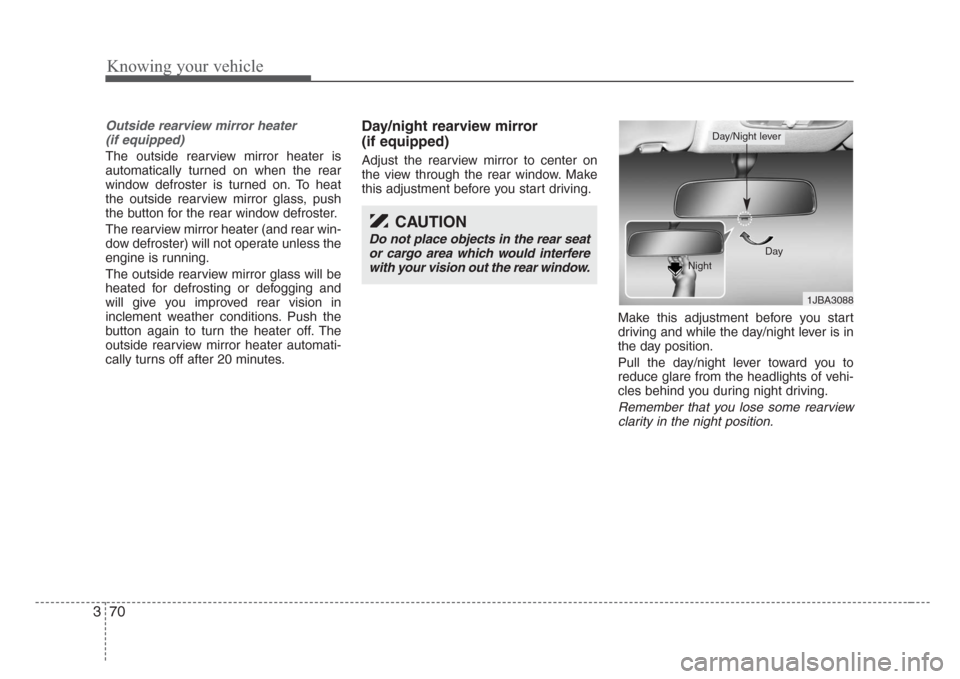
Adjust the rearview mirror to center on
the view through the rear window. Make
this adjustment before you start driving.
Make this adjustment before you start
driving and while the day/night lever is in
the day position.
Pull the day/night lever toward you to
reduce glare from the headlights of vehi-
cles behind you during night driving.
Remember that you lose some rearview
clarity in the night position.
CAUTION
Do not place objects in the rear seat
or cargo area which would interfere
with your vision out the rear window.
1JBA3088 Day
Night
Day/Night lever