seats KIA Rio 2011 2.G User Guide
[x] Cancel search | Manufacturer: KIA, Model Year: 2011, Model line: Rio, Model: KIA Rio 2011 2.GPages: 240, PDF Size: 4.68 MB
Page 51 of 240
Knowing your vehicle
42
3
Child restraint system
For small children and babies, the use of
a child seat or infant seat is strongly rec-
ommended and is required by law in
almost all states. This child seat or infant
seat should be of appropriate size for the
child and should be installed in accor-
dance with the manufacturer's instruc-
tions.
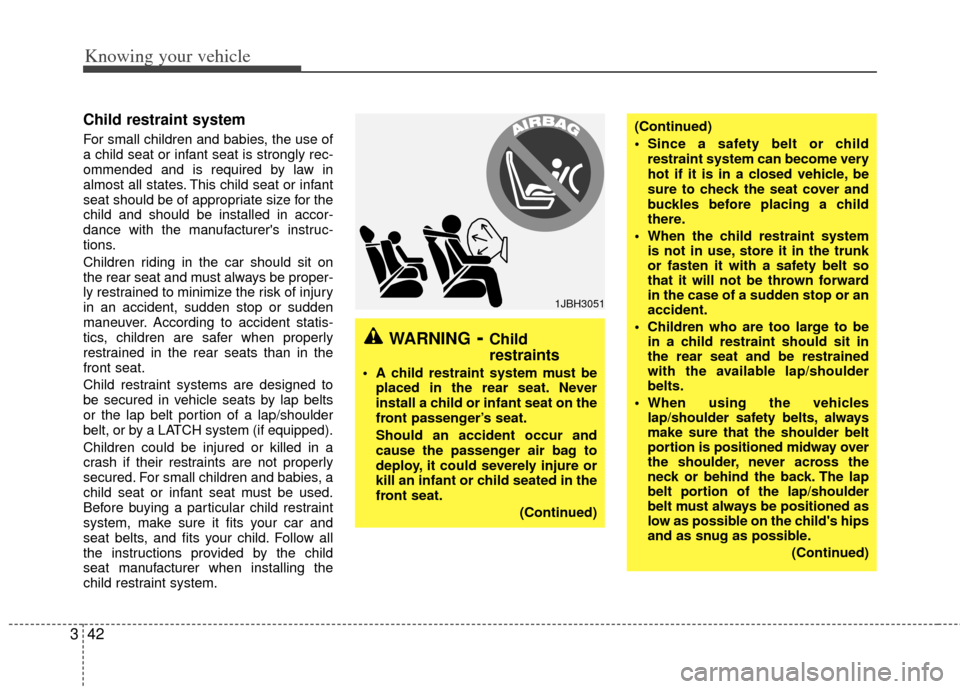
Children riding in the car should sit on
the rear seat and must always be proper-
ly restrained to minimize the risk of injury
in an accident, sudden stop or sudden
maneuver. According to accident statis-
tics, children are safer when properly
restrained in the rear seats than in the
front seat.
Child restraint systems are designed to
be secured in vehicle seats by lap belts
or the lap belt portion of a lap/shoulder
belt, or by a LATCH system (if equipped).
Children could be injured or killed in a
crash if their restraints are not properly
secured. For small children and babies, a
child seat or infant seat must be used.
Before buying a particular child restraint
system, make sure it fits your car and
seat belts, and fits your child. Follow all
the instructions provided by the child
seat manufacturer when installing the
child restraint system.
1JBH3051
WARNING- Child
restraints
A child restraint system must be
placed in the rear seat. Never
install a child or infant seat on the
front passenger’s seat.
Should an accident occur and
cause the passenger air bag to
deploy, it could severely injure or
kill an infant or child seated in the
front seat.
(Continued)
(Continued)
Since a safety belt or childrestraint system can become very
hot if it is in a closed vehicle, be
sure to check the seat cover and
buckles before placing a child
there.
When the child restraint system is not in use, store it in the trunk
or fasten it with a safety belt so
that it will not be thrown forward
in the case of a sudden stop or an
accident.
Children who are too large to be in a child restraint should sit in
the rear seat and be restrained
with the available lap/shoulder
belts.
When using the vehicles lap/shoulder safety belts, always
make sure that the shoulder belt
portion is positioned midway over
the shoulder, never across the
neck or behind the back. The lap
belt portion of the lap/shoulder
belt must always be positioned as
low as possible on the child's hips
and as snug as possible.
(Continued)
Page 52 of 240
343
Knowing your vehicle
Installing a child restraint system
For safety reasons, we recommend that
the child restraint system be used in the
rear seats.
Never place a rear-facing child
restraint in the front passenger seat,
because of the danger that an inflat-
ing passenger side air bag could
impact the rear-facing child restraint
and kill the child.
Since all passenger safety belts move
freely under normal conditions and only
lock under extreme or emergency condi-
tions (emergency lock mode), you must
manually change these safety belts to
the auto lock mode to secure a child
restraint.(Continued)
If the vehicle’s safety belt will notproperly fit the child, you must
use an appropriate child restraint
or booster seat in the rear.
Never allow a child to stand up or kneel while the vehicle is moving.
Never use an infant carrier or child seat that "hooks" over a
seatback. It will not provide ade-
quate protection in an accident.
Never allow a child to be held while they are in a moving vehi-
cle, as this could result in serious
injury or death to the child in the
event of an accident or sudden
stop. Holding a child in a moving
vehicle does not provide the child
with any protection during an
accident, even if the person hold-
ing the child is wearing a seat
belt.WARNING- Child seat
installation
Before installing the child
restraint system, read the instruc-
tions supplied by the child
restraint system manufacturer.
If the safety belt does not operate as described in this section, have
the system checked immediately
by your authorized Kia dealer.
Failure to observe this manual's instructions regarding child
restraint system and the instruc-
tions provided with the child
restraint system could increase
the chance and/or severity of
injury or death in an accident.
Page 53 of 240
Knowing your vehicle
44
3
Placing a passenger safety belt
into the auto lock mode
The use of the auto lock mode will
ensure that the normal movement of the
child in the vehicle does not cause the
safety belt to be pulled out and loosen
the firmness of its hold on the child
restraint system. To secure a child
restraint system, use the following proce-
dure.
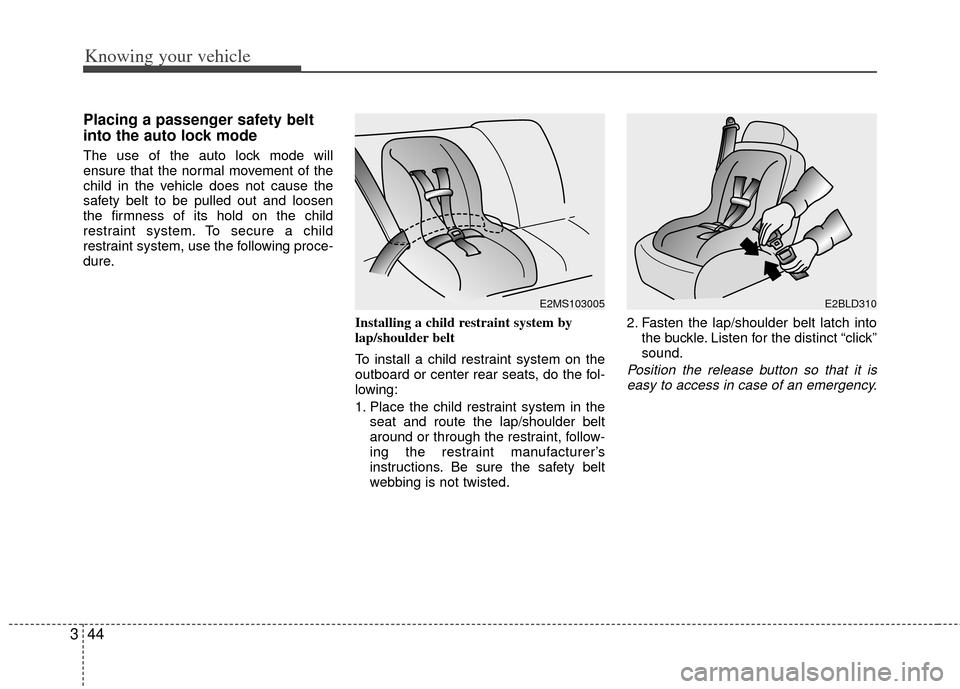
Installing a child restraint system by
lap/shoulder belt
To install a child restraint system on the
outboard or center rear seats, do the fol-
lowing:
1. Place the child restraint system in theseat and route the lap/shoulder belt
around or through the restraint, follow-
ing the restraint manufacturer’s
instructions. Be sure the safety belt
webbing is not twisted. 2. Fasten the lap/shoulder belt latch into
the buckle. Listen for the distinct “click”
sound.
Position the release button so that it iseasy to access in case of an emergency.
E2MS103005E2BLD310
Page 55 of 240
Knowing your vehicle
46
3
When the safety belt is allowed to
retract to its fully stowed position, the
retractor will automatically switch
from the “Auto Lock” mode to the
emergency lock mode for normal
adult usage.
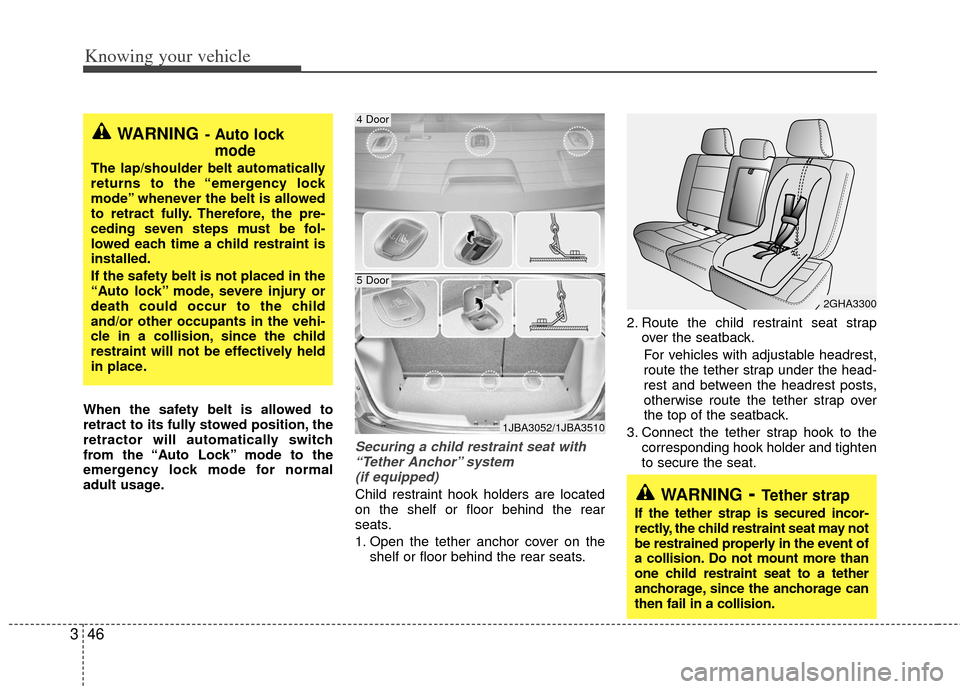
Securing a child restraint seat with
“Tether Anchor” system (if equipped)
Child restraint hook holders are located
on the shelf or floor behind the rear
seats.
1. Open the tether anchor cover on the shelf or floor behind the rear seats. 2. Route the child restraint seat strap
over the seatback.
For vehicles with adjustable headrest,
route the tether strap under the head-
rest and between the headrest posts,
otherwise route the tether strap over
the top of the seatback.
3. Connect the tether strap hook to the corresponding hook holder and tighten
to secure the seat.
WARNING- Auto lockmode
The lap/shoulder belt automatically
returns to the “emergency lock
mode” whenever the belt is allowed
to retract fully. Therefore, the pre-
ceding seven steps must be fol-
lowed each time a child restraint is
installed.
If the safety belt is not placed in the
“Auto lock” mode, severe injury or
death could occur to the child
and/or other occupants in the vehi-
cle in a collision, since the child
restraint will not be effectively held
in place.
1JBA3052/1JBA3510
4 Door
5 Door
2GHA3300
WARNING- Tether strap
If the tether strap is secured incor-
rectly, the child restraint seat may not
be restrained properly in the event of
a collision. Do not mount more than
one child restraint seat to a tether
anchorage, since the anchorage can
then fail in a collision.
Page 56 of 240
347
Knowing your vehicle
Child seat lower anchors
Some child seat manufacturers make
child restraint seats that are labeled as
LATCH or LATCH-compatible child
restraint system. LATCH stands for
"Lower Anchors and Tethers for
Children". These seats include two rigid
or webbing mounted attachments that
connect to two LATCH anchors at specif-
ic seating positions in your vehicle. This
type of child restraint seat eliminates the
need to use seat belts to attach the child
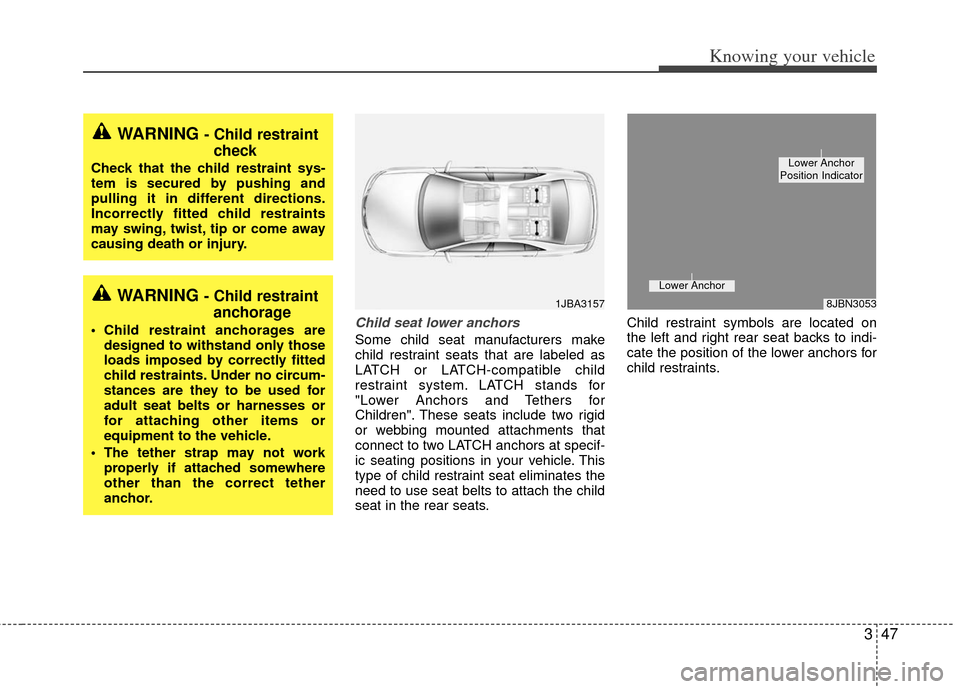
seat in the rear seats.Child restraint symbols are located on
the left and right rear seat backs to indi-
cate the position of the lower anchors for
child restraints.
WARNING - Child restraint
check
Check that the child restraint sys-
tem is secured by pushing and
pulling it in different directions.
Incorrectly fitted child restraints
may swing, twist, tip or come away
causing death or injury.
WARNING - Child restraintanchorage
Child restraint anchorages are
designed to withstand only those
loads imposed by correctly fitted
child restraints. Under no circum-
stances are they to be used for
adult seat belts or harnesses or
for attaching other items or
equipment to the vehicle.
The tether strap may not work properly if attached somewhere
other than the correct tether
anchor.
1JBA31578JBN3053
Lower Anchor
Lower Anchor
Position Indicator
Page 57 of 240
Knowing your vehicle
48
3
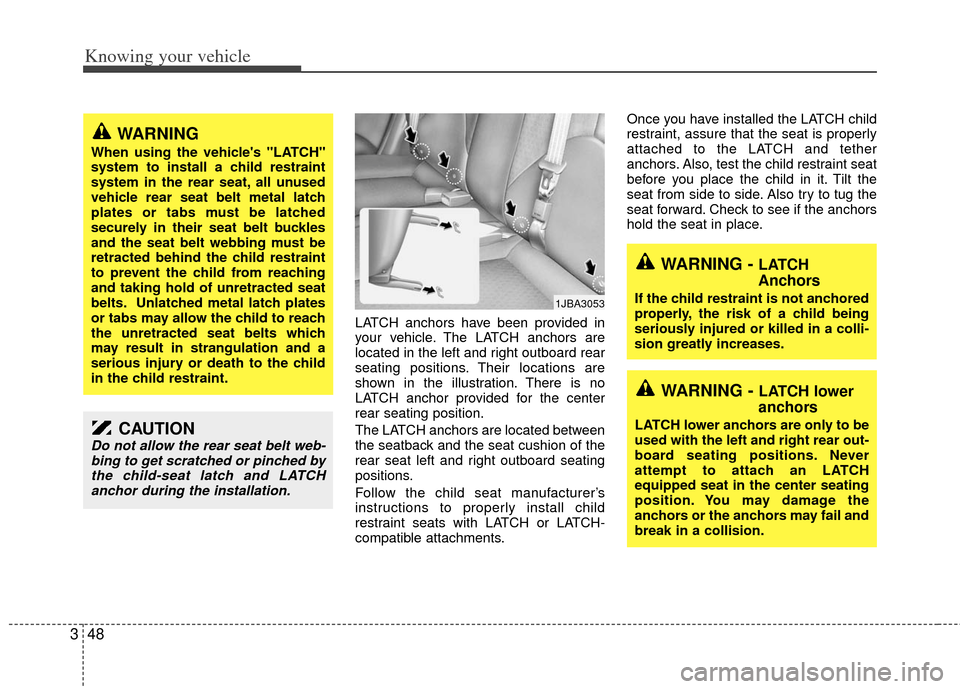
LATCH anchors have been provided in
your vehicle. The LATCH anchors are
located in the left and right outboard rear
seating positions. Their locations are
shown in the illustration. There is no
LATCH anchor provided for the center
rear seating position.
The LATCH anchors are located between
the seatback and the seat cushion of the
rear seat left and right outboard seating
positions.
Follow the child seat manufacturer’s
instructions to properly install child
restraint seats with LATCH or LATCH-
compatible attachments. Once you have installed the LATCH child
restraint, assure that the seat is properly
attached to the LATCH and tether
anchors. Also, test the child restraint seat
before you place the child in it. Tilt the
seat from side to side. Also try to tug the
seat forward. Check to see if the anchors
hold the seat in place.
WARNING - LATCH
Anchors
If the child restraint is not anchored
properly, the risk of a child being
seriously injured or killed in a colli-
sion greatly increases.
WARNING - LATCH lower
anchors
LATCH lower anchors are only to be
used with the left and right rear out-
board seating positions. Never
attempt to attach an LATCH
equipped seat in the center seating
position. You may damage the
anchors or the anchors may fail and
break in a collision.
WARNING
When using the vehicle's "LATCH"
system to install a child restraint
system in the rear seat, all unused
vehicle rear seat belt metal latch
plates or tabs must be latched
securely in their seat belt buckles
and the seat belt webbing must be
retracted behind the child restraint
to prevent the child from reaching
and taking hold of unretracted seat
belts. Unlatched metal latch plates
or tabs may allow the child to reach
the unretracted seat belts which
may result in strangulation and a
serious injury or death to the child
in the child restraint.
1JBA3053
CAUTION
Do not allow the rear seat belt web-
bing to get scratched or pinched bythe child-seat latch and LATCHanchor during the installation.
Page 62 of 240
353
Knowing your vehicle
Side air bag (if equipped)
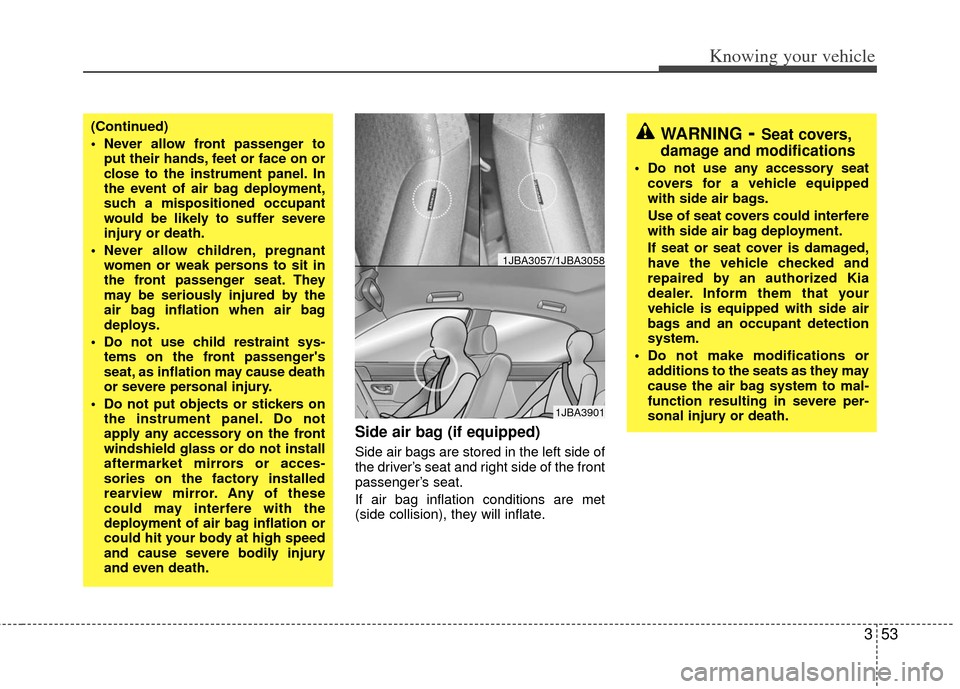
Side air bags are stored in the left side of
the driver’s seat and right side of the front
passenger’s seat.
If air bag inflation conditions are met
(side collision), they will inflate.
(Continued)
Never allow front passenger toput their hands, feet or face on or
close to the instrument panel. In
the event of air bag deployment,
such a mispositioned occupant
would be likely to suffer severe
injury or death.
Never allow children, pregnant women or weak persons to sit in
the front passenger seat. They
may be seriously injured by the
air bag inflation when air bag
deploys.
Do not use child restraint sys- tems on the front passenger's
seat, as inflation may cause death
or severe personal injury.
Do not put objects or stickers on the instrument panel. Do not
apply any accessory on the front
windshield glass or do not install
aftermarket mirrors or acces-
sories on the factory installed
rearview mirror. Any of these
could may interfere with the
deployment of air bag inflation or
could hit your body at high speed
and cause severe bodily injury
and even death.
1JBA3901
1JBA3057/1JBA3058
WARNING- Seat covers,
damage and modifications
Do not use any accessory seat
covers for a vehicle equipped
with side air bags.
Use of seat covers could interfere
with side air bag deployment.
If seat or seat cover is damaged,
have the vehicle checked and
repaired by an authorized Kia
dealer. Inform them that your
vehicle is equipped with side air
bags and an occupant detection
system.
Do not make modifications or additions to the seats as they may
cause the air bag system to mal-
function resulting in severe per-
sonal injury or death.
Page 63 of 240
Knowing your vehicle
54
3
Curtain air bag (if equipped)
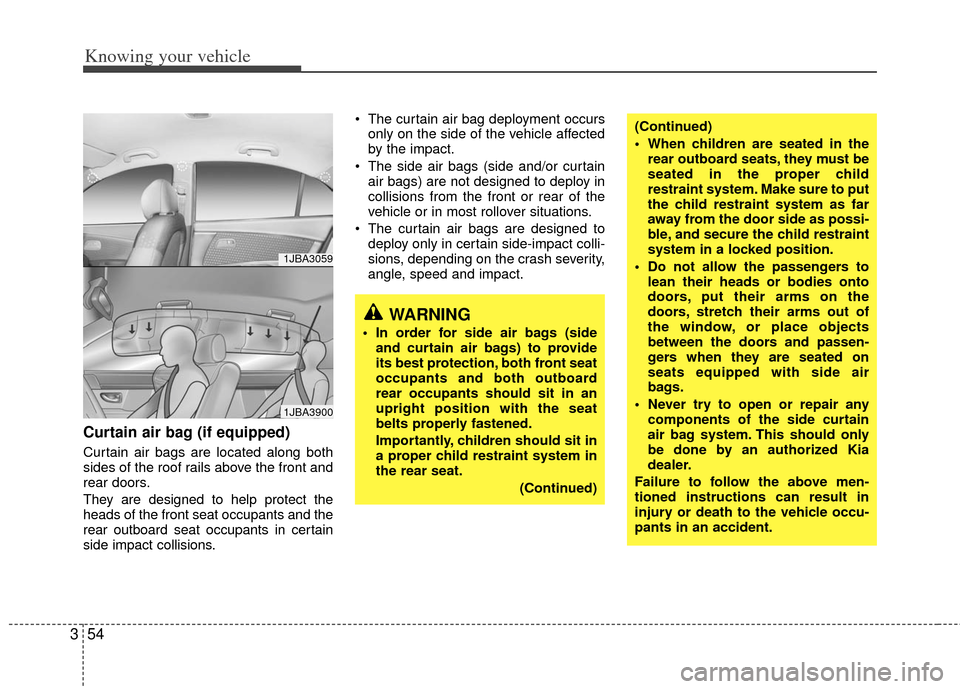
Curtain air bags are located along both
sides of the roof rails above the front and
rear doors.
They are designed to help protect the
heads of the front seat occupants and the
rear outboard seat occupants in certain
side impact collisions. The curtain air bag deployment occurs
only on the side of the vehicle affected
by the impact.
The side air bags (side and/or curtain air bags) are not designed to deploy in
collisions from the front or rear of the
vehicle or in most rollover situations.
The curtain air bags are designed to deploy only in certain side-impact colli-
sions, depending on the crash severity,
angle, speed and impact.
1JBA3059
1JBA3900
WARNING
In order for side air bags (sideand curtain air bags) to provide
its best protection, both front seat
occupants and both outboard
rear occupants should sit in an
upright position with the seat
belts properly fastened.
Importantly, children should sit in
a proper child restraint system in
the rear seat.
(Continued)
(Continued)
When children are seated in therear outboard seats, they must be
seated in the proper child
restraint system. Make sure to put
the child restraint system as far
away from the door side as possi-
ble, and secure the child restraint
system in a locked position.
Do not allow the passengers to lean their heads or bodies onto
doors, put their arms on the
doors, stretch their arms out of
the window, or place objects
between the doors and passen-
gers when they are seated on
seats equipped with side air
bags.
Never try to open or repair any components of the side curtain
air bag system. This should only
be done by an authorized Kia
dealer.
Failure to follow the above men-
tioned instructions can result in
injury or death to the vehicle occu-
pants in an accident.
Page 71 of 240

Knowing your vehicle
62
3
Air bag warning light
The purpose of air bag warning light in
your instrument panel is to alert you of a
potential problem with your air bag -
Supplemental Restraint System (SRS).
When the ignition switch is turned ON,
the indicator light should blink or illumi-
nate for approximately 6 seconds, then
go off.
Have the system checked if:
The light does not turn on briefly when
you turn the ignition ON.
The light stays on after the engine starts.
The light comes on while the vehicle is in motion.
Air bag (Supplemental Restraint
System) service
Your Supplemental Restraint System is
virtually maintenance-free. There are no
parts which you can service.
You must have the system serviced
under the following circumstances:
If an air bag ever inflates, the air bagmust be replaced. Do not try to remove
or discard the air bag by yourself. This
must be done by an authorized Kia
dealer.
If the air bag warning indicator light alerts you to a problem, have the air
bag system checked as soon as possi-
ble. Otherwise, your air bag system
may be ineffective.
WARNING
Never put child restraint in thefront passenger seat. If the front
passenger air bag inflates, it may
cause severe or fatal injuries.
When children are seated in the rear outboard seats in which cur-
tain air bags are equipped, be
sure to put the child restraint sys-
tem as far away from the door
side as possible, and secure the
child restraint system to be
locked in position.
Inflation of side or curtain air bag
(if equipped) could cause severe
injury or death due to the expan-
sion impact.
CAUTION - No modification
Do not modify any part of the air bagsystem. Modification could make the air bag system ineffective orcould cause unnecessary deploy- ment.
W7-147
Page 227 of 240
Maintenance
36
7
Aluminum wheel maintenance
The aluminum wheels are coated with a
clear protective finish.
Do not use any abrasive cleaner, pol-
ishing compound, solvent, or wire
brushes on aluminum wheels. They
may scratch or damage the finish.
Use only a mild soap or neutral deter- gent, and rinse thoroughly with water.
Also, be sure to clean the wheels after
driving on salted roads. This helps pre-
vent corrosion.
Avoid washing the wheels with high- speed car wash brushes.
Do not use any acid detergent. It may damage and corrode the aluminum
wheels coated with a clear protective
finish.
INTERIOR CARE
Interior general precautions
Prevent caustic solutions such as per-
fume and cosmetic oil from contacting
the dashboard because they may cause
damage or discoloration. If they do con-
tact the dashboard, wipe them off imme-
diately. See the instructions that follow for
the proper way to clean vinyl.
✽ ✽ NOTICE
Never allow water or other liquids to
come in contact with electrical/electron-
ic components inside the vehicle as this
may damage them.
Cleaning the upholstery and inte-
rior trim
Vinyl
Remove dust and loose dirt from vinyl
with a whisk broom or vacuum cleaner.
Clean vinyl surfaces with a vinyl cleaner.
Fabric
Remove dust and loose dirt from fabric
with a whisk broom or vacuum cleaner.
Clean with a mild soap solution recom-
mended for upholstery or carpets.
Remove fresh spots immediately with a
fabric spot cleaner. If fresh spots do not
receive immediate attention, the fabric
can be stained and its color can be
affected. Also, its fire-resistant properties
can be reduced if the material is not
properly maintained.
✽ ✽NOTICE
Using anything but recommended
cleaners and procedures may affect the
fabric’s appearance and fire-resistant
properties.
CAUTION
When cleaning leather products
(steering wheel, seats etc.), useneutral detergents or low alcoholcontent solutions. If you use highalcohol content solutions oracid/alkaline detergents, the colorof the leather may fade or the sur- face may get stripped off.