Oil KIA Rio 2011 2.G Owner's Guide
[x] Cancel search | Manufacturer: KIA, Model Year: 2011, Model line: Rio, Model: KIA Rio 2011 2.GPages: 240, PDF Size: 4.68 MB
Page 208 of 240
717
Maintenance
✽
✽NOTICE
“COLD” scale is for reference only and
should NOT be used to determine
transaxle fluid level.
New automatic transaxle fluid should
be red. The red dye is added so the
assembly plant can identify it as auto-
matic transaxle fluid and distinguish it
from engine oil or antifreeze. The red
dye, which is not an indicator of fluid
quality, is not permanent. As the vehi-
cle is driven, the automatic transaxle
fluid will begin to look darker. The
color may eventually appear light
brown.
✽ ✽NOTICE
Have an Authorized Kia dealer inspect
or change the automatic transaxle fluid
according to the Scheduled
Maintenance at the beginning of this
section.
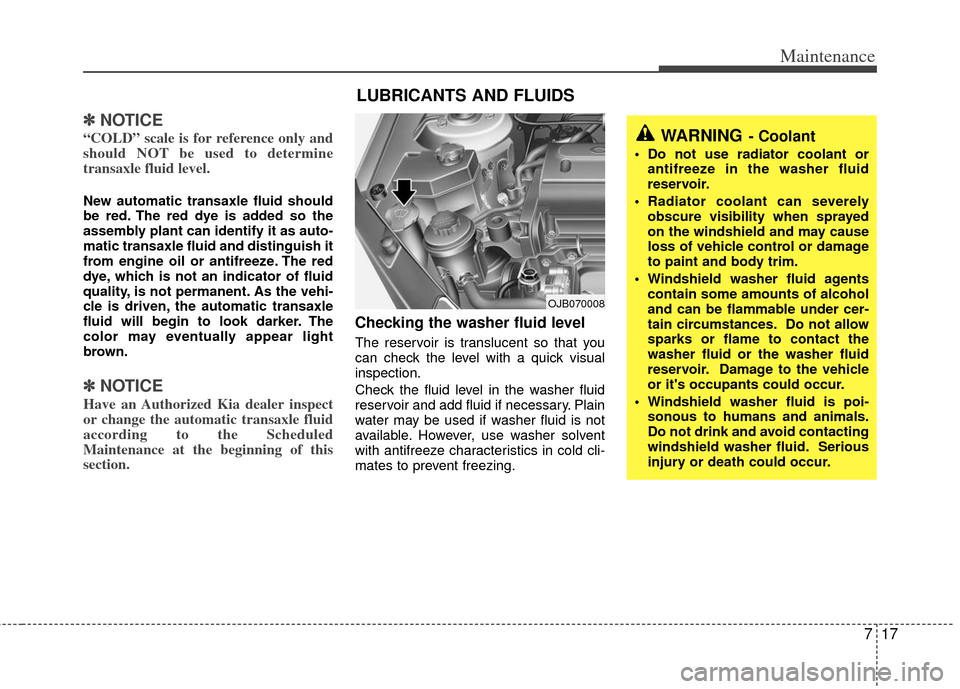
Checking the washer fluid level
The reservoir is translucent so that you
can check the level with a quick visual
inspection.
Check the fluid level in the washer fluid
reservoir and add fluid if necessary. Plain
water may be used if washer fluid is not
available. However, use washer solvent
with antifreeze characteristics in cold cli-
mates to prevent freezing.
LUBRICANTS AND FLUIDS
WARNING- Coolant
Do not use radiator coolant or
antifreeze in the washer fluid
reservoir.
Radiator coolant can severely obscure visibility when sprayed
on the windshield and may cause
loss of vehicle control or damage
to paint and body trim.
Windshield washer fluid agents contain some amounts of alcohol
and can be flammable under cer-
tain circumstances. Do not allow
sparks or flame to contact the
washer fluid or the washer fluid
reservoir. Damage to the vehicle
or it's occupants could occur.
Windshield washer fluid is poi- sonous to humans and animals.
Do not drink and avoid contacting
windshield washer fluid. Serious
injury or death could occur.
OJB070008
Page 209 of 240
Maintenance
18
7
Body lubrication
All moving points of the body, such as
door hinges, hood hinges, and locks,
should be lubricated each time the
engine oil is changed. Use a non-freez-
ing lubricant on locks during cold weath-
er.
Make sure the engine hood secondary
latch keeps the hood from opening when
the primary latch is released.
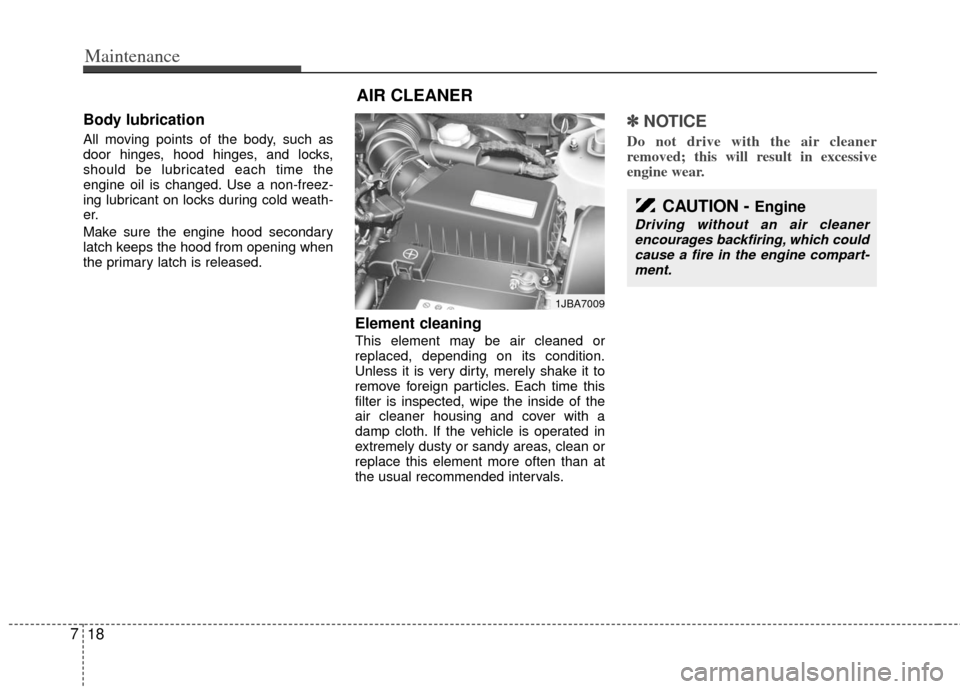
Element cleaning
This element may be air cleaned or
replaced, depending on its condition.
Unless it is very dirty, merely shake it to
remove foreign particles. Each time this
filter is inspected, wipe the inside of the
air cleaner housing and cover with a
damp cloth. If the vehicle is operated in
extremely dusty or sandy areas, clean or
replace this element more often than at
the usual recommended intervals.
✽ ✽
NOTICE
Do not drive with the air cleaner
removed; this will result in excessive
engine wear.
1JBA7009
CAUTION - Engine
Driving without an air cleaner
encourages backfiring, which couldcause a fire in the engine compart- ment.
AIR CLEANER
Page 214 of 240
723
Maintenance
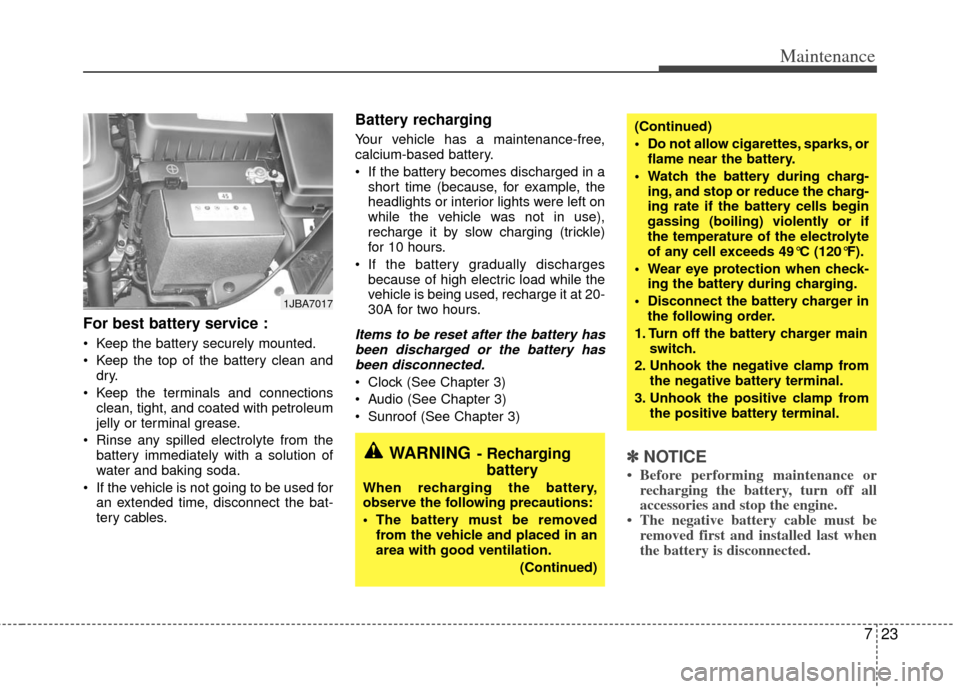
For best battery service :
Keep the battery securely mounted.
Keep the top of the battery clean anddry.
Keep the terminals and connections clean, tight, and coated with petroleum
jelly or terminal grease.
Rinse any spilled electrolyte from the battery immediately with a solution of
water and baking soda.
If the vehicle is not going to be used for an extended time, disconnect the bat-
tery cables.
Battery recharging
Your vehicle has a maintenance-free,
calcium-based battery.
If the battery becomes discharged in ashort time (because, for example, the
headlights or interior lights were left on
while the vehicle was not in use),
recharge it by slow charging (trickle)
for 10 hours.
If the battery gradually discharges because of high electric load while the
vehicle is being used, recharge it at 20-
30A for two hours.
Items to be reset after the battery hasbeen discharged or the battery hasbeen disconnected.
Clock (See Chapter 3)
Audio (See Chapter 3)
Sunroof (See Chapter 3)
✽ ✽ NOTICE
• Before performing maintenance or
recharging the battery, turn off all
accessories and stop the engine.
• The negative battery cable must be removed first and installed last when
the battery is disconnected.
1JBA7017
WARNING- Recharging
battery
When recharging the battery,
observe the following precautions:
The battery must be removed
from the vehicle and placed in an
area with good ventilation.
(Continued)
(Continued)
Do not allow cigarettes, sparks, orflame near the battery.
Watch the battery during charg- ing, and stop or reduce the charg-
ing rate if the battery cells begin
gassing (boiling) violently or if
the temperature of the electrolyte
of any cell exceeds 49°C (120°F).
Wear eye protection when check- ing the battery during charging.
Disconnect the battery charger in the following order.
1. Turn off the battery charger main switch.
2. Unhook the negative clamp from the negative battery terminal.
3. Unhook the positive clamp from the positive battery terminal.
Page 224 of 240
733
Maintenance
LUBRICANT SPECIFICATIONS
Recommended lubricants
To help achieve proper engine and powertrain performance and
durability, use only lubricants of the proper quality. The correct
lubricants also help promote engine efficiency that results in
improved fuel economy.
Engine oils labeled Energy Conserving Oil are now available.
Along with other additional benefits, they contribute to fuel
economy by reducing the amount of fuel necessary to over-
come engine friction. Often, these improvements are difficult to
measure in everyday driving, but in a year’s time, they can offer
significant cost and energy savings.
Recommended SAE viscosity number
✽ ✽NOTICE
Always be sure to clean the area around any filler plug, drain
plug, or dipstick before checking or draining any lubricant.
This is especially important in dusty or sandy areas and when
the vehicle is used on unpaved roads. Cleaning the plug and
dipstick areas will prevent dirt and grit from entering the
engine and other mechanisms that could be damaged.
Engine oil viscosity (thickness) has an effect on fuel economy
and cold weather operating (starting and oil flow). Lower vis-
cosity engine oils can provide better fuel economy and cold
weather performance, however, higher viscosity engine oils are
required for satisfactory lubrication in hot weather. Using oils of
any viscosity other than those recommended could result in
engine damage.
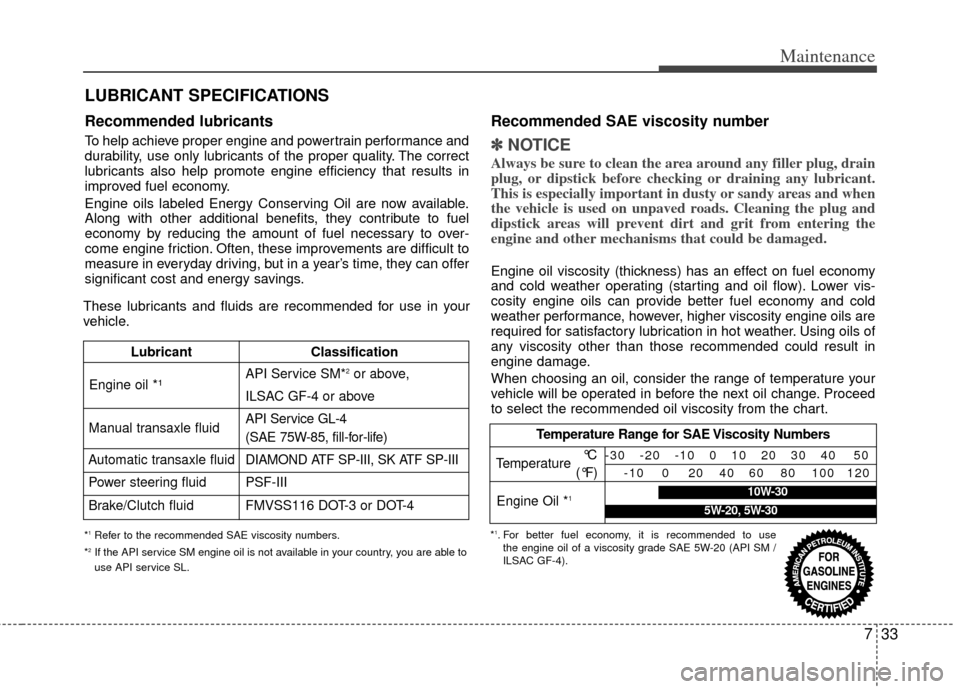
When choosing an oil, consider the range of temperature your
vehicle will be operated in before the next oil change. Proceed
to select the recommended oil viscosity from the chart.
*1Refer to the recommended SAE viscosity numbers.
*2If the API service SM engine oil is not available in your country, you are able to
use API service SL.
These lubricants and fluids are recommended for use in your
vehicle.
Lubricant Classification
API Service SM*
2or above,
ILSAC GF-4 or above
Manual transaxle fluid API Service GL-4
(SAE 75W-85, fill-for-life)
DIAMOND ATF SP-III, SK ATF SP-III
Power steering fluid PSF-III
Brake/Clutch fluid FMVSS116 DOT-3 or DOT-4Engine oil *¹
Automatic transaxle fluid
Temperature Range for SAE Viscosity Numbers
Temperature
Engine Oil *
1
°C
(°F)-30 -20 -10 0 10 20 30 40 50
-10 0 20 40 60 80 100 120
*1. For better fuel economy, it is recommended to use the engine oil of a viscosity grade SAE 5W-20 (API SM /
ILSAC GF-4).
10W-30
5W-20, 5W-30
Page 226 of 240
735
Maintenance
Waxing
Wax the vehicle when water will no
longer bead on the paint.
Always wash and dry the vehicle before
waxing. Use a good quality liquid or
paste wax, and follow the manufacturer’s
instructions. Wax all metal trim to protect
it and to maintain its luster.
Removing oil, tar, and similar materials
with a spot remover will usually strip the
wax from the finish. Be sure to re-wax
these areas even if the rest of the vehicle
does not yet need waxing.
✽ ✽NOTICE
• Wiping dust or dirt off the body with
a dry cloth will scratch the finish.
• Do not use steel wool, abrasive clean- ers, or strong detergents containing
highly alkaline or caustic agents on
chrome-plated or anodized aluminum
parts. This may result in damage to
the protective coating and cause dis-
coloration or paint deterioration.
Finish damage repair
Deep scratches or stone chips in the
painted surface must be repaired
promptly. Exposed metal will quickly rust
and may develop into a major repair
expense.
✽ ✽ NOTICE
If your vehicle is damaged and requires
any metal repair or replacement, be sure
the body shop applies anti-corrosion
materials to the parts repaired or
replaced.
Bright-metal maintenance
To remove road tar and insects, use a
tar remover, not a scraper or other
sharp object.
To protect the surfaces of bright-metal parts from corrosion, apply a coating of
wax or chrome preservative and rub to
a high luster.
During winter weather or in coastal areas, cover the bright metal parts with
a heavier coating of wax or preserva-
tive. If necessary, coat the parts with
non-corrosive petroleum jelly or other
protective compound.
Underbody maintenance
Corrosive materials used for ice and
snow removal and dust control may col-
lect on the underbody. If these materials
are not removed, accelerated rusting can
occur on underbody parts such as the
fuel lines, frame, floor pan and exhaust
system, even though they have been
treated with rust protection.
Thoroughly flush the vehicle underbody
and wheel openings with lukewarm or
cold water once a month, after off-road
driving and at the end of each winter. Pay
special attention to these areas because
it is difficult to see all the mud and dirt. It
will do more harm than good to wet down
the road grime without removing it. The
lower edges of doors, rocker panels, and
frame members have drain holes that
should not be allowed to clog with dirt;
trapped water in these areas can cause
rusting.
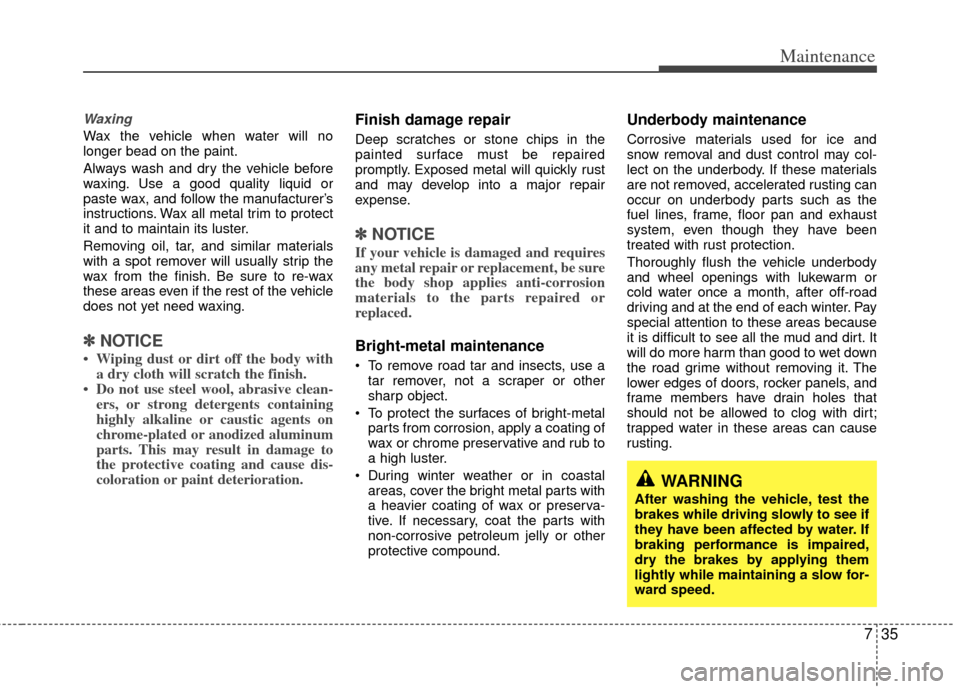
WARNING
After washing the vehicle, test the
brakes while driving slowly to see if
they have been affected by water. If
braking performance is impaired,
dry the brakes by applying them
lightly while maintaining a slow for-
ward speed.
Page 227 of 240
Maintenance
36
7
Aluminum wheel maintenance
The aluminum wheels are coated with a
clear protective finish.
Do not use any abrasive cleaner, pol-
ishing compound, solvent, or wire
brushes on aluminum wheels. They
may scratch or damage the finish.
Use only a mild soap or neutral deter- gent, and rinse thoroughly with water.
Also, be sure to clean the wheels after
driving on salted roads. This helps pre-
vent corrosion.
Avoid washing the wheels with high- speed car wash brushes.
Do not use any acid detergent. It may damage and corrode the aluminum
wheels coated with a clear protective
finish.
INTERIOR CARE
Interior general precautions
Prevent caustic solutions such as per-
fume and cosmetic oil from contacting
the dashboard because they may cause
damage or discoloration. If they do con-
tact the dashboard, wipe them off imme-
diately. See the instructions that follow for
the proper way to clean vinyl.
✽ ✽ NOTICE
Never allow water or other liquids to
come in contact with electrical/electron-
ic components inside the vehicle as this
may damage them.
Cleaning the upholstery and inte-
rior trim
Vinyl
Remove dust and loose dirt from vinyl
with a whisk broom or vacuum cleaner.
Clean vinyl surfaces with a vinyl cleaner.
Fabric
Remove dust and loose dirt from fabric
with a whisk broom or vacuum cleaner.
Clean with a mild soap solution recom-
mended for upholstery or carpets.
Remove fresh spots immediately with a
fabric spot cleaner. If fresh spots do not
receive immediate attention, the fabric
can be stained and its color can be
affected. Also, its fire-resistant properties
can be reduced if the material is not
properly maintained.
✽ ✽NOTICE
Using anything but recommended
cleaners and procedures may affect the
fabric’s appearance and fire-resistant
properties.
CAUTION
When cleaning leather products
(steering wheel, seats etc.), useneutral detergents or low alcoholcontent solutions. If you use highalcohol content solutions oracid/alkaline detergents, the colorof the leather may fade or the sur- face may get stripped off.
Page 228 of 240
737
Maintenance
Cleaning the lap/shoulder belt
webbing
Clean the belt webbing with any mild
soap solution recommended for cleaning
upholstery or carpet. Follow the instruc-
tions provided with the soap. Do not
bleach or re-dye the webbing because
this may weaken it.
Cleaning the interior window
glass
If the interior glass surfaces of the vehi-
cle become fogged (that is, covered with
an oily, greasy or waxy film), they should
be cleaned with glass cleaner. Follow the
directions on the glass cleaner container.
✽ ✽NOTICE
Do not scrape or scratch the inside of
the rear window. This may result in
damage to the rear window defroster
grid.
Page 232 of 240
Specifications
48
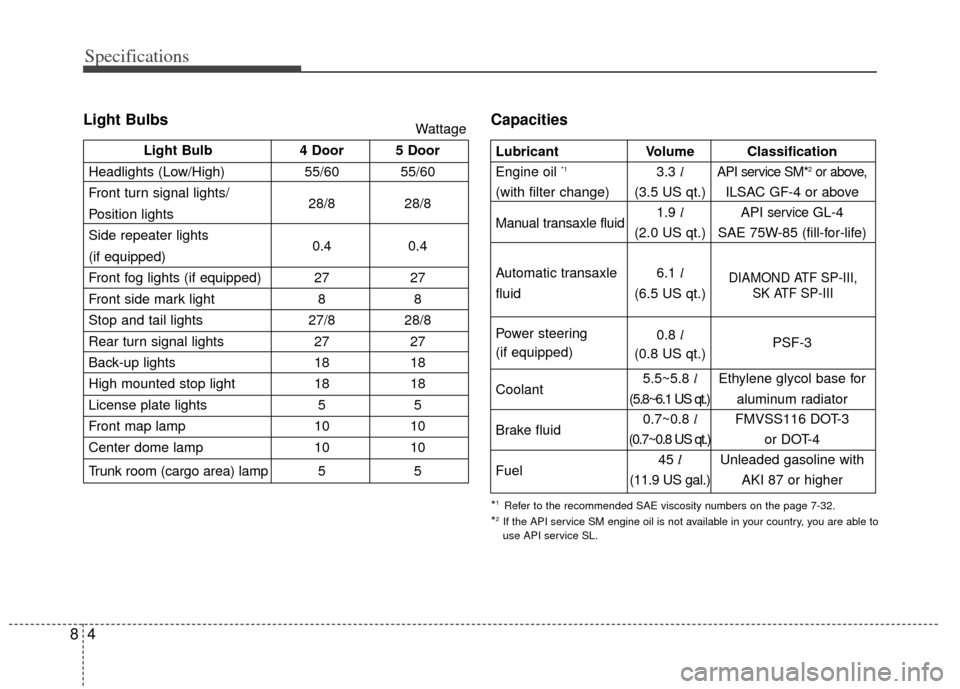
Light BulbsCapacities
Light Bulb4 Door 5 Door
Headlights (Low/High) 55/60 55/60
Front turn signal lights/ 28/8 28/8
Position lights
Side repeater lights
0.40.4
(if equipped)
Front fog lights (if equipped) 27 27
Front side mark light 88
Stop and tail lights 27/8 28/8
Rear turn signal lights 2727
Back-up lights 1818
High mounted stop light 1818
License plate lights 55
Front map lamp 1010
Center dome lamp 1010
Trunk room (cargo area) lamp 5 5
Wattage
LubricantVolume Classification
Engine oil
*13.3 lAPI service SM*2or above,
(with filter change) (3.5 US qt.) ILSAC GF-4 or above
Manual transaxle fluid1.9 l API serviceGL-4
(2.0 US qt.) SAE 75W-85 (fill-for-life)
Automatic transaxle 6.1 l
fluid (6.5 US qt.)
Power steering 0.8 l
PSF-3
(if equipped) (0.8 US qt.)
Coolant 5.5~5.8
lEthylene glycol base for
(5.8~6.1 US qt.) aluminum radiator
Brake fluid 0.7~0.8
lFMVSS116 DOT-3
(0.7~0.8 US qt.) o r D OT- 4
Fuel 45
l Unleaded gasoline with
(11.9 US gal.) AKI 87 or higher
*1Refer to the recommended SAE viscosity numbers on the page 7-32.
*2If the API service SM engine oil is not available in your country, you are able to
use API service SL.
DIAMOND ATF SP-III,
SK ATF SP-III
Page 235 of 240

93
Index
Climate control air filter ··················\
··················\
············7-19
Climate control system ··················\
··················\
··············4-39Air conditioning ··················\
··················\
··················\
··4-44
Clock (Digital) ··················\
··················\
··················\
·········3-78
Combined instrument, see instrument cluster ···············4-20
Compact spare tire ··················\
··················\
··················\
···6-18
Compact spare tire replacement ··················\
··················\
6-19
Coolant ··················\
··················\
··················\
··················\
···7-12
Cooling fluid, see engine coolant ··················\
················7-12
Cruise control system ··················\
··················\
················4-14
Cup holder ··················\
··················\
··················\
···············3-76
Curtain air bag ··················\
··················\
··················\
·········3-54
Dashboard illumination, see instrument panel illumination ··················\
···········4-25
Dashboard, see instrument cluster ··················\
···············4-20
Defogging (Windshield) ··················\
··················\
············4-46
Defroster (Rear window) ··················\
··················\
···········4-38
Defrosting (Windshield) ··················\
··················\
············4-46
Digital clock··················\
··················\
··················\
·············3-78
Dimensions ··················\
··················\
··················\
················8-2
Display illumination, see instrument panel illumination ··················\
···········4-25
Displays, see instrument cluster ··················\
··················\
4-20
Door locks··················\
··················\
··················\
··················\
3-9 Central door lock switch ··················\
··················\
·······3-10
Child-protector rear door lock ··················\
················3-12 Drinks holders, see cup holders··················\
··················\
·3-76
Driver's air bag··················\
··················\
··················\
·········3-51
Driving at night ··················\
··················\
··················\
··········5-7
Driving in flooded areas ··················\
··················\
··············5-8
Driving in the rain··················\
··················\
··················\
······5-7
Economical operation ··················\
··················\
··················\
5-5
Emergency starting ··················\
··················\
··················\
····6-4
Jump starting ··················\
··················\
··················\
·········6-4
Push starting ··················\
··················\
··················\
··········6-5
Emergency trunk safety release ··················\
··················\
·3-65
Emergency while driving ··················\
··················\
·············6-2
Emission control system ··················\
··················\
··············5-2
Engine compartment ··················\
··················\
············2-4, 7-9
Engine coolant ··················\
··················\
··················\
·········7-11
Engine number ··················\
··················\
··················\
·········5-11
Engine oil ··················\
··················\
··················\
·················7-11\
Engine overheats ··················\
··················\
··················\
········6-3
Exterior care··················\
··················\
··················\
·············7-34
Flat tire ··················\
··················\
··················\
··················\
···6-17 Changing tires ··················\
··················\
··················\
·····6-19
Compact spare tire ··················\
··················\
················6-18
Jack and tools ··················\
··················\
··················\
······6-17
Removing and storing the spare tire ··················\
·······6-17
D
E
F
Page 237 of 240

95
Index
Jack and tools··················\
··················\
··················\
···········6-17
Jump starting··················\
··················\
··················\
··············6-4
Key positions ··················\
··················\
··················\
·············4-2
Keys ··················\
··················\
··················\
··················\
·········3-2Immobilizer system ··················\
··················\
·················3-7
Label Air bag warning label··················\
··················\
············3-63
Certification label ··················\
··················\
··················\
5-10
Tire sidewall labeling ··················\
··················\
············7-29
Tire specification and pressure label ··················\
·······5-11
Vehicle certification label··················\
··················\
······5-10
Latch system, see lower anchor system··················\
·······3-47
Lighting··················\
··················\
··················\
··················\
··4-31 Battery saver function ··················\
··················\
···········4-31
Lower anchor system ··················\
··················\
·················3-47\
Lubricants and capacities··················\
··················\
·············8-4
Luggage net (holder) ··················\
··················\
·················3-81\
Main fuse ··················\
··················\
··················\
··················\
·6-8
Maintenance
Maintenance services ··················\
··················\
··············7-2
Owner maintenance··················\
··················\
·················7-7
Tire maintenance ··················\
··················\
··················\
·7-29
Manual climate control system··················\
··················\
··4-39 Air conditioning ··················\
··················\
··················\
··4-44
Climate control air filter··················\
··················\
········7-19
Heating and air conditioning ··················\
··················\
·4-44
Manual transaxle··················\
··················\
··················\
········4-4
Memory fuse ··················\
··················\
··················\
············6-12
Mirrors ··················\
··················\
··················\
··················\
···4-32 Inside rearview mirror ··················\
··················\
···········3-72
Outside rearview mirror ··················\
··················\
········3-70
Moonroof, see sunroof··················\
··················\
···············3-79
Neck restraints, see headrest ··················\
··············3-21, 3-26
Odometer ··················\
··················\
··················\
·················4-21\
Oil (Engine) ··················\
··················\
··················\
·············7-11
J
K
L
M
N
O