Air bag light KIA Rio 2011 2.G Owner's Manual
[x] Cancel search | Manufacturer: KIA, Model Year: 2011, Model line: Rio, Model: KIA Rio 2011 2.GPages: 240, PDF Size: 4.68 MB
Page 8 of 240
23
Your vehicle at a glance
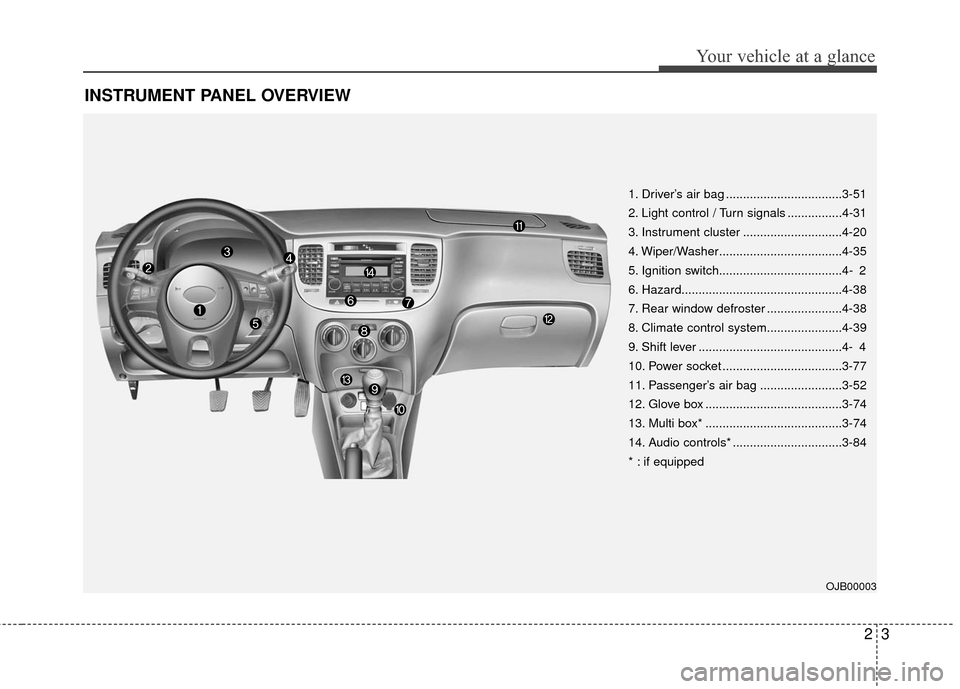
INSTRUMENT PANEL OVERVIEW
1. Driver’s air bag ..................................3-51
2. Light control / Turn signals ................4-31
3. Instrument cluster .............................4-20
4. Wiper/Washer....................................4-35
5. Ignition switch....................................4- 2
6. Hazard...............................................4-38
7. Rear window defroster ......................4-38
8. Climate control system......................4-39
9. Shift lever ..........................................4- 4
10. Power socket ...................................3-77
11. Passenger’s air bag ........................3-52
12. Glove box ........................................3-74
13. Multi box* ........................................3-74
14. Audio controls* ................................3-84
* : if equipped
OJB00003
Page 10 of 240
3
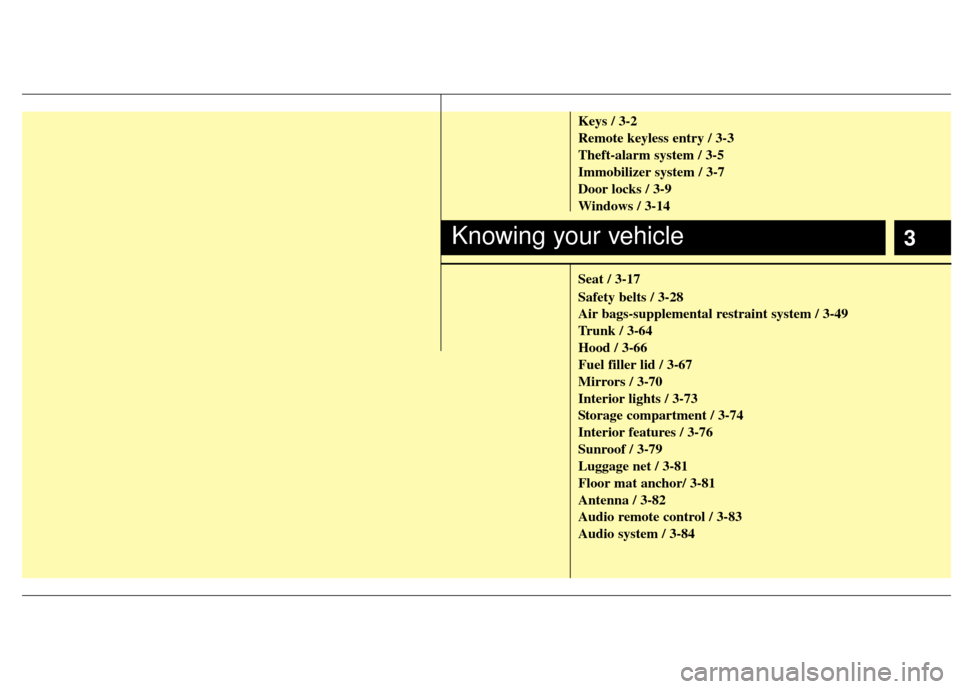
Keys / 3-2
Remote keyless entry / 3-3
Theft-alarm system / 3-5
Immobilizer system / 3-7
Door locks / 3-9
Windows / 3-14
Seat / 3-17
Safety belts / 3-28
Air bags-supplemental restraint system / 3-49
Trunk / 3-64
Hood / 3-66
Fuel filler lid / 3-67
Mirrors / 3-70
Interior lights / 3-73
Storage compartment / 3-74
Interior features / 3-76
Sunroof / 3-79
Luggage net / 3-81
Floor mat anchor/ 3-81
Antenna / 3-82
Audio remote control / 3-83
Audio system / 3-84
Knowing your vehicle
Page 37 of 240
Knowing your vehicle
28
3
Pre-tensioner seat belt
(if equipped)
Your vehicle is equipped with driver's and
front passenger's pre-tensioner safety
belts. The purpose of the pre-tensioner
is to make sure that excess slack is taken
up in certain frontal collisions. The pre-
tensioner seat belts will activate together
with the air bags, where the frontal colli-
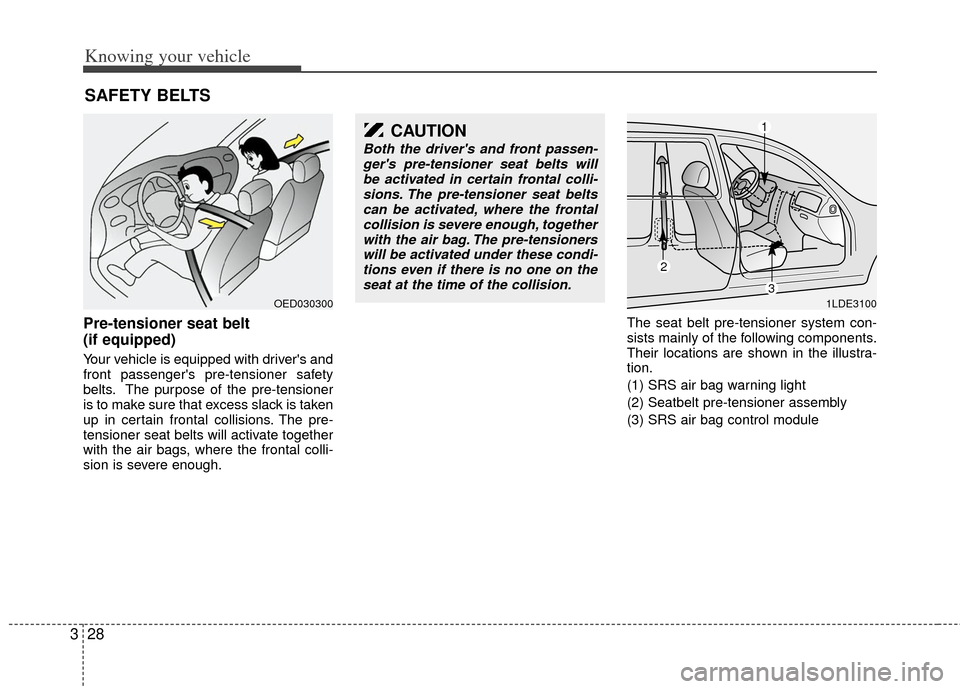
sion is severe enough. The seat belt pre-tensioner system con-
sists mainly of the following components.
Their locations are shown in the illustra-
tion.
(1) SRS air bag warning light
(2) Seatbelt pre-tensioner assembly
(3) SRS air bag control module
SAFETY BELTS
OED030300
CAUTION
Both the driver's and front passen-
ger's pre-tensioner seat belts will be activated in certain frontal colli-sions. The pre-tensioner seat belts can be activated, where the frontalcollision is severe enough, together with the air bag. The pre-tensionerswill be activated under these condi-tions even if there is no one on the seat at the time of the collision.
1LDE3100
1
2
3
Page 38 of 240
329
Knowing your vehicle
CAUTION - Air bag/Pre-
tensioner dust
When the air bags and pre-tension-
ers are activated, a loud noise maybe heard and fine dust, which mayappear to be smoke, may be visiblein the passenger compartment. Thisdust is not toxic. The dust maycause skin irritation and should notbe breathed for prolonged periods.Ventilate the vehicle after impact and wash your hands and face thor-oughly after an accident.
WARNING- Air bag/pre-
tensioner warning light
If the SRS air bag warning light
does not illuminate when the igni-
tion key is turned to “ON” , or if it
remains illuminated after approxi-
mately 6 seconds, or if it illuminates
while the vehicle is being driven,
please have an authorized Kia deal-
er inspect the pre-tensioner and air
bag system as soon as possible.
WARNING- Safety belt adjustment
To obtain maximum benefit from a
pre-tensioner seat belt:
The safety belt must be worn cor-
rectly.
The safety belt must be adjusted to the correct position.
WARNING- Replacing
used pre-tensioners
Pre-tensioners are designed to
operate once. After activation,
pre-tensioner seat belts must be
replaced. All seat belts, of any
type, should always be replaced
after they have been worn during
a collision.
Do not attempt to replace the pre- tensioners yourself. This must be
done by an authorized Kia dealer.
CAUTION - Hot parts
The pre-tensioner assembly mecha-nism becomes hot during activa-tion. Do not touch the pre-tensionerseat belt assembly for several min-utes after they have been activated.WARNING- Damaging the
pre-tensioners
Do not hit or strike the pre-ten-
sioner assemblies, especially
with a tool or heavy object.
Do not attempt to service or repair the pre-tensioners.
If the vehicle or pre-tensioner seat belt must be discarded, con-
tact an authorized Kia dealer.
Page 50 of 240
341
Knowing your vehicle
Restraint of larger children
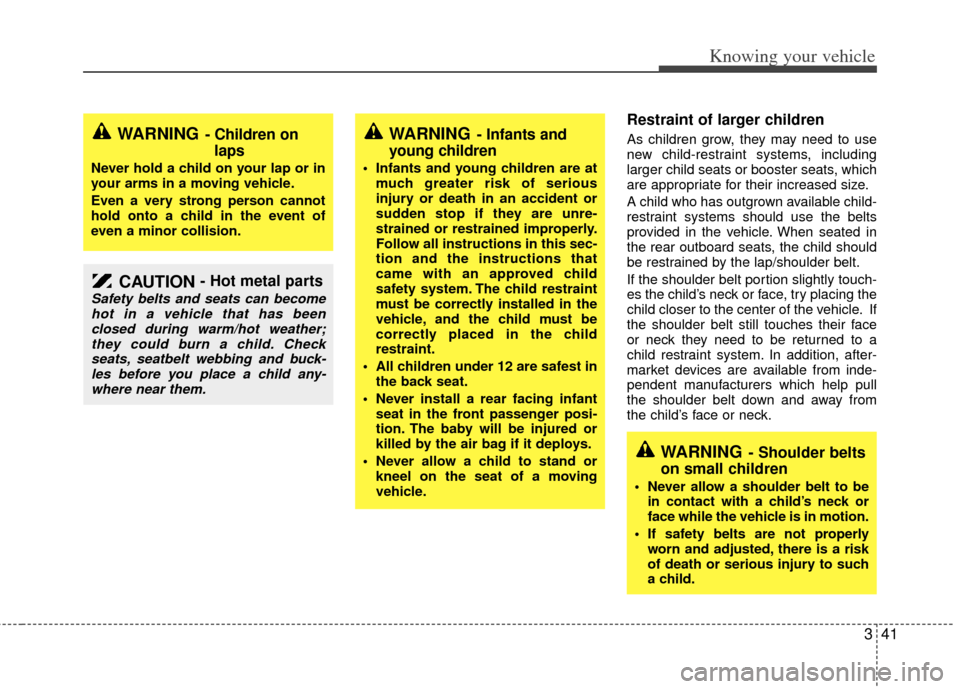
As children grow, they may need to use
new child-restraint systems, including
larger child seats or booster seats, which
are appropriate for their increased size.
A child who has outgrown available child-
restraint systems should use the belts
provided in the vehicle. When seated in
the rear outboard seats, the child should
be restrained by the lap/shoulder belt.
If the shoulder belt portion slightly touch-
es the child’s neck or face, try placing the
child closer to the center of the vehicle. If
the shoulder belt still touches their face
or neck they need to be returned to a
child restraint system. In addition, after-
market devices are available from inde-
pendent manufacturers which help pull
the shoulder belt down and away from
the child’s face or neck.WARNING- Infants and
young children
Infants and young children are at
much greater risk of serious
injury or death in an accident or
sudden stop if they are unre-
strained or restrained improperly.
Follow all instructions in this sec-
tion and the instructions that
came with an approved child
safety system. The child restraint
must be correctly installed in the
vehicle, and the child must be
correctly placed in the child
restraint.
All children under 12 are safest in the back seat.
Never install a rear facing infant seat in the front passenger posi-
tion. The baby will be injured or
killed by the air bag if it deploys.
Never allow a child to stand or kneel on the seat of a moving
vehicle.
WARNING- Children onlaps
Never hold a child on your lap or in
your arms in a moving vehicle.
Even a very strong person cannot
hold onto a child in the event of
even a minor collision.
CAUTION- Hot metal parts
Safety belts and seats can become
hot in a vehicle that has been closed during warm/hot weather;they could burn a child. Checkseats, seatbelt webbing and buck-les before you place a child any-where near them.
WARNING- Shoulder belts
on small children
Never allow a shoulder belt to be
in contact with a child’s neck or
face while the vehicle is in motion.
If safety belts are not properly worn and adjusted, there is a risk
of death or serious injury to such
a child.
Page 59 of 240
Knowing your vehicle
50
3
What your air bag system does
Driver’s air bag and front passenger’s air
bag are designed to supplement the pro-
tection offered by the safety belt in cer-
tain frontal collisions. Likewise, side air
bag and curtain air bags are designed to
supplement the protection offered by the
safety belt in side collisions. Safety belts
are designed to reduce the injury of the
driver or passengers in case of light
impact or collision. No safety belt or air
bag system can completely eliminate
injuries that may cause in collisions or
impacts. To help reduce impact on driver
or passengers in any collision, safety
belts must be correctly worn.
What your air bag system does
not do
The air bag system is designed to sup-
plement the protection offered by the
safety belt system. IT IS NOT A SUBSTI-
TUTE FOR THE SAFETY BELT.
The importance of using
safety belts
There are four very important reasons to
use safety belts even with an air bag sup-
plemental restraint system. They:
help keep you in the proper position
(away from the air bag) when it inflates.
reduce the risk of harm in rollover, side impact (vehicles not equipped with
side and curtain air bags) or rear
impact collisions, because an air bag is
not designed to inflate in such situa-
tions and even a side curtain air bag is
designed to inflate only in certain side
impact collisions.
reduce the risk of harm in frontal or side collisions which are not severe
enough to actuate the air bag supple-
mental restraint system.
reduce the risk of being ejected from your vehicle. Your vehicle’s Supplemental Restraint
System Control Module is equipped
with a recording device that may
record the use or status of the safety
belt restraint system by the driver and
front passenger in certain collisions.
WARNING- Air bags &
safety belts
Even in vehicles with air bags,
you and your passengers must
always wear the safety belts pro-
vided in order to minimize the risk
and severity of injury in the event
of a collision or rollover.
Always wear your safety belt. It can help keep you away from the
air bags during heavy braking
just before a collision. It may also
reduce the risk of occupant ejec-
tion.
If occupants are not wearing safe- ty belts or correctly seated, they
cannot be fully protected, and
thus face a greater risk of serious
injury or death.
(Continued)
Page 60 of 240
351
Knowing your vehicle
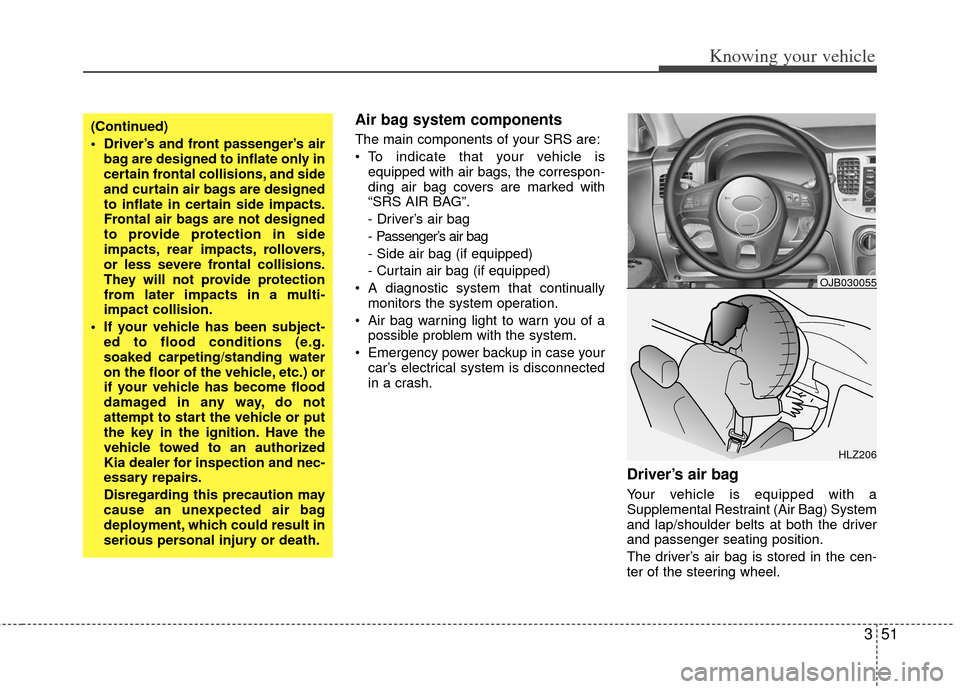
Air bag system components
The main components of your SRS are:
To indicate that your vehicle isequipped with air bags, the correspon-
ding air bag covers are marked with
“SRS AIR BAG”.
- Driver’s air bag
- Passenger’s air bag
- Side air bag (if equipped)
- Curtain air bag (if equipped)
A diagnostic system that continually monitors the system operation.
Air bag warning light to warn you of a possible problem with the system.
Emergency power backup in case your car’s electrical system is disconnected
in a crash.
Driver’s air bag
Your vehicle is equipped with a
Supplemental Restraint (Air Bag) System
and lap/shoulder belts at both the driver
and passenger seating position.
The driver’s air bag is stored in the cen-
ter of the steering wheel.
(Continued)
Driver’s and front passenger’s airbag are designed to inflate only in
certain frontal collisions, and side
and curtain air bags are designed
to inflate in certain side impacts.
Frontal air bags are not designed
to provide protection in side
impacts, rear impacts, rollovers,
or less severe frontal collisions.
They will not provide protection
from later impacts in a multi-
impact collision.
If your vehicle has been subject- ed to flood conditions (e.g.
soaked carpeting/standing water
on the floor of the vehicle, etc.) or
if your vehicle has become flood
damaged in any way, do not
attempt to start the vehicle or put
the key in the ignition. Have the
vehicle towed to an authorized
Kia dealer for inspection and nec-
essary repairs.
Disregarding this precaution may
cause an unexpected air bag
deployment, which could result in
serious personal injury or death.
HLZ206
OJB030055
Page 71 of 240

Knowing your vehicle
62
3
Air bag warning light
The purpose of air bag warning light in
your instrument panel is to alert you of a
potential problem with your air bag -
Supplemental Restraint System (SRS).
When the ignition switch is turned ON,
the indicator light should blink or illumi-
nate for approximately 6 seconds, then
go off.
Have the system checked if:
The light does not turn on briefly when
you turn the ignition ON.
The light stays on after the engine starts.
The light comes on while the vehicle is in motion.
Air bag (Supplemental Restraint
System) service
Your Supplemental Restraint System is
virtually maintenance-free. There are no
parts which you can service.
You must have the system serviced
under the following circumstances:
If an air bag ever inflates, the air bagmust be replaced. Do not try to remove
or discard the air bag by yourself. This
must be done by an authorized Kia
dealer.
If the air bag warning indicator light alerts you to a problem, have the air
bag system checked as soon as possi-
ble. Otherwise, your air bag system
may be ineffective.
WARNING
Never put child restraint in thefront passenger seat. If the front
passenger air bag inflates, it may
cause severe or fatal injuries.
When children are seated in the rear outboard seats in which cur-
tain air bags are equipped, be
sure to put the child restraint sys-
tem as far away from the door
side as possible, and secure the
child restraint system to be
locked in position.
Inflation of side or curtain air bag
(if equipped) could cause severe
injury or death due to the expan-
sion impact.
CAUTION - No modification
Do not modify any part of the air bagsystem. Modification could make the air bag system ineffective orcould cause unnecessary deploy- ment.
W7-147
Page 140 of 240
Driving your vehicle
28
4
Low brake fluid level warning
If the warning light remains on, it may
indicate that the brake fluid level in the
reservoir is low.
If the warning light remains on:
1. Drive carefully to the nearest safe
location and stop your vehicle.
2. With the engine stopped, check the brake fluid level immediately and add
fluid as required. Then check all brake
components for fluid leaks.
3. Do not drive the vehicle if leaks are found, the warning light remains on or
the brakes do not operate properly.
Have it towed to any authorized Kia
dealer for a brake system inspection
and necessary repairs.
To check bulb operation, check whether
the parking brake and brake fluid warning
light illuminates when the ignition switch
is in the ON position.
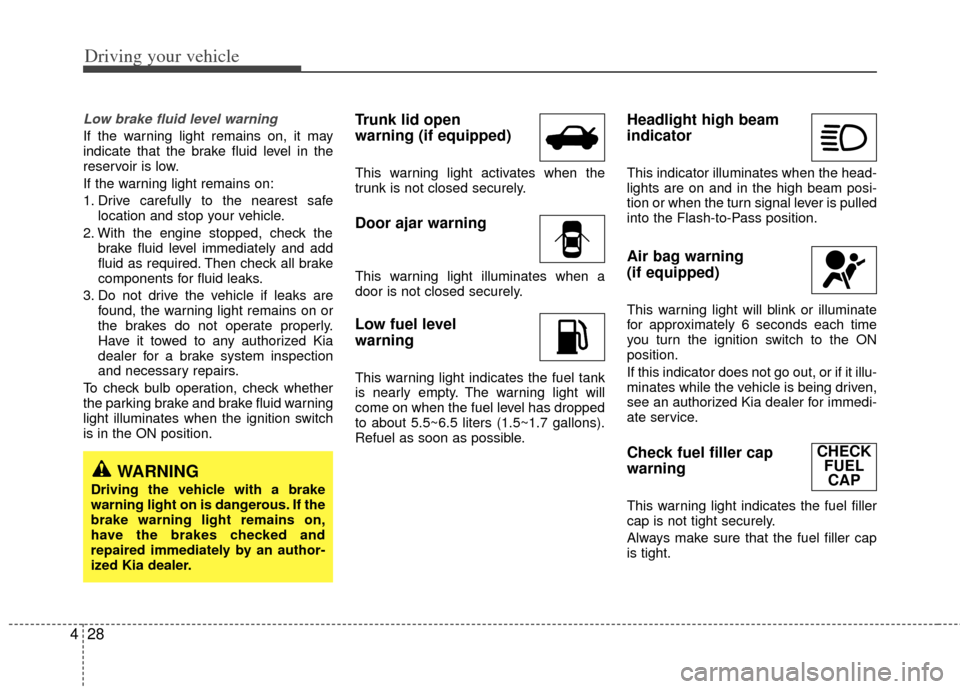
Trunk lid open
warning (if equipped)
This warning light activates when the
trunk is not closed securely.
Door ajar warning
This warning light illuminates when a
door is not closed securely.
Low fuel level
warning
This warning light indicates the fuel tank
is nearly empty. The warning light will
come on when the fuel level has dropped
to about 5.5~6.5 liters (1.5~1.7 gallons).
Refuel as soon as possible.
Headlight high beam
indicator
This indicator illuminates when the head-
lights are on and in the high beam posi-
tion or when the turn signal lever is pulled
into the Flash-to-Pass position.
Air bag warning
(if equipped)
This warning light will blink or illuminate
for approximately 6 seconds each time
you turn the ignition switch to the ON
position.
If this indicator does not go out, or if it illu-
minates while the vehicle is being driven,
see an authorized Kia dealer for immedi-
ate service.
Check fuel filler cap
warning
This warning light indicates the fuel filler
cap is not tight securely.
Always make sure that the fuel filler cap
is tight.
WARNING
Driving the vehicle with a brake
warning light on is dangerous. If the
brake warning light remains on,
have the brakes checked and
repaired immediately by an author-
ized Kia dealer.
CHECK FUELCAP
Page 180 of 240
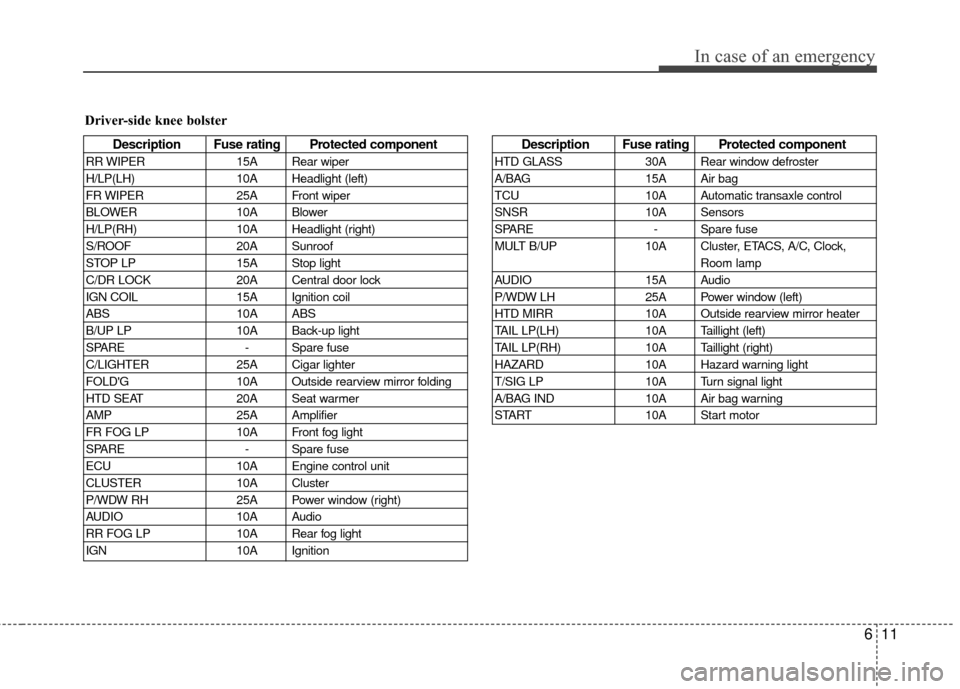
611
In case of an emergency
Driver-side knee bolster
Description Fuse rating Protected component
RR WIPER15A Rear wiper
H/LP(LH) 10A Headlight (left)
FR WIPER 25A Front wiper
BLOWER 10A Blower
H/LP(RH) 10A Headlight (right)
S/ROOF 20A Sunroof
STOP LP 15A Stop light
C/DR LOCK 20A Central door lock
IGN COIL 15A Ignition coil
ABS 10A ABS
B/UP LP 10A Back-up light
SPARE - Spare fuse
C/LIGHTER 25A Cigar lighter
FOLD'G 10A Outside rearview mirror folding
HTD SEAT 20A Seat warmer
AMP 25A Amplifier
FR FOG LP 10A Front fog light
SPARE - Spare fuse
ECU 10A Engine control unit
CLUSTER 10A Cluster
P/WDW RH 25A Power window (right)
AUDIO 10A Audio
RR FOG LP 10A Rear fog light
IGN 10A Ignition
Description Fuse rating Protected component
HTD GLASS30A Rear window defroster
A/BAG 15A Air bag
TCU 10A Automatic transaxle control
SNSR 10A Sensors
SPARE - Spare fuse
MULT B/UP 10A Cluster, ETACS, A/C, Clock,
Room lamp
AUDIO 15A Audio
P/WDW LH 25A Power window (left)
HTD MIRR 10A Outside rearview mirror heater
TAIL LP(LH) 10A Taillight (left)
TAIL LP(RH) 10A Taillight (right)
HAZARD 10A Hazard warning light
T/SIG LP 10A Turn signal light
A/BAG IND 10A Air bag warning
START 10A Start motor