warning KIA Rio 2014 3.G Owner's Manual
[x] Cancel search | Manufacturer: KIA, Model Year: 2014, Model line: Rio, Model: KIA Rio 2014 3.GPages: 397, PDF Size: 7.56 MB
Page 269 of 397
545
Driving your vehicle
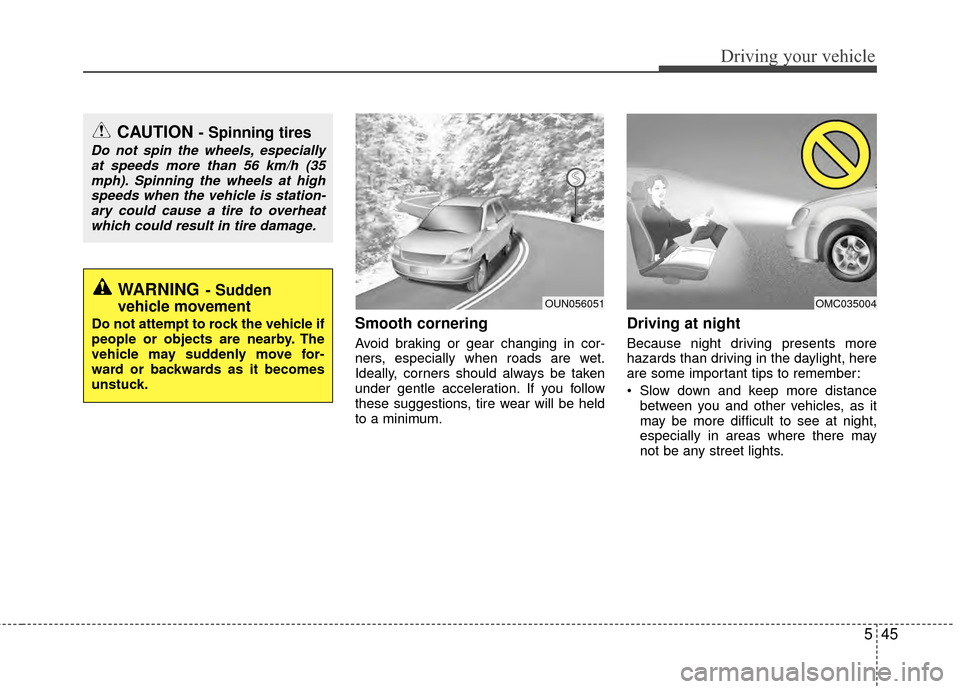
Smooth cornering
Avoid braking or gear changing in cor-
ners, especially when roads are wet.
Ideally, corners should always be taken
under gentle acceleration. If you follow
these suggestions, tire wear will be held
to a minimum.
Driving at night
Because night driving presents more
hazards than driving in the daylight, here
are some important tips to remember:
Slow down and keep more distancebetween you and other vehicles, as it
may be more difficult to see at night,
especially in areas where there may
not be any street lights.
OUN056051OMC035004WARNING- Sudden
vehicle movement
Do not attempt to rock the vehicle if
people or objects are nearby. The
vehicle may suddenly move for-
ward or backwards as it becomes
unstuck.
CAUTION - Spinning tires
Do not spin the wheels, especially
at speeds more than 56 km/h (35mph). Spinning the wheels at highspeeds when the vehicle is station-ary could cause a tire to overheat which could result in tire damage.
Page 271 of 397
547
Driving your vehicle
Driving off-road
Drive carefully off-road because your
vehicle may be damaged by rocks of
roots of trees. Become familiar with the
off-road conditions where you are going
to drive before you begin driving.
Highway driving
Tires
Adjust the tire inflation pressures to
specification. Low tire inflation pressures
will result in overheating and possible
failure of the tires.
Avoid using worn or damaged tires which
may result in reduced traction or tire fail-
ure.
Never exceed the maximum tire inflation
pressure shown on the tires.
Fuel, engine coolant and engine oil
High speed travel consumes more fuel
than urban motoring. Do not forget to
check both the engine coolant and
engine oil.
Drive belt
A loose or damaged drive belt may over-
heat the engine.
WARNING - Under/overinflated tires
Always check the tires for proper
inflation before driving.
Underinflated or overinflated tires
can cause poor handling, loss of
vehicle control, and sudden tire fail-
ure leading to accidents, injuries,
and even death. For proper tire
pressures, refer to “Tires and
wheels” in section 8.
WARNING - Tire tread
Always check the tire tread before
driving your vehicle. Worn-out tires
can result in loss of vehicle control.
Worn-out tires should be replaced
as soon as possible. For further
information and tread limits, refer
to "Tires and wheels" in section 7.
Page 278 of 397
Driving your vehicle
54
5
Certification label
The certification label is located on the
driver's door sill at the center pillar.
This label shows the maximum allowable
weight of the fully loaded vehicle. This is
called the GVWR (Gross Vehicle Weight
Rating). The GVWR includes the weight
of the vehicle, all occupants, fuel and
cargo.
This label also tells you the maximum
weight that can be supported by the front
and rear axles, called Gross Axle Weight
Rating (GAWR).
To find out the actual loads on your front
and rear axles, you need to go to a weigh
station and weigh your vehicle. Your deal-
er can help you with this. Be sure to
spread out your load equally on both
sides of the centerline. The label will help you decide how much
cargo and installed equipment your vehi-
cle can carry.
If you carry items inside your vehicle -
like suitcases, tools, packages, or any-
thing else - they are moving as fast as
the vehicle. If you have to stop or turn
quickly, or if there is a crash, the items
will keep going and can cause an injury if
they strike the driver or a passenger.WARNING -Over loading
Never exceed the GVWR for your
vehicle, the GAWR for either the
front or rear axle and vehicle capac-
ity weight. Exceeding these ratings
can affect your vehicle’s handling
and braking ability.
Page 279 of 397
555
Driving your vehicle
✽
✽NOTICE
Overloading your vehicle may cause
damage. Repairs would not be covered
by your warranty. Do not overload your
vehicle.
WARNING - Over loading
Do not overload your vehicle.
Overloading your vehicle can
cause heat buildup in your vehi-
cle's tires and possible tire failure,
increased stopping distances and
poor vehicle handling--all of which
may result in a crash.
WARNING - Loose cargo
Do not travel with unsecured blunt
objects in the passenger compart-
ment of your vehicle (e.g. suit
cases or unsecured child seats).
These items may strike occupant
during a sudden stop or crash.
Page 281 of 397
6
Road warning / 6-2
In case of an emergency while driving / 6-2
If the engine will not start / 6-3
Emergency starting / 6-4
If the engine overheats / 6-7
Tire pressure monitoring system (TPMS) / 6-8
If you have a flat tire / 6-13, 21
Towing / 6-27
What to do in an emergency
Page 282 of 397
What to do in an emergency
26
ROAD WARNING
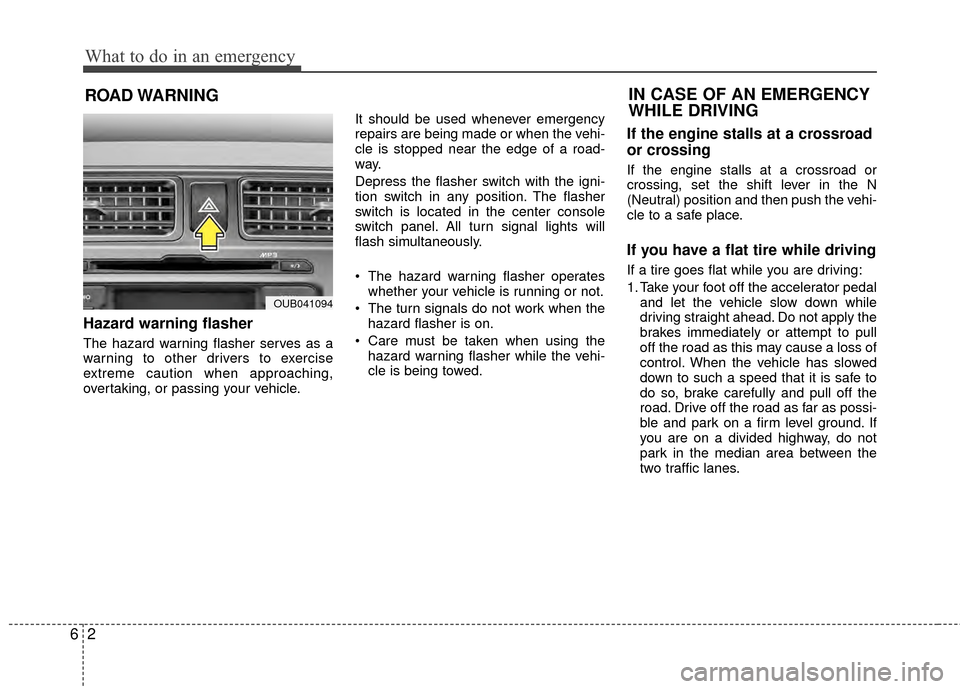
Hazard warning flasher
The hazard warning flasher serves as a
warning to other drivers to exercise
extreme caution when approaching,
overtaking, or passing your vehicle.It should be used whenever emergency
repairs are being made or when the vehi-
cle is stopped near the edge of a road-
way.
Depress the flasher switch with the igni-
tion switch in any position. The flasher
switch is located in the center console
switch panel. All turn signal lights will
flash simultaneously.
• The hazard warning flasher operates
whether your vehicle is running or not.
The turn signals do not work when the hazard flasher is on.
Care must be taken when using the hazard warning flasher while the vehi-
cle is being towed.
If the engine stalls at a crossroad
or crossing
If the engine stalls at a crossroad or
crossing, set the shift lever in the N
(Neutral) position and then push the vehi-
cle to a safe place.
If you have a flat tire while driving
If a tire goes flat while you are driving:
1. Take your foot off the accelerator pedaland let the vehicle slow down while
driving straight ahead. Do not apply the
brakes immediately or attempt to pull
off the road as this may cause a loss of
control. When the vehicle has slowed
down to such a speed that it is safe to
do so, brake carefully and pull off the
road. Drive off the road as far as possi-
ble and park on a firm level ground. If
you are on a divided highway, do not
park in the median area between the
two traffic lanes.
IN CASE OF AN EMERGENCY
WHILE DRIVING
OUB041094
Page 283 of 397
63
What to do in an emergency
2. When the vehicle is stopped, turn onyour emergency hazard flashers, set
the parking brake and put the transaxle
in P (automatic transaxle) or reverse
(manual transaxle).
3. Have all passengers get out of the vehicle. Be sure they all get out on the
side of the vehicle that is away from
traffic.
4. When changing a flat tire, follow the instruction provided later in this sec-
tion.
If engine stalls while driving
1. Reduce your speed gradually, keeping a straight line. Move cautiously off the
road to a safe place.
2. Turn on your emergency flashers.
3. Try to start the engine again. If your vehicle will not start, contact an
authorized Kia dealer or seek other
qualified assistance.
If the engine doesn't turn over or
turns over slowly
1. If your vehicle has an automatictransaxle, be sure the shift lever is in N
(Neutral) or P (Park) and the emer-
gency brake is set.
2. Check the battery connections to be sure they are clean and tight.
3. Turn on the interior light. If the light dims or goes out when you operate the
starter, the battery is discharged.
4. Check the starter connections to be sure they are securely tightened.
5. Do not push or pull the vehicle to start it. See instructions for "Jump starting".
If engine turns over normally but
does not start
1. Check fuel level.
2. With the ignition switch in the LOCKposition, check all connectors at the
ignition coil and spark plugs.
Reconnect any that may be discon-
nected or loose.
3. Check the fuel line in the engine com- partment.
4. If the engine still does not start, call an authorized Kia dealer or seek other
qualified assistance.
IF THE ENGINE WILL NOT START
WARNING - Push/pull start
Do not push or pull the vehicle to
start it. Push or pull starting may
cause the catalytic converter to
overload and create a fire hazard.
Page 284 of 397
What to do in an emergency
46
EMERGENCY STARTING
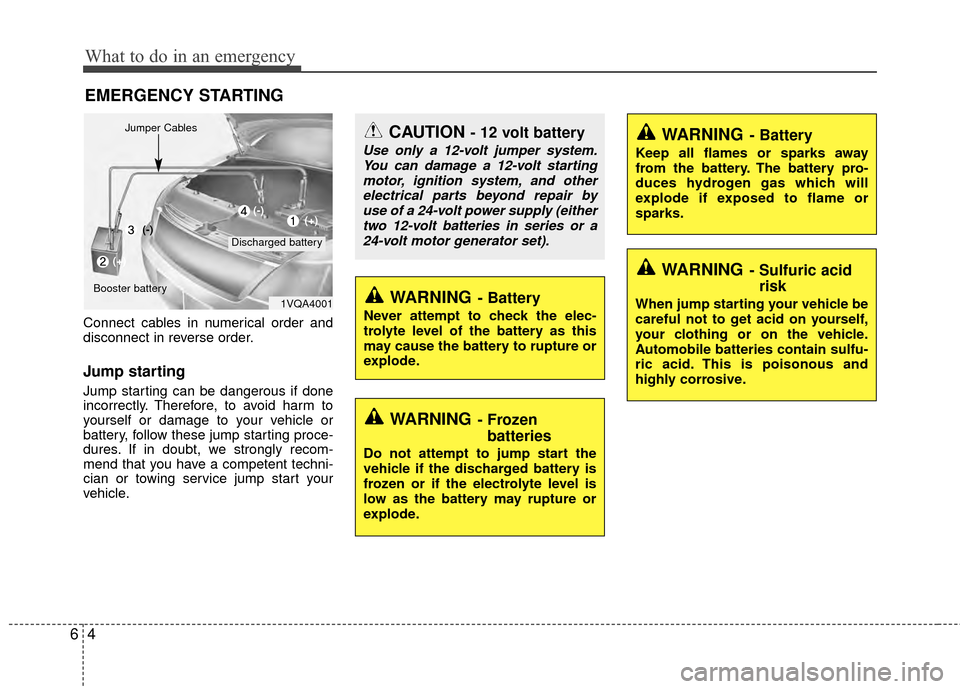
Connect cables in numerical order and
disconnect in reverse order.
Jump starting
Jump starting can be dangerous if done
incorrectly. Therefore, to avoid harm to
yourself or damage to your vehicle or
battery, follow these jump starting proce-
dures. If in doubt, we strongly recom-
mend that you have a competent techni-
cian or towing service jump start your
vehicle.
CAUTION - 12 volt battery
Use only a 12-volt jumper system.You can damage a 12-volt startingmotor, ignition system, and otherelectrical parts beyond repair byuse of a 24-volt power supply (either two 12-volt batteries in series or a24-volt motor generator set).WARNING- Battery
Keep all flames or sparks away
from the battery. The battery pro-
duces hydrogen gas which will
explode if exposed to flame or
sparks.
WARNING- Battery
Never attempt to check the elec-
trolyte level of the battery as this
may cause the battery to rupture or
explode.
WARNING- Frozen batteries
Do not attempt to jump start the
vehicle if the discharged battery is
frozen or if the electrolyte level is
low as the battery may rupture or
explode.
WARNING- Sulfuric acidrisk
When jump starting your vehicle be
careful not to get acid on yourself,
your clothing or on the vehicle.
Automobile batteries contain sulfu-
ric acid. This is poisonous and
highly corrosive.1VQA4001
Discharged battery
Jumper Cables
Booster battery(-)
(+)
(+)(-)
Page 286 of 397
What to do in an emergency
66
Push-starting
Your manual transaxle-equipped vehicle
should not be push-started because it
might damage the emission control sys-
tem.
Vehicles equipped with automatic
transaxle cannot be push-started.
Follow the directions in this section for
jump-starting.
WARNING - Tow startingvehicle
Never tow a vehicle to start it
because the sudden surge forward
when the engine starts could cause
a collision with the tow vehicle.
Page 287 of 397
67
What to do in an emergency
IF THE ENGINE OVERHEATS
If your temperature gauge indicates over-
heating, you will experience a loss of
power, or hear loud pinging or knocking,
the engine is probably too hot. If this hap-
pens, you should:
1. Pull off the road and stop as soon as itis safe to do so.
2. Place the shift lever in P (automatic transaxle) or neutral (manual
transaxle) and set the parking brake. If
the air conditioning is on, turn it off.
3. If engine coolant is running out under the vehicle or steam is coming out
from underneath the hood, stop the
engine. Do not open the hood until the
coolant has stopped running or the
steaming has stopped. If there is no
visible loss of engine coolant and no
steam, leave the engine running and
check to be sure the engine cooling
fan is operating. If the fan is not run-
ning, turn the engine off.
4. Check to see if the water pump drive belt is missing. If it is not missing,
check to see that it is tight. If the drive
belt seems to be satisfactory, check for
coolant leaking from the radiator,
hoses or under the vehicle. (If the air
conditioning had been in use, it is nor-
mal for cold water to be draining from
it when you stop). 5. If the water pump drive belt is broken
or engine coolant leaks, stop the
engine immediately and call the near-
est authorized Kia dealer for assis-
tance. 6. If you cannot find the cause of the
overheating, wait until the engine tem-
perature has returned to normal. Then,
if coolant has been lost, carefully add
coolant to the reservoir to bring the
fluid level in the reservoir up to the
halfway mark.
7. Proceed with caution, keeping alert for further signs of overheating. If over-
heating happens again, call an author-
ized Kia dealer for assistance.
Serious loss of coolant indicates there is
a leak in the cooling system and this
should be checked as soon as possible
by an authorized Kia dealer.
WARNING - Under the hood
While the engine is running, keep
hair, hands and clothing away from
moving parts such as the fan and
drive belts.
WARNING - Radiator cap
Do not remove the radiator cap
when the engine is hot. This can
allow coolant to be blown out of the
opening and cause serious burns.