media system KIA Rio 2015 3.G Owner's Guide
[x] Cancel search | Manufacturer: KIA, Model Year: 2015, Model line: Rio, Model: KIA Rio 2015 3.GPages: 398, PDF Size: 7.61 MB
Page 293 of 398
What to do in an emergency
12
6
You may not be able to identify a low
tire by simply looking at it. Always
use a good quality tire pressure
gauge to measure the tire's inflation
pressure. Please note that a tire that
is hot (from being driven) will have a
higher pressure measurement than a
tire that is cold.
A cold tire means the vehicle has
been sitting for 3 hours and driven for
less than 1.6 km (1 mile) in that 3
hour period.
Allow the tire to cool before measur-
ing the inflation pressure. Always be
sure the tire is cold before inflating to
the recommended pressure.
The TPMS cannot alert you to severe
and sudden tire damage caused by
external factors such as nails or road
debris.
If you feel any vehicle instability,
immediately take your foot off the
accelerator, apply the brakes gradu-
ally and with light force, and slowly
move to a safe position off the road.✽ ✽
NOTICE
Tampering with, modifying, or dis-
abling the Tire Pressure Monitoring
System (TPMS) components may
interfere with the system's ability to
warn the driver of low tire pressure
conditions and/or TPMS malfunc-
tions. Tampering with, modifying,
or disabling the Tire Pressure
Monitoring System (TPMS) compo-
nents may void the warranty for
that portion of the vehicle.
This device complies with Industry
Canada Standard RSS-210.
Operation is subject to the following
two conditions:
1.This device may not cause harmful
interference, and
2.This device must accept any inter- ference received, including inter-
ference that may cause undesired
operation.
Page 321 of 398
Maintenance
10
7
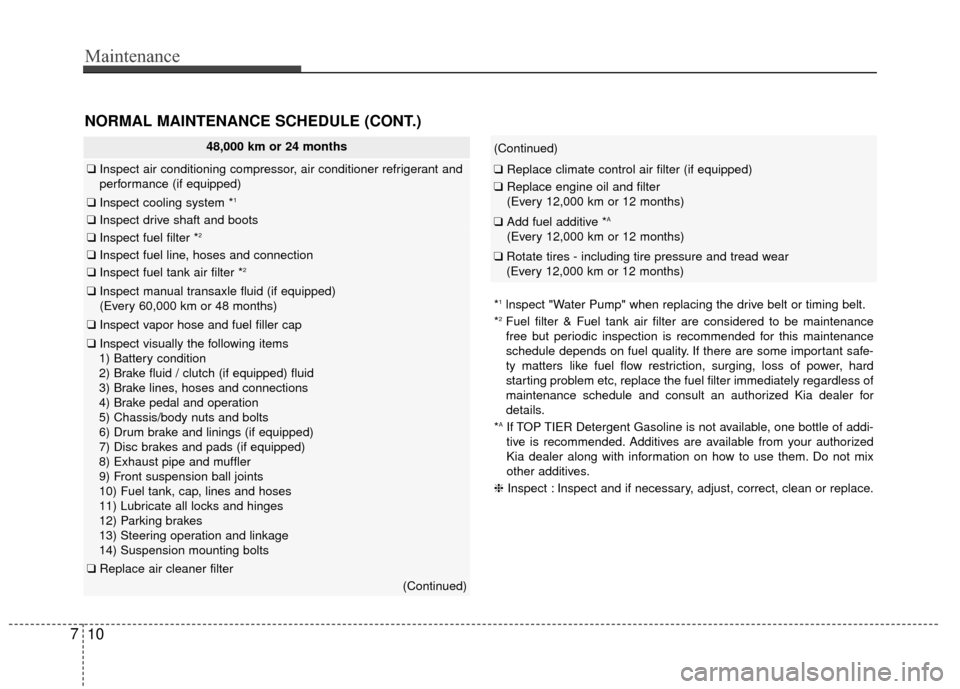
NORMAL MAINTENANCE SCHEDULE (CONT.)
48,000 km or 24 months
❑ Inspect air conditioning compressor, air conditioner refrigerant and
performance (if equipped)
❑ Inspect cooling system *1
❑Inspect drive shaft and boots
❑Inspect fuel filter *2
❑Inspect fuel line, hoses and connection
❑Inspect fuel tank air filter *2
❑Inspect manual transaxle fluid (if equipped)
(Every 60,000 km or 48 months)
❑ Inspect vapor hose and fuel filler cap
❑Inspect visually the following items
1) Battery condition
2) Brake fluid / clutch (if equipped) fluid
3) Brake lines, hoses and connections
4) Brake pedal and operation
5) Chassis/body nuts and bolts
6) Drum brake and linings (if equipped)
7) Disc brakes and pads (if equipped)
8) Exhaust pipe and muffler
9) Front suspension ball joints
10) Fuel tank, cap, lines and hoses
11) Lubricate all locks and hinges
12) Parking brakes
13) Steering operation and linkage
14) Suspension mounting bolts
❑ Replace air cleaner filter
(Continued)
(Continued)
❑ Replace climate control air filter (if equipped)
❑Replace engine oil and filter
(Every 12,000 km or 12 months)
❑Add fuel additive *A
(Every 12,000 km or 12 months)
❑Rotate tires - including tire pressure and tread wear
(Every 12,000 km or 12 months)
*1lnspect "Water Pump" when replacing the drive belt or timing belt.
*2Fuel filter & Fuel tank air filter are considered to be maintenance
free but periodic inspection is recommended for this maintenance
schedule depends on fuel quality. If there are some important safe-
ty matters like fuel flow restriction, surging, loss of power, hard
starting problem etc, replace the fuel filter immediately regardless of
maintenance schedule and consult an authorized Kia dealer for
details.
*
AIf TOP TIER Detergent Gasoline is not available, one bottle of addi-
tive is recommended. Additives are available from your authorized
Kia dealer along with information on how to use them. Do not mix
other additives.
❈ Inspect : Inspect and if necessary, adjust, correct, clean or replace.
Page 323 of 398

*1lnspect \"Water Pump\" when replacing the drive belt or timing belt.
*2Fuel filter & Fuel tank air filter are considered to be maintenance free\
b")
Maintenance
12
7
NORMAL MAINTENANCE SCHEDULE (CONT.)
*1lnspect "Water Pump" when replacing the drive belt or timing belt.
*2Fuel filter & Fuel tank air filter are considered to be maintenance free\
but
periodic inspection is recommended for this maintenance schedule
depends on fuel quality. If there are some important safety matters like
fuel flow restriction, surging, loss of power, hard starting problem etc,
replace the fuel filter immediately regardless of maintenance schedule
and consult an authorized Kia dealer for details.
*
3Inspect for excessive tappet noise and/or engine vibration and adjust if
necessary.
*
4The drive belt should be replaced when cracks occur or tension is reduced excessively.
*
AIf TOP TIER Detergent Gasoline is not available, one bottle of additive is
recommended. Additives are available from your authorized Kia dealer
along with information on how to use them. Do not mix other additives.
❈ Inspect : Inspect and if necessary, adjust, correct, clean or replace.
96,000 km or 48 months
❑Inspect air conditioning compressor, air conditioner refrigerant and
performance (if equipped)
❑ Inspect cooling system *1
❑Inspect drive belt *4
(First, 96,000 km or 72 months
after every 24,000 km or 24 months)
❑ Inspect drive shaft and boots
❑ Inspect fuel filter *2
❑Inspect fuel line, hoses and connection
❑Inspect fuel tank air filter *2
❑Inspect valve clearance *3
❑Inspect vapor hose and fuel filler cap
❑Inspect visually the following items
1) Battery condition
2) Brake fluid / clutch (if equipped) fluid
3) Brake lines, hoses and connections
4) Brake pedal and operation
5) Chassis/body nuts and bolts
6) Drum brake and linings (if equipped)
7) Disc brakes and pads (if equipped)
8) Exhaust pipe and muffler
9) Front suspension ball joints
10) Fuel tank, cap, lines and hoses
(Continued)
(Continued)
11) Lubricate all locks and hinges
12) Parking brakes
13) Steering operation and linkage
14) Suspension mounting bolts
❑ Replace air cleaner filter
❑Replace climate control air filter (if equipped)
❑Replace engine oil and filter
(Every 12,000 km or 12 months)
❑Add fuel additive *A
(Every 12,000 km or 12 months)
❑Rotate tires - including tire pressure and tread wear
(Every 12,000 km or 12 months)
Page 325 of 398
Maintenance
14
7
*1lnspect "Water Pump" when replacing the drive belt or timing belt.
*2Fuel filter & Fuel tank air filter are considered to be maintenance
free but periodic inspection is recommended for this maintenance
schedule depends on fuel quality. If there are some important safe-
ty matters like fuel flow restriction, surging, loss of power, hard
starting problem etc, replace the fuel filter immediately regardless of
maintenance schedule and consult an authorized Kia dealer for
details.
*
4The drive belt should be replaced when cracks occur or tension is reduced excessively.
*
AIf TOP TIER Detergent Gasoline is not available, one bottle of addi-
tive is recommended. Additives are available from your authorized
Kia dealer along with information on how to use them. Do not mix
other additives.
❈ Inspect : Inspect and if necessary, adjust, correct, clean or replace.
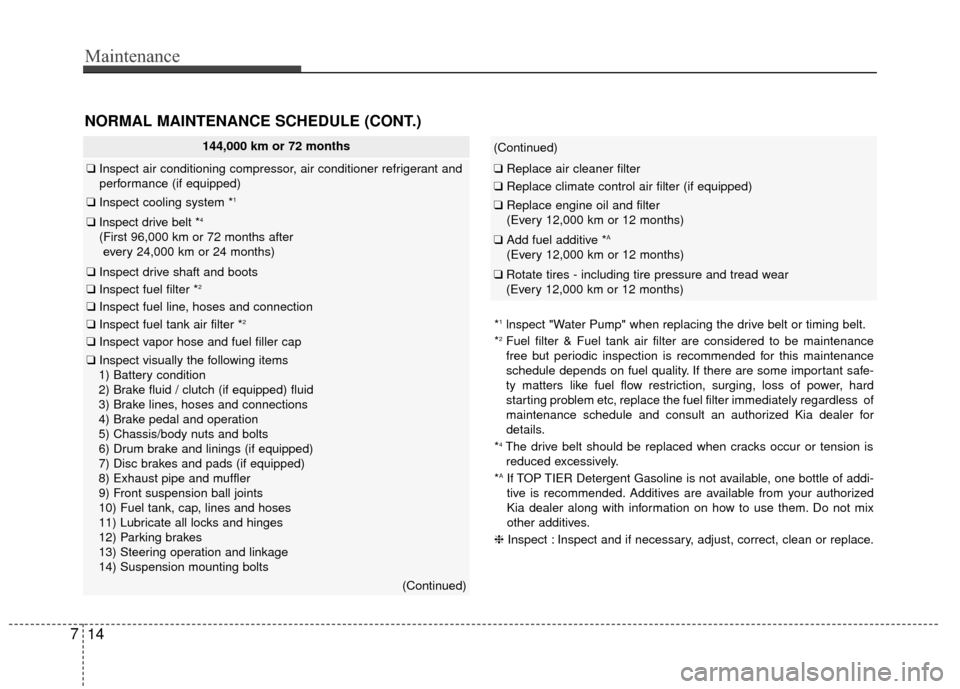
NORMAL MAINTENANCE SCHEDULE (CONT.)
144,000 km or 72 months
❑Inspect air conditioning compressor, air conditioner refrigerant and
performance (if equipped)
❑ Inspect cooling system *1
❑Inspect drive belt *4
(First 96,000 km or 72 months after
every 24,000 km or 24 months)
❑ Inspect drive shaft and boots
❑ Inspect fuel filter *2
❑Inspect fuel line, hoses and connection
❑Inspect fuel tank air filter *2
❑Inspect vapor hose and fuel filler cap
❑Inspect visually the following items
1) Battery condition
2) Brake fluid / clutch (if equipped) fluid
3) Brake lines, hoses and connections
4) Brake pedal and operation
5) Chassis/body nuts and bolts
6) Drum brake and linings (if equipped)
7) Disc brakes and pads (if equipped)
8) Exhaust pipe and muffler
9) Front suspension ball joints
10) Fuel tank, cap, lines and hoses
11) Lubricate all locks and hinges
12) Parking brakes
13) Steering operation and linkage
14) Suspension mounting bolts
(Continued)
(Continued)
❑ Replace air cleaner filter
❑Replace climate control air filter (if equipped)
❑Replace engine oil and filter
(Every 12,000 km or 12 months)
❑Add fuel additive *A
(Every 12,000 km or 12 months)
❑Rotate tires - including tire pressure and tread wear
(Every 12,000 km or 12 months)
Page 327 of 398
Maintenance
16
7
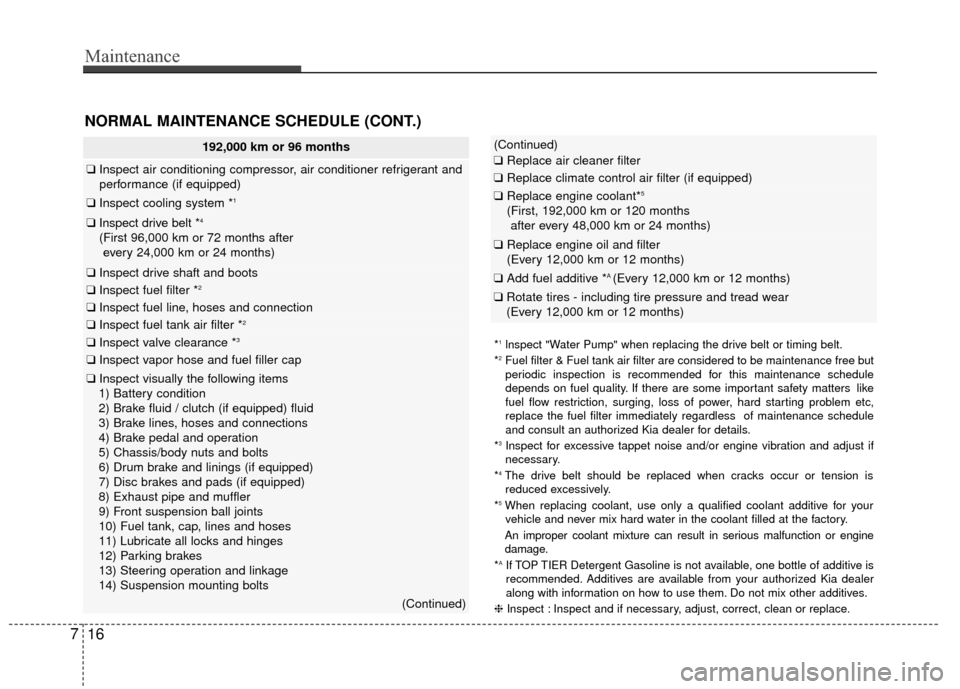
NORMAL MAINTENANCE SCHEDULE (CONT.)
192,000 km or 96 months
❑ Inspect air conditioning compressor, air conditioner refrigerant and
performance (if equipped)
❑ Inspect cooling system *1
❑Inspect drive belt *4
(First 96,000 km or 72 months after
every 24,000 km or 24 months)
❑ Inspect drive shaft and boots
❑ Inspect fuel filter *2
❑Inspect fuel line, hoses and connection
❑Inspect fuel tank air filter *2
❑Inspect valve clearance *3
❑Inspect vapor hose and fuel filler cap
❑Inspect visually the following items
1) Battery condition
2) Brake fluid / clutch (if equipped) fluid
3) Brake lines, hoses and connections
4) Brake pedal and operation
5) Chassis/body nuts and bolts
6) Drum brake and linings (if equipped)
7) Disc brakes and pads (if equipped)
8) Exhaust pipe and muffler
9) Front suspension ball joints
10) Fuel tank, cap, lines and hoses
11) Lubricate all locks and hinges
12) Parking brakes
13) Steering operation and linkage
14) Suspension mounting bolts
(Continued)
(Continued)
❑ Replace air cleaner filter
❑Replace climate control air filter (if equipped)
❑Replace engine coolant*5
(First, 192,000 km or 120 months
after every 48,000 km or 24 months)
❑ Replace engine oil and filter
(Every 12,000 km or 12 months)
❑ Add fuel additive *A (Every 12,000 km or 12 months)
❑Rotate tires - including tire pressure and tread wear
(Every 12,000 km or 12 months)
*1lnspect "Water Pump" when replacing the drive belt or timing belt.
*2Fuel filter & Fuel tank air filter are considered to be maintenance free\
but
periodic inspection is recommended for this maintenance schedule
depends on fuel quality. If there are some important safety matters like
fuel flow restriction, surging, loss of power, hard starting problem etc,
replace the fuel filter immediately regardless of maintenance schedule
and consult an authorized Kia dealer for details.
*
3Inspect for excessive tappet noise and/or engine vibration and adjust if
necessary.
*
4The drive belt should be replaced when cracks occur or tension is reduced excessively.
*
5When replacing coolant, use only a qualified coolant additive for your vehicle and never mix hard water in the coolant filled at the factory.
An improper coolant mixture can result in serious malfunction or engine
damage.
*
AIf TOP TIER Detergent Gasoline is not available, one bottle of additive is
recommended. Additives are available from your authorized Kia dealer
along with information on how to use them. Do not mix other additives.
❈ Inspect : Inspect and if necessary, adjust, correct, clean or replace.
Page 329 of 398
Maintenance
18
7
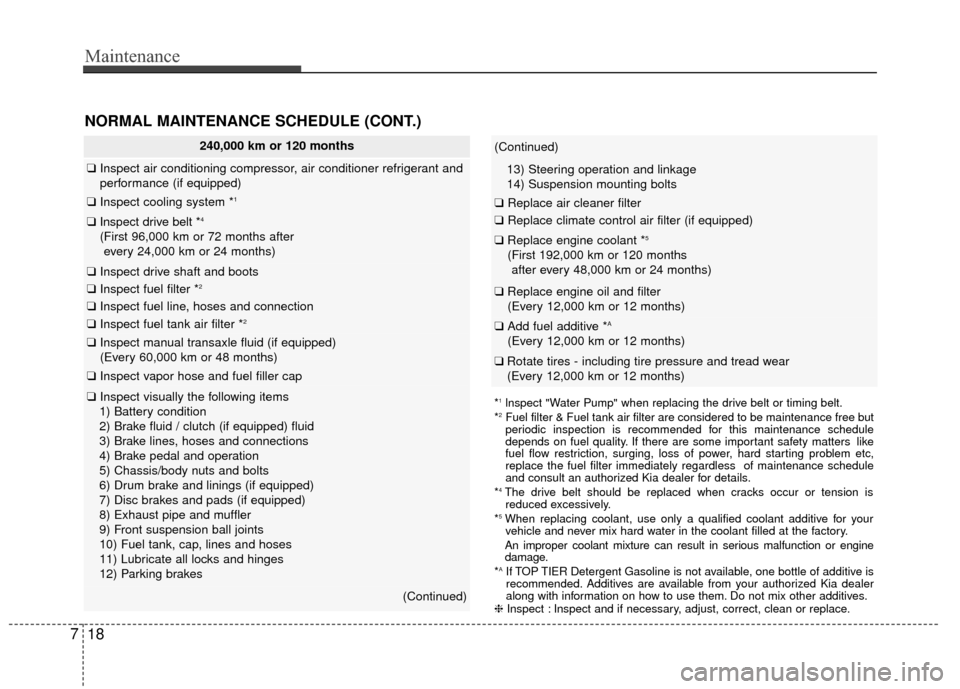
240,000 km or 120 months
❑ Inspect air conditioning compressor, air conditioner refrigerant and
performance (if equipped)
❑ Inspect cooling system *1
❑Inspect drive belt *4
(First 96,000 km or 72 months after
every 24,000 km or 24 months)
❑ Inspect drive shaft and boots
❑ Inspect fuel filter *2
❑Inspect fuel line, hoses and connection
❑Inspect fuel tank air filter *2
❑Inspect manual transaxle fluid (if equipped)
(Every 60,000 km or 48 months)
❑ Inspect vapor hose and fuel filler cap
❑Inspect visually the following items
1) Battery condition
2) Brake fluid / clutch (if equipped) fluid
3) Brake lines, hoses and connections
4) Brake pedal and operation
5) Chassis/body nuts and bolts
6) Drum brake and linings (if equipped)
7) Disc brakes and pads (if equipped)
8) Exhaust pipe and muffler
9) Front suspension ball joints
10) Fuel tank, cap, lines and hoses
11) Lubricate all locks and hinges
12) Parking brakes
(Continued)
(Continued)
13) Steering operation and linkage
14) Suspension mounting bolts
❑ Replace air cleaner filter
❑Replace climate control air filter (if equipped)
❑Replace engine coolant *5
(First 192,000 km or 120 months
after every 48,000 km or 24 months)
❑ Replace engine oil and filter
(Every 12,000 km or 12 months)
❑Add fuel additive *A
(Every 12,000 km or 12 months)
❑Rotate tires - including tire pressure and tread wear
(Every 12,000 km or 12 months)
NORMAL MAINTENANCE SCHEDULE (CONT.)
*1lnspect "Water Pump" when replacing the drive belt or timing belt.
*2Fuel filter & Fuel tank air filter are considered to be maintenance free\
but
periodic inspection is recommended for this maintenance schedule
depends on fuel quality. If there are some important safety matters like
fuel flow restriction, surging, loss of power, hard starting problem etc,
replace the fuel filter immediately regardless of maintenance schedule
and consult an authorized Kia dealer for details.
*
4The drive belt should be replaced when cracks occur or tension is reduced excessively.
*
5When replacing coolant, use only a qualified coolant additive for your vehicle and never mix hard water in the coolant filled at the factory.
An improper coolant mixture can result in serious malfunction or engine
damage.
*
AIf TOP TIER Detergent Gasoline is not available, one bottle of additive is
recommended. Additives are available from your authorized Kia dealer
along with information on how to use them. Do not mix other additives.
❈ Inspect : Inspect and if necessary, adjust, correct, clean or replace.
Page 333 of 398
Maintenance
22
7
EXPLANATION OF SCHEDULED MAINTENANCE ITEMS
Engine oil and filter
The engine oil and filter should be
changed at the intervals specified in the
maintenance schedule. If the vehicle is
being driven in severe conditions, more
frequent oil and filter changes are
required.
Drive belts
Inspect all drive belts for evidence of
cuts, cracks, excessive wear or oil satu-
ration and replace if necessary. Drive
belts should be checked periodically for
proper tension and adjusted as neces-
sary.
Fuel filter
A clogged filter can limit the speed at
which the vehicle may be driven, damage
the emission system and cause multiple
issues such as hard starting. If an exces-
sive amount of foreign matter accumu-
lates in the fuel tank, the filter may
require replacement more frequently.
After installing a new filter, run the engine
for several minutes, and check for leaks
at the connections. Fuel filters should be
installed by an authorized Kia dealer.
Fuel lines, fuel hoses and con-
nections
Check the fuel lines, fuel hoses and con-
nections for leakage and damage. Have
an authorized Kia dealer replace any
damaged or leaking parts immediately.
Vapor hose and fuel filler cap
The vapor hose and fuel filler cap should
be inspected at those intervals specified
in the maintenance schedule. Make sure
that a new vapor hose or fuel filler cap is
correctly replaced.
Vacuum crankcase ventilation
hoses (if equipped)
Inspect the surface of hoses for evidence
of heat and/or mechanical damage. Hard
and brittle rubber, cracking, tears, cuts,
abrasions, and excessive swelling indi-
cate deterioration. Particular attention
should be paid to examine those hose
surfaces nearest to high heat sources,
such as the exhaust manifold.
Inspect the hose routing to assure that
the hoses do not come in contact with
any heat source, sharp edges or moving
component which might cause heat dam-
age or mechanical wear. Inspect all hose
connections, such as clamps and cou-
plings, to make sure they are secure, and
that no leaks are present. Hoses should
be replaced immediately if there is any
evidence of deterioration or damage.
Page 334 of 398
723
Maintenance
Air cleaner filter
A Genuine Kia air cleaner filter is recom-
mended when the filter is replaced.
Spark plugs
Make sure to install new spark plugs of
the correct heat range.
Valve clearance (if equipped)
Inspect for excessive valve noise and/or
engine vibration and adjust if necessary.
An authorized Kia dealer should perform
the operation.
Cooling system
Check the cooling system components,
such as the radiator, coolant reservoir,
hoses and connections for leakage and
damage. Replace any damaged parts.
Coolant
The coolant should be changed at the
intervals specified in the maintenance
schedule.
Manual transaxle fluid
(if equipped)
Inspect the manual transaxle fluid
according to the maintenance schedule.
Automatic transaxle fluid
(if equipped)
Automatic transaxle fluid should not be
checked under normal usage conditions.
But in severe conditions, the fluid should
be changed at an authorized Kia dealer
in accordance to the scheduled mainte-
nance at the beginning of this chapter.
✽ ✽NOTICE
Automatic transaxle fluid color is basi-
cally red.
As the vehicle is driven, the automatic
transaxle fluid will begin to look darker.
This is a normal condition and you
should not judge the need to replace the
fluid based upon the changed color.
Brake hoses and lines
Visually check for proper installation,
chafing, cracks, deterioration and any
leakage. Replace any deteriorated or
damaged parts immediately.
Brake/Clutch (if equipped) fluid
Check the brake fluid level in the brake
fluid reservoir. The level should be
between “MIN” and “MAX” marks on the
side of the reservoir. Use only hydraulic
brake fluid conforming to DOT 3 or DOT
4 specification.
Parking brake
Inspect the parking brake system includ-
ing the parking brake lever and cables.
CAUTION - Specified fluid
The use of a non-specified fluid
could result in transaxle malfunc-tion and failure.
Use only specified automatictransaxle fluid. (Refer to“Recommended lubricants andcapacities” in section 8.)
Page 340 of 398
729
Maintenance
BRAKE/CLUTCH (IF EQUIPPED) FLUID
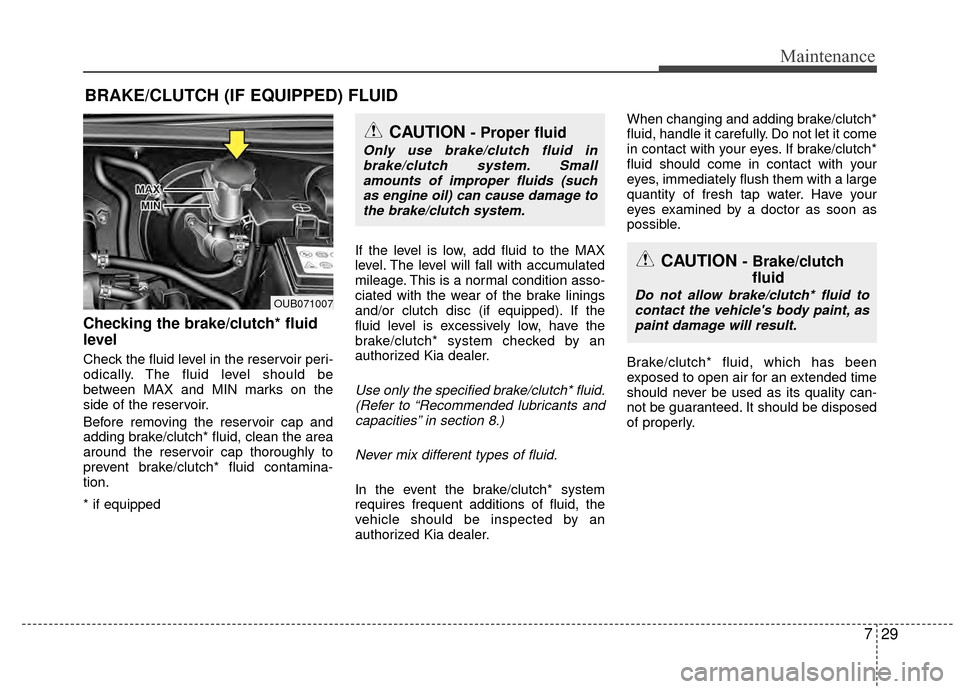
Checking the brake/clutch* fluid
level
Check the fluid level in the reservoir peri-
odically. The fluid level should be
between MAX and MIN marks on the
side of the reservoir.
Before removing the reservoir cap and
adding brake/clutch* fluid, clean the area
around the reservoir cap thoroughly to
prevent brake/clutch* fluid contamina-
tion.
* if equippedIf the level is low, add fluid to the MAX
level. The level will fall with accumulated
mileage. This is a normal condition asso-
ciated with the wear of the brake linings
and/or clutch disc (if equipped). If the
fluid level is excessively low, have the
brake/clutch* system checked by an
authorized Kia dealer.
Use only the specified brake/clutch* fluid.
(Refer to “Recommended lubricants and capacities” in section 8.)
Never mix different types of fluid.
In the event the brake/clutch* system
requires frequent additions of fluid, the
vehicle should be inspected by an
authorized Kia dealer. When changing and adding brake/clutch*
fluid, handle it carefully. Do not let it come
in contact with your eyes. If brake/clutch*
fluid should come in contact with your
eyes, immediately flush them with a large
quantity of fresh tap water. Have your
eyes examined by a doctor as soon as
possible.
Brake/clutch* fluid, which has been
exposed to open air for an extended time
should never be used as its quality can-
not be guaranteed. It should be disposed
of properly.
CAUTION - Brake/clutch
fluid
Do not allow brake/clutch* fluid to
contact the vehicle's body paint, aspaint damage will result.
CAUTION - Proper fluid
Only use brake/clutch fluid in brake/clutch system. Smallamounts of improper fluids (suchas engine oil) can cause damage tothe brake/clutch system.
OUB071007
Page 346 of 398
735
Maintenance
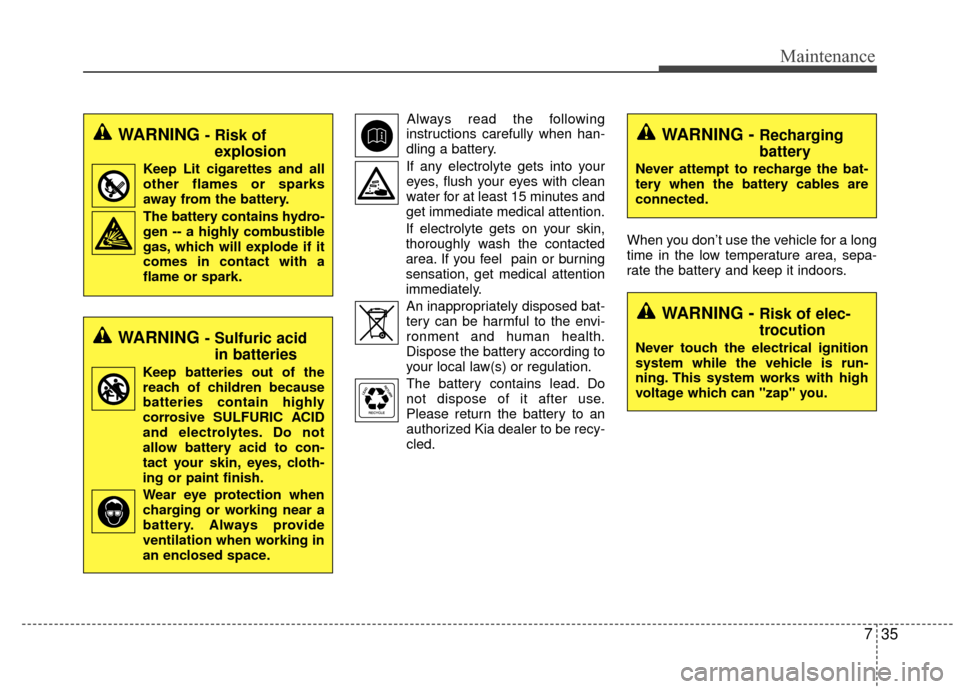
Always read the following
instructions carefully when han-
dling a battery.
If any electrolyte gets into your eyes, flush your eyes with clean
water for at least 15 minutes and
get immediate medical attention.
If electrolyte gets on your skin,
thoroughly wash the contacted
area. If you feel pain or burning
sensation, get medical attention
immediately. An inappropriately disposed bat-tery can be harmful to the envi-
ronment and human health.
Dispose the battery according to
your local law(s) or regulation.
The battery contains lead. Do
not dispose of it after use.
Please return the battery to an
authorized Kia dealer to be recy-
cled. When you don’t use the vehicle for a long
time in the low temperature area, sepa-
rate the battery and keep it indoors.
WARNING - Risk of
explosion
Keep Lit cigarettes and all
other flames or sparks
away from the battery.
The battery contains hydro-
gen -- a highly combustible
gas, which will explode if it
comes in contact with a
flame or spark.
WARNING - Sulfuric acidin batteries
Keep batteries out of the
reach of children because
batteries contain highly
corrosive SULFURIC ACID
and electrolytes. Do not
allow battery acid to con-
tact your skin, eyes, cloth-
ing or paint finish.
Wear eye protection when charging or working near a
battery. Always provide
ventilation when working in
an enclosed space.
WARNING - Recharging
battery
Never attempt to recharge the bat-
tery when the battery cables are
connected.
WARNING - Risk of elec-
trocution
Never touch the electrical ignition
system while the vehicle is run-
ning. This system works with high
voltage which can "zap" you.