ABS KIA RIO 2017 Owner's Manual
[x] Cancel search | Manufacturer: KIA, Model Year: 2017, Model line: RIO, Model: KIA RIO 2017Pages: 449, PDF Size: 14.88 MB
Page 420 of 449
Maintenance
84
7
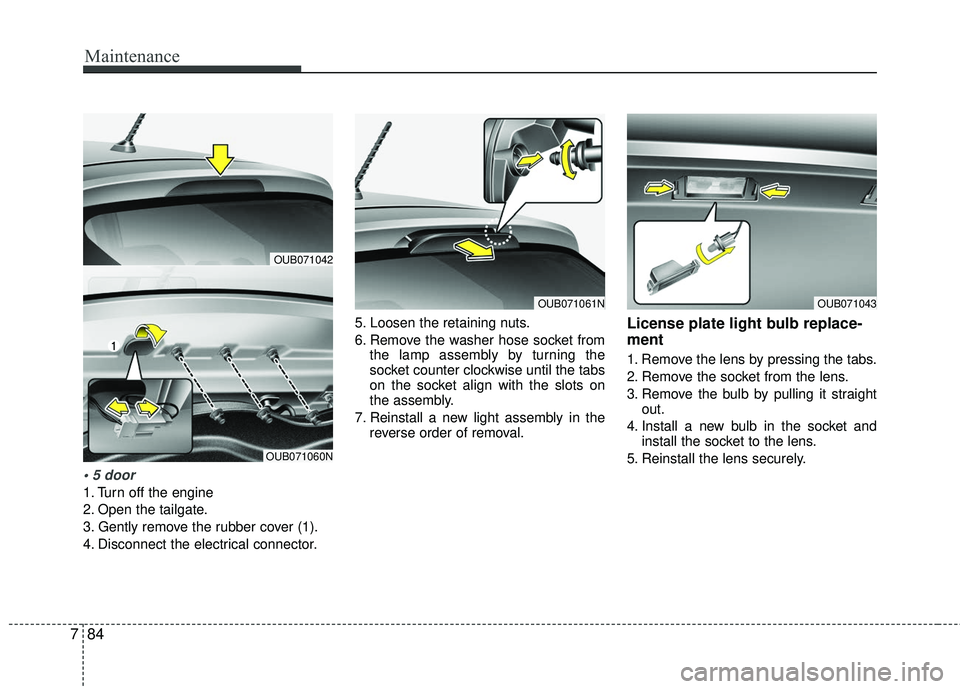
1. Turn off the engine
2. Open the tailgate.
3. Gently remove the rubber cover (1).
4. Disconnect the electrical connector. 5. Loosen the retaining nuts.
6. Remove the washer hose socket from
the lamp assembly by turning the
socket counter clockwise until the tabs
on the socket align with the slots on
the assembly.
7. Reinstall a new light assembly in the reverse order of removal.
License plate light bulb replace-
ment
1. Remove the lens by pressing the tabs.
2. Remove the socket from the lens.
3. Remove the bulb by pulling it straightout.
4. Install a new bulb in the socket and install the socket to the lens.
5. Reinstall the lens securely.
OUB071060N
OUB071042
OUB071043OUB071061N
Page 421 of 449
785
Maintenance
Interior light bulb replacement
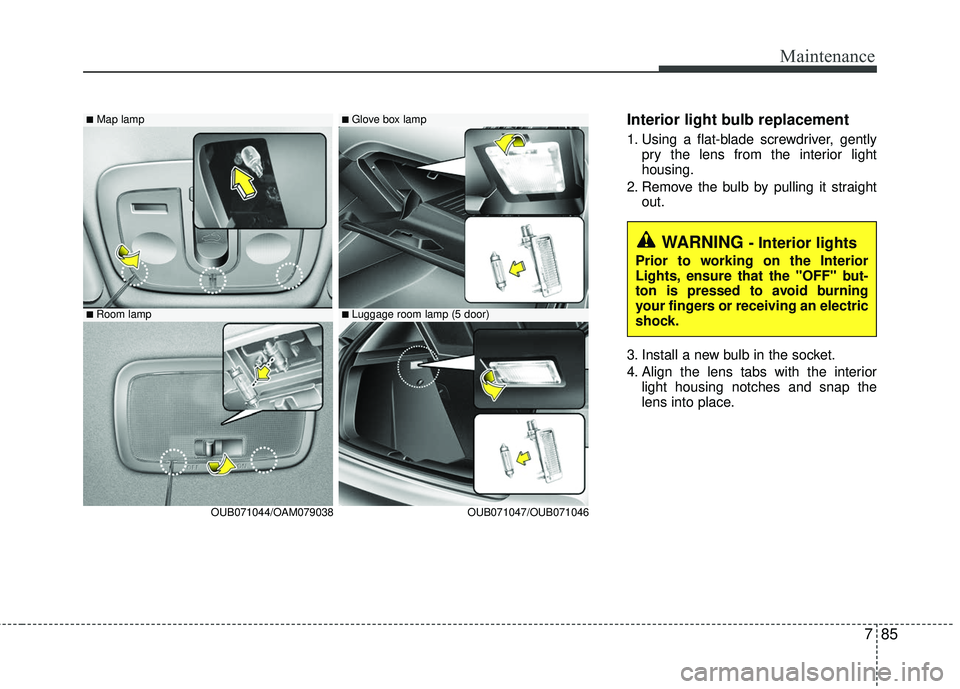
1. Using a flat-blade screwdriver, gentlypry the lens from the interior light
housing.
2. Remove the bulb by pulling it straight out.
3. Install a new bulb in the socket.
4. Align the lens tabs with the interior light housing notches and snap the
lens into place.
■Map lamp
■ Room lamp
OUB071044/OAM079038
■ Glove box lamp
■ Luggage room lamp (5 door) OUB071047/OUB071046
WARNING - Interior lights
Prior to working on the Interior
Lights, ensure that the "OFF" but-
ton is pressed to avoid burning
your fingers or receiving an electric
shock.
Page 429 of 449
793
Maintenance
Canister
Fuel vapors generated inside the fuel
tank are absorbed and stored in the
onboard canister. When the engine is
running, the fuel vapors absorbed in the
canister are drawn into the surge tank
through the purge control solenoid valve.
Purge Control Solenoid Valve (PCSV)
The purge control solenoid valve is con-
trolled by the Engine Control Module
(ECM); when the engine coolant temper-
ature is low during idling, the PCSV clos-
es so that evaporated fuel is not taken
into the engine. After the engine warms
up during ordinary driving, the PCSV
opens to introduce evaporated fuel to the
engine.
3. Exhaust emission control system
The Exhaust Emission Control System is
a highly effective system which controls
exhaust emissions while maintaining
good vehicle performance.
Vehicle modifications
This vehicle should not be modified.
Modification of your vehicle could affect
its performance, safety or durability and
may even violate governmental safety
and emissions regulations.
In addition, damage or performance
problems resulting from any modification
may not be covered under warranty.
If you use unauthorized electronic
devices, it may cause the vehicle to
operate abnormally, wire damage, bat-
tery discharge and fire. For your safety,
do not use unauthorized electronic
devices.
Engine exhaust gas precautions(carbon monoxide)
Carbon monoxide can be present with other exhaust fumes. Therefore, if you
smell exhaust fumes of any kind inside
your vehicle, have it inspected and
repaired immediately. If you ever sus-
pect exhaust fumes are coming into
your vehicle, drive it only with all the
windows fully open. Have your vehicle
checked and repaired immediately.
WARNING- Exhaust
Engine exhaust gases contain car-
bon monoxide (CO). Though color-
less and odorless, it is dangerous
and could be lethal if inhaled.
Follow the instructions on this
page to avoid CO poisoning.
Page 443 of 449
 ···Â")
I3
Index
Brake system··················\
··················\
··················\
············5-22Anti-Lock Brake System (ABS) ··················\
··············5-25
Electronic Stability Control (ESC)··················\
············5-27
Good braking practices··················\
··················\
············5-32
Hill-start Assist Control (HAC)··················\
·················5-30\
Parking brake ··················\
··················\
··················\
·········5-24
Power brakes··················\
··················\
··················\
··········5-22
Vehicle Stability Management (VSM) ··················\
······5-30
BRAKE/CLUTCH fluid ··················\
··················\
···········7-39 Checking the brake/clutch fluid level··················\
········7-39
Bulb wattage ··················\
··················\
··················\
··············8-3
Child restraint system ··················\
··················\
················3-25 Using a child restraint system ··················\
··················\
·3-26
Climate control air filter ··················\
··················\
············7-42 Filter inspection ··················\
··················\
··················\
·····7-42
Cruise Control system ··················\
··················\
···············5-34 To cancel cruise control:············\
··················\
················5-37
To decrease the cruising speed: ··················\
·················5-36\
To increase cruise control set speed: ··················\
·········5-35
To resume cruising speed at more than approximately40 km/h (25 mph):··················\
··················\
·················5-37\
To set cruise control speed: ··················\
··················\
·····5-34
To temporarily accelerate with the cruise control on: ··5-36
To turn cruise control off:··················\
··················\
········5-38 Defroster ··················\
··················\
··················\
··················\
4-83
Rear window defroster ··················\
··················\
············4-83
Dimensions ··················\
··················\
··················\
················8-2
Door locks··················\
··················\
··················\
················4-16 Auto door Lock/Unlock feature ··················\
················4-18
Child-protector rear door lock ··················\
··················\
·4-19
Impact sensing door unlock system ··················\
··········4-18
Operating door locks from inside the vehicle ·············4-17
Operating door locks from outside the vehicle ··········4-16
Economical operation ··················\
··················\
················5-44
Emergency starting ··················\
··················\
··················\
····6-5 Jump starting ··················\
··················\
··················\
···········6-5
Push-starting ··················\
··················\
··················\
··········6-7
Emission control system ··················\
··················\
············7-92 1. Crankcase emission control system ··················\
······7-92
2. Evaporative emission control (including ORVR:Onboard Refueling Vapor Recovery) system ············7-92
3. Exhaust emission control system ··················\
··········7-93
Engine ··················\
··················\
··················\
··················\
······8-2
Engine compartment ··················\
··················\
············2-6, 7-2
Engine coolant ··················\
··················\
··················\
·········7-36 Changing the coolant ··················\
··················\
···············7-38
Checking the coolant level ··················\
··················\
·····7-36D
CE