engine oil KIA RIO 2019 Owner's Manual
[x] Cancel search | Manufacturer: KIA, Model Year: 2019, Model line: RIO, Model: KIA RIO 2019Pages: 503, PDF Size: 10.4 MB
Page 394 of 503
Maintenance
22
8
Changing the engine oil and
filter
Have engine oil and filter changed by
an authorized Kia dealer according
to the Maintenance Schedule at the
beginning of this chapter.
WARNING - Used engine
oil
Used engine oil may cause irrita-
tion or cancer of the skin if left in
contact with the skin for pro-
longed periods of time. Always
protect your skin by washing
your hands thoroughly with
soap and warm water as soon as
possible after handling used oil.
SC CAN (ENG) 8.qxp 7/18/2018 5:32 PM Page 22
Page 398 of 503
Maintenance
26
8
BRAKE/CLUTCH FLUID (IF EQUIPPED)
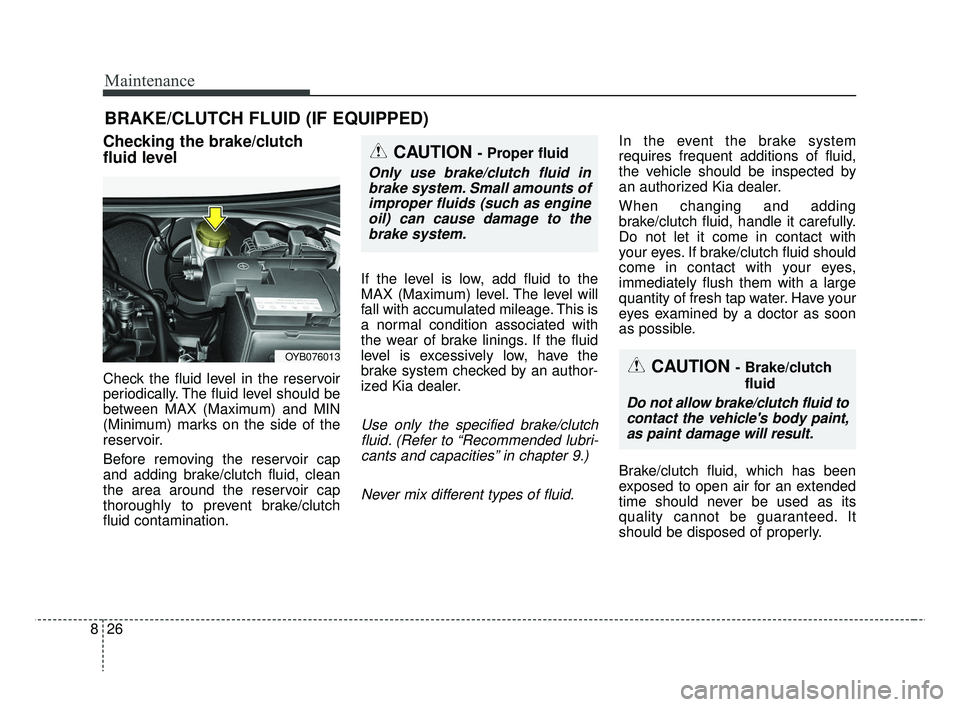
Checking the brake/clutch
fluid level
Check the fluid level in the reservoir
periodically. The fluid level should be
between MAX (Maximum) and MIN
(Minimum) marks on the side of the
reservoir.
Before removing the reservoir cap
and adding brake/clutch fluid, clean
the area around the reservoir cap
thoroughly to prevent brake/clutch
fluid contamination. If the level is low, add fluid to the
MAX (Maximum) level. The level will
fall with accumulated mileage. This is
a normal condition associated with
the wear of brake linings. If the fluid
level is excessively low, have the
brake system checked by an author-
ized Kia dealer.
Use only the specified brake/clutch
fluid. (Refer to “Recommended lubri-cants and capacities” in chapter 9.)
Never mix different types of fluid.
In the event the brake system
requires frequent additions of fluid,
the vehicle should be inspected by
an authorized Kia dealer.
When changing and adding
brake/clutch fluid, handle it carefully.
Do not let it come in contact with
your eyes. If brake/clutch fluid should
come in contact with your eyes,
immediately flush them with a large
quantity of fresh tap water. Have your
eyes examined by a doctor as soon
as possible.
Brake/clutch fluid, which has been
exposed to open air for an extended
time should never be used as its
quality cannot be guaranteed. It
should be disposed of properly.
OYB076013CAUTION - Brake/clutch fluid
Do not allow brake/clutch fluid tocontact the vehicle's body paint,as paint damage will result.
CAUTION - Proper fluid
Only use brake/clutch fluid inbrake system. Small amounts ofimproper fluids (such as engineoil) can cause damage to thebrake system.
SC CAN (ENG) 8.qxp 7/18/2018 5:33 PM Page 26
Page 411 of 503
839
Maintenance
When recharging the battery,
observe the following precautions:
The battery must be removed fromthe vehicle and placed in an area
with good ventilation.
Do not allow cigarettes, sparks, or flame near the battery.
Watch the battery during charging, and stop or reduce the charging
rate if the battery cells begin
gassing (boiling) violently or if the
temperature of the electrolyte of
any cell exceeds 49°C (120°F).
Wear eye protection when check- ing the battery during charging.
Disconnect the battery charger in the following order.
1. Turn off the battery charger main switch.
2. Unhook the negative clamp from the negative battery terminal.
3. Unhook the positive clamp from the positive battery terminal. Before performing maintenance or
recharging the battery, turn off all
accessories and stop the engine.
The negative battery cable must be removed first and installed last
when the battery is disconnected.Reset items
The following items should be reset
after the battery has been dis-
charged or the battery has been dis-
connected.
Auto up/down window
Sunroof
Trip computer
Climate control system
SC CAN (ENG) 8.qxp 7/18/2018 5:33 PM Page 39
Page 427 of 503
855
Maintenance
FUSES
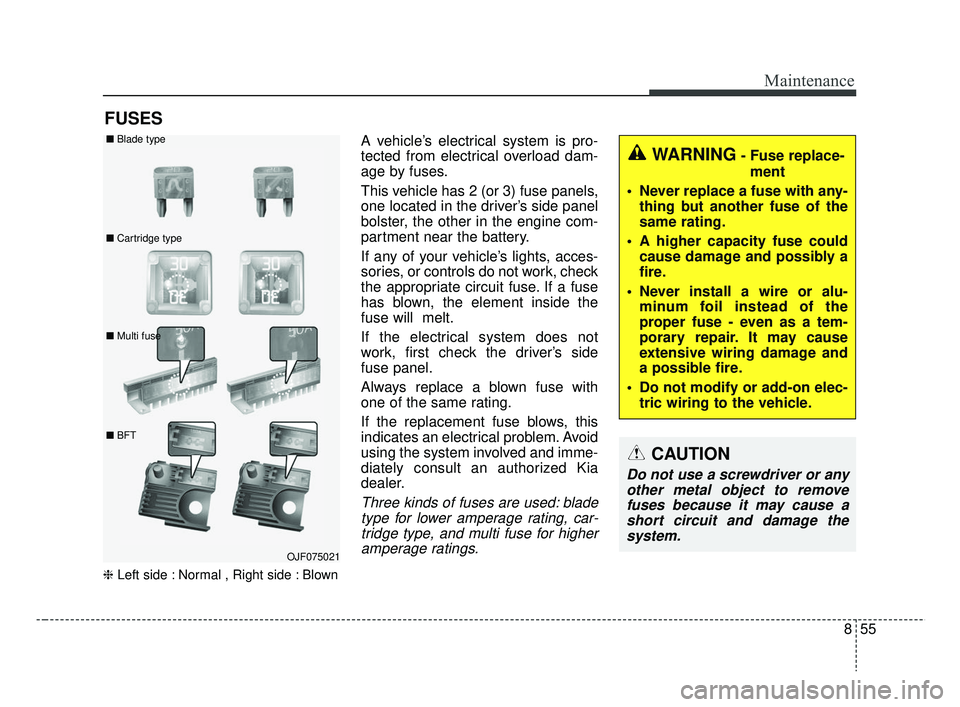
❈Left side : Normal , Right side : Blown
A vehicle’s electrical system is pro-
tected from electrical overload dam-
age by fuses.
This vehicle has 2 (or 3) fuse panels,
one located in the driver’s side panel
bolster, the other in the engine com-
partment near the battery.
If any of your vehicle’s lights, acces-
sories, or controls do not work, check
the appropriate circuit fuse. If a fuse
has blown, the element inside the
fuse will melt.
If the electrical system does not
work, first check the driver’s side
fuse panel.
Always replace a blown fuse with
one of the same rating.
If the replacement fuse blows, this
indicates an electrical problem. Avoid
using the system involved and imme-
diately consult an authorized Kia
dealer.
Three kinds of fuses are used: blade
type for lower amperage rating, car-tridge type, and multi fuse for higheramperage ratings.
OJF075021
■
Blade type
■ Cartridge type
■ Multi fuse
■ BFT
WARNING- Fuse replace-
ment
Never replace a fuse with any- thing but another fuse of the
same rating.
A higher capacity fuse could cause damage and possibly a
fire.
Never install a wire or alu- minum foil instead of the
proper fuse - even as a tem-
porary repair. It may cause
extensive wiring damage and
a possible fire.
Do not modify or add-on elec- tric wiring to the vehicle.
CAUTION
Do not use a screwdriver or anyother metal object to removefuses because it may cause ashort circuit and damage thesystem.
SC CAN (ENG) 8.qxp 7/18/2018 5:34 PM Page 55
Page 439 of 503
867
Maintenance
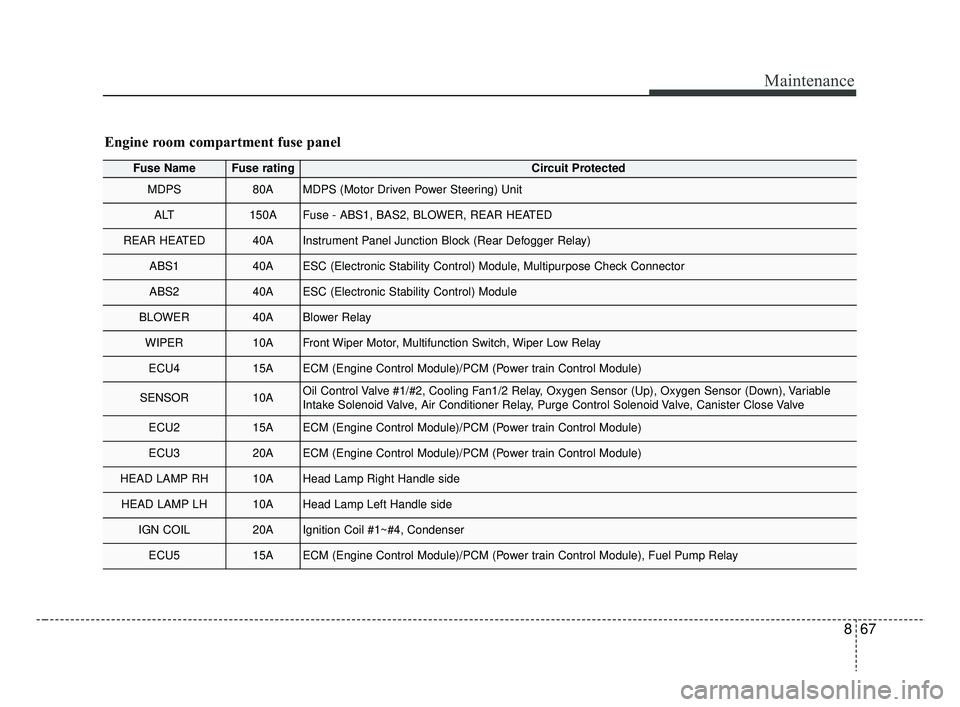
Engine room compartment fuse panel
Fuse NameFuse ratingCircuit Protected
MDPS80AMDPS (Motor Driven Power Steering) Unit
ALT150AFuse - ABS1, BAS2, BLOWER, REAR HEATED
REAR HEATED40AInstrument Panel Junction Block (Rear Defogger Relay)
ABS140AESC (Electronic Stability Control) Module, Multipurpose Check Connector
ABS240AESC (Electronic Stability Control) Module
BLOWER40ABlower Relay
WIPER10AFront Wiper Motor, Multifunction Switch, Wiper Low Relay
ECU415AECM (Engine Control Module)/PCM (Power train Control Module)
SENSOR10AOil Control Valve #1/#2, Cooling Fan1/2 Relay, Oxygen Sensor (Up), Oxygen Sensor (Down), Variable
Intake Solenoid Valve, Air Conditioner Relay, Purge Control Solenoid Valve, Canister Close Valve
ECU215AECM (Engine Control Module)/PCM (Power train Control Module)
ECU320AECM (Engine Control Module)/PCM (Power train Control Module)
HEAD LAMP RH10AHead Lamp Right Handle side
HEAD LAMP LH10AHead Lamp Left Handle side
IGN COIL20AIgnition Coil #1~#4, Condenser
ECU515AECM (Engine Control Module)/PCM (Power train Control Module), Fuel Pump Relay
SC CAN (ENG) 8.qxp 7/18/2018 5:34 PM Page 67
Page 472 of 503
Maintenance
100
8
OJB037800
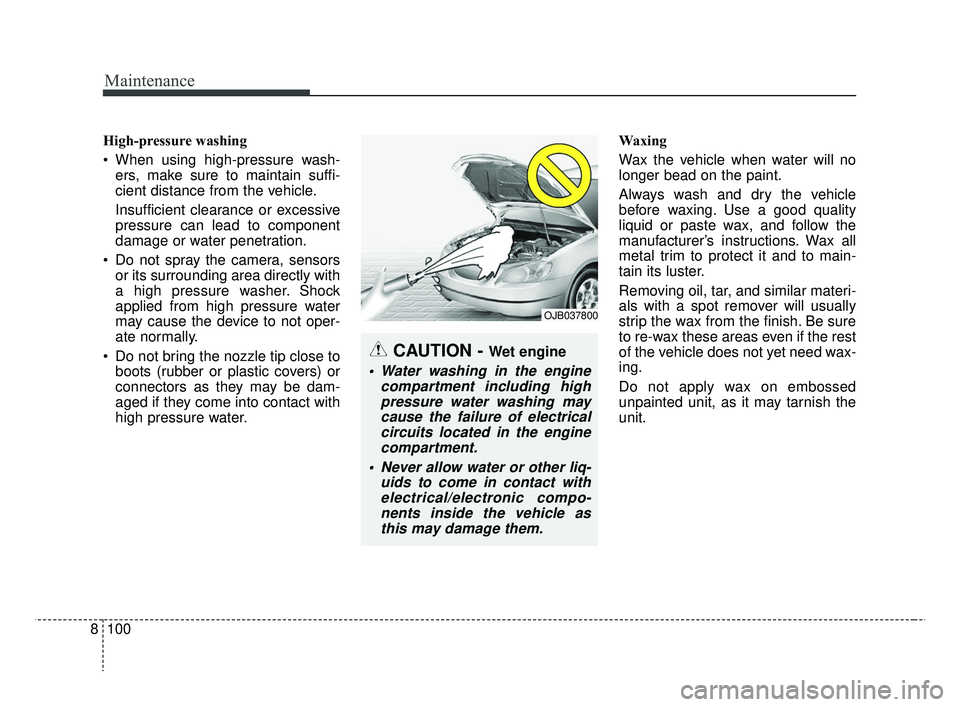
CAUTION - Wet engine
Water washing in the engine
compartment including highpressure water washing maycause the failure of electricalcircuits located in the enginecompartment.
Never allow water or other liq- uids to come in contact withelectrical/electronic compo-nents inside the vehicle asthis may damage them.
High-pressure washing
When using high-pressure wash- ers, make sure to maintain suffi-
cient distance from the vehicle.
Insufficient clearance or excessive
pressure can lead to component
damage or water penetration.
Do not spray the camera, sensors or its surrounding area directly with
a high pressure washer. Shock
applied from high pressure water
may cause the device to not oper-
ate normally.
Do not bring the nozzle tip close to boots (rubber or plastic covers) or
connectors as they may be dam-
aged if they come into contact with
high pressure water. Waxing
Wax the vehicle when water will no
longer bead on the paint.
Always wash and dry the vehicle
before waxing. Use a good quality
liquid or paste wax, and follow the
manufacturer’s instructions. Wax all
metal trim to protect it and to main-
tain its luster.
Removing oil, tar, and similar materi-
als with a spot remover will usually
strip the wax from the finish. Be sure
to re-wax these areas even if the rest
of the vehicle does not yet need wax-
ing.
Do not apply wax on embossed
unpainted unit, as it may tarnish the
unit.
SC CAN (ENG) 8.qxp 7/18/2018 5:37 PM Page 100
Page 489 of 503
97
Specifications & Consumer information
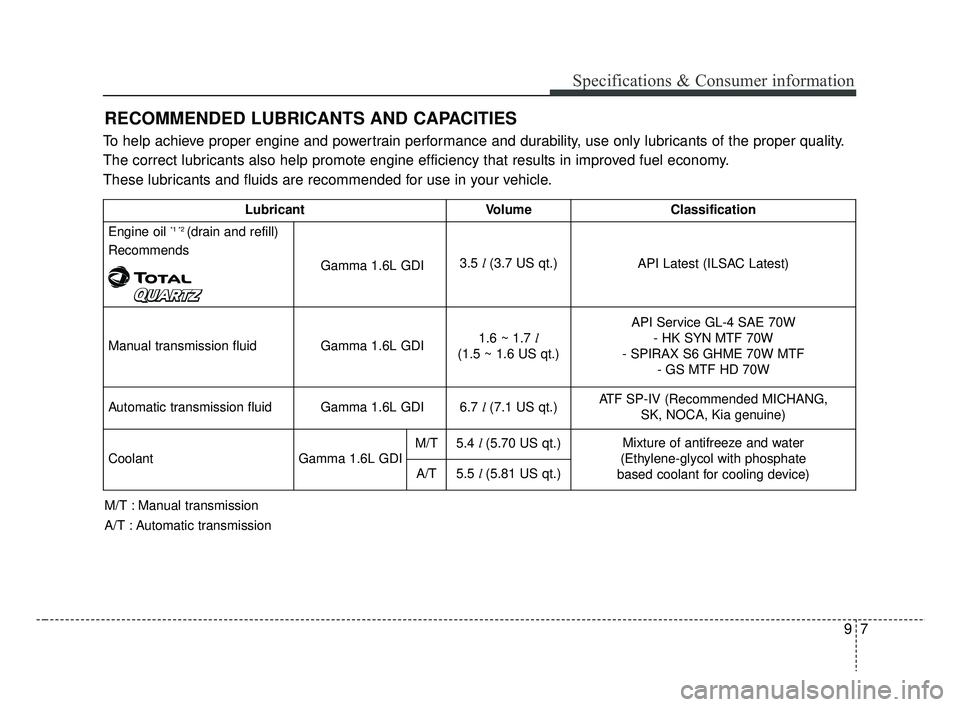
RECOMMENDED LUBRICANTS AND CAPACITIES
To help achieve proper engine and powertrain performance and durability, use only lubricants of the proper quality.
The correct lubricants also help promote engine efficiency that results in improved fuel economy.
These lubricants and fluids are recommended for use in your vehicle.
LubricantVolumeClassification
Engine oil *1 *2 (drain and refill)
Recommends
Gamma 1.6L GDI3.5 l(3.7 US qt.)API Latest (ILSAC Latest)
Manual transmission fluidGamma 1.6L GDI1.6 ~ 1.7 l
(1.5 ~ 1.6 US qt.)
API Service GL-4 SAE 70W - HK SYN MTF 70W
- SPIRAX S6 GHME 70W MTF - GS MTF HD 70W
Automatic transmission fluidGamma 1.6L GDI6.7 l(7.1 US qt.)ATF SP-IV (Recommended MICHANG,
SK, NOCA, Kia genuine)
Coolant Gamma 1.6L GDI
M/T5.4 l (5.70 US qt.)Mixture of antifreeze and water
(Ethylene-glycol with phosphate
based coolant for cooling device)
A/T5.5 l (5.81 US qt.)
M/T : Manual transmission
A/T : Automatic transmission
SC CAN (ENG) 9.qxp 8/3/2018 5:47 PM Page 7
Page 490 of 503
Specifications & Consumer information
89
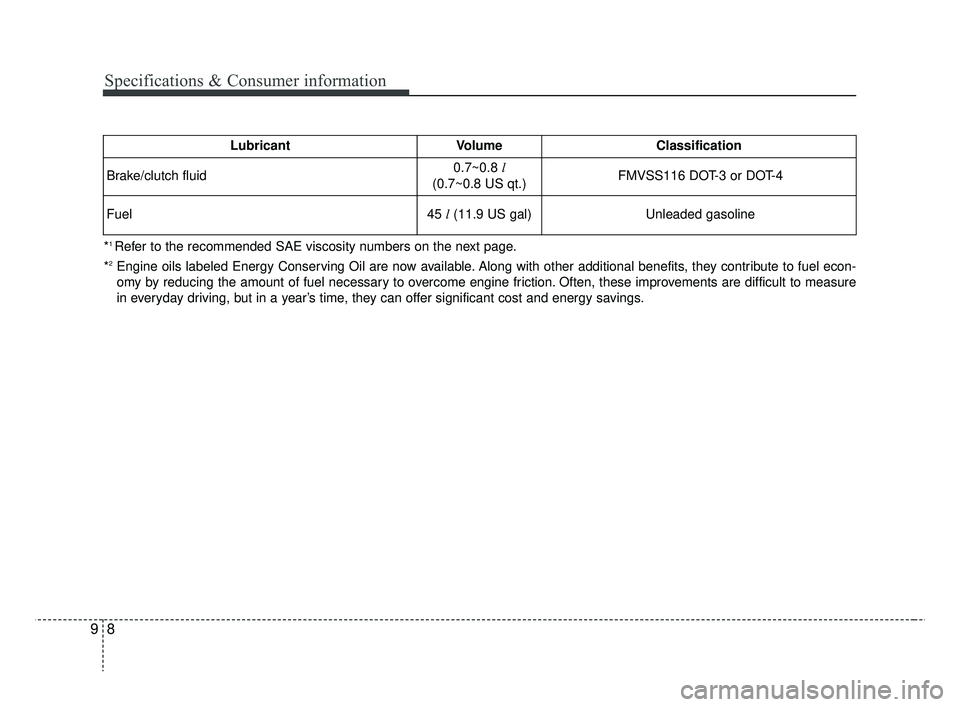
*1 Refer to the recommended SAE viscosity numbers on the next page.
*
2Engine oils labeled Energy Conserving Oil are now available. Along with other additional benefits, they contribute to fuel econ-
omy by reducing the amount of fuel necessary to overcome engine friction. Often, these improvements are difficult to measure
in everyday driving, but in a year’s time, they can offer significant cost and energy savings.
LubricantVolumeClassification
Brake/clutch fluid0.7~0.8 l
(0.7~0.8 US qt.)FMVSS116 DOT-3 or DOT-4
Fuel45 l(11.9 US gal)Unleaded gasoline
SC CAN (ENG) 9.qxp 8/3/2018 5:47 PM Page 8
Page 491 of 503
99
Specifications & Consumer information
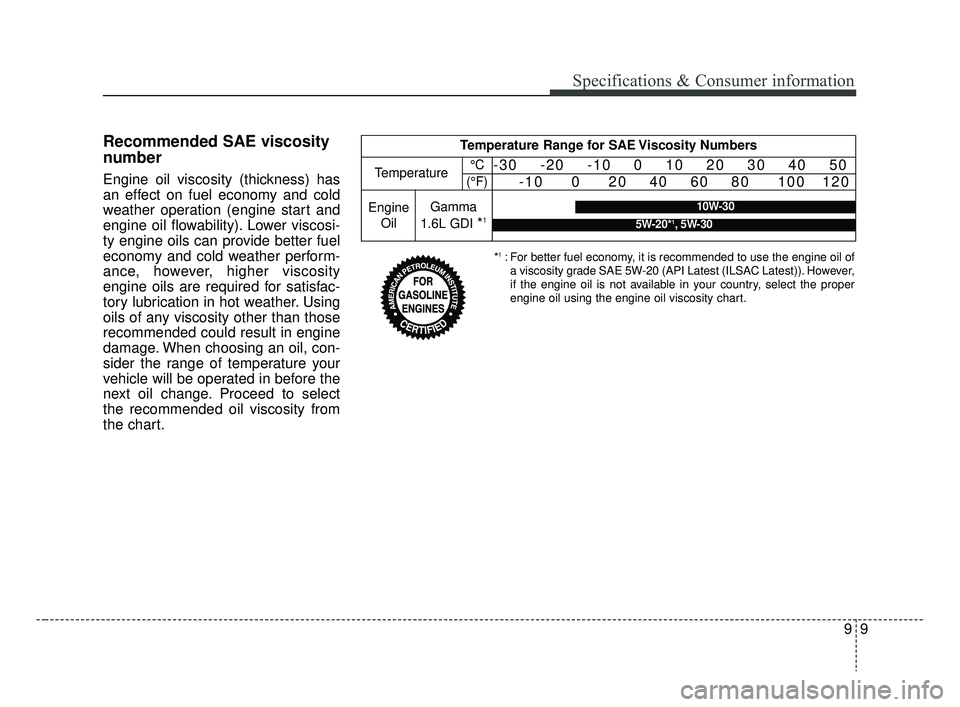
Recommended SAE viscosity
number
Engine oil viscosity (thickness) has
an effect on fuel economy and cold
weather operation (engine start and
engine oil flowability). Lower viscosi-
ty engine oils can provide better fuel
economy and cold weather perform-
ance, however, higher viscosity
engine oils are required for satisfac-
tory lubrication in hot weather. Using
oils of any viscosity other than those
recommended could result in engine
damage. When choosing an oil, con-
sider the range of temperature your
vehicle will be operated in before the
next oil change. Proceed to select
the recommended oil viscosity from
the chart.
*1: For better fuel economy, it is recommended to use the engine oil ofa viscosity grade SAE 5W-20 (API Latest (ILSAC Latest)). However,
if the engine oil is not available in your country, select the proper
engine oil using the engine oil viscosity chart.
Temperature Range for SAE Viscosity Numbers
Temperature°C
(°F)-30 -20 -10 0 10 20 30 40 50 -10 0 20 40 60 80 100 120
Gamma
1.6L GDI
*110W-30
5W-20*1, 5W-30
Engine Oil
SC CAN (ENG) 9.qxp 8/3/2018 5:47 PM Page 9
Page 497 of 503

Index
4I
Engine oil ......................................................................8-\
21Changing the engine oil and filter ..............................8-22
Checking the engine oil level ....................................8-21
Engine start/stop button ..................................................6-8 Engine start/stop button position ..................................6-8
Illuminated engine start/stop button ............................6-8
Explanation of scheduled maintenance items ..............8-16
Exterior overview ............................................................2-2
Forward Collision-avoidance Assist (FCA) system (Radar type) ................................................................6-39Brake operation ..........................................................6-42
FCA warning message and system control ................6-41
Limitation of the system ............................................6-45
Sensor to detect the distance from the vehicle in front (front radar) ..............................................................6-43
System malfunction ....................................................6-44
Fuel filler lid ..................................................................4-42 Closing the fuel filler lid ............................................4-42
Opening the fuel filler lid ..........................................4-42
Fuel requirements ............................................................1-3 Do not use methanol ....................................................1-5
Fuel Additives ..............................................................1-5
Gasoline containing alcohol and methanol ..................1-3 Fuses ........................................................................\
......8-55
Engine compartment fuse replacement ......................8-59
Fuse/relay panel description ......................................8-61
Inner panel fuse replacement ......................................8-57
Memory fuse ..............................................................8-58
Hood ........................................................................\
......4-39 Closing the hood ........................................................4-40
Hood open warning ....................................................4-40
Opening the hood ........................................................4-39
How to use this manual ..................................................1-2
If the engine overheats ....................................................7-6
If the engine will not start ..............................................7-4 If engine turns over normally but does not start ..........7-4
If the engine doesn't turn over or turns over slowly ....7-4
If you have a flat tire (with spare tire) ..........................7-26 Changing tires ............................................................7-28
Jack and tools ..............................................................7-26
Jack label ....................................................................7-35\
Removing and storing the spare tire ..........................7-27
If you have a flat tire (with Tire Mobility Kit)..............7-18 Checking the tire inflation pressure ............................7-24
Components of the Tire Mobility Kit ........................7-20
F
H
I
SC CAN (ENG) Index.qxp 7/18/2018 5:31 PM Page 4