parking brake KIA RIO 2019 Owner's Guide
[x] Cancel search | Manufacturer: KIA, Model Year: 2019, Model line: RIO, Model: KIA RIO 2019Pages: 503, PDF Size: 10.4 MB
Page 362 of 503
729
What to do in an emergency
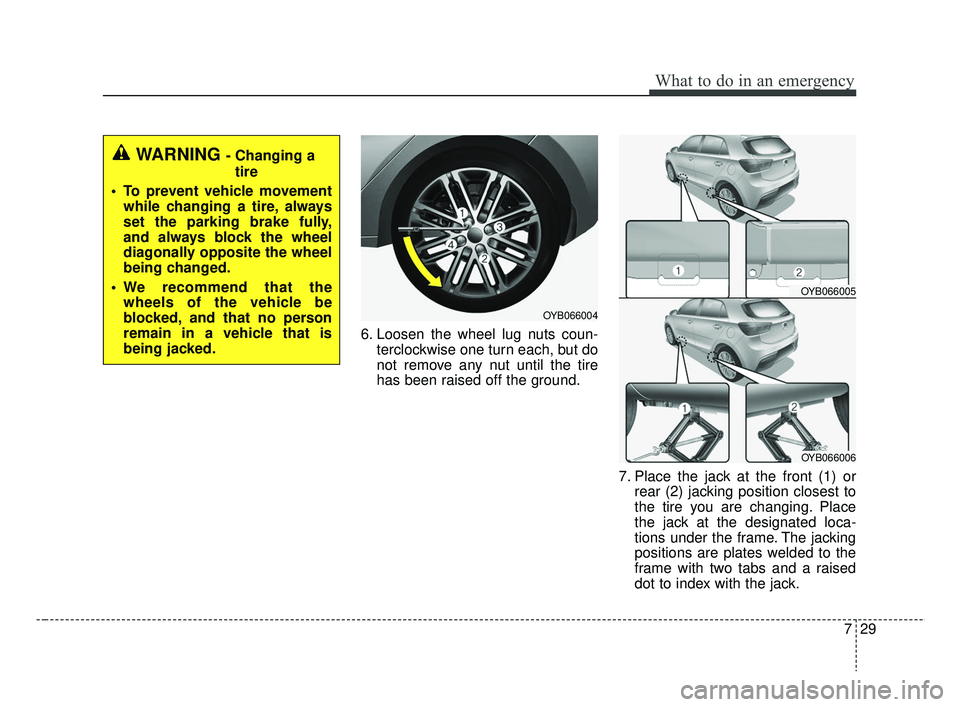
6. Loosen the wheel lug nuts coun-terclockwise one turn each, but do
not remove any nut until the tire
has been raised off the ground.
7. Place the jack at the front (1) orrear (2) jacking position closest to
the tire you are changing. Place
the jack at the designated loca-
tions under the frame. The jacking
positions are plates welded to the
frame with two tabs and a raised
dot to index with the jack.
OYB066004
OYB066005
OYB066006
WARNING - Changing a
tire
To prevent vehicle movement while changing a tire, always
set the parking brake fully,
and always block the wheel
diagonally opposite the wheel
being changed.
We recommend that the wheels of the vehicle be
blocked, and that no person
remain in a vehicle that is
being jacked.
SC CAN (ENG) 7.qxp 7/18/2018 5:39 PM Page 29
Page 368 of 503

735
What to do in an emergency
Jack label1. Model Name
2. Maximum allowable load
3. When using the jack, set yourparking brake.
4. When using the jack, stop the engine.
5. Do not get under a vehicle that is supported by a jack.
6. The designated locations under the frame
7. When supporting the vehicle, the base plate of jack must be vertical
under the lifting point.
8. Shift into Reverse gear on vehicles with Manual Transmission or move
the shift lever to the P position on
vehicles with Automatic
Transmission.
9. The jack should be used on firm level ground.
10. Jack manufacturer
11. Production date
12. Representative company and address
OHYK064001
OHYK064005
OHYK064002
■Example
❈The actual Jack label in the vehicle may differ from the illustration.
For more detailed specifications, refer to the label attached to the jack.
SC CAN (ENG) 7.qxp 7/18/2018 5:40 PM Page 35
Page 370 of 503
737
What to do in an emergency
When towing your vehicle in an
emergency without wheel dollies :
1. Set the ignition switch in the ACCposition.
2. Place the transmission shift lever in N (Neutral).
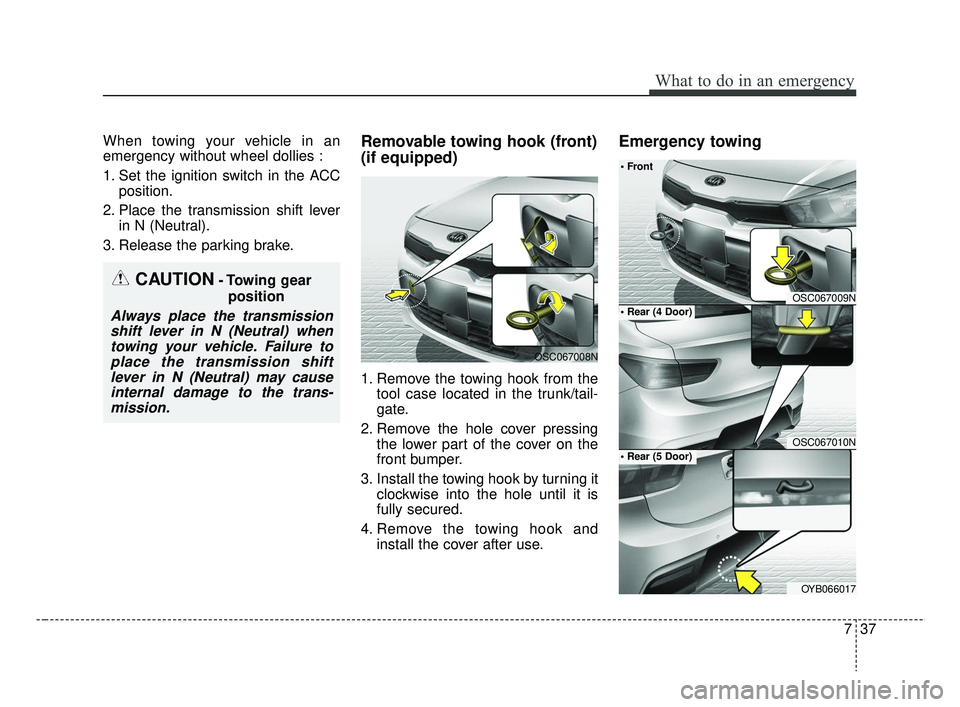
3. Release the parking brake.Removable towing hook (front)
(if equipped)
1. Remove the towing hook from the tool case located in the trunk/tail-
gate.
2. Remove the hole cover pressing the lower part of the cover on the
front bumper.
3. Install the towing hook by turning it clockwise into the hole until it is
fully secured.
4. Remove the towing hook and install the cover after use.
Emergency towing
OSC067008N
OSC067009N
OSC067010N
OYB066017
CAUTION- Towing gear
position
Always place the transmissionshift lever in N (Neutral) whentowing your vehicle. Failure toplace the transmission shiftlever in N (Neutral) may causeinternal damage to the trans-mission.
SC CAN (ENG) 7.qxp 7/18/2018 5:40 PM Page 37
Page 372 of 503
739
What to do in an emergency
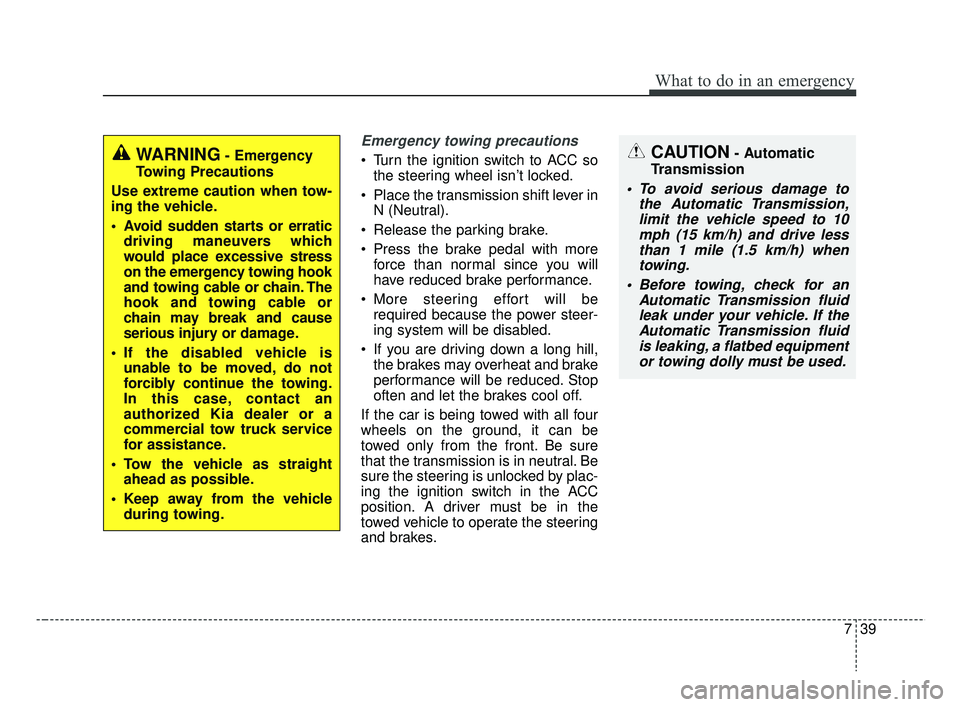
Emergency towing precautions
Turn the ignition switch to ACC sothe steering wheel isn’t locked.
Place the transmission shift lever in N (Neutral).
Release the parking brake.
Press the brake pedal with more force than normal since you will
have reduced brake performance.
More steering effort will be required because the power steer-
ing system will be disabled.
If you are driving down a long hill, the brakes may overheat and brake
performance will be reduced. Stop
often and let the brakes cool off.
If the car is being towed with all four
wheels on the ground, it can be
towed only from the front. Be sure
that the transmission is in neutral. Be
sure the steering is unlocked by plac-
ing the ignition switch in the ACC
position. A driver must be in the
towed vehicle to operate the steering
and brakes.WARNING- Emergency
Towing Precautions
Use extreme caution when tow-
ing the vehicle.
Avoid sudden starts or erratic driving maneuvers which
would place excessive stress
on the emergency towing hook
and towing cable or chain. The
hook and towing cable or
chain may break and cause
serious injury or damage.
If the disabled vehicle is unable to be moved, do not
forcibly continue the towing.
In this case, contact an
authorized Kia dealer or a
commercial tow truck service
for assistance.
Tow the vehicle as straight ahead as possible.
Keep away from the vehicle during towing.CAUTION- Automatic
Transmission
To avoid serious damage to the Automatic Transmission,limit the vehicle speed to 10mph (15 km/h) and drive lessthan 1 mile (1.5 km/h) whentowing.
Before towing, check for an Automatic Transmission fluidleak under your vehicle. If theAutomatic Transmission fluidis leaking, a flatbed equipmentor towing dolly must be used.
SC CAN (ENG) 7.qxp 7/18/2018 5:40 PM Page 39
Page 373 of 503
Maintenance
Engine compartment . . . . . . . . . . . . . . . . . . . . . . . . 8-4
Maintenance services . . . . . . . . . . . . . . . . . . . . . . . . 8-5
• Owner’s responsibility . . . . . . . . . . . . . . . . . . . . . . . . . 8-5
• Owner maintenance precautions . . . . . . . . . . . . . . . . . 8-6
Owner maintenance . . . . . . . . . . . . . . . . . . . . . . . . . 8-7
• Owner maintenance schedule. . . . . . . . . . . . . . . . . . . . 8-7
Scheduled maintenance service. . . . . . . . . . . . . . . 8-10
• Scheduled maintenance service precaution . . . . . . . 8-10
Explanation of scheduled maintenance items . . . 8-16
Checking fluid levels . . . . . . . . . . . . . . . . . . . . . . . 8-20
Engine oil. . . . . . . . . . . . . . . . . . . . . . . . . . . . . . . . . 8-21
• Checking the engine oil level . . . . . . . . . . . . . . . . . . . 8-21
• Changing the engine oil and filter . . . . . . . . . . . . . . . 8-22
Engine coolant . . . . . . . . . . . . . . . . . . . . . . . . . . . . 8-23
• Checking the coolant level . . . . . . . . . . . . . . . . . . . . . 8-23
• Changing the coolant . . . . . . . . . . . . . . . . . . . . . . . . . 8-25
Brake/clutch fluid . . . . . . . . . . . . . . . . . . . . . . . . . . 8-26
• Checking the brake/clutch fluid level . . . . . . . . . . . . 8-26
Washer fluid . . . . . . . . . . . . . . . . . . . . . . . . . . . . . . 8-27
• Checking the washer fluid level . . . . . . . . . . . . . . . . . 8-27
Parking brake . . . . . . . . . . . . . . . . . . . . . . . . . . . . . 8-28
• Checking the parking brake. . . . . . . . . . . . . . . . . . . . 8-28
Air cleaner. . . . . . . . . . . . . . . . . . . . . . . . . . . . . . . . 8-29
• Filter replacement . . . . . . . . . . . . . . . . . . . . . . . . . . . . 8-29
Climate control air filter . . . . . . . . . . . . . . . . . . . . 8-31
• Filter inspection . . . . . . . . . . . . . . . . . . . . . . . . . . . . . . 8-31
Wiper blades . . . . . . . . . . . . . . . . . . . . . . . . . . . . . . 8-33
• Blade inspection . . . . . . . . . . . . . . . . . . . . . . . . . . . . . . 8-33
• Blade replacement . . . . . . . . . . . . . . . . . . . . . . . . . . . . 8-33
Battery . . . . . . . . . . . . . . . . . . . . . . . . . . . . . . . . . . . 8-\
37
• For best battery service . . . . . . . . . . . . . . . . . . . . . . . 8-37
• Recharging the battery . . . . . . . . . . . . . . . . . . . . . . . . 8-38
• Reset items . . . . . . . . . . . . . . . . . . . . . . . . . . . . . . . . . . 8-39\
Tires and wheels . . . . . . . . . . . . . . . . . . . . . . . . . . . 8-40
• Tire care . . . . . . . . . . . . . . . . . . . . . . . . . . . . . . . . . . . . \
8-40
• Recommended cold tire inflation pressures . . . . . . . 8-40
• Tire pressure . . . . . . . . . . . . . . . . . . . . . . . . . . . . . . . . 8-41
• Checking tire inflation pressure. . . . . . . . . . . . . . . . . 8-41
• Tire rotation . . . . . . . . . . . . . . . . . . . . . . . . . . . . . . . . . 8-42
• Wheel alignment and tire balance . . . . . . . . . . . . . . . 8-43
• Tire replacement . . . . . . . . . . . . . . . . . . . . . . . . . . . . . 8-44
• Wheel replacement . . . . . . . . . . . . . . . . . . . . . . . . . . . 8-45
• Tire traction . . . . . . . . . . . . . . . . . . . . . . . . . . . . . . . . . 8-45
• Tire maintenance . . . . . . . . . . . . . . . . . . . . . . . . . . . . . 8-45
• Tire sidewall labeling . . . . . . . . . . . . . . . . . . . . . . . . . 8-45
• All season tires . . . . . . . . . . . . . . . . . . . . . . . . . . . . . . . 8-52
• Summer tires . . . . . . . . . . . . . . . . . . . . . . . . . . . . . . . . 8-52
• Snow tires . . . . . . . . . . . . . . . . . . . . . . . . . . . . . . . . . . . 8-\
53
8
SC CAN (ENG) 8.qxp 7/18/2018 5:32 PM Page 1
Page 380 of 503
Maintenance
88
If any slipping or changes in theoperation of your transmission
occurs, check the transmission
fluid level.
Check manual transmission opera- tion, including clutch operation.
Check the automatic transmission P (Park) function.
Check the parking brake.
Check for fluid leaks under your vehicle (water dripping from the air
conditioning system during or after
use is normal).At least monthly:
Check the coolant level in theengine coolant reservoir.
Check the operation of all exterior lights, including the stoplights, turn
signals and hazard warning flash-
ers.
Check the inflation pressures of all tires including the spare for tires
that are worn, show uneven wear,
or are damaged.
Check for loose wheel lug nuts.
At least twice a year (i.e., every Spring and Fall) :
Check the radiator, heater and air conditioning hoses for leaks or
damage.
Check the windshield washer spray and wiper operation. Clean
the wiper blades with clean cloth
dampened with washer fluid.
Check the headlight alignment.
Check the muffler, exhaust pipes, shields and clamps.
Check the lap/shoulder belts for wear and function.
SC CAN (ENG) 8.qxp 7/18/2018 5:32 PM Page 8
Page 385 of 503
813
Maintenance
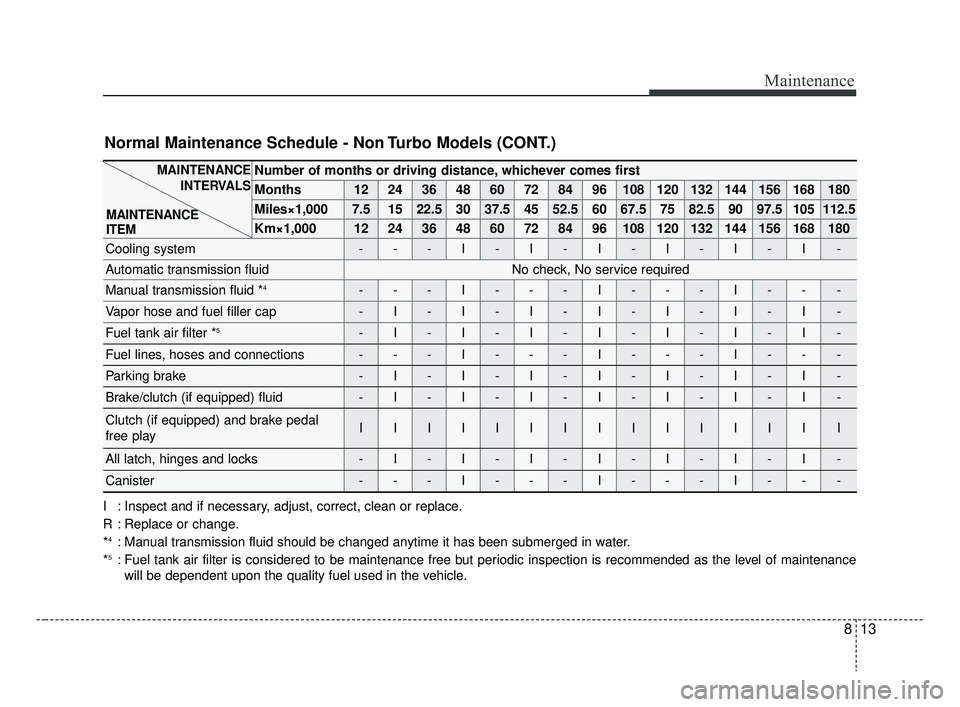
Number of months or driving distance, whichever comes first
Months1224364860728496108120132144156168180
Miles×1,0007.51522.530 37.5 45 52.5 60 67.5 75 82.5 90 97.5 105 112.5
Km×1,00012 24 36 48 60 72 84 96 108 120 132 144 156 168 180
Cooling system---I-I-I-I-I-I-
Automatic transmission fluidNo check, No service required
Manual transmission fluid *4---I---I---I---
Vapor hose and fuel filler cap-I-I-I-I-I-I-I-
Fuel tank air filter *5-I-I-I-I-I-I-I-
Fuel lines, hoses and connections---I---I---I---
Parking brake-I-I-I-I-I-I-I-
Brake/clutch (if equipped) fluid-I-I-I-I-I-I-I-
Clutch (if equipped) and brake pedal
free playIIIIIIIIIIIIIII
All latch, hinges and locks-I-I-I-I-I-I-I-
Canister---I---I---I---
Normal Maintenance Schedule - Non Turbo Models (CONT.)
I : Inspect and if necessary, adjust, correct, clean or replace.
R : Replace or change.
*
4: Manual transmission fluid should be changed anytime it has been submerged in water.
*5: Fuel tank air filter is considered to be maintenance free but periodic inspection is recommended as the level of maintenance will be dependent upon the quality fuel used in the vehicle.
MAINTENANCE INTERVALS
MAINTENANCE
ITEM
SC CAN (ENG) 8.qxp 7/18/2018 5:32 PM Page 13
Page 386 of 503

Maintenance
14
8
Maintenance Under Severe Usage Conditions - Non Turbo Models
The following items must be serviced more frequently on cars normally used under severe driving conditions. Refer
to the chart below for the appropriate maintenance intervals.
R : Replace I : Inspect and, after inspection, clean, adjust, repair or replace if neces\
sary
MAINTENANCE ITEMMAINTENANCE
OPERATIONMAINTENANCE INTERVALSDRIVING
CONDITION
Engine oil and
engine oil filterGamma 1.6L GDIREvery 6,000 km (3,750 miles) or 6 monthsA, B, C, D, E,
F, G, H, I, J, K
Air cleaner filterRMore frequentlyC, E
Spark plugs RMore frequentlyA, B, F, G, H, I, K
Automatic transmission fluidREvery 96,000 km (60,000 miles)A, C, D, E,
F, G, H, I, J
Manual transmission fluidREvery 120,000 km (75,000 miles)C, D, E, F, G, H, I, J
Brake discs and pads, calipers and rotorsIMore frequentlyC, D, E, G, H
Parking brakeIMore frequentlyC, D, G, H
Steering gear rack, linkage and bootsIMore frequentlyC, D, E, F, G
Suspension ball joints and mounting boltsIMore frequentlyC, D, E, F, G
SC CAN (ENG) 8.qxp 7/18/2018 5:32 PM Page 14
Page 390 of 503
Maintenance
18
8
Brake hoses and lines
Visually check for proper installation,
chafing, cracks, deterioration and
any leakage. Replace any deteriorat-
ed or damaged parts immediately.
Brake/Clutch fluid
Check the brake/clutch fluid level in
the brake/clutch fluid reservoir. The
level should be between “MIN” and
“MAX” marks on the side of the
reservoir. Use only hydraulic
brake/clutch fluid conforming to DOT
3 or DOT 4 specification.
Parking brake
Inspect the parking brake system
including the parking brake lever and
cables.
Brake discs, pads, calipers
and rotors
Check the pads for excessive wear,
discs for run out and wear, and
calipers for fluid leakage.
Exhaust pipe and muffler
Visually inspect the exhaust pipes,
muffler and hangers for cracks, dete-
rioration, or damage. Start the
engine and listen carefully for any
exhaust gas leakage. Tighten con-
nections or replace parts as neces-
sary.
Suspension mounting bolts
Check the suspension connections
for looseness or damage. Retighten
to the specified torque.
CAUTION
Use only specified automatic
transmission fluid. The use of anon-specified fluid could resultin a transmission malfunctionand failure. (Refer to"Recommended lubricants andcapacities" in chapter 9.)
SC CAN (ENG) 8.qxp 7/18/2018 5:32 PM Page 18
Page 400 of 503

Maintenance
28
8
Checking the parking brake
Check the stroke of the parking
brake by counting the number of
“clicks’’ heard while fully applying it
from the released position. Also, the
parking brake alone should securely
hold the vehicle on a fairly steep
grade. If the stroke is more or less
than specified, have the parking
brake adjusted by an authorized Kia
dealer.
Stroke : 5~7 “clicks’’ at a force of 20
kg (44 lbs, 196 N).
PARKING BRAKE
OYB076016
SC CAN (ENG) 8.qxp 7/18/2018 5:33 PM Page 28