collision KIA RIO 2019 Owners Manual
[x] Cancel search | Manufacturer: KIA, Model Year: 2019, Model line: RIO, Model: KIA RIO 2019Pages: 503, PDF Size: 10.4 MB
Page 12 of 503
Your vehicle at a glance
22
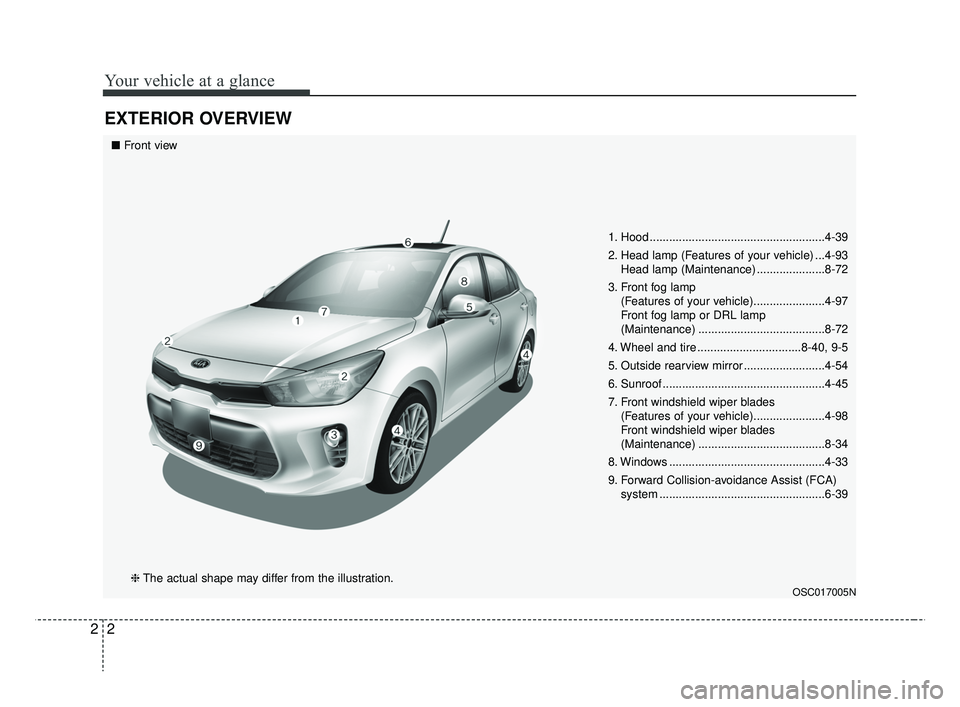
EXTERIOR OVERVIEW
1. Hood ......................................................4-39
2. Head lamp (Features of your vehicle) ...4-93Head lamp (Maintenance) .....................8-72
3. Front fog lamp (Features of your vehicle)......................4-97
Front fog lamp or DRL lamp
(Maintenance) .......................................8-72
4. Wheel and tire ................................8-40, 9-5
5. Outside rearview mirror .........................4-54
6. Sunroof ..................................................4-45
7. Front windshield wiper blades (Features of your vehicle)......................4-98
Front windshield wiper blades
(Maintenance) .......................................8-34
8. Windows ................................................4-33
9. Forward Collision-avoidance Assist (FCA) system ...................................................6-39
OSC017005N
■Front view
❈ The actual shape may differ from the illustration.
SC CAN (ENG) 2.qxp 7/18/2018 5:29 PM Page 2
Page 23 of 503
Safety features of your vehicle
63
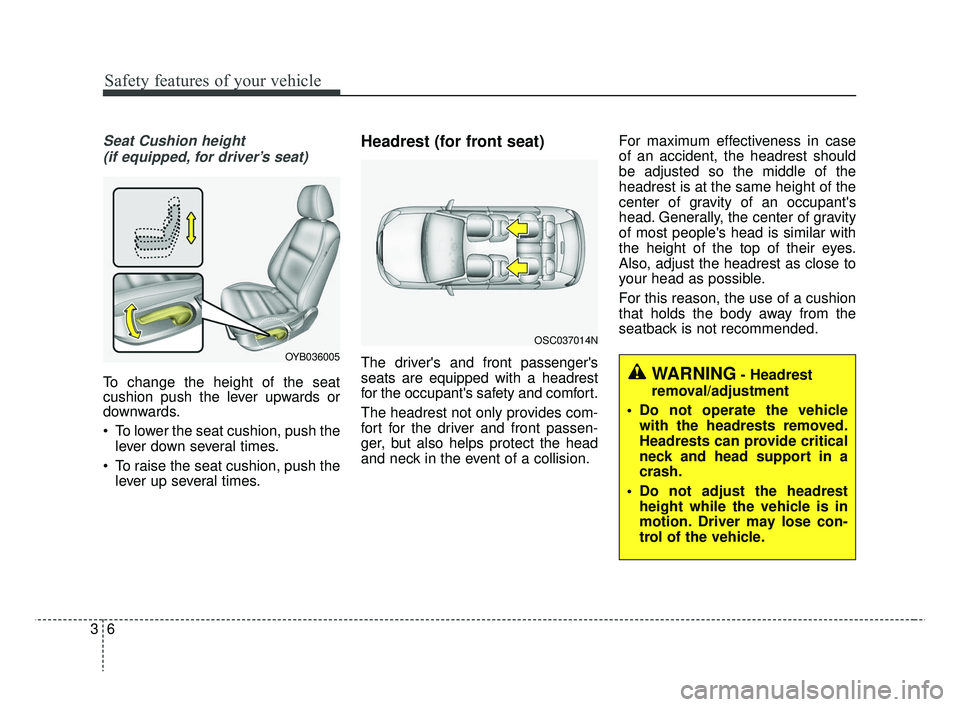
Seat Cushion height (if equipped, for driver’s seat)
To change the height of the seat
cushion push the lever upwards or
downwards.
To lower the seat cushion, push the lever down several times.
To raise the seat cushion, push the lever up several times.
Headrest (for front seat)
The driver's and front passenger's
seats are equipped with a headrest
for the occupant's safety and comfort.
The headrest not only provides com-
fort for the driver and front passen-
ger, but also helps protect the head
and neck in the event of a collision. For maximum effectiveness in case
of an accident, the headrest should
be adjusted so the middle of the
headrest is at the same height of the
center of gravity of an occupant's
head. Generally, the center of gravity
of most people's head is similar with
the height of the top of their eyes.
Also, adjust the headrest as close to
your head as possible.
For this reason, the use of a cushion
that holds the body away from the
seatback is not recommended.OYB036005
WARNING- Headrest
removal/adjustment
Do not operate the vehicle with the headrests removed.
Headrests can provide critical
neck and head support in a
crash.
Do not adjust the headrest height while the vehicle is in
motion. Driver may lose con-
trol of the vehicle.
OSC037014N
SC CAN (ENG) 3.QXP 7/18/2018 5:55 PM Page 6
Page 26 of 503
39
Safety features of your vehicle
Seatback pocket
The seatback pocket is provided on
the back of the front passenger’s
seatback.
Rear seat adjustment
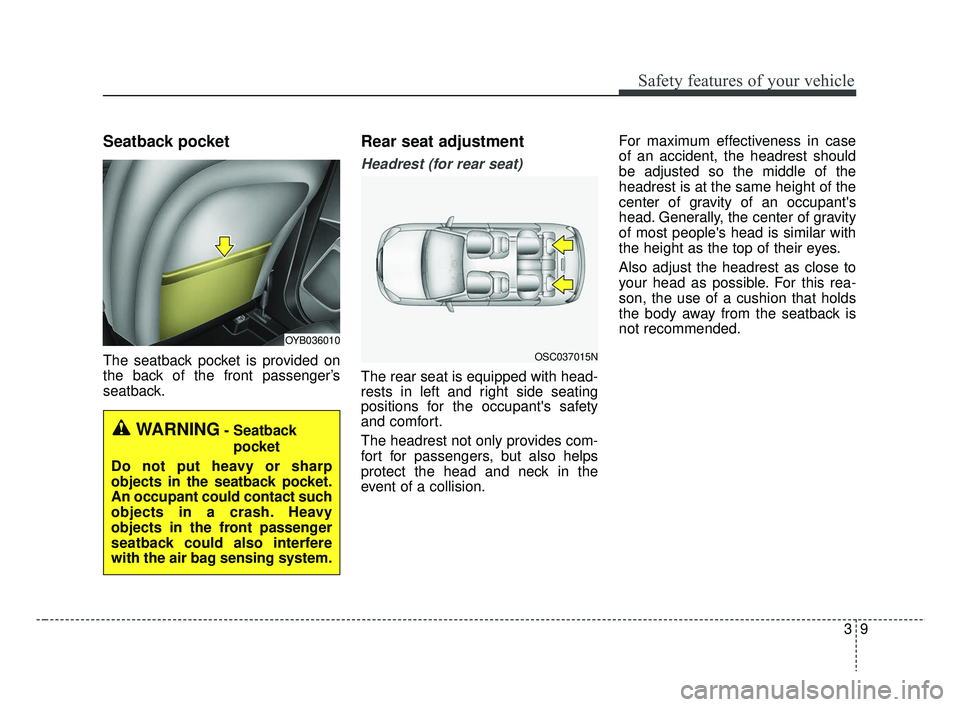
Headrest (for rear seat)
The rear seat is equipped with head-
rests in left and right side seating
positions for the occupant's safety
and comfort.
The headrest not only provides com-
fort for passengers, but also helps
protect the head and neck in the
event of a collision.For maximum effectiveness in case
of an accident, the headrest should
be adjusted so the middle of the
headrest is at the same height of the
center of gravity of an occupant's
head. Generally, the center of gravity
of most people's head is similar with
the height as the top of their eyes.
Also adjust the headrest as close to
your head as possible. For this rea-
son, the use of a cushion that holds
the body away from the seatback is
not recommended.
WARNING- Seatback
pocket
Do not put heavy or sharp
objects in the seatback pocket.
An occupant could contact such
objects in a crash. Heavy
objects in the front passenger
seatback could also interfere
with the air bag sensing system.
OYB036010
OSC037015N
SC CAN (ENG) 3.QXP 7/18/2018 5:55 PM Page 9
Page 29 of 503
Safety features of your vehicle
12
3
To unfold the rear seat
1. To use the rear seat, lift and pull
the seatback rearward. Pull the
seatback firmly until it clicks into
place. Make sure the seatback is
locked in place. When you return
the seatback to its upright posi-
tion, always be sure it has locked
into position by pushing on the top
of the seatback.
2. Return the rear seat belt to the proper position.
3. When the seatback is completely installed, check the seatback fold-
ing lever again.
When returning the rear seatbacks to
the upright position, remember to
return the rear shoulder belts to their
proper position.CAUTION
Be careful when loading cargo through the rear passengerseats to prevent damage to thevehicle interior.
WARNING
Unless the driver’s position is
properly set according to the
driver’s physical figure, do not
fold the rear seat. It may
increase body injuries in a sud-
den stop or collision.
WARNING - Uprighting
seat
When you return the seatback
to its upright position, hold the
seatback and return it slowly. If
the seatback is returned with-
out holding it, the back of the
seat could spring forward
resulting in injury caused by
being struck by the seatback.
WARNING
When you return the rear seat-
back to its upright position after
being folded down:
Be careful not to damage the
seat belt webbing or buckle. Do
not allow the seat belt webbing
or buckle to get caught or
pinched in the rear seat. Ensure
that the seatback is completely
locked into its upright position
by pushing on the top of the
seatback. Otherwise, in an acci-
dent or sudden stop, the seat
could fold down and allow
cargo enter the passenger com-
partment, which could result in
serious injury or death.
SC CAN (ENG) 3.QXP 7/18/2018 5:55 PM Page 12
Page 30 of 503
313
Safety features of your vehicle
WARNING - Objects
Objects carried on the folded
down seatback should not extend
higher than the top of the front
seatbacks. This could allow cargo
to slide forward and cause injury
or damage during sudden stops.
WARNING- Cargo
Cargo should always be
secured to prevent it from being
thrown about the vehicle in a
collision and causing injury to
the vehicle occupants. Do not
place objects in the rear seats,
since they cannot be properly
secured and may hit the front
seat occupants in a collision.
SC CAN (ENG) 3.QXP 7/18/2018 5:55 PM Page 13
Page 34 of 503
317
Safety features of your vehicle
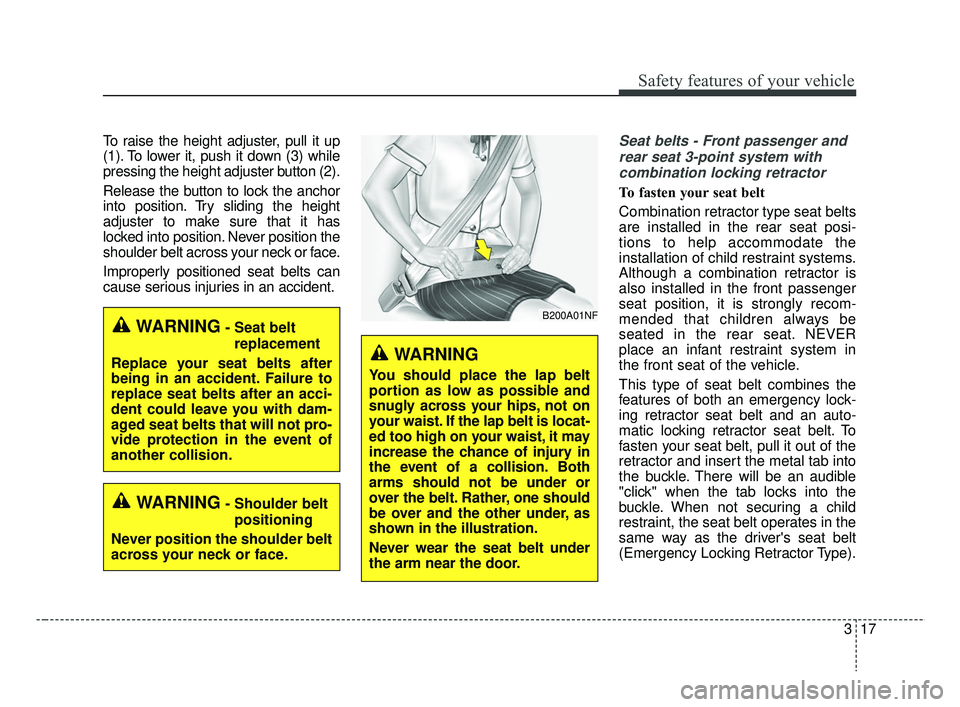
To raise the height adjuster, pull it up
(1). To lower it, push it down (3) while
pressing the height adjuster button (2).
Release the button to lock the anchor
into position. Try sliding the height
adjuster to make sure that it has
locked into position. Never position the
shoulder belt across your neck or face.
Improperly positioned seat belts can
cause serious injuries in an accident.Seat belts - Front passenger andrear seat 3-point system withcombination locking retractor
To fasten your seat belt
Combination retractor type seat belts
are installed in the rear seat posi-
tions to help accommodate the
installation of child restraint systems.
Although a combination retractor is
also installed in the front passenger
seat position, it is strongly recom-
mended that children always be
seated in the rear seat. NEVER
place an infant restraint system in
the front seat of the vehicle.
This type of seat belt combines the
features of both an emergency lock-
ing retractor seat belt and an auto-
matic locking retractor seat belt. To
fasten your seat belt, pull it out of the
retractor and insert the metal tab into
the buckle. There will be an audible
"click" when the tab locks into the
buckle. When not securing a child
restraint, the seat belt operates in the
same way as the driver's seat belt
(Emergency Locking Retractor Type).
WARNING- Seat belt replacement
Replace your seat belts after
being in an accident. Failure to
replace seat belts after an acci-
dent could leave you with dam-
aged seat belts that will not pro-
vide protection in the event of
another collision.
WARNING- Shoulder belt positioning
Never position the shoulder belt
across your neck or face.
B200A01NF
WARNING
You should place the lap belt
portion as low as possible and
snugly across your hips, not on
your waist. If the lap belt is locat-
ed too high on your waist, it may
increase the chance of injury in
the event of a collision. Both
arms should not be under or
over the belt. Rather, one should
be over and the other under, as
shown in the illustration.
Never wear the seat belt under
the arm near the door.
SC CAN (ENG) 3.QXP 7/18/2018 5:55 PM Page 17
Page 37 of 503
Safety features of your vehicle
20
3
Pre-tensioner seat belt
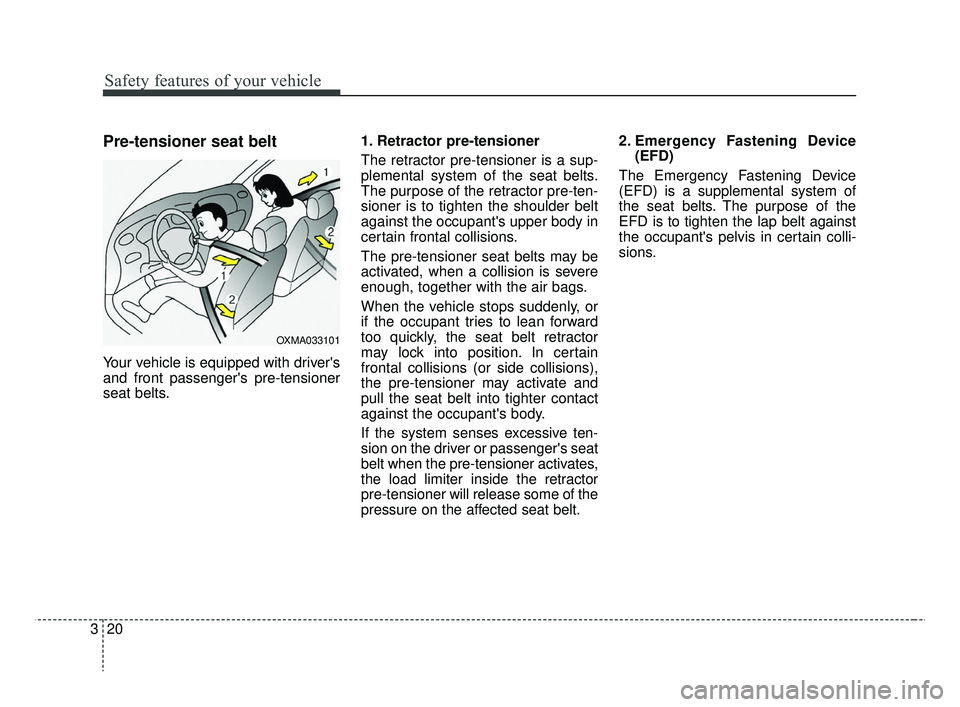
Your vehicle is equipped with driver's
and front passenger's pre-tensioner
seat belts. 1. Retractor pre-tensioner
The retractor pre-tensioner is a sup-
plemental system of the seat belts.
The purpose of the retractor pre-ten-
sioner is to tighten the shoulder belt
against the occupant's upper body in
certain frontal collisions.
The pre-tensioner seat belts may be
activated, when a collision is severe
enough, together with the air bags.
When the vehicle stops suddenly, or
if the occupant tries to lean forward
too quickly, the seat belt retractor
may lock into position. In certain
frontal collisions (or side collisions),
the pre-tensioner may activate and
pull the seat belt into tighter contact
against the occupant's body.
If the system senses excessive ten-
sion on the driver or passenger's seat
belt when the pre-tensioner activates,
the load limiter inside the retractor
pre-tensioner will release some of the
pressure on the affected seat belt.2. Emergency Fastening Device
(EFD)
The Emergency Fastening Device
(EFD) is a supplemental system of
the seat belts. The purpose of the
EFD is to tighten the lap belt against
the occupant's pelvis in certain colli-
sions.
OXMA033101
SC CAN (ENG) 3.QXP 7/18/2018 5:56 PM Page 20
Page 39 of 503
Safety features of your vehicle
22
3
Because the sensor that activates the
SRS air bag is connected with the
pre-tensioner seat belt, the SRS air
bag warning light ( ) on the instru-
ment panel will illuminate for approxi-
mately 6 seconds after the ignition
switch has been turned to the ON
position, and then it should turn off.If
the pre-tensioner seat belt does not
work properly, this warning light will
illuminate even if the SRS air bag
has not malfunctioned. If the SRS air
bag warning light does not illuminate
when the ignition switch is turned
ON, or if it remains illuminated after
illuminating for approximately 6 sec-
onds, or if it illuminates while the
vehicle is being driven, please have
an authorized Kia dealer inspect the
pre-tensioner seat belt or SRS air
bag system as soon as possible.
✽ ✽
NOTICE
Do not attempt to service or repair
the pre-tensioner seat belt system in
any manner. Do not attempt to
inspect or replace the pre-tensioner
seat belts yourself. This must be
done by an authorized Kia dealer.
Pre-tensioners are designed to oper-
ate only one time. After activation,
pre-tensioner seat belts must be
replaced. If the pre-tensioner must
be replaced, contact an authorized
Kia dealer.
Seat belt precautions
Infant or small child
You should be aware of the specific
requirements in your country. Child
and/or infant seats must be properly
placed and installed in the rear seat.
For more information about the use
of these restraints, refer to “Child
restraint system” in this section.
WARNING - Hot pre-
tensioner
Do not touc
h the pre-tensioner
seat belt assemblies for several
minutes after they have been
activated. When the pre-ten-
sioner seat belt mechanism
fires during a collision the pre-
tensioner becomes hot and can
burn you.
SC CAN (ENG) 3.QXP 7/18/2018 5:56 PM Page 22
Page 40 of 503
323
Safety features of your vehicle
Larger children
Children who are too large for child
restraint systems should always occu-
py the rear seat and use the available
lap/shoulder belts. The lap portion
should be fastened snug on the hips
and as low as possible. Periodically
check belt fit. A child's squirming could
put the belt out of position. Children
are given the most safety in the event
of an accident when they are
restrained by a proper restraint system
in the rear seat. If a larger child (over
age 13) must be seated in the front
seat, the child should be securely
restrained by the available lap/shoul-
der belt and the seat should be placed
in the rearmost position. Children age
13 and under should be restrained
securely in the rear seat. NEVER
place a child age 13 and under in the
front seat. NEVER place a rear facing
child seat in the front seat of a vehicle.
If the shoulder belt portion slightly
touches the child’s neck or face, try
placing the child closer to the center of
the vehicle. If the shoulder belt still
touches their face or neck they need to
be returned to a child restraint system.
Restraint of pregnant women
Pregnant women should wear
lap/shoulder belt assemblies when-
ever possible according to specific
recommendations by their doctors.
The lap portion of the belt should be
worn AS SNUGLY AND LOW AS
POSSIBLE on the hips, not across
the abdomen.WARNING- Small chil-dren
Do not allow small children to
ride in the vehicle without an
appropriate child restraint sys-
tem. If the shoulder belt comes
in contact with your child's neck
or face your child is too small to
ride in the vehicle. In a crash the
seat belt will inflict injury to
your child's neck, throat and
face.
WARNING - Pregnant women
Pregnant women must never
place the lap portion of the seat
belt above or on the abdomen
where the fetus is located. The
force of the seat belt during a
collision will crush the fetus.
SC CAN (ENG) 3.QXP 7/18/2018 5:56 PM Page 23
Page 42 of 503
325
Safety features of your vehicle
Keep belts clean and dry
Seat belts should be kept clean and
dry. If belts become dirty, they can be
cleaned by using a mild soap solu-
tion and warm water. Bleach, dye,
strong detergents or abrasives
should not be used because they
may damage and weaken the fabric.
When to replace seat belts
The entire in-use seat belt assembly
or assemblies should be replaced if
the vehicle has been involved in an
accident. This should be done even if
no damage is visible. Additional
questions concerning seat belt oper-
ation should be directed to an
authorized Kia dealer.
WARNING- Pinched Seatbelts
Make sure that the webbing
and/or buckle does not get
caught or pinched in the rear
seat when returning the rear
seatback to its upright position.
A caught or pinched
webbing/buckle may become
damaged and could fail during a
collision or sudden stop.
WARNING
Seatbelts can become hot in a
vehicle that has been closed up
in sunny weather. They could
burn infants and children.
SC CAN (ENG) 3.QXP 7/18/2018 5:56 PM Page 25