eco KIA RIO 2021 Owners Manual
[x] Cancel search | Manufacturer: KIA, Model Year: 2021, Model line: RIO, Model: KIA RIO 2021Pages: 534, PDF Size: 13.49 MB
Page 404 of 534
Maintenance
12
7
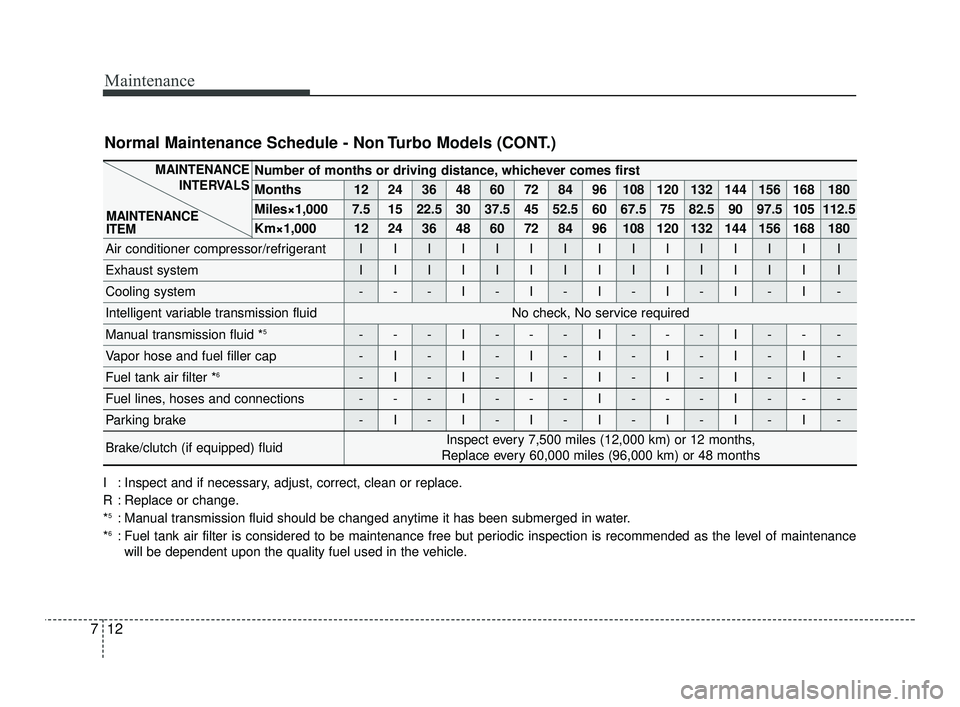
Number of months or driving distance, whichever comes first
Months1224364860728496108120132144156168180
Miles×1,0007.51522.530 37.5 45 52.5 60 67.5 75 82.5 90 97.5 105 112.5
Km×1,00012 24 36 48 60 72 84 96 108 120 132 144 156 168 180
Air conditioner compressor/refrigerantIIIIIIIIIIIIIII
Exhaust systemIIIIIIIIIIIIIII
Cooling system---I-I-I-I-I-I-
Intelligent variable transmission fluidNo check, No service required
Manual transmission fluid *5---I---I---I---
Vapor hose and fuel filler cap-I-I-I-I-I-I-I-
Fuel tank air filter *6-I-I-I-I-I-I-I-
Fuel lines, hoses and connections---I---I---I---
Parking brake-I-I-I-I-I-I-I-
Brake/clutch (if equipped) fluidInspect every 7,500 miles (12,000 km) or 12 months,
Replace every 60,000 miles (96,000 km) or 48 months
MAINTENANCE INTERVALS
MAINTENANCE
ITEM
Normal Maintenance Schedule - Non Turbo Models (CONT.)
I : Inspect and if necessary, adjust, correct, clean or replace.
R : Replace or change.
*
5: Manual transmission fluid should be changed anytime it has been submerged in water.
*6: Fuel tank air filter is considered to be maintenance free but periodic inspection is recommended as the level of maintenance will be dependent upon the quality fuel used in the vehicle.
SC PE USA 7.qxp 10/23/2020 6:05 PM Page 12
Page 406 of 534
Maintenance
14
7
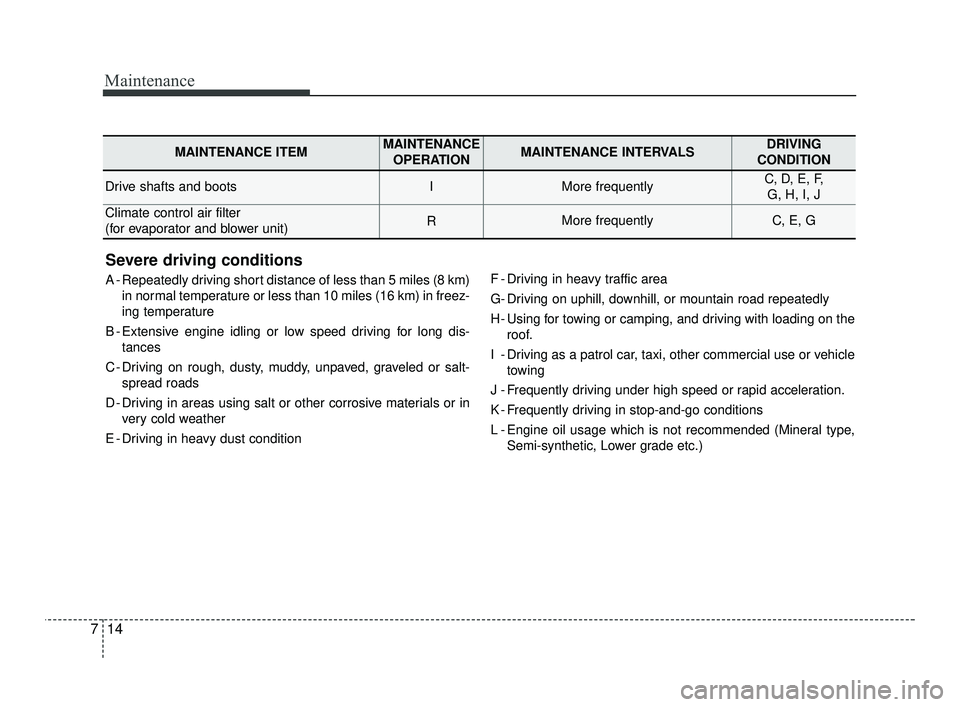
Severe driving conditions
A - Repeatedly driving short distance of less than 5 miles (8 km)
in normal temperature or less than 10 miles (16 km) in freez-
ing temperature
B - Extensive engine idling or low speed driving for long dis- tances
C - Driving on rough, dusty, muddy, unpaved, graveled or salt- spread roads
D - Driving in areas using salt or other corrosive materials or in very cold weather
E - Driving in heavy dust condition F - Driving in heavy traffic area
G- Driving on uphill, downhill, or mountain road repeatedly
H - Using for towing or camping, and driving with loading on the
roof.
I - Driving as a patrol car, taxi, other commercial use or vehicle towing
J - Frequently driving under high speed or rapid acceleration.
K - Frequently driving in stop-and-go conditions
L - Engine oil usage which is not recommended (Mineral type, Semi-synthetic, Lower grade etc.)
MAINTENANCE ITEMMAINTENANCEOPERATIONMAINTENANCE INTERVALSDRIVING
CONDITION
Drive shafts and bootsIMore frequentlyC, D, E, F, G, H, I, J
Climate control air filter
(for evaporator and blower unit)RMore frequentlyC, E, G
SC PE USA 7.qxp 10/23/2020 6:05 PM Page 14
Page 409 of 534
717
Maintenance
✽ ✽NOTICE
The Intelligent Variable
Transmission (IVT) fluid color is
amber. As the vehicle is driven, the
Intelligent Variable Transmission
(IVT) fluid will begin to look darker.
This is normal, and you should not
judge the need to replace the fluid
based upon the changed color.
Brake hoses and lines
Visually check for proper installation,
chafing, cracks, deterioration and
any leakage. Replace any deteriorat-
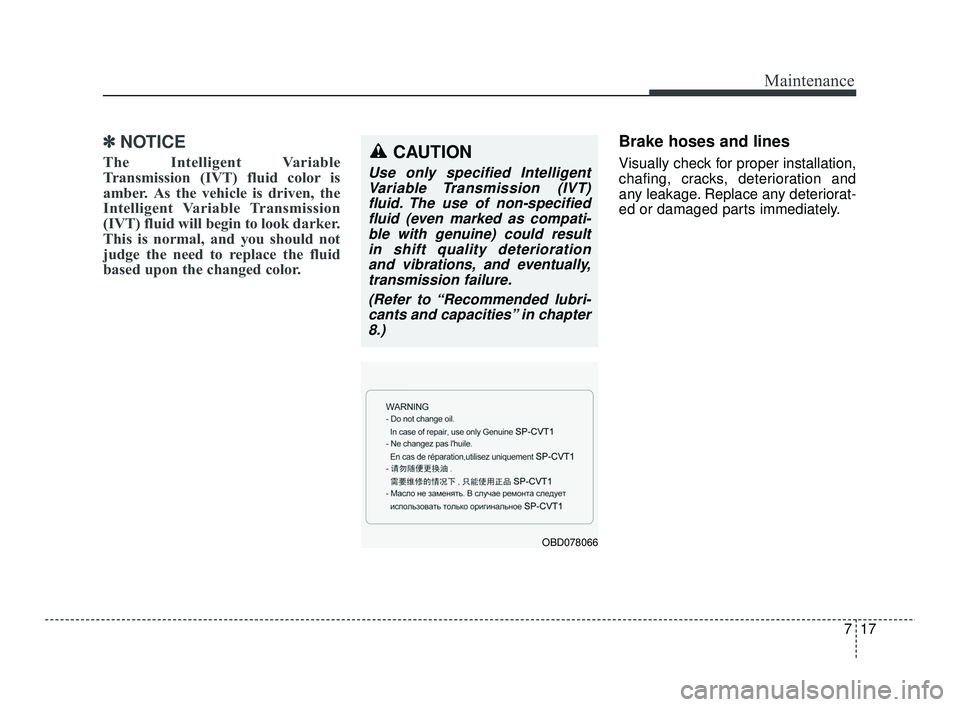
ed or damaged parts immediately.CAUTION
Use only specified Intelligent
Variable Transmission (IVT)fluid. The use of non-specifiedfluid (even marked as compati-ble with genuine) could resultin shift quality deteriorationand vibrations, and eventually,transmission failure.
(Refer to “Recommended lubri-cants and capacities” in chapter8.)
OBD078066
SC PE USA 7.qxp 10/23/2020 6:05 PM Page 17
Page 414 of 534
Maintenance
22
7
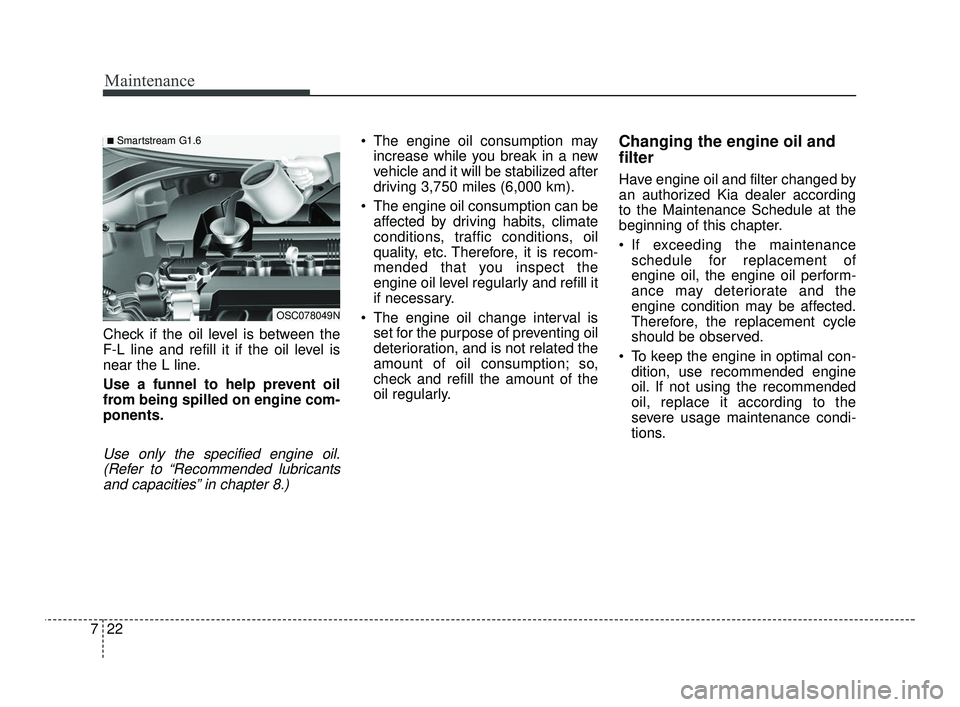
Check if the oil level is between the
F-L line and refill it if the oil level is
near the L line.
Use a funnel to help prevent oil
from being spilled on engine com-
ponents.
Use only the specified engine oil.
(Refer to “Recommended lubricantsand capacities” in chapter 8.)
The engine oil consumption may increase while you break in a new
vehicle and it will be stabilized after
driving 3,750 miles (6,000 km).
The engine oil consumption can be affected by driving habits, climate
conditions, traffic conditions, oil
quality, etc. Therefore, it is recom-
mended that you inspect the
engine oil level regularly and refill it
if necessary.
The engine oil change interval is set for the purpose of preventing oil
deterioration, and is not related the
amount of oil consumption; so,
check and refill the amount of the
oil regularly.Changing the engine oil and
filter
Have engine oil and filter changed by
an authorized Kia dealer according
to the Maintenance Schedule at the
beginning of this chapter.
If exceeding the maintenanceschedule for replacement of
engine oil, the engine oil perform-
ance may deteriorate and the
engine condition may be affected.
Therefore, the replacement cycle
should be observed.
To keep the engine in optimal con- dition, use recommended engine
oil. If not using the recommended
oil, replace it according to the
severe usage maintenance condi-
tions.
OSC078049N
■Smartstream G1.6
SC PE USA 7.qxp 10/23/2020 6:05 PM Page 22
Page 417 of 534
725
Maintenance
Check the condition and connections
of all cooling system hoses and
heater hoses. Replace any swollen
or deteriorated hoses.
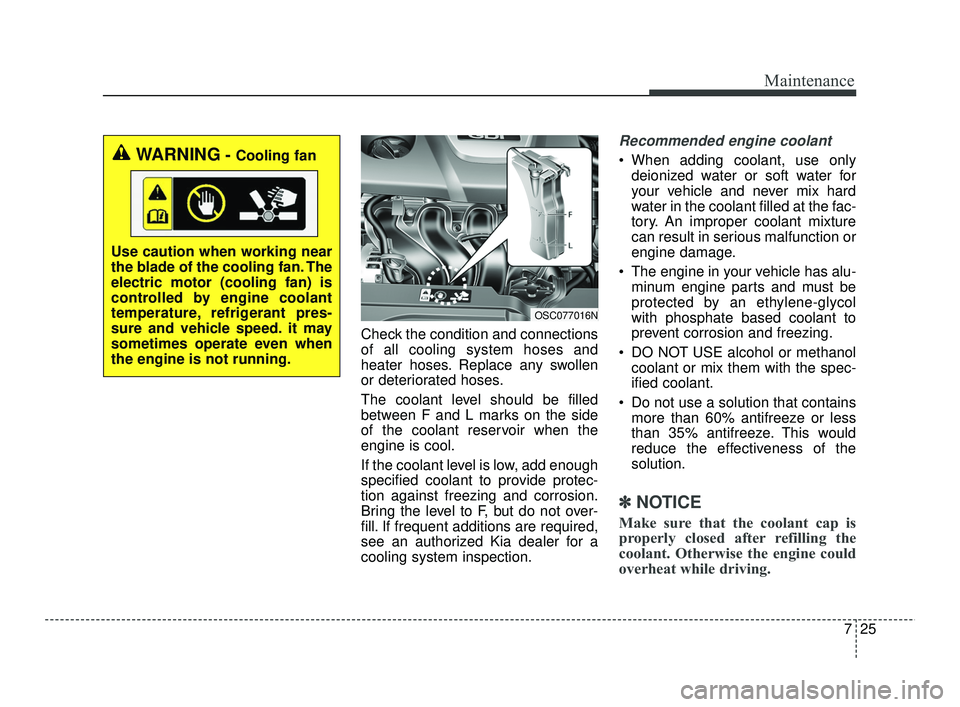
The coolant level should be filled
between F and L marks on the side
of the coolant reservoir when the
engine is cool.
If the coolant level is low, add enough
specified coolant to provide protec-
tion against freezing and corrosion.
Bring the level to F, but do not over-
fill. If frequent additions are required,
see an authorized Kia dealer for a
cooling system inspection.
Recommended engine coolant
When adding coolant, use onlydeionized water or soft water for
your vehicle and never mix hard
water in the coolant filled at the fac-
tory. An improper coolant mixture
can result in serious malfunction or
engine damage.
The engine in your vehicle has alu- minum engine parts and must be
protected by an ethylene-glycol
with phosphate based coolant to
prevent corrosion and freezing.
DO NOT USE alcohol or methanol coolant or mix them with the spec-
ified coolant.
Do not use a solution that contains more than 60% antifreeze or less
than 35% antifreeze. This would
reduce the effectiveness of the
solution.
✽ ✽
NOTICE
Make sure that the coolant cap is
properly closed after refilling the
coolant. Otherwise the engine could
overheat while driving.
OSC077016N
WARNING- Cooling fan
Use caution when working near
the blade of the cooling fan. The
electric motor (cooling fan) is
controlled by engine coolant
temperature, refrigerant pres-
sure and vehicle speed. it may
sometimes operate even when
the engine is not running.
SC PE USA 7.qxp 10/23/2020 6:05 PM Page 25
Page 419 of 534
727
Maintenance
BRAKE/CLUTCH FLUID (IF EQUIPPED)
Checking the brake/clutch
fluid level
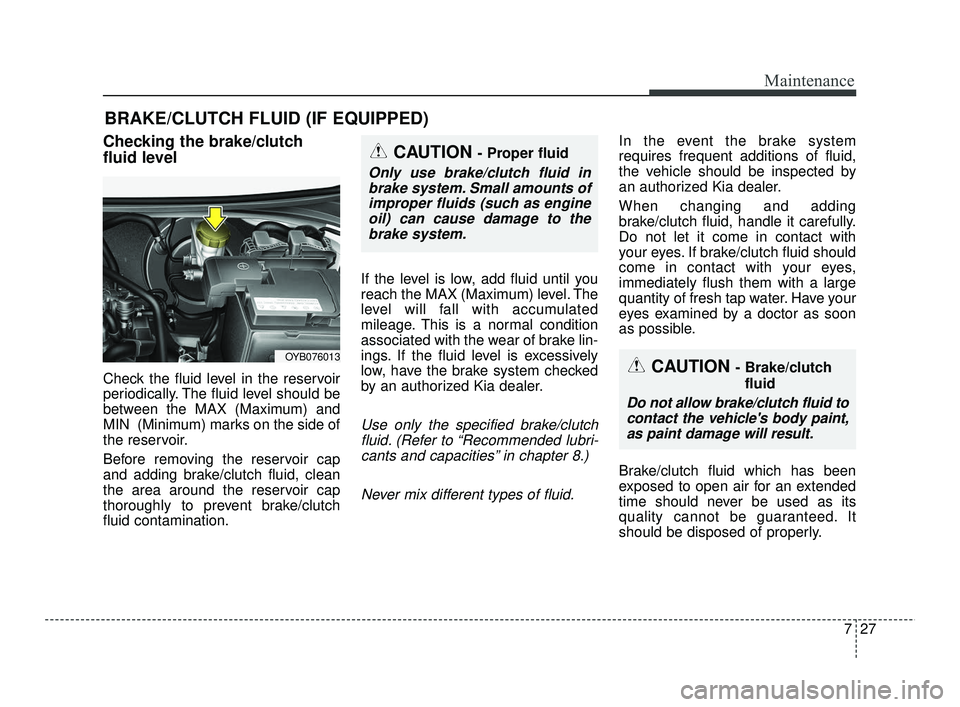
Check the fluid level in the reservoir
periodically. The fluid level should be
between the MAX (Maximum) and
MIN (Minimum) marks on the side of
the reservoir.
Before removing the reservoir cap
and adding brake/clutch fluid, clean
the area around the reservoir cap
thoroughly to prevent brake/clutch
fluid contamination.If the level is low, add fluid until you
reach the MAX (Maximum) level. The
level will fall with accumulated
mileage. This is a normal condition
associated with the wear of brake lin-
ings. If the fluid level is excessively
low, have the brake system checked
by an authorized Kia dealer.
Use only the specified brake/clutch
fluid. (Refer to “Recommended lubri-cants and capacities” in chapter 8.)
Never mix different types of fluid.
In the event the brake system
requires frequent additions of fluid,
the vehicle should be inspected by
an authorized Kia dealer.
When changing and adding
brake/clutch fluid, handle it carefully.
Do not let it come in contact with
your eyes. If brake/clutch fluid should
come in contact with your eyes,
immediately flush them with a large
quantity of fresh tap water. Have your
eyes examined by a doctor as soon
as possible.
Brake/clutch fluid which has been
exposed to open air for an extended
time should never be used as its
quality cannot be guaranteed. It
should be disposed of properly.
OYB076013CAUTION - Brake/clutch fluid
Do not allow brake/clutch fluid tocontact the vehicle's body paint,as paint damage will result.
CAUTION - Proper fluid
Only use brake/clutch fluid inbrake system. Small amounts ofimproper fluids (such as engineoil) can cause damage to thebrake system.
SC PE USA 7.qxp 10/23/2020 6:05 PM Page 27
Page 424 of 534
Maintenance
32
7
Replace the filter according to the
Maintenance Schedule.
If the vehicle is operated in extreme-
ly dusty or sandy areas, replace theelement more often than the usualrecommended intervals. (Refer to“Maintenance under severe usageconditions” in this chapter.)
CAUTION - Air filter
maintenance
Do not drive with the air clean- er removed; this will result inexcessive engine wear.
When removing the air cleaner filter, be careful that dust ordirt does not enter the airintake, or damage may result.
Use a Kia genuine part. Use of a non-genuine part coulddamage the air flow sensor.
SC PE USA 7.qxp 10/23/2020 6:06 PM Page 32
Page 427 of 534
735
Maintenance
WIPER BLADES
Blade inspection
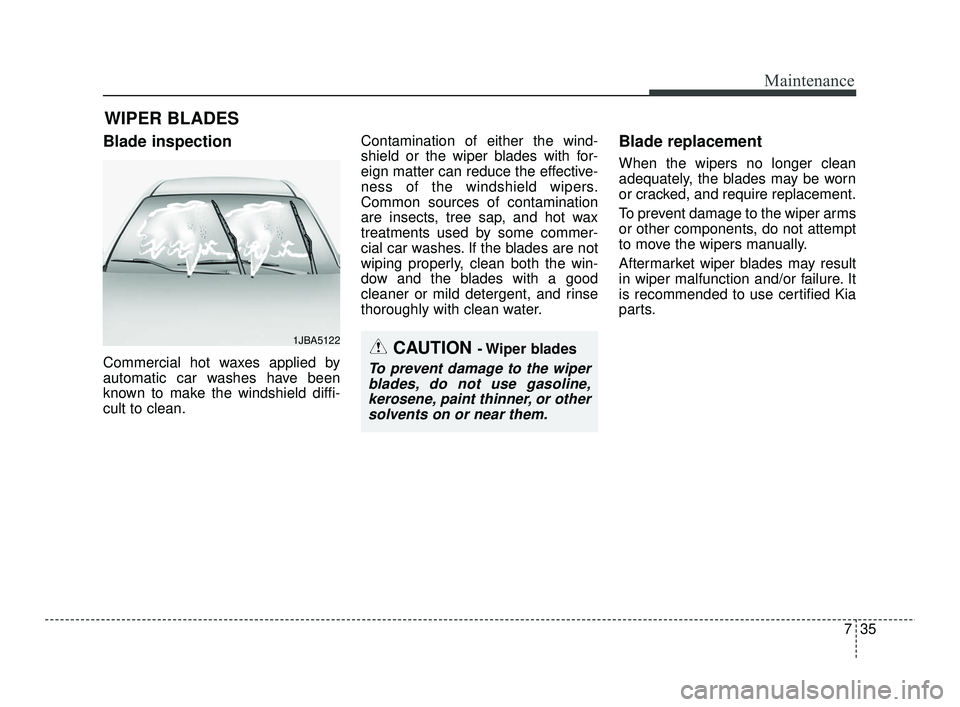
Commercial hot waxes applied by
automatic car washes have been
known to make the windshield diffi-
cult to clean.Contamination of either the wind-
shield or the wiper blades with for-
eign matter can reduce the effective-
ness of the windshield wipers.
Common sources of contamination
are insects, tree sap, and hot wax
treatments used by some commer-
cial car washes. If the blades are not
wiping properly, clean both the win-
dow and the blades with a good
cleaner or mild detergent, and rinse
thoroughly with clean water.
Blade replacement
When the wipers no longer clean
adequately, the blades may be worn
or cracked, and require replacement.
To prevent damage to the wiper arms
or other components, do not attempt
to move the wipers manually.
Aftermarket wiper blades may result
in wiper malfunction and/or failure. It
is recommended to use certified Kia
parts.
1JBA5122CAUTION - Wiper blades
To prevent damage to the wiper
blades, do not use gasoline,kerosene, paint thinner, or othersolvents on or near them.
SC PE USA 7.qxp 10/23/2020 6:06 PM Page 35
Page 432 of 534
Maintenance
40
7
✽ ✽
NOTICE
If you connect unauthorized elec-
tronic devices to the battery, the bat-
tery may be discharged. Never use
unauthorized devices.
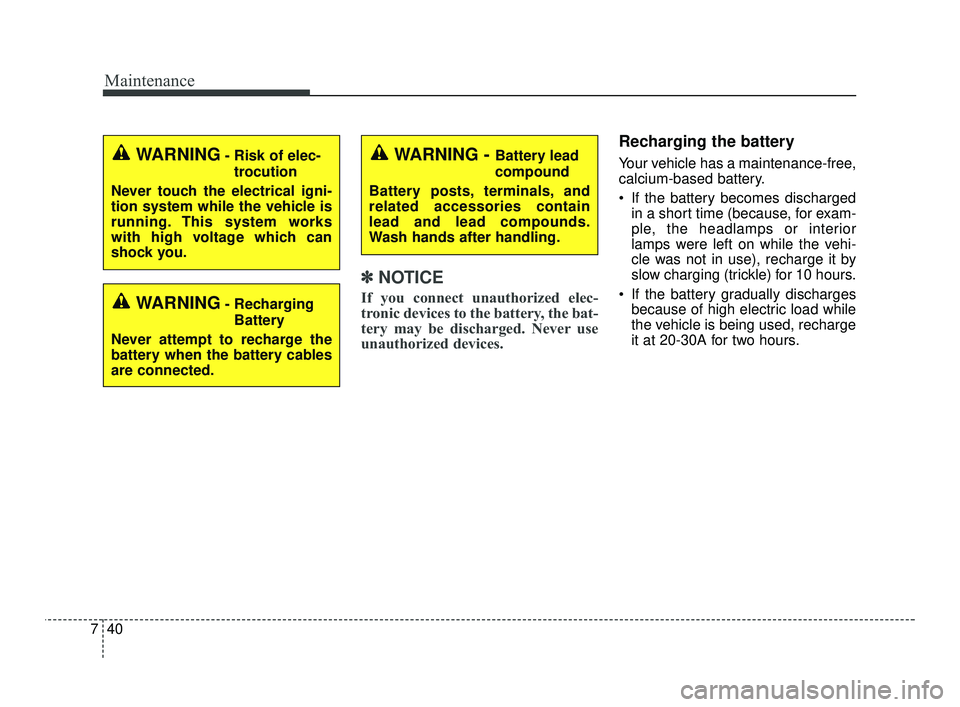
Recharging the battery
Your vehicle has a maintenance-free,
calcium-based battery.
If the battery becomes discharged
in a short time (because, for exam-
ple, the headlamps or interior
lamps were left on while the vehi-
cle was not in use), recharge it by
slow charging (trickle) for 10 hours.
If the battery gradually discharges because of high electric load while
the vehicle is being used, recharge
it at 20-30A for two hours.WARNING- Risk of elec-
trocution
Never touch the electrical igni-
tion system while the vehicle is
running. This system works
with high voltage which can
shock you.
WARNING- Recharging Battery
Never attempt to recharge the
battery when the battery cables
are connected.
WARNING - Battery lead
compound
Battery posts, terminals, and
related accessories contain
lead and lead compounds.
Wash hands after handling.
SC PE USA 7.qxp 10/23/2020 6:06 PM Page 40
Page 434 of 534
Maintenance
42
7
TIRES AND WHEELS
Tire care
For proper maintenance, safety, and
maximum fuel economy, you must
always maintain recommended tire
inflation pressures and stay within
the load limits and weight distribution
recommended for your vehicle.
Recommended cold tire infla-
tion pressures
All tire pressures (including the
spare) should be checked when the
tires are cold. “Cold Tires” means the
vehicle has not been driven for at
least three hours or driven less than
1 mile (1.6 km).
Recommended pressures must be
maintained for the best ride, top vehi-
cle handling, and minimum tire wear.
For recommended inflation pressure
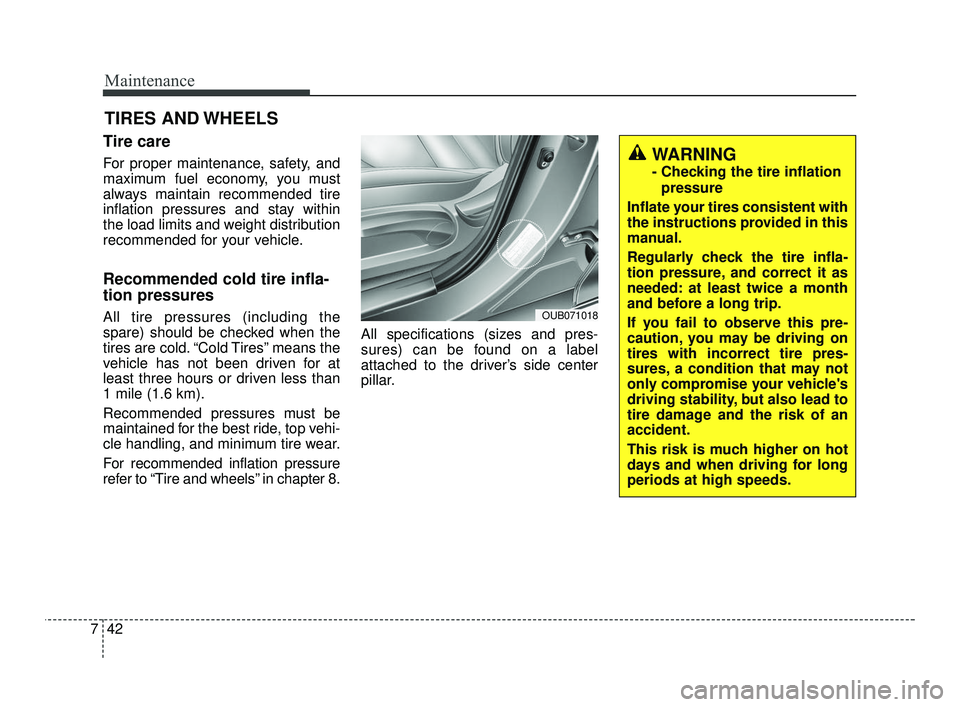
refer to “Tire and wheels” in chapter 8. All specifications (sizes and pres-
sures) can be found on a label
attached to the driver’s side center
pillar.OUB071018
WARNING
- Checking the tire inflation
pressure
Inflate your tires consistent with
the instructions provided in this
manual.
Regularly check the tire infla-
tion pressure, and correct it as
needed: at least twice a month
and before a long trip.
If you fail to observe this pre-
caution, you may be driving on
tires with incorrect tire pres-
sures, a condition that may not
only compromise your vehicle's
driving stability, but also lead to
tire damage and the risk of an
accident.
This risk is much higher on hot
days and when driving for long
periods at high speeds.
SC PE USA 7.qxp 10/23/2020 6:06 PM Page 42