radio KIA RIO 2021 Owners Manual
[x] Cancel search | Manufacturer: KIA, Model Year: 2021, Model line: RIO, Model: KIA RIO 2021Pages: 534, PDF Size: 13.49 MB
Page 64 of 534
345
Safety features of your vehicle
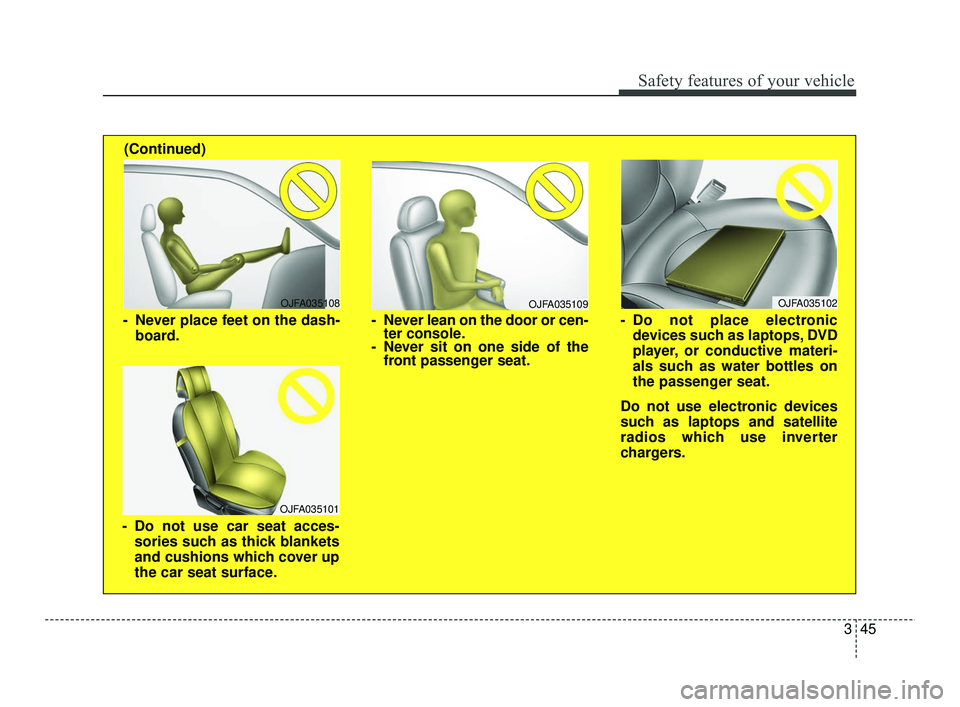
OJFA035109
- Never lean on the door or cen-ter console.
- Never sit on one side of the front passenger seat.
OJFA035108
- Never place feet on the dash-
board.
OJFA035101
- Do not use car seat acces-sories such as thick blankets
and cushions which cover up
the car seat surface.
(Continued)
OJFA035102
- Do not place electronic
devices such as laptops, DVD
player, or conductive materi-
als such as water bottles on
the passenger seat.
Do not use electronic devices
such as laptops and satellite
radios which use inverter
chargers.
SC PE USA 3.QXP 10/23/2020 5:36 PM Page 45
Page 88 of 534
47
Features of your vehicle
Trunk open (3)
The trunk is opened if the button is
pressed for more than 1 second.
Liftgate unlock (3)
The liftgate is unlocked if the button
is pressed for more than 1 second.
However, after pressing this button,
the liftgate will lock automatically
unless you open the liftgate within 30
seconds.
Also, once the liftgate is opened and
then closed, the liftgate will lock
automatically.
Alarm (4)
The horn sounds and the hazard
warning lights blink for about 30 sec-
onds if this button is pressed for
more than 0.5 seconds. To stop the
horn and lights, press any button on
the transmitter.
Transmitter precautions
The transmitter (or smart key) will not
work if any of following occurs:
The ignition key is in the ignitionswitch.
You exceed the operating distance limit (about 90 feet [30 m]).
The battery in the transmitter (or smart key) is weak.
Other vehicles or objects may be blocking the signal.
The weather is extremely cold.
The transmitter (or smart key) is close to a radio transmitter such as
a radio station or an airport which
can interfere with normal operation
of the transmitter.
When the transmitter (or smart key)
does not work properly, open and
close the door with the ignition key. If
you have a problem with the trans-
mitter (or smart key), contact an
authorized Kia dealer. If the transmitter (or smart key) is
in close proximity to your cell
phone or smart phone, the signal
from the transmitter (or smart key)
could be blocked by normal opera-
tion of your cell phone or smart
phone. This is especially important
when the phone is active such as
making calls, receiving calls, text
messaging, and/or sending/receiv-
ing emails.
Avoid placing the transmitter (or
smart key) and your cell phone or
smart phone in the same pants or
jacket pocket and maintain ade-
quate distance between the two
devices.
SC PE USA 4.QXP 10/23/2020 5:39 PM Page 7
Page 94 of 534
413
Features of your vehicle
Smart key precautions
If you lose your smart key, you willnot be able to start the engine. Tow
the vehicle, if necessary, and con-
tact an authorized Kia dealer.
A maximum of 2 smart keys can be registered to a single vehicle. If
you lose a smart key, you should
immediately take the vehicle and
key to your authorized Kia dealer
to protect it from potential theft.
The smart key will not work if any of following occurs:
- The smart key is close to a radiotransmitter such as a radio sta-
tion or an airport which can inter-
fere with normal operation of the
smart key.
- The smart key is near a mobile two-way radio system or a cellu-
lar phone.
- Another vehicle’s smart key is being operated close to your
vehicle.
When the smart key does not work
correctly, open and close the door
with the mechanical key. If you
have a problem with the smart key,
contact an authorized Kia dealer. If the smart key is in close proximi-
ty to your cell phone or smart
phone, the signal from the smart
key could be blocked by normal
operation of your cell phone or
smart phone. This is especially
important when the phone is active
such as making calls, receiving
calls, text messaging, and/or send-
ing/receiving emails. Avoid placing
the smart key and your cell phone
or smart phone in the same pants
or jacket pocket and maintain ade-
quate distance between the two
devices.
Do not leave the smart key near metallic objects such as golf bags,
metal cases and so on.
Door Lock/Unlock failure or poor starting can occur when the smart
key is placed near metallic objects.
Always carry your smart key when you leave the car. An unattended
smart key close to the vehicle can
cause the vehicle battery to be dis-
charged. Internal circuit damage may occur
when the key comes into contact
with moisture (beverage, water
etc.) or heat. Damage to the smart
key due to exposure to liquids or
heat is not covered by the manu-
facturer's vehicle warranty.
CAUTION - Transmitter
Keep the smart key away fromwater or any liquid as it canbecome damaged and not func-tion properly.
SC PE USA 4.QXP 10/23/2020 5:40 PM Page 13
Page 110 of 534
429
Features of your vehicle
✽ ✽
NOTICE
• The Smart Trunk Release function
will not work if any of the follow-
ing occurs:
- The smart key is close to a radiotransmitter such as a radio sta-
tion or an airport which can
interfere with normal operation
of the transmitter.
- The smart key is near a mobile two way radio system or a cellu-
lar phone.
- Another vehicle's smart key is being operated close to your
vehicle.
• The detecting range may decrease or increase when :
- One side of the tire is raised toreplace a tire or to inspect the
vehicle.
- The vehicle is slantingly parked on a slope or unpaved road, etc.
SC PE USA 4.QXP 10/23/2020 5:40 PM Page 29
Page 232 of 534
4151
Features of your vehicle
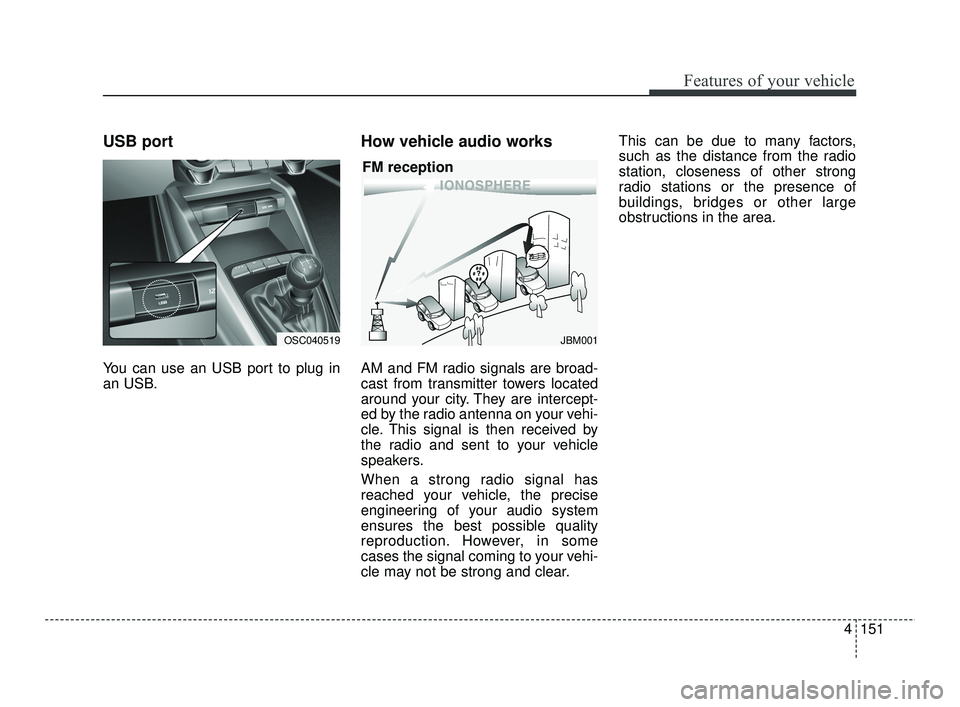
USB port
You can use an USB port to plug in
an USB.
How vehicle audio works
AM and FM radio signals are broad-
cast from transmitter towers located
around your city. They are intercept-
ed by the radio antenna on your vehi-
cle. This signal is then received by
the radio and sent to your vehicle
speakers.
When a strong radio signal has
reached your vehicle, the precise
engineering of your audio system
ensures the best possible quality
reproduction. However, in some
cases the signal coming to your vehi-
cle may not be strong and clear.This can be due to many factors,
such as the distance from the radio
station, closeness of other strong
radio stations or the presence of
buildings, bridges or other large
obstructions in the area.
JBM001
FM reception
OSC040519
SC PE USA 4.QXP 10/23/2020 5:47 PM Page 151
Page 233 of 534
Features of your vehicle
152
4
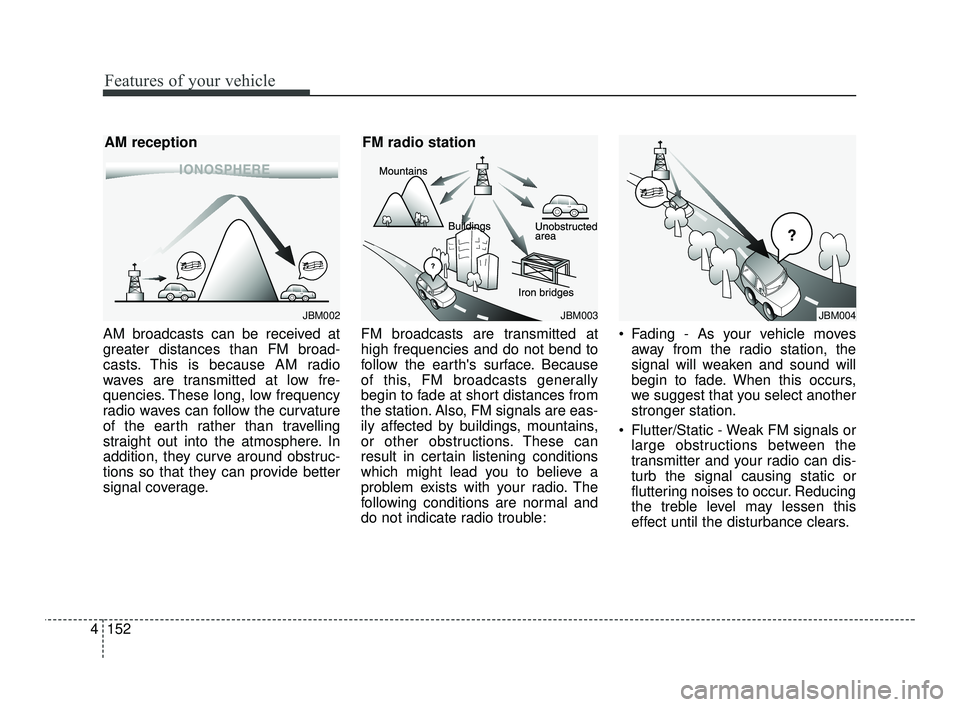
AM broadcasts can be received at
greater distances than FM broad-
casts. This is because AM radio
waves are transmitted at low fre-
quencies. These long, low frequency
radio waves can follow the curvature
of the earth rather than travelling
straight out into the atmosphere. In
addition, they curve around obstruc-
tions so that they can provide better
signal coverage. FM broadcasts are transmitted at
high frequencies and do not bend to
follow the earth's surface. Because
of this, FM broadcasts generally
begin to fade at short distances from
the station. Also, FM signals are eas-
ily affected by buildings, mountains,
or other obstructions. These can
result in certain listening conditions
which might lead you to believe a
problem exists with your radio. The
following conditions are normal and
do not indicate radio trouble: Fading - As your vehicle moves
away from the radio station, the
signal will weaken and sound will
begin to fade. When this occurs,
we suggest that you select another
stronger station.
Flutter/Static - Weak FM signals or large obstructions between the
transmitter and your radio can dis-
turb the signal causing static or
fluttering noises to occur. Reducing
the treble level may lessen this
effect until the disturbance clears.
JBM002
AM reception
JBM003
FM radio station
JBM004
SC PE USA 4.QXP 10/23/2020 5:47 PM Page 152
Page 234 of 534
4153
Features of your vehicle
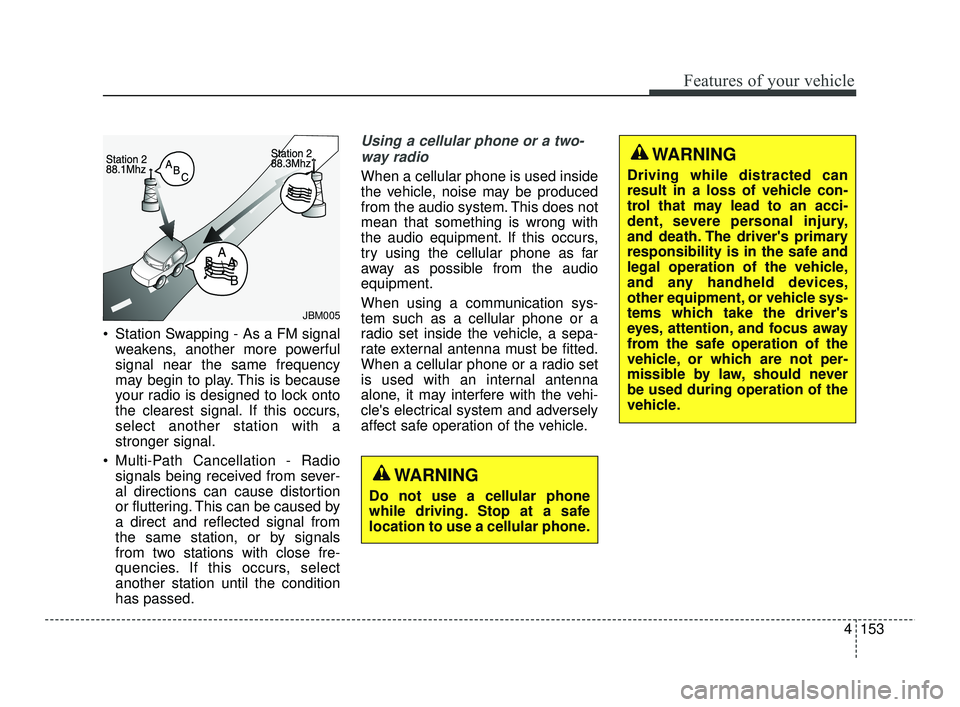
Station Swapping - As a FM signalweakens, another more powerful
signal near the same frequency
may begin to play. This is because
your radio is designed to lock onto
the clearest signal. If this occurs,
select another station with a
stronger signal.
Multi-Path Cancellation - Radio signals being received from sever-
al directions can cause distortion
or fluttering. This can be caused by
a direct and reflected signal from
the same station, or by signals
from two stations with close fre-
quencies. If this occurs, select
another station until the condition
has passed.
Using a cellular phone or a two-
way radio
When a cellular phone is used inside
the vehicle, noise may be produced
from the audio system. This does not
mean that something is wrong with
the audio equipment. If this occurs,
try using the cellular phone as far
away as possible from the audio
equipment.
When using a communication sys-
tem such as a cellular phone or a
radio set inside the vehicle, a sepa-
rate external antenna must be fitted.
When a cellular phone or a radio set
is used with an internal antenna
alone, it may interfere with the vehi-
cle's electrical system and adversely
affect safe operation of the vehicle.
JBM005
WARNING
Do not use a cellular phone
while driving. Stop at a safe
location to use a cellular phone.
WARNING
Driving while distracted can
result in a loss of vehicle con-
trol that may lead to an acci-
dent, severe personal injury,
and death. The driver's primary
responsibility is in the safe and
legal operation of the vehicle,
and any handheld devices,
other equipment, or vehicle sys-
tems which take the driver's
eyes, attention, and focus away
from the safe operation of the
vehicle, or which are not per-
missible by law, should never
be used during operation of the
vehicle.
SC PE USA 4.QXP 10/23/2020 5:48 PM Page 153
Page 236 of 534
4155
Features of your vehicle
Declaration of Conformity
FCC
This equipment has been tested and found to comply with the limits for a Class B digital device, pursuant to part 15
of the FCC Rules. These limits are designed to provide reasonable protection against harmful interference in a resi-
dential installation.
This equipment generates, uses and can radiate radio frequency energy and, if not installed and used in accordance
with the instructions,may cause harmful interference to radio communications. However, there is no guarantee that
interference will not occur in a particular installation. If this equipment does cause harmful interference to radio or tel-
evision reception, which can be determined by turning the equipment off and on, the user is encouraged to try to cor-
rect the interference by one or more of the following measures : Reorient or relocate the receiving antenna.
Increase the separation between the equipment and receiver.
Connect the equipment into an outlet on a circuit different from that to which the receiver is connected.
Consult the dealer or an experienced radio/TV technician for help.
Caution: Any changes or modifications to this device not explicitly approved by manufacturer could void
your authority to operate this equipment.
SC PE USA 4.QXP 10/23/2020 5:48 PM Page 155
Page 239 of 534
 . . . . . . . . . . . . 5-78
• Basic function. . . . . . . . . . . . . . . . . . . . . . . . . . . . . . . . \
5-78
• Leading Vehicle Departure Alert function . . .")
Driver Attention Warning (DAW) . . . . . . . . . . . . 5-78
• Basic function. . . . . . . . . . . . . . . . . . . . . . . . . . . . . . . . \
5-78
• Leading Vehicle Departure Alert function . . . . . . . . 5-78
• Detecting sensor . . . . . . . . . . . . . . . . . . . . . . . . . . . . . . 5-78
• Function settings . . . . . . . . . . . . . . . . . . . . . . . . . . . . . 5-79
• Function operation . . . . . . . . . . . . . . . . . . . . . . . . . . . 5-81
• Function malfunction and limitations . . . . . . . . . . . . 5-84
Cruise Control (CC). . . . . . . . . . . . . . . . . . . . . . . . 5-87
• Function operation . . . . . . . . . . . . . . . . . . . . . . . . . . . 5-87
• To increase set speed . . . . . . . . . . . . . . . . . . . . . . . . . . 5-88
• To decrease speed . . . . . . . . . . . . . . . . . . . . . . . . . . . . 5-88
• To temporarily pause the function . . . . . . . . . . . . . . 5-89
• To resume the function . . . . . . . . . . . . . . . . . . . . . . . . 5-89
Lane Following Assist (LFA) . . . . . . . . . . . . . . . . . 5-91
• Detecting sensor . . . . . . . . . . . . . . . . . . . . . . . . . . . . . . 5-91
• Function settings . . . . . . . . . . . . . . . . . . . . . . . . . . . . . 5-92
• Function operation . . . . . . . . . . . . . . . . . . . . . . . . . . . 5-92
• Function malfunction and limitations . . . . . . . . . . . . 5-95
Rear Cross-Traffic Collision Warning (RCCW) . 5-96
• Detecting sensor . . . . . . . . . . . . . . . . . . . . . . . . . . . . . . 5-97
• Functions settings . . . . . . . . . . . . . . . . . . . . . . . . . . . . 5-97
• Function operation . . . . . . . . . . . . . . . . . . . . . . . . . . . 5-98
Function malfunction and limitations . . . . . . . . . . . . . 5-99
Declaration of Conformity . . . . . . . . . . . . . . . . . 5-104
• The radio frequency components(Rear Corner Radar) complies . . . . . . . . . . . . . . . 5-104
Economical operation . . . . . . . . . . . . . . . . . . . . . 5-105
Special driving conditions . . . . . . . . . . . . . . . . . . . 5107
• Hazardous driving conditions . . . . . . . . . . . . . . . . 5-107
• Rocking the vehicle . . . . . . . . . . . . . . . . . . . . . . . . . 5-107
• Smooth cornering . . . . . . . . . . . . . . . . . . . . . . . . . . . 5-108
• Driving at night . . . . . . . . . . . . . . . . . . . . . . . . . . . . 5-108
• Driving in the rain . . . . . . . . . . . . . . . . . . . . . . . . . . . 5-109
• Driving in flooded areas . . . . . . . . . . . . . . . . . . . . . . 5-110
• Driving off-road . . . . . . . . . . . . . . . . . . . . . . . . . . . . . 5-110
• Highway driving . . . . . . . . . . . . . . . . . . . . . . . . . . . . 5-110
Winter driving . . . . . . . . . . . . . . . . . . . . . . . . . . . 5-112
• Snowy or Icy conditions . . . . . . . . . . . . . . . . . . . . . . 5-112
• Use high quality ethylene glycol coolant . . . . . . . . . 5-114
• Check battery and cables . . . . . . . . . . . . . . . . . . . . . 5-114
• Change to "winter weight" oil if necessary . . . . . . 5-115
• Check spark plugs and ignition system . . . . . . . . . . 5-115
• To keep locks from freezing . . . . . . . . . . . . . . . . . . . 5-115
• Use approved window washer anti-freeze in system5-115
• Don't let your parking brake freeze . . . . . . . . . . . . 5-115
• Don't let ice and snow accumulate underneath . . . 5-115
• Carry emergency equipment . . . . . . . . . . . . . . . . . . 5-116
5
SC PE USA 5.QXP 10/23/2020 5:49 PM Page 2
Page 297 of 534
Driving your vehicle
60
5
✽ ✽
NOTICE
In some instances, FCA may be can-
celed when subjected to electromag-
netic interference.
This device complies with Part 15
of the FCC rules.
Operation is subject to the following
three conditions:
1. This device may not cause harm-
ful interference, and
2. This device must accept any inter- ference received, including inter-
ference that may cause undesired
operation.
3. Changes or modifications not expressly approved by the party
responsible for compliance could
void the user’s authority to operate
the device. Radio frequency radiation expo-
sure information:
This equipment complies with FCC
radiation exposure limits set forth for
an uncontrolled environment.
This equipment should be installed
and operated with minimum distance
of 8 in (20 cm) between the radiator
(antenna) and your body.
This transmitter must not be co-locat-
ed or operating in conjunction with
any other antenna or transmitter.(Continued)
When replacing or reinstalling
the windshield, front bumper
or front view camera recogni-
tion after removal, take your
vehicle to an authorized Kia
dealer and have the system
checked.
SC PE USA 5.QXP 10/23/2020 5:51 PM Page 60