ECU KIA RIO HATCHBACK 2007 Owner's Manual
[x] Cancel search | Manufacturer: KIA, Model Year: 2007, Model line: RIO HATCHBACK, Model: KIA RIO HATCHBACK 2007Pages: 221, PDF Size: 2.65 MB
Page 84 of 221
375
Knowing your vehicle
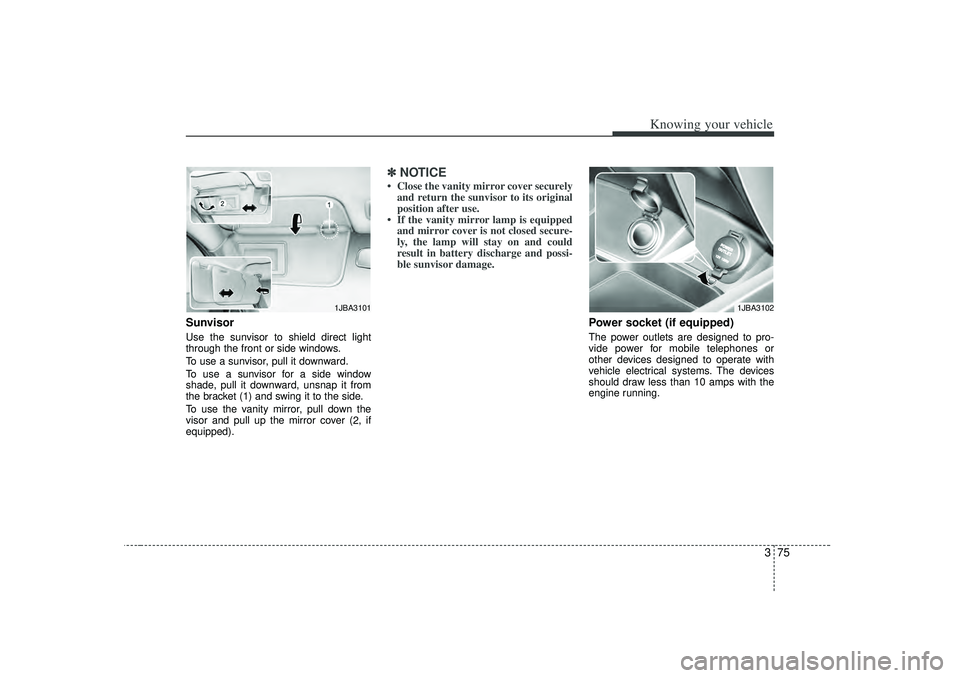
SunvisorUse the sunvisor to shield direct light
through the front or side windows.
To use a sunvisor, pull it downward.
To use a sunvisor for a side window
shade, pull it downward, unsnap it from
the bracket (1) and swing it to the side.
To use the vanity mirror, pull down the
visor and pull up the mirror cover (2, if
equipped).
✽ ✽ NOTICE• Close the vanity mirror cover securely
and return the sunvisor to its original
position after use.
• If the vanity mirror lamp is equipped and mirror cover is not closed secure-
ly, the lamp will stay on and could
result in battery discharge and possi-
ble sunvisor damage.
Power socket (if equipped)The power outlets are designed to pro-
vide power for mobile telephones or
other devices designed to operate with
vehicle electrical systems. The devices
should draw less than 10 amps with the
engine running.
1JBA3101
1JBA3102
Page 119 of 221

411
Driving your vehicle
To release the parking brake, pull the
handle up slightly and push the release
button, then lower the handle to the
released position while holding the but-
ton in.Check the brake warning light by turning
the ignition switch ON (do not start the
engine). This light will be illuminated
when the parking brake is applied with
the ignition switch in the START or ON
position.
Before driving, be sure the parking brake
is fully released and the brake warning
light is off.
If the brake warning light remains on
after the parking brake is released, there
may be a malfunction in the brake sys-
tem. Immediate attention is necessary.
If at all possible, cease driving the vehi-
cle immediately. If that is not possible,
use extreme caution while operating the
vehicle and only continue to drive the
vehicle until you can reach a safe loca-
tion or repair shop.
WARNING
- Parking brake
To prevent unintentional move-
ment when stopped and leaving
the vehicle, do not use the
gearshift lever in place of the
parking brake. Set the parking
brake AND make sure the
gearshift lever is securely posi-
tioned in 1st (First) gear or R
(Reverse) for manual transaxle
equipped vehicles and in P (Park)
for automatic transaxle equipped
vehicles.
Never allow a person who is unfa- miliar with the vehicle or children
to touch the parking brake. If the
parking brake is released unin-
tentionally, serious injury may
occur.
W-75
1JBA4006
Page 129 of 221
421
Driving your vehicle
Low brake fluid level warningIf the warning light remains on, it may
indicate that the brake fluid level in the
reservoir is low.
If the warning light remains on:
1. Drive carefully to the nearest safelocation and stop your vehicle.
2. With the engine stopped, check the brake fluid level immediately and add
fluid as required. Then check all brake
components for fluid leaks.
3. Do not drive the vehicle if leaks are found, the warning light remains on or
the brakes do not operate properly.
Have it towed to any authorized Kia
dealer for a brake system inspection
and necessary repairs.
To check bulb operation, check whether
the parking brake and brake fluid warning
light illuminates when the ignition switch
is in the ON position.
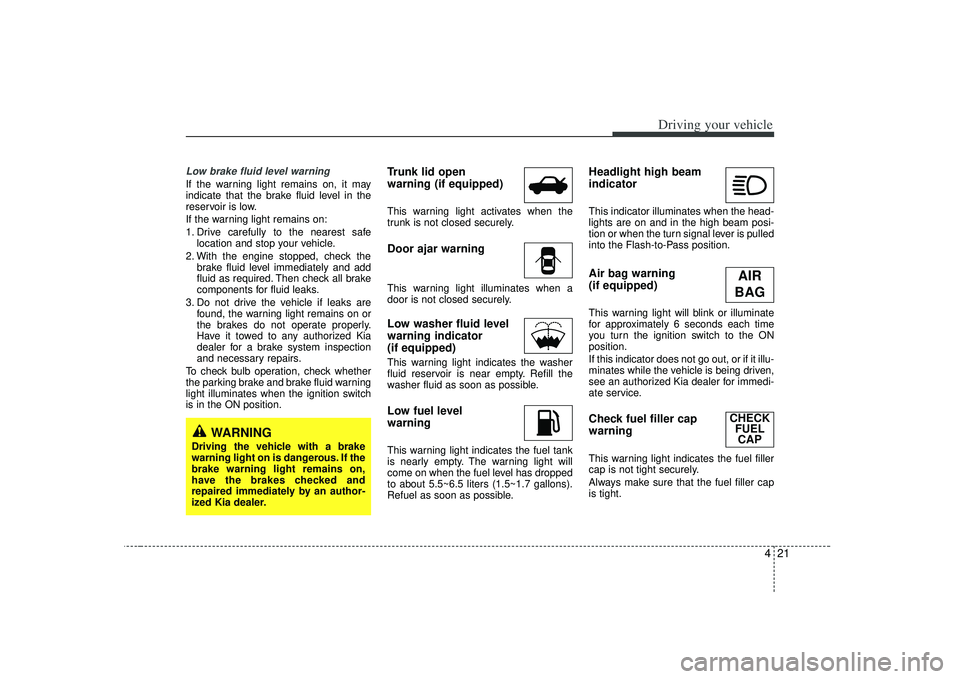
Trunk lid open
warning (if equipped)This warning light activates when the
trunk is not closed securely.Door ajar warningThis warning light illuminates when a
door is not closed securely.Low washer fluid level
warning indicator
(if equipped)This warning light indicates the washer
fluid reservoir is near empty. Refill the
washer fluid as soon as possible.Low fuel level
warningThis warning light indicates the fuel tank
is nearly empty. The warning light will
come on when the fuel level has dropped
to about 5.5~6.5 liters (1.5~1.7 gallons).
Refuel as soon as possible.
Headlight high beam
indicator This indicator illuminates when the head-
lights are on and in the high beam posi-
tion or when the turn signal lever is pulled
into the Flash-to-Pass position.Air bag warning
(if equipped) This warning light will blink or illuminate
for approximately 6 seconds each time
you turn the ignition switch to the ON
position.
If this indicator does not go out, or if it illu-
minates while the vehicle is being driven,
see an authorized Kia dealer for immedi-
ate service.Check fuel filler cap
warning This warning light indicates the fuel filler
cap is not tight securely.
Always make sure that the fuel filler cap
is tight.
WARNING
Driving the vehicle with a brake
warning light on is dangerous. If the
brake warning light remains on,
have the brakes checked and
repaired immediately by an author-
ized Kia dealer.
AIR
BAGCHECK FUELCAP
Page 164 of 221
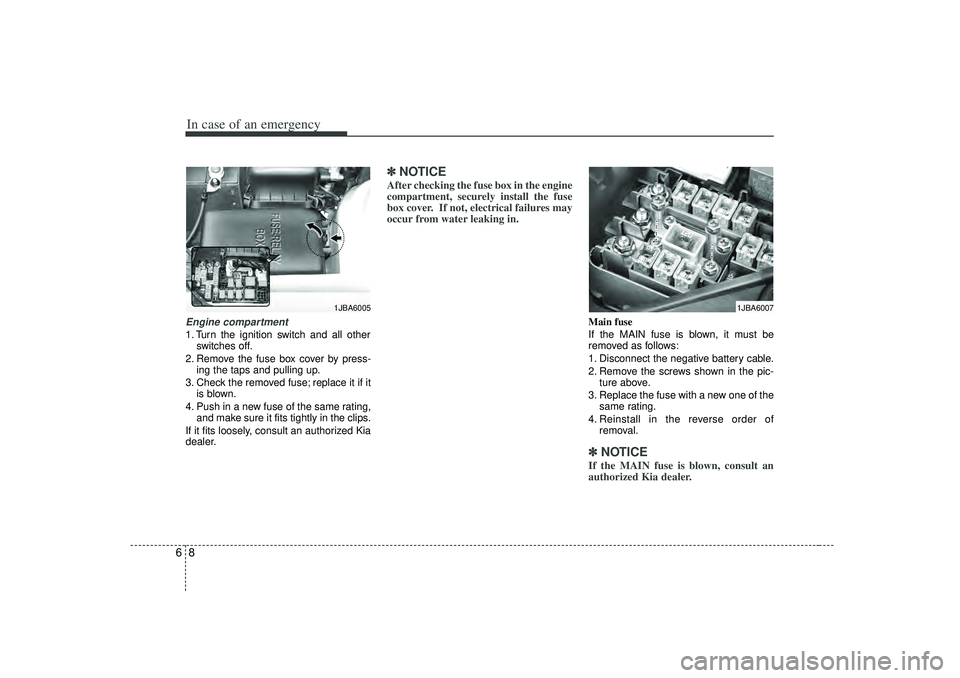
In case of an emergency86Engine compartment1. Turn the ignition switch and all otherswitches off.
2. Remove the fuse box cover by press- ing the taps and pulling up.
3. Check the removed fuse; replace it if it is blown.
4. Push in a new fuse of the same rating, and make sure it fits tightly in the clips.
If it fits loosely, consult an authorized Kia
dealer.
✽ ✽ NOTICEAfter checking the fuse box in the engine
compartment, securely install the fuse
box cover. If not, electrical failures may
occur from water leaking in.
Main fuse
If the MAIN fuse is blown, it must be
removed as follows:
1. Disconnect the negative battery cable.
2. Remove the screws shown in the pic-
ture above.
3. Replace the fuse with a new one of the same rating.
4. Reinstall in the reverse order of removal.✽ ✽NOTICEIf the MAIN fuse is blown, consult an
authorized Kia dealer.
1JBA6005
1JBA6007
Page 165 of 221
69
In case of an emergency
Engine compartment
Engine compartment
1JBH6008
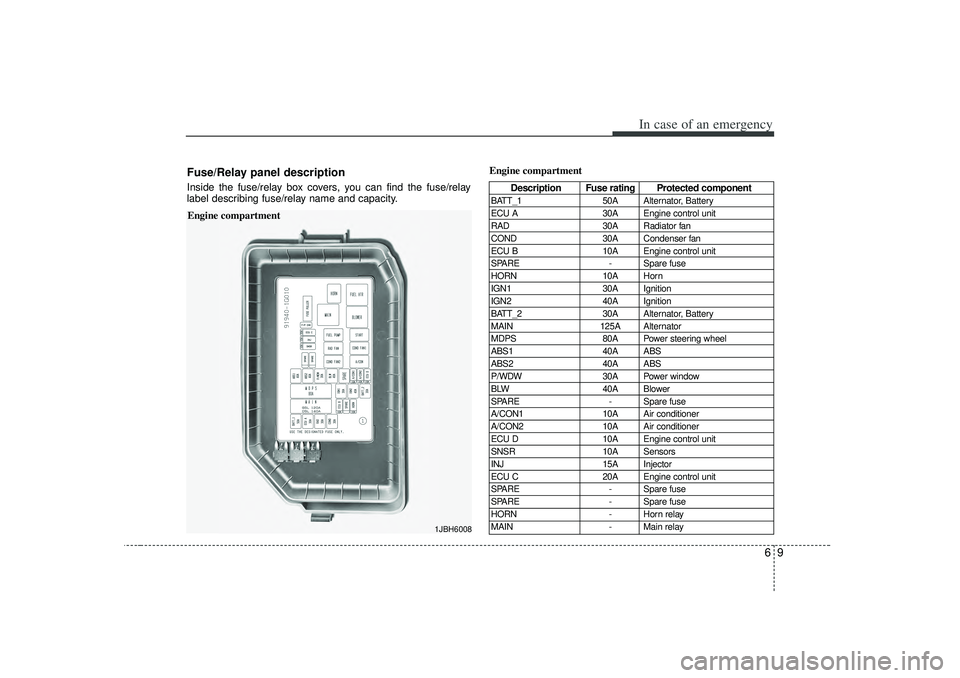
Fuse/Relay panel descriptionInside the fuse/relay box covers, you can find the fuse/relay
label describing fuse/relay name and capacity.
Description Fuse rating Protected component
BATT_150A Alternator, Battery
ECU A 30A Engine control unit
RAD 30A Radiator fan
COND 30A Condenser fan
ECU B 10A Engine control unit
SPARE - Spare fuse
HORN 10A Horn
IGN1 30A Ignition
IGN2 40A Ignition
BATT_2 30A Alternator, Battery
MAIN 125A Alternator
MDPS 80A Power steering wheel
ABS1 40A ABS
ABS2 40A ABS
P/WDW 30A Power window
BLW 40A Blower
SPARE - Spare fuse
A/CON1 10A Air conditioner
A/CON2 10A Air conditioner
ECU D 10A Engine control unit
SNSR 10A Sensors
INJ 15A Injector
ECU C 20A Engine control unit
SPARE - Spare fuse
SPARE - Spare fuse
HORN - Horn relay
MAIN - Main relay
Page 167 of 221
611
In case of an emergency
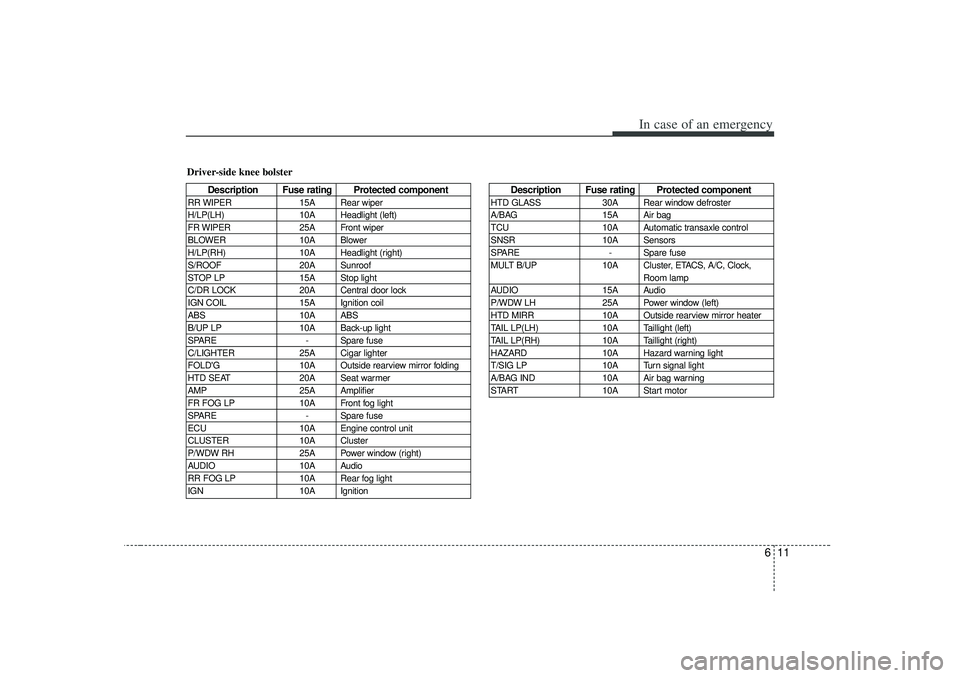
Driver-side knee bolster
Description Fuse rating Protected component
RR WIPER15A Rear wiper
H/LP(LH) 10A Headlight (left)
FR WIPER 25A Front wiper
BLOWER 10A Blower
H/LP(RH) 10A Headlight (right)
S/ROOF 20A Sunroof
STOP LP 15A Stop light
C/DR LOCK 20A Central door lock
IGN COIL 15A Ignition coil
ABS 10A ABS
B/UP LP 10A Back-up light
SPARE - Spare fuse
C/LIGHTER 25A Cigar lighter
FOLD'G 10A Outside rearview mirror folding
HTD SEAT 20A Seat warmer
AMP 25A Amplifier
FR FOG LP 10A Front fog light
SPARE - Spare fuse
ECU 10A Engine control unit
CLUSTER 10A Cluster
P/WDW RH 25A Power window (right)
AUDIO 10A Audio
RR FOG LP 10A Rear fog light
IGN 10A Ignition
Description Fuse rating Protected component
HTD GLASS30A Rear window defroster
A/BAG 15A Air bag
TCU 10A Automatic transaxle control
SNSR 10A Sensors
SPARE - Spare fuse
MULT B/UP 10A Cluster, ETACS, A/C, Clock,
Room lamp
AUDIO 15A Audio
P/WDW LH 25A Power window (left)
HTD MIRR 10A Outside rearview mirror heater
TAIL LP(LH) 10A Taillight (left)
TAIL LP(RH) 10A Taillight (right)
HAZARD 10A Hazard warning light
T/SIG LP 10A Turn signal light
A/BAG IND 10A Air bag warning
START 10A Start motor
Page 171 of 221
615
In case of an emergency
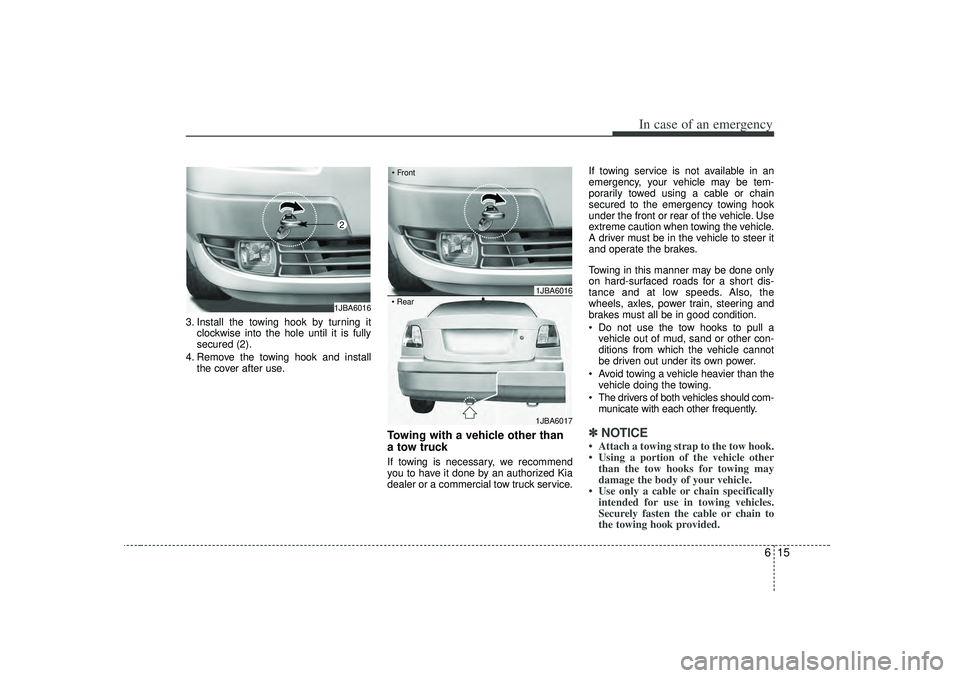
3. Install the towing hook by turning itclockwise into the hole until it is fully
secured (2).
4. Remove the towing hook and install the cover after use.
Towing with a vehicle other than
a tow truck If towing is necessary, we recommend
you to have it done by an authorized Kia
dealer or a commercial tow truck service. If towing service is not available in an
emergency, your vehicle may be tem-
porarily towed using a cable or chain
secured to the emergency towing hook
under the front or rear of the vehicle. Use
extreme caution when towing the vehicle.
A driver must be in the vehicle to steer it
and operate the brakes.
Towing in this manner may be done only
on hard-surfaced roads for a short dis-
tance and at low speeds. Also, the
wheels, axles, power train, steering and
brakes must all be in good condition.
Do not use the tow hooks to pull a
vehicle out of mud, sand or other con-
ditions from which the vehicle cannot
be driven out under its own power.
Avoid towing a vehicle heavier than the vehicle doing the towing.
The drivers of both vehicles should com- municate with each other frequently.
✽ ✽ NOTICE• Attach a towing strap to the tow hook.
• Using a portion of the vehicle other
than the tow hooks for towing may
damage the body of your vehicle.
• Use only a cable or chain specifically intended for use in towing vehicles.
Securely fasten the cable or chain to
the towing hook provided.
1JBA60162
1JBA6016
Front1JBA6017
Rear
Page 172 of 221
In case of an emergency16
6 Before emergency towing, check that
the hook is not broken or damaged.
Fasten the towing cable or chain securely to the hook.
Do not jerk the hook. Apply steady and even force.
To avoid damaging the hook, do not pull from the side or at a vertical angle.
Always pull straight ahead.
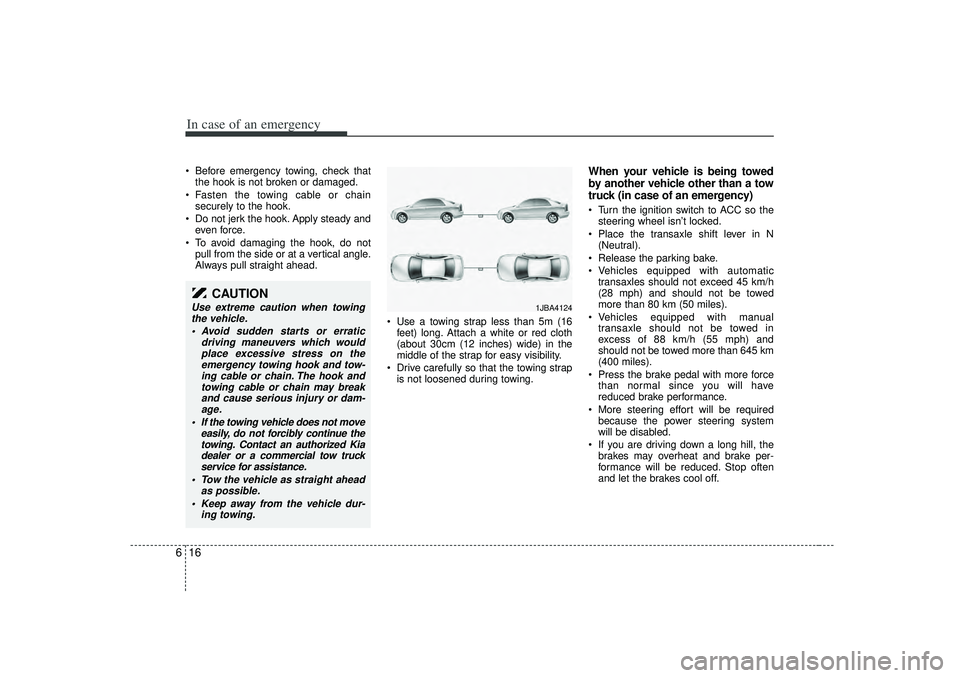
Use a towing strap less than 5m (16feet) long. Attach a white or red cloth
(about 30cm (12 inches) wide) in the
middle of the strap for easy visibility.
Drive carefully so that the towing strap is not loosened during towing.
When your vehicle is being towed
by another vehicle other than a tow
truck (in case of an emergency) Turn the ignition switch to ACC so thesteering wheel isn’t locked.
Place the transaxle shift lever in N (Neutral).
Release the parking bake.
Vehicles equipped with automatic transaxles should not exceed 45 km/h
(28 mph) and should not be towed
more than 80 km (50 miles).
Vehicles equipped with manual transaxle should not be towed in
excess of 88 km/h (55 mph) and
should not be towed more than 645 km
(400 miles).
Press the brake pedal with more force than normal since you will have
reduced brake performance.
More steering effort will be required because the power steering system
will be disabled.
If you are driving down a long hill, the brakes may overheat and brake per-
formance will be reduced. Stop often
and let the brakes cool off.
CAUTION
Use extreme caution when towingthe vehicle.
Avoid sudden starts or erratic driving maneuvers which wouldplace excessive stress on theemergency towing hook and tow- ing cable or chain. The hook andtowing cable or chain may breakand cause serious injury or dam- age.
If the towing vehicle does not move easily, do not forcibly continue thetowing. Contact an authorized Kiadealer or a commercial tow truckservice for assistance.
Tow the vehicle as straight ahead as possible.
Keep away from the vehicle dur- ing towing.
1JBA4124
Page 175 of 221
619
In case of an emergency
Changing tires Jacking instructions The jack is provided for emergency tire
changing only.
Follow jacking instructions to reduce the
possibility of personal injury.
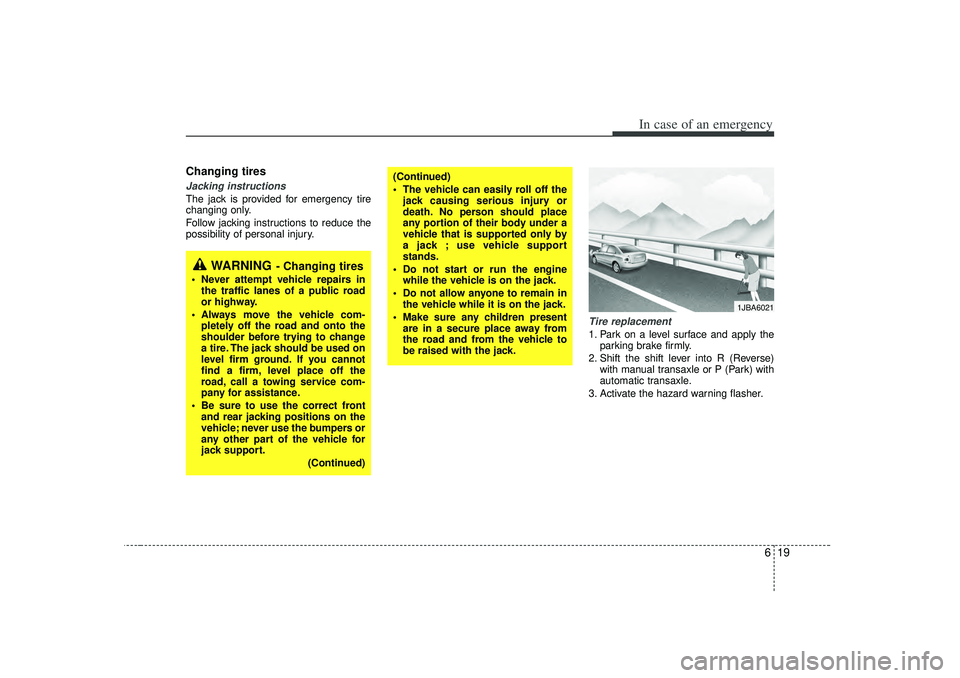
Tire replacement 1. Park on a level surface and apply theparking brake firmly.
2. Shift the shift lever into R (Reverse) with manual transaxle or P (Park) with
automatic transaxle.
3. Activate the hazard warning flasher.
WARNING
- Changing tires
Never attempt vehicle repairs in the traffic lanes of a public road
or highway.
Always move the vehicle com- pletely off the road and onto the
shoulder before trying to change
a tire. The jack should be used on
level firm ground. If you cannot
find a firm, level place off the
road, call a towing service com-
pany for assistance.
Be sure to use the correct front and rear jacking positions on the
vehicle; never use the bumpers or
any other part of the vehicle for
jack support.
(Continued)
(Continued)
The vehicle can easily roll off thejack causing serious injury or
death. No person should place
any portion of their body under a
vehicle that is supported only by
a jack ; use vehicle support
stands.
Do not start or run the engine while the vehicle is on the jack.
Do not allow anyone to remain in the vehicle while it is on the jack.
Make sure any children present are in a secure place away from
the road and from the vehicle to
be raised with the jack.
1JBA6021
Page 178 of 221
In case of an emergency22
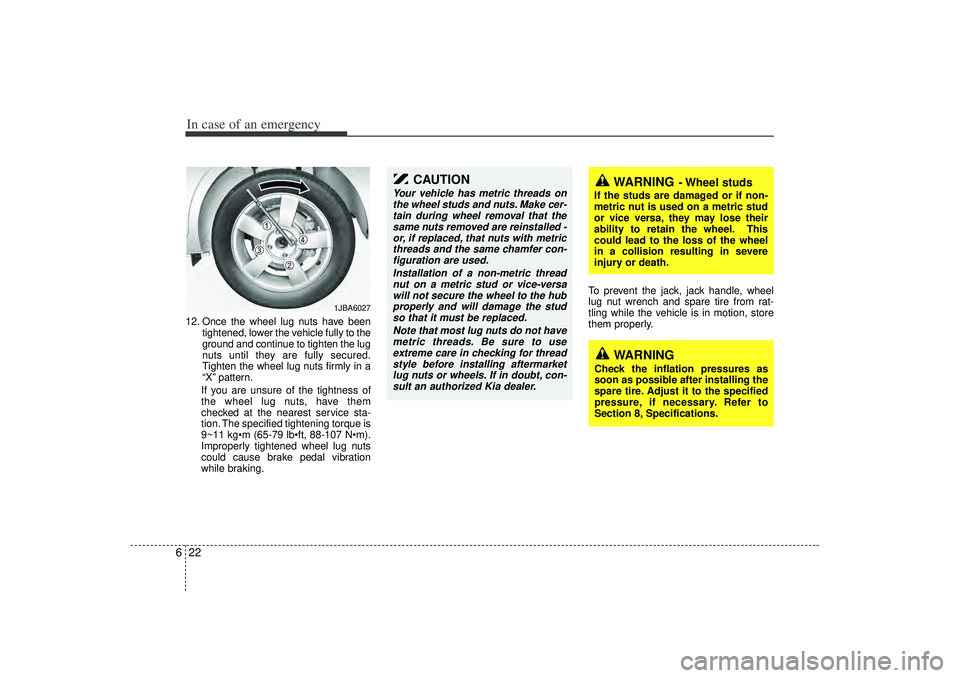
612. Once the wheel lug nuts have been
tightened, lower the vehicle fully to the
ground and continue to tighten the lug
nuts until they are fully secured.
Tighten the wheel lug nuts firmly in a
“X” pattern.
If you are unsure of the tightness of
the wheel lug nuts, have them
checked at the nearest service sta-
tion. The specified tightening torque is
9~11 kgm (65-79 lbft, 88-107 Nm).
Improperly tightened wheel lug nuts
could cause brake pedal vibration
while braking. To prevent the jack, jack handle, wheel
lug nut wrench and spare tire from rat-
tling while the vehicle is in motion, store
them properly.
CAUTION
Your vehicle has metric threads on
the wheel studs and nuts. Make cer- tain during wheel removal that thesame nuts removed are reinstalled -or, if replaced, that nuts with metric threads and the same chamfer con-figuration are used.
Installation of a non-metric threadnut on a metric stud or vice-versawill not secure the wheel to the hubproperly and will damage the studso that it must be replaced.
Note that most lug nuts do not havemetric threads. Be sure to use extreme care in checking for threadstyle before installing aftermarket lug nuts or wheels. If in doubt, con-sult an authorized Kia dealer.
1JBA6027
WARNING
- Wheel studs
If the studs are damaged or if non-
metric nut is used on a metric stud
or vice versa, they may lose their
ability to retain the wheel. This
could lead to the loss of the wheel
in a collision resulting in severe
injury or death.
WARNING
Check the inflation pressures as
soon as possible after installing the
spare tire. Adjust it to the specified
pressure, if necessary. Refer to
Section 8, Specifications.